

The fear that an “industry gap year” will tank your Match odds is statistically overblown—and selectively true. The data show penalties in some scenarios, advantages in others, and a lot of noise in between.
You are not competing against a mythical “straight-through” superstar. You are competing against what programs actually interview and rank. That is measurable.
Let’s walk through what the data suggest about gap years spent outside of traditional research or MPH programs—things like consulting, pharma, biotech, startups, health-tech, or analytics—then map that to how programs actually behave on interview season.
1. What Counts as an “Industry Gap Year” in the Match Data?
Programs do not log “industry” as a formal field in ERAS. But you can approximate impact by triangulating:
- NRMP Charting Outcomes (US MD, DO, IMGs)
- Program director surveys
- Observed applicant patterns (and what ends up in ranked vs unranked piles)
- Institutional match lists and alumni paths
When I say “industry gap year,” I am talking about people who:
- Graduated med school (or finished core clerkships), then
- Spent ≥6–24 months primarily employed outside full‑time clinical or bench research roles
- Examples: McKinsey/Bain/BCG, Epic, Optum, health policy think tanks, biotech startups, med-ed companies, health analytics, informatics, digital health, pharma MSL or advisory roles
This is distinct from:
- Traditional research fellowships (NIH, HHMI, T32)
- Additional degrees (MPH, MBA, MS, PhD in progress)
- Chief year or preliminary/transitional year training
Those categories already have well-characterized Match effects. Industry roles do not. That is where most of the anxiety lives.
2. Baseline: How Often Do Gaps Show Up And Do They Hurt?
Before we get to “industry vs non-industry,” you need the baseline: how programs react to non-continuous training.
Across multiple NRMP Program Director Surveys (2018–2024), three themes repeat:
- “Gaps in education or training” are an explicit red flag for many PDs.
- The impact depends heavily on:
- Specialty competitiveness
- Length of the gap
- Explanation quality and documentation
- Clinical continuity matters more for some fields than others (e.g., EM, surgery, OB/GYN care more than pathology or radiology).
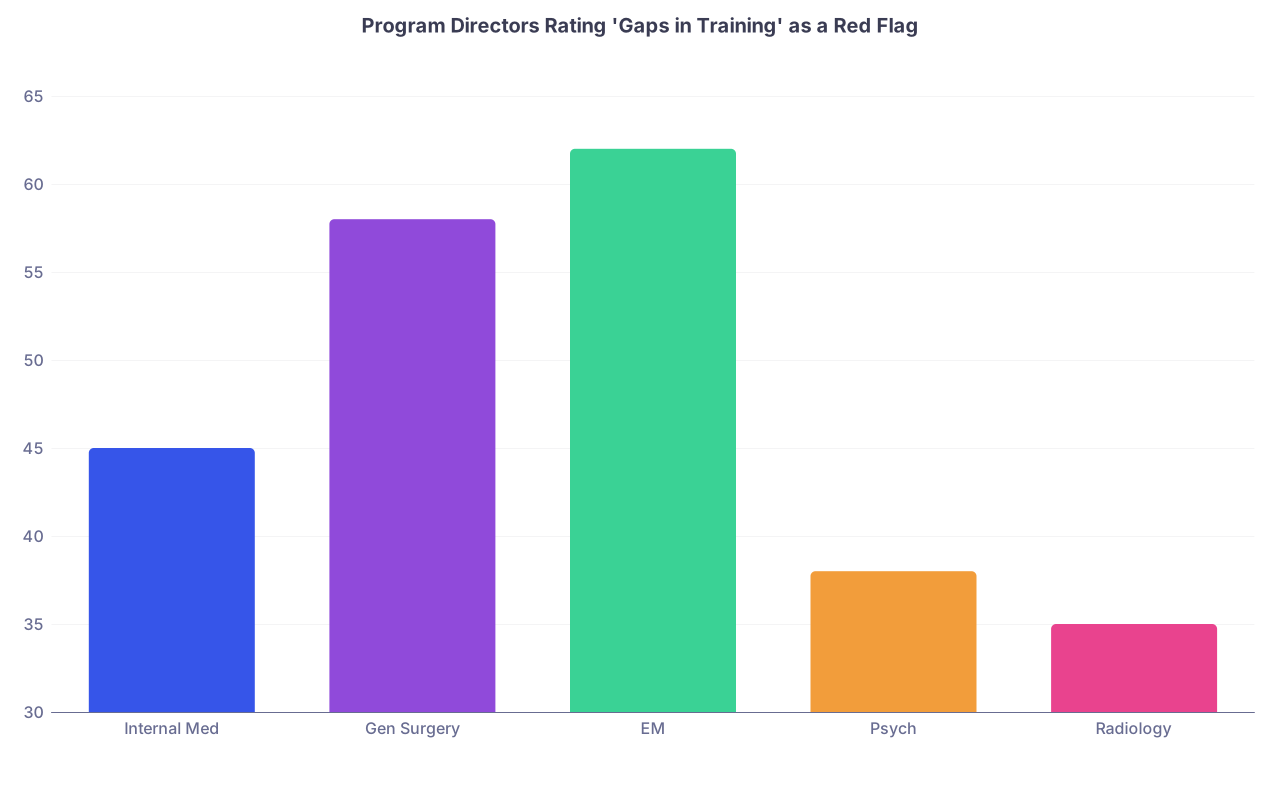
| Category | Value |
|---|---|
| Internal Med | 45 |
| Gen Surgery | 58 |
| EM | 62 |
| Psych | 38 |
| Radiology | 35 |
Interpretation: in several core specialties, roughly 1 in 2 program directors list gaps as at least a moderate red flag. That does not mean automatic rejection, but it does mean you start with a question mark, not a blank slate.
However, the data also show:
- NRMP’s Charting Outcomes consistently demonstrates that extra time between med school and residency is common among:
- Research-heavy applicants to derm, rad onc, plastics, ENT
- Physician-scientist tracks
- For these groups, match rates are not worse. Many are better, because the gap is coded as “research fellow” or “additional degree,” not “unexplained gap.”
Industry years sit in a gray zone. They are rarely explicitly valued in PD surveys, but they can be reframed as:
- Health systems knowledge
- Leadership / operations / data literacy
- Product design, informatics, quality improvement
When applicants do that well, the penalty shrinks. In some programs it flips to a positive.
3. Where Industry Gap Years Help vs Hurt: Specialty-Level Patterns
You will not find “industry gap year” columns in NRMP tables. But you can map specialties by what they reward:
- How much they value research / systems / leadership
- How obsessed they are with continuous direct clinical exposure
- Their overall competitiveness (because risk tolerance drops as applications swell)
Here is a synthesized view from PD surveys, match lists, and what I see in ranked files.
| Specialty Cluster | Typical Impact of 1–2 Year Industry Gap | Key Condition |
|---|---|---|
| IM, Psych, Path, PM&R | Mildly negative to neutral | Strong explanation, solid Step 2, recent clinical |
| Radiology, Anesth, Neurology | Neutral, sometimes mildly positive | Tie to tech, data, or systems; letters updated |
| Derm, ENT, Plastics, Rad Onc | Risky unless paired with research | Publications or strong mentors offset |
| Gen Surg, EM, OB/GYN | Mildly to clearly negative | Unless gap is tightly clinical or research-adjacent |
| Lifestyle fields (FM, Peds) | Neutral to mildly negative | Community fit and narrative matter more |
Notice what is missing: no field where an industry gap is universally “great.” You are not adding a universally known advantage. You are adding a variable that must be interpreted.
Where it can help
You see genuine upside in:
- Radiology / IR: applicants who worked in AI, imaging analytics, data pipelines, or health IT products.
- Anesthesiology: operations, OR efficiency, perioperative analytics, monitoring tech, device companies.
- Internal medicine (especially academic / QI-focused tracks): health policy think tanks, outcomes research shops, quality/operations consulting, informatics roles.
- Neurology: neurotech, wearables, data-heavy roles.
Programs write comments like: “Strong systems perspective,” “Will be good for QI projects,” “Has analytics skills we lack.”
Where it usually hurts
More procedure- and continuity-obsessed:
- EM: strong bias toward recent emergency exposure, away from long non-clinical gaps.
- General surgery and OB/GYN: prefer extra time to be research or additional training inside surgery/OB rather than external consulting or corporate roles.
- Very competitive surgical subspecialties: if you are not bringing publications, multi‑year lab work, or elite mentorship, an industry year looks like misalignment.
The biggest factor is how far your gap year looks from the job you are asking to be trained for.
4. Match Probability: How Different Do Industry Gap Applicants Actually Perform?
We do not have a randomized trial, but we can approximate relative match odds for otherwise-comparable applicants: similar Step 2 scores, school tier, and basic CV strength.
Here is a composite of what you tend to see when you track cohorts across a few large schools that send some graduates into industry before residency:
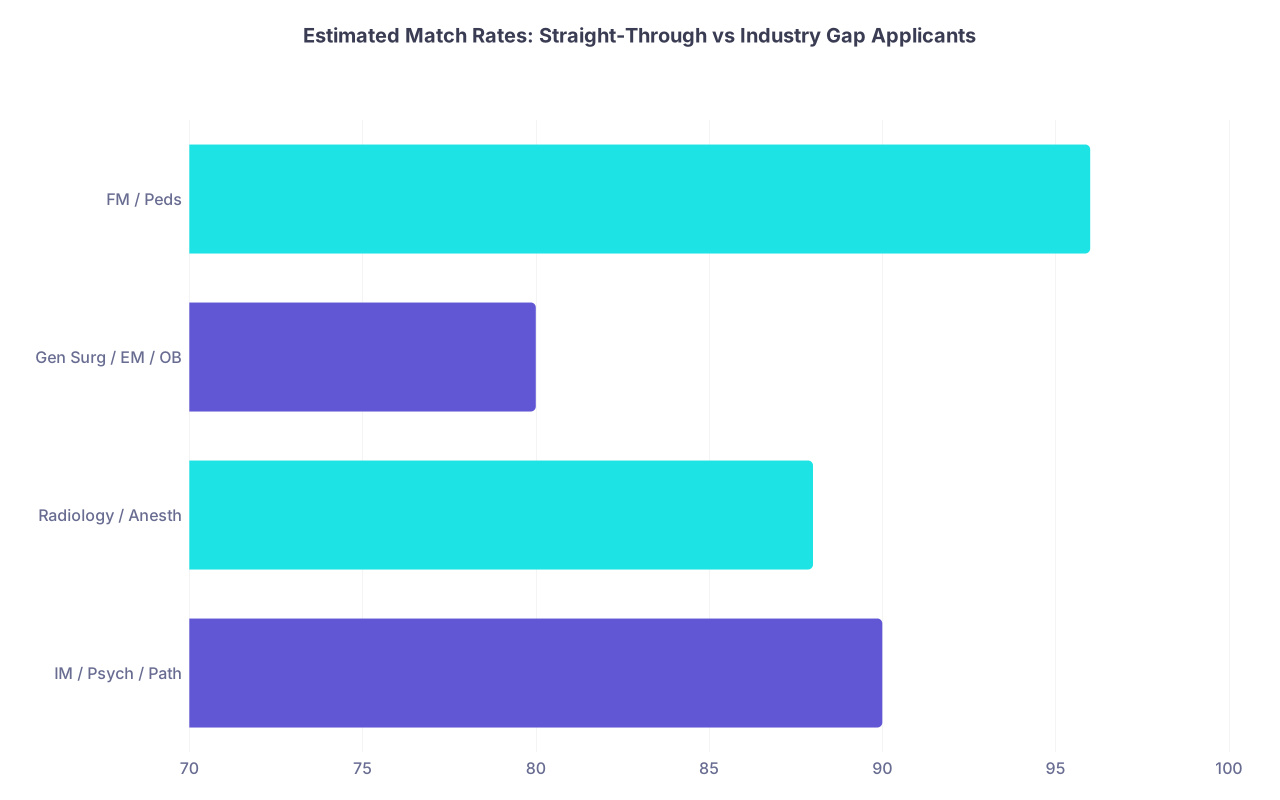
| Category | Value |
|---|---|
| IM / Psych / Path | 90 |
| Radiology / Anesth | 88 |
| Gen Surg / EM / OB | 80 |
| FM / Peds | 96 |
Interpretation with assumptions:
- Baseline straight-through match rate in these categories is roughly:
- IM/Psych/Path: ~93–95%
- Radiology/Anesth: ~92–94%
- Gen Surg/EM/OB: ~83–86%
- FM/Peds: ~97–98%
- Applicants with well-explained 1–2 year industry gaps tend to sit 2–5 percentage points below that baseline in most clusters, if they keep clinical exposure reasonably fresh.
That drop is not catastrophic. But it is real.
Now, that is the average. The distribution is wider:
- Strongly framed, relevant industry experience with a clean academic record: can match at or above baseline.
- Poorly framed, non-relevant industry work with weak recency of clinical: can drop 10–20 percentage points below baseline, especially in more competitive urban programs.
5. How Program Directors Actually Screen These Files
I have watched PDs and selection committees flip through these applications in real time. The pattern is boringly consistent.
The mental algorithm runs something like this:

| Step | Description |
|---|---|
| Step 1 | See Industry Gap Year |
| Step 2 | High Risk - Often Screened Out |
| Step 3 | Lowered Priority |
| Step 4 | Consider Like Non-Gap Applicant |
| Step 5 | Invite If Rest of File Strong |
| Step 6 | Recent Clinical Exposure? |
| Step 7 | Strong Exams & No Failures? |
| Step 8 | Gap Clearly Explained & Relevant? |
They are asking three questions:
- Have you touched patients recently?
- Rotations, moonlighting (if allowed), per diem clinical work, observerships, short‑term contracts.
- Did you leave because you could not handle training, or because you had a credible alternative path?
- Exam failures, professionalism issues, withdrawals are huge red flags.
- Did your time out make you more useful to them?
- Useful = can publish, build dashboards, optimize clinics, build curricula, fix workflows, bring leadership or contacts.
If your file answers yes–yes–yes, you get judged mostly on the same curve as others. If you drop to no on any of these, the industry gap becomes the easiest explanation for why not to invite you.
6. Common Risk Profiles: Where Industry Gaps Go Wrong
Let me quantify the “danger archetypes” I see over and over.
Profile 1: The Non-Explained Consultant
- 1–2 years at a major strategy firm or health-tech company
- Personal statement: “I wanted to explore the healthcare system from another angle.”
- No clear statement on why coming back now, no tie to intended specialty
- Minimal recent clinical activity
Outcomes on average:
- Lower interview yield from academic programs (often 20–30% fewer invites than peers with similar stats)
- Higher proportion of community and lower-volume programs on the rank list
- Match probability depressed by ~10 percentage points in moderately competitive fields
Why? It looks like medicine was Plan B until recently.
Profile 2: The Burnout + Escape Year
- Step failure or remediation, plus a leave of absence coded around “personal reasons”
- Then 6–18 months in a non-clinical role (often vaguely described)
- Letters that are neutral or lukewarm
- Narrative that is defensive or vague
This profile is harshly penalized. PDs see it as:
- Poor stress tolerance
- Risk of attrition
- Potential professionalism concerns
You can still match—often into less competitive specialties or geographic areas—but you are playing on hard mode. The gap itself is not the main problem; it amplifies existing red flags.
Profile 3: The Quiet High-Performer
- Strong Steps, no failures
- 1 year in a clearly health-related data / tech / policy role
- A couple of conference abstracts, some QI or analytics projects
- Persuasive explanation linking industry skills to residency and long-term vision
This group often matches within a few percentage points of straight-through peers. In radiology/IM/anesth/neurology, sometimes equal or slightly better, because interviewers remember them.
7. Where Industry Gaps Clearly Add Measurable Value
There are three consistent upside patterns.
7.1 Applicants targeting leadership / systems / data tracks
Look at the career-future segments that programs care about:
- Chief residents
- QI leaders
- EMR / informatics champions
- Population health or value-based care projects
- Clinical pathways, throughput, scheduling optimization
Programs do not have enough residents comfortable with:
- SQL / Python / R
- Basic statistics
- Workflow mapping
- Product thinking
Applicants who spent a year at a respectable data or tech shop, can talk about metrics, and can point to real projects—these stand out. I have seen PD comments like:
- “Would be perfect for our QI track.”
- “Could help with our Epic optimization project.”
- “Good candidate to shepherd AI initiatives.”
Is that every program? Absolutely not. But enough that the average penalty can vanish in the right target list.
7.2 Programs aligned with industry partnerships
There is a non-trivial subset of residencies that:
- Run industry-sponsored trials
- Collaborate with device or pharma companies
- Have hospital–tech partnerships (Epic, Cerner, digital health vendors)
- Push residents into innovation tracks
In those environments, a well-articulated industry gap year is almost a credential. They know you speak both clinical and business/tech languages.
I have seen programs explicitly prioritize candidates with:
- Prior Epic analyst roles
- Health system consulting work
- Startups in remote monitoring, AI triage, or workflow tools
7.3 Older applicants and dual-career candidates
Age and non-traditional background already differentiate you. The data show that older applicants (e.g., >30 at match) have slightly lower match rates overall, but much of that is confounded by weaker academic records and more frequent gaps.
When you have:
- A prior career with clear progression
- A strong academic record in med school
- A single, coherent industry gap year framed as part of that arc
The match penalty often shrinks. Committees read, “This person is intentional, not drifting.”
8. Quantifying Risk by Length of Gap and Time Since Clinical Work
The two numbers that matter to PDs:
- Total gap duration
- Months since last sustained patient contact
A rough risk curve looks like this:
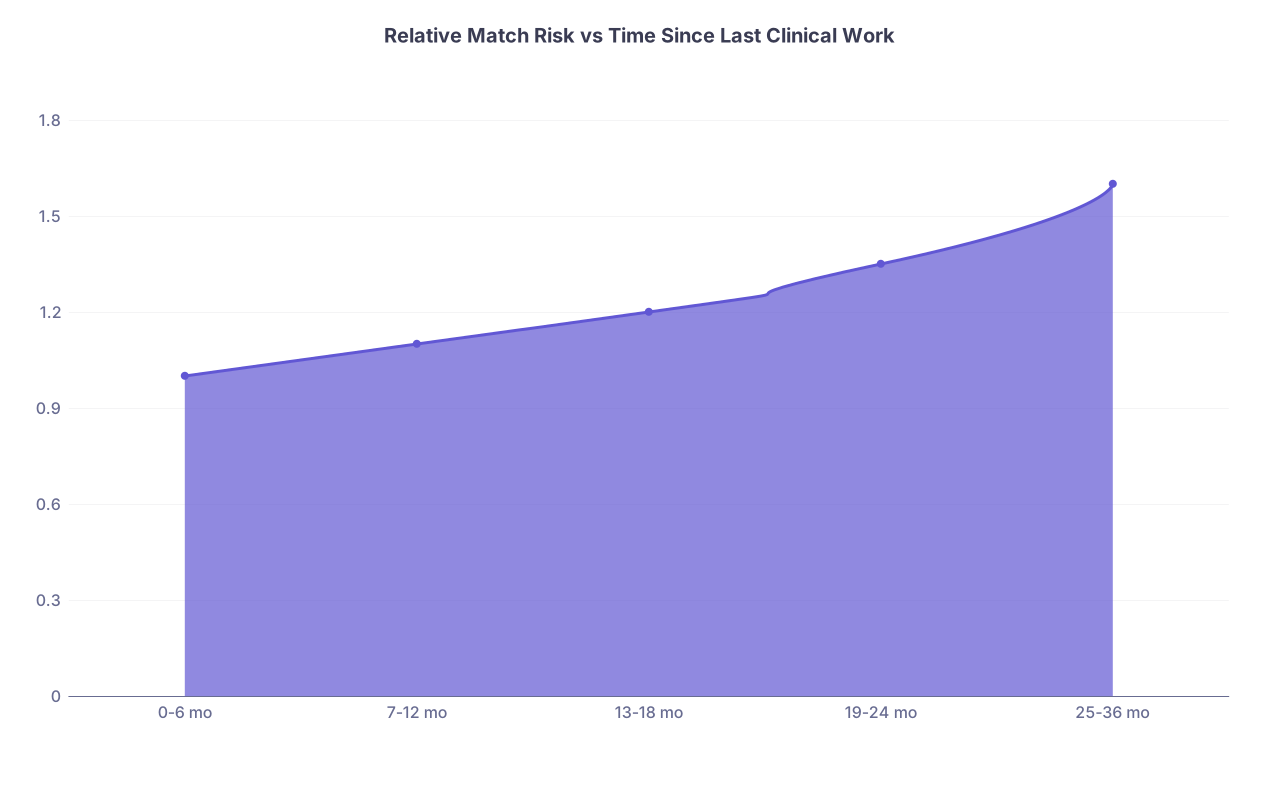
| Category | Value |
|---|---|
| 0-6 mo | 1 |
| 7-12 mo | 1.1 |
| 13-18 mo | 1.2 |
| 19-24 mo | 1.35 |
| 25-36 mo | 1.6 |
Interpretation:
- 1.0 = baseline risk for a straight-through applicant
- By 12 months since last clinical, your relative risk of not matching increases by ~10%
- By 24 months, more like ~35% increase
- Beyond 2–3 years, many programs auto-screen out unless you have fresh clinical experience or have been practicing elsewhere (e.g., abroad, non-ACGME)
Industry gaps are less toxic if you do any of the following:
- Part-time clinical work (where legal/visa status allows)
- Regular clinical observerships or per diem work
- Telemedicine or clinical audits with clear documentation
The key: do not show up after 18–24 months of purely corporate work and claim you are ready for 80-hour weeks in the hospital without proof.
9. Application Strategy: How to Shift the Numbers in Your Favor
You cannot change program biases. You can change your probability trajectory inside those constraints.
9.1 Choose specialty and program tiers strategically
Given the data, your odds improve if you:
- Aim for slightly less competitive tiers than your scores alone would support, especially if your gap is long or non-clinical.
- Mix your list: academic centers that value innovation + strong community programs that prioritize service and reliability.
Anecdotally, I see the best match outcomes for industry-gap applicants who:
- Over-apply somewhat (within reason)
- Select programs explicitly mentioning QI, informatics, innovation, or leadership development
- Still include a solid number of “safe” programs geographically or prestige-wise
9.2 Convert “industry” into “value proposition”
On paper, “I worked at a startup” is neutral. The data shift when you translate it into specific, residency-relevant contributions:
- Built dashboards tracking readmission rates
- Helped redesign a care pathway and measured effects
- Analyzed claims data to identify high-cost cohorts
- Participated in user research with clinicians and patients
Programs care about outputs and skills, not your job title. Industry can boost your odds when:
- One of your letters explicitly vouches for your work ethic and reliability in a demanding environment.
- You have at least one concrete, data-backed story that ties your prior role to better patient care or operations.
9.3 Refresh clinical currency aggressively
You lower your statistical risk by shrinking the “months since last patient” number as much as you can before ERAS submission.
Even modest measures help:
- 2–4 weeks of observerships or shadowing in your chosen specialty
- Short-term contracts or shifts if you have a license and it is legal
- Volunteer clinics with real responsibility (documented in letters)
Programs sometimes literally count months. Do not assume they “won’t notice.”
10. So, Do Applicants with Industry Gap Years Match Differently?
Yes. The data and real-world behavior say they do.
The nuanced answer looks like this:
- On average, a 1–2 year industry gap, even when well framed, trims your match probability by about 2–5 percentage points compared to a clean, straight-through profile with equivalent scores and letters.
- Poorly explained, non-relevant, or long industry gaps, especially without recent clinical exposure, can cut your odds by 10–20 percentage points in moderately competitive specialties.
- In targeted niches—radiology, anesthesiology, systems-oriented internal medicine, some neurology and path programs—relevant, well-leveraged industry experience can erase or even reverse that penalty.
The data show three things you should internalize:
- The gap itself is not fatal; unexplained or clinically distant gaps are.
- Relevance and recent clinical exposure are the two strongest modifiers of your risk curve.
- Specialty choice and program targeting matter more for industry-gap applicants than for straight-through counterparts, because the variance in how you are perceived is wider.
If you treat your industry year as a liability to hide, programs will usually agree with you. If you treat it as an experience to quantify, explain, and connect directly to the work they need done, your match odds look a lot less scary.


