This article is for educational purposes only. It is not financial advice, not legal advice, and not tax advice. Figures vary by individual circumstances, so consult a qualified professional before acting.
The Promotion Paradox: Which Teaching Style Matters More?
Academic promotion rests on three legs: scholarship, service, and teaching. Research gets counted in publications and grant dollars. Service gets counted in committee seats. Teaching? Teaching gets counted in whatever scraps of evidence you remembered to save.
That's where the paradox bites. The average clinician-educator spends the bulk of their teaching life at the bedside, precepting in clinic, running ward rounds, supervising in the OR. Yet when the dossier lands in front of the promotions committee, the entries that pop are the didactic ones: "Annual Lecture Series, PGY-2 Curriculum, 12 sessions." Titled. Scheduled. Evaluated by forty residents at once.
Meanwhile, three years of superb ward teaching compresses into a single line: "Inpatient attending, 8 weeks/year." I've watched this happen in actual dossier reviews, a thin lecture series outshining years of transformative bedside mentorship, simply because one had paperwork and the other didn't.
So the question isn't really which teaching type is worth more. It's which type your institution can see. This article gives you the evidence-based comparison, the unwritten committee logic, and a concrete plan to make your bedside teaching count for what it's actually worth.
Defining the Teaching Types: Bedside Precepting vs. Classroom Didactics
Let's get precise, because committees certainly will be.
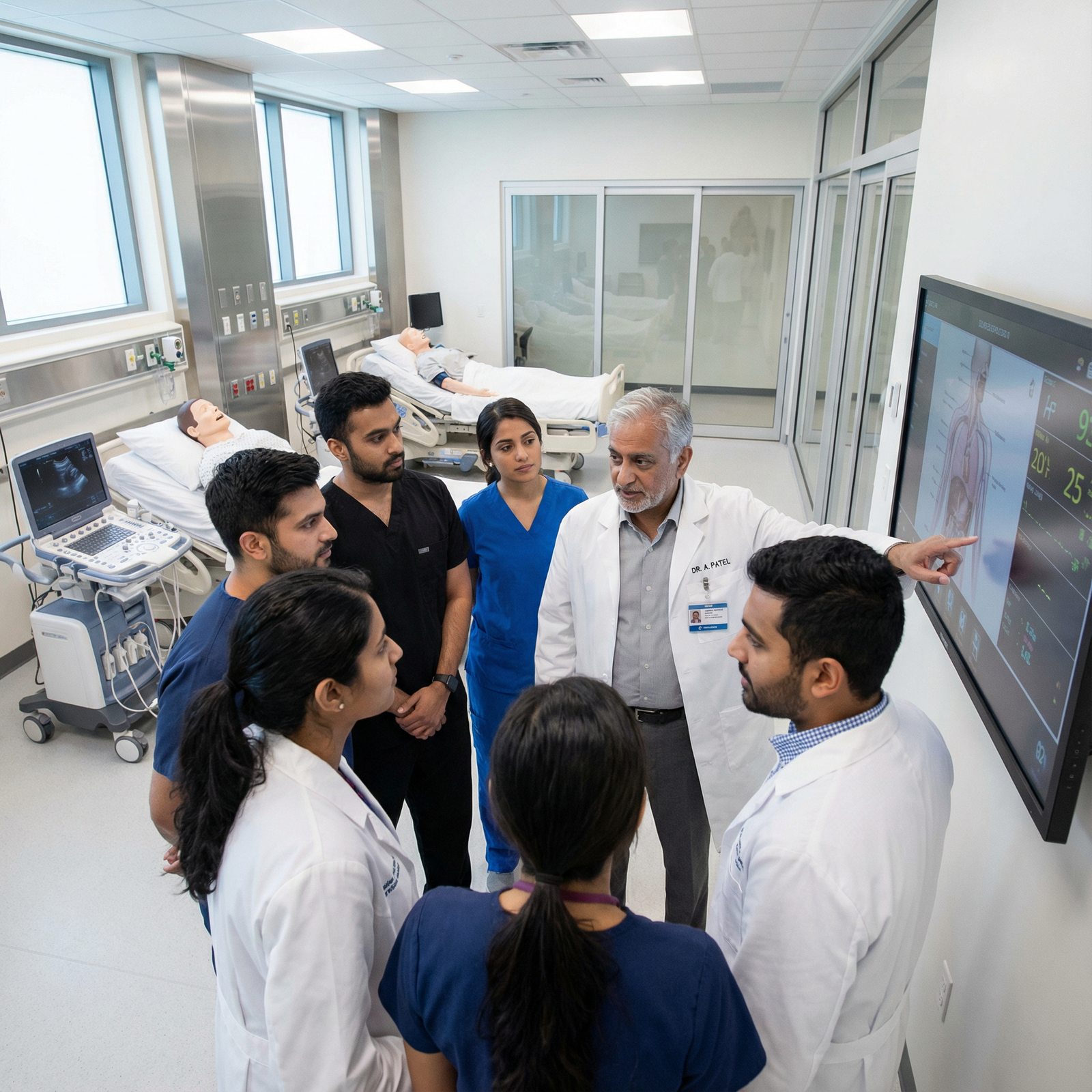
Bedside precepting is clinical teaching anchored to real patients. You, one to four learners, an actual human being with an actual problem. It happens on ward rounds, in clinic precepting, in the ED at 2 a.m. The hallmarks:
- Immediate, specific feedback ("Walk me through why you ordered that")
- Role modeling of physical exam, communication, and clinical reasoning in real time
- Teaching moments driven by whatever rolls through the door, unpredictable, unscripted
- Deep interaction with very few learners at once
Classroom didactics is formal curriculum delivery. Scheduled lectures, grand rounds, board review sessions, simulation debriefs in a classroom setting. The hallmarks:
- Structured content mapped to a curriculum
- Large audiences, dozens or hundreds of learners per hour of your time
- Standardized evaluation forms collected from everyone at once
- Full control over content, pacing, and repetition
The differences that matter for promotion come down to four axes:
| Dimension | Bedside Precepting | Classroom Didactics |
|---|---|---|
| Audience size | 1-4 learners | 20-200+ learners |
| Interaction depth | Very high | Low to moderate |
| Evaluation method | Sparse, often informal | Standardized, high-volume |
| Dossier visibility | Low unless documented | High by default |
Here's my bias, stated plainly: bedside teaching is where learners become physicians. Lecture is where they become note-takers. Didactics have real value for breadth, you can't precept your way through all of pharmacology, but nobody looks back twenty years later and credits a slide deck for how they practice medicine.
How Promotion Committees Weigh Teaching Types
Committees don't weigh teaching types pedagogically. They weigh them bureaucratically. Understand that, and the whole system makes sense.
Most promotion guidelines assess teaching across four dimensions:
- Volume, How much teaching, sustained over how long?
- Quality, Learner evaluations, peer observations, teaching awards
- Innovation, New curricula, novel methods, leadership of educational programs
- Scholarship of teaching, Publications, presentations, or peer-reviewed educational products derived from your teaching
Now watch how the two modalities score on each. A single lecture to 150 students generates 150 evaluation forms, a title, a date, and a slot in the curriculum map. That's volume, quality data, and visibility in one tidy package. A month of ward attending, where you might teach the same learner more in one morning than a semester of lectures, generates maybe three end-of-rotation evaluations. If the students remember to mention your name. If the clerkship office even routes the comments to you.
Institutions vary, of course. Research-heavy tenure tracks treat teaching as a checkbox next to your grant portfolio. Clinician-educator tracks, increasingly the home of hospitalists and proceduralists, explicitly weight educational contribution and often require a formal educator's portfolio. Some schools have adopted structured teaching portfolios that deliberately capture bedside work; many haven't. The pattern below reflects what published promotion guidelines and educator portfolio analyses typically show when teaching weight is broken out by modality:
Notice what that chart is really telling you. Bedside precepting, where most clinical teaching hours actually live, pulls roughly 30% of the weight. Didactics pull 40% on a fraction of the hours. That's not a merit verdict. It's a measurement artifact.
The fixable part: committees genuinely value bedside teaching when evidence of it reaches the room. Letters from former trainees describing how your rounds changed their practice. Peer observation narratives. Named teaching awards voted on by residents. I've seen a single extraordinary trainee letter outweigh a page of lecture listings. But none of that evidence generates itself. You have to build it.
Evidence: What the Literature Says About Educational Impact
If promotion were decided purely on educational impact, this article would be much shorter. The learning science is not subtle.
Bedside teaching wins on impact. Learners consistently rate it as their most valuable educational experience, and it drives the skills that lectures can't touch, physical exam technique, clinical reasoning under uncertainty, patient communication. Time-motion studies of rounds tell a depressing story, though: bedside teaching has collapsed from the majority of rounding time in the 1960s to a small fraction, often under 20%, in modern surveys. The teaching method with the strongest learner endorsement is the one the system has been quietly strangling for fifty years. Make of that what you will.
Didactics win on efficiency, lose on retention. One hour of your time reaches a hundred learners, unbeatable for covering breadth. But passive lecture formats produce weaker retention than active, patient-anchored learning, a finding replicated enough times that it's close to settled. The best didactics borrow bedside techniques: cases, questions, forced reasoning.
Here's the rub for promotion: committees rarely measure impact directly. They measure proxies, learner evaluation scores and peer observation reports. And those proxies behave differently across modalities. Didactics generate evaluation volume (forty forms from one talk). Bedside teaching generates evaluation depth (three forms, but detailed and personal). Neither proxy alone proves excellence. A portfolio that shows both, though? That's a story a committee can act on.
The pipeline from your teaching to the committee's decision looks like this:
Read that diagram carefully. The bottleneck isn't step A. You're already doing the teaching. The bottleneck is step B, documentation, and that's entirely in your control.
Strategies to Build a Balanced Teaching Portfolio for Promotion
Enough diagnosis. Here's the treatment plan, five moves, roughly in order.
1. Audit what you actually do. For the next 90 days, log every teaching activity: precepting sessions, ward weeks, lectures, informal chalk talks, simulation debriefs. Most educators are shocked by the total. You're probably teaching two or three times what your current CV suggests.
2. Document bedside work with the same rigor as lectures. This is where parity gets won.
- Keep a running teaching log: dates, learner levels, topics, your role
- Ask the clerkship or residency office to pull every evaluation that names you, they exist, and they sit in a database nobody sends you
- After a strong rotation, email the clerkship director and ask that your precepting be noted in the rotation summary
3. Collect human evidence. Raw scores flatten; narratives persuade.
- Request one peer observation per year, with a written report for your file
- When a former trainee emails you a thank-you, reply with one sentence: "Would you be willing to say this in a short letter for my educator portfolio?" Most will say yes. Almost nobody asks.
4. Pair the modalities. Give the lecture and precept the clinic on the same topic. You double your dossier entries, reach learners at both depths, and generate evaluation volume plus evaluation depth on one subject. It's the single highest-yield structural change you can make.
5. Convert teaching into scholarship. This is the multiplier. A bedside teaching method becomes a workshop at a regional meeting. A lecture series becomes a curriculum submission to a peer-reviewed education repository. A recurring learner struggle becomes an education research question. Teaching that produces scholarship hits two of the three promotion legs at once, and scholarship is the leg committees weigh most heavily.

Key Takeaways
- Both modalities count, but parity isn't automatic. Bedside precepting usually needs deliberate documentation to achieve the weight classroom didactics get by default.
- Evidence beats hours. Committees reward demonstrated impact, learner outcomes, peer recognition, scholarship, far more than raw teaching volume.
- Integration wins. The strongest portfolios combine modalities and convert teaching into measurable, scholarly contributions to the educational mission.
Your Move
Don't wait for the promotion cycle to discover your dossier is a lecture list with a teaching-shaped hole in it. This month, do three things: start the 90-day teaching log, request your named evaluations from the clerkship office, and identify one bedside teaching activity you could convert into a scholarly product before the next review. The teaching is already excellent. Make the evidence match it.