
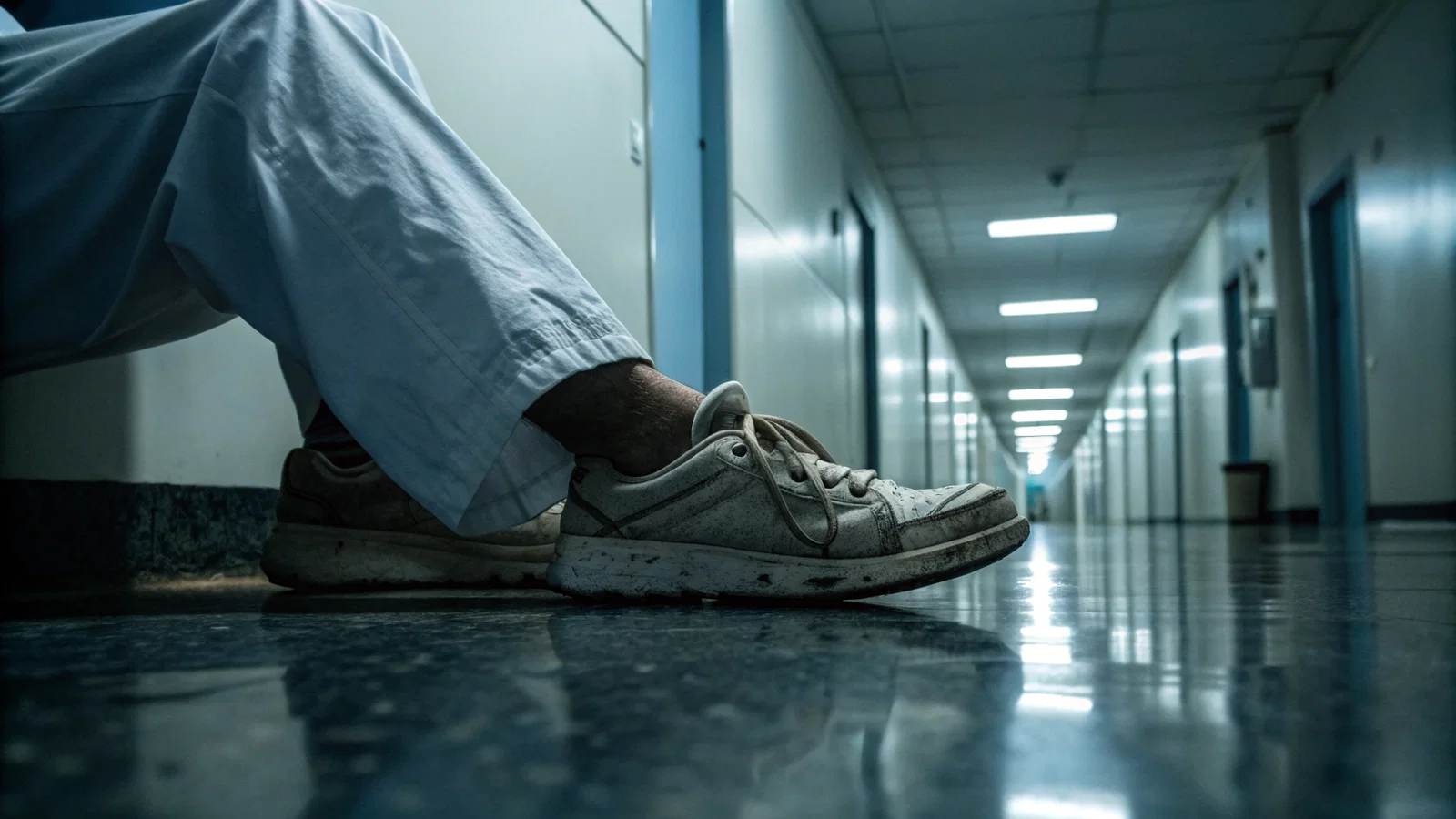
Night Shift Footwear: The Silent Energy Drain
Everyone obsesses over caffeine timing, blue light glasses, and meal prep for nights. No one checks their shoes.
That's a mistake. A big one.
Your footwear is your foundation for a 12-hour shift. Get it wrong and you won't make it to midnight without your calves screaming, your back aching, and your brain fogging over. I've seen residents limp into morning sign-out, completely spent, and blame the night itself. It wasn't the night. It was the cheap, flat, fashion sneakers they wore for 10 hours on concrete floors.
Bad shoes don't just hurt your feet. They drain your whole system. Every step without cushioning, every slide on a slick floor, every hotspot from trapped sweat forces your body to compensate. Muscles work overtime. Your posture collapses. Your energy tank empties fast.
Don't let that happen. Here are the seven footwear mistakes that will wreck you before midnight, and how to avoid them.
Mistake #1: Prioritizing Style Over Support
Don't wear the cute shoes.
Those minimalist canvas slip-ons, the trendy street sneakers, the clogs that look great on Instagram, they have zero business on a night shift. Fashion-forward shoes usually have flat, thin soles and no real shock absorption.
What happens? Every foot strike sends impact straight up your shins. Your leg muscles have to act as shock absorbers. By hour three, they're fatigued. By hour five, your lower back is compensating.
Stop trying to be stylish at 3 AM. No one cares. Your patient doesn't care. Your attending doesn't care.
Look for function first:
- Real midsole cushioning you can press with your thumb and feel bounce back
- A slight rocker or heel drop, not dead flat
- A secure heel cup that locks your foot in place
Style that actually supports you exists. But support comes first. Always.
Mistake #2: Skipping Arch Support
This is the one that sneaks up on you.
Flat insoles feel fine for the first hour. Then that dull ache starts in your arch. Then your plantar fascia starts screaming. Then that pain shoots up into your Achilles, your knees, your hips.
Your arch is a spring. Without support, the spring collapses. The whole kinetic chain falls apart. You'll feel it as general fatigue, lower back tightness, that "I just can't stand anymore" feeling at 11 PM. It's not lack of sleep. It's lack of arch support.
Do this instead:
- Choose shoes with built-in arch support, not just squishy foam
- If you have flat feet or high arches, get removable insoles so you can swap in your own orthotic
- Test it: stand on one foot. If your arch collapses inward and your knee buckles, that shoe is failing you
Don't wait until you have plantar fasciitis to take this seriously.
Mistake #3: Choosing Non-Breathable Materials
Plastic shoes cook your feet.
Cheap synthetic leather, solid rubber uppers, vinyl clogs, they trap heat and sweat. Your feet swell at night anyway. Add trapped moisture and you get hot, swollen, blistered feet that feel ten pounds heavier with every step.
And yes, that drains energy. Your body is spending extra effort cooling overheated feet, dealing with friction, fighting discomfort. It's a constant low-grade stressor. Metabolic cost goes up. Focus goes down.
You want materials that breathe.
Look for engineered mesh, perforated leather, knit uppers with airflow. Your feet should be able to vent.
The difference is not subtle. Breathable shoes keep your core foot temperature down and prevent that swampy, heavy-leg feeling that hits around 1 AM. Non-breathable shoes guarantee it.
Mistake #4: Ignoring Slip Resistance
Night floors are dangerous. I mean it.
Spilled saline, a smear of betadine, freshly mopped hallways at 2 AM, it's a rink out there. If your shoes don't grip, your body goes into constant micro-bracing mode. Tiny stabilizing muscles in your ankles and calves fire every step to keep you from eating it in front of the nurses' station.
That's exhausting. And risky.
One slip when you're carrying meds, or rushing to a code, and you're done. Sprained ankle. Back injury. Incident report.
Don't gamble.
- Look for outsoles explicitly labeled slip-resistant or SRA / SRB / SRC rated
- Check the tread pattern, you want channels that displace liquid, not flat smooth rubber
- Avoid worn-smooth soles. If you can slide across the break room tile, those shoes are done
Grip is not optional for nights. It's protection.
Mistake #5: Wearing Incorrect Size
This mistake is so common it hurts. Literally.
Too tight: you get blisters, black toenails, numb toes, compressed nerves. Circulation gets cut off. Your feet throb. Every step is pain, which your brain reads as fatigue.
Too loose: your foot slides around. You get friction blisters on your heel, you have to curl your toes to keep the shoe on, your stride shortens. More work, more energy waste.
And here's what no one tells you, your feet swell on night shift. By 10 PM you're half a size bigger than you were at 7 PM.
Fix it:
- Try shoes on later in the evening or after a long shift when your feet are swollen
- Wear your actual work socks to the fitting, not thin ankle socks
- Check for a thumb's width of space between your longest toe and the end of the shoe
- Your heel should not lift when you walk
If you've had the same size since college, re-measure. Feet change. Especially under night shift stress.
Mistake #6: Holding Onto Worn-Out Shoes
I get it. You found the perfect pair. They're broken in. They're comfortable. You don't want to let go.
But dead shoes are energy vampires.
After 300-500 miles, or about 6 months of regular night shifts, the midsole foam compresses. It looks fine on the outside. Inside, the cushioning is flat. Shock absorption is gone. You're essentially walking on hard plastic that used to be a shoe.
You won't notice all at once. You'll just feel more tired. Earlier. For no clear reason. That's your shoes failing, not you.
Run this check every month:
Don't wait for sole separation or a blowout. If the midsole doesn't bounce back, it's done. Replace it before your next block of nights. Your back will thank you.
Mistake #7: Not Rotating Footwear
Wearing the same pair every single night is slowly killing that pair.
Foam needs time to decompress. After 12 hours of your weight pounding it, the midsole stays compressed. Put it on again 18 hours later and it hasn't recovered. Day after day, you accelerate the breakdown. Support drops off a cliff.
Worse, you never dry the shoe out. Sweat stays trapped. Bacteria builds. Your cushioning holds moisture.
Rotation is cheap insurance. Two pairs means each pair gets 24-48 hours to air out, de-foam, and rebound.
Simple plan that works:
- Buy two pairs of the same model you love, or two different models for different tasks
- Alternate nightly: Mon A, Tue B, Wed A, Thu B
- Store the off-duty pair with the tongue pulled out, in a ventilated spot, not locked in your locker
Two pairs last more than twice as long as one pair worn every day. And your energy stays consistent.
Summary: Protect Your Energy With Smart Footwear Choices
You can't control the census, the codes, or the circadian torture of nights. You can control what you put on your feet.
Don't be the resident who burns out by midnight because you prioritized looks over function. Protect your energy like your shift depends on it, because it does.
Quick save:
- Cushioning + arch support is non-negotiable. Not a nice-to-have. A requirement. Look for real midsole bounce and structured support.
- Breathe and grip. Breathable uppers to keep heat down, slip-resistant outsoles to keep you upright and stop that constant muscle bracing.
- Fit right and know when to quit. A thumb's width of space, fit for swollen feet, replace every 6 months of heavy night use, and rotate two pairs so they actually last.
I've watched too many good clinicians run themselves into the ground over preventable stuff. Shoes seem small. They aren't. Fix this one thing and you'll feel the difference before your first break.
Stop draining your energy from the ground up.


