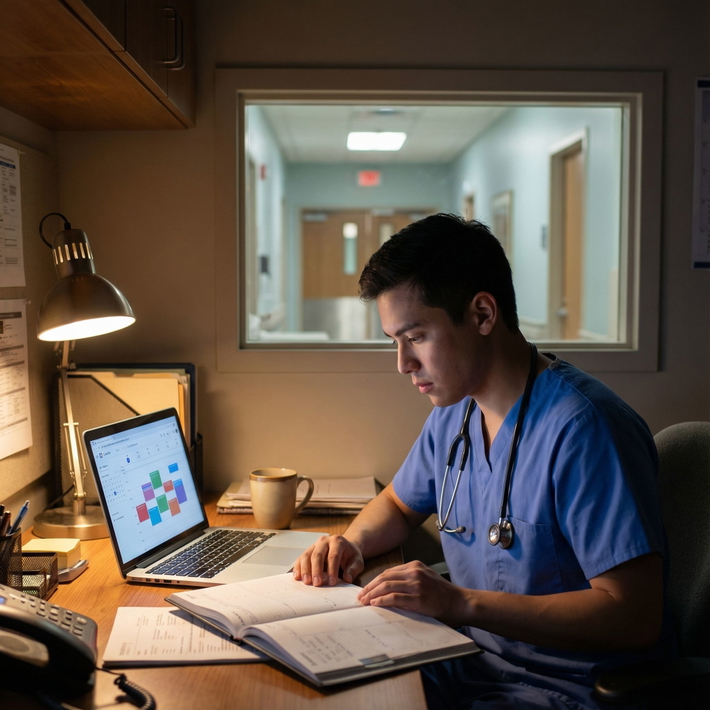
You know the moment. It's 3:07 a.m. You're halfway through cross-cover, your mouth feels like printer paper, your coffee has gone cold in the worst possible way, and there's a dull pounding behind your eyes that makes you wonder if you've somehow already wrecked your body. You start doing that anxious inventory: Am I dehydrated? Am I getting sick? Is this why I feel weirdly shaky? Did I mess up by having coffee and not enough water? Is this one of those tiny bad habits that means I'm secretly terrible at residency?
I hate how fast the mind goes there on nights. Everything feels more dramatic in the dark. A dry mouth turns into a crisis. A headache turns into a referendum on your competence. And because dehydration symptoms overlap with basically everything miserable about night float, sleep debt, stress, caffeine crash, skipped meals, bad circadian timing, it's easy to assume the worst.
That overlap is the whole problem. Tired feels like dehydrated. Overcaffeinated feels like dehydrated. Anxious feels like dehydrated. Wearing a mask for hours, talking nonstop, breathing dry hospital air, and forgetting to eat can all make you feel like you're drying out from the inside. Sometimes you do need more fluids. A lot of the time, though, what you're feeling is routine night-shift discomfort wearing a scary costume.
That's the good news, if there is any good news at 3 a.m. Most night-shift hydration problems are fixable and not a sign that you're falling apart. You do not need a perfect wellness routine. You need a sane one. Steady fluids. Less panic. Fewer dumb mistakes like chugging a liter of water in five minutes and then spending the next hour running to the bathroom while still feeling awful.
The 3 a.m. panic scenario: why night-shift dehydration feels worse than it is
Night shift distorts everything. I'm convinced of that. The same dry mouth you'd ignore at 2 p.m. suddenly feels ominous at 3 a.m., mostly because you're already running on borrowed energy. Your body wants sleep, not another admission, and when basic signals start getting noisy, your brain fills in the blanks with catastrophe.
Dehydration is especially sneaky because the symptoms are vague and annoyingly noncommittal. Headache. Fatigue. Dizziness. Feeling off. Trouble focusing. Mild nausea. Those are also symptoms of being underslept, stressed, underfed, overscheduled, overcaffeinated, and alive in a hospital overnight. So people panic and decide the answer must be to slam water immediately, as if the human body works like a dying houseplant.
It doesn't.
Most of the time, that awful "I'm definitely dehydrated and maybe failing as a person" feeling is a blend of circadian disruption and bad timing. You had coffee too fast. You forgot to drink for three hours. You ate crackers for dinner. You've been power-walking between floors in dry air and talking through an N95. That's not great, but it's not instant danger either.
The trick is to stop treating hydration as an emergency fix for every bad night-shift sensation. It's a maintenance task. Boring. Repetitive. Effective. And honestly, that's reassuring. If you can replace panic with a simple plan, the whole shift gets less noisy.
What sleep docs actually mean by "hydrate": enough, not excessive
This is the part no one says clearly enough: when sleep doctors or occupational health people tell you to hydrate on nights, they do not mean carry a gallon jug like you're training for a fitness influencer audition. They mean maintain a steady, reasonable intake across the shift.
Enough. Not excessive.
That distinction matters because overdrinking on night shift is its own kind of misery. If you chug huge amounts of water all at once, you don't become optimally hydrated and morally superior. You become uncomfortable. You break your focus because you're hunting for a bathroom every 30 minutes. If you're trying to nap on a break, good luck with that. And if your stomach is already touchy from caffeine and weird meal timing, too much water too fast can make you feel nauseated, bloated, and somehow more panicked. Just what you needed.
Hydration is not measured by one dramatic moment. It's a pattern over hours. That's why thirst alone isn't enough. Thirst matters, sure, but so do other clues: Is your urine getting very dark? Do you have persistent dry mouth? A headache that's not settling? Dizziness when you stand? Have you basically had coffee and two bites of a protein bar since sign-out? Look at the whole picture. Night shift punishes tunnel vision.
And let's kill two terrible myths.
First: "If I'm tired, I must be dehydrated." No. You're on night shift. You are tired because this schedule is biologically rude. Water does not cure circadian misalignment. It helps if you're behind on fluids, but it won't magically turn 4 a.m. into noon.
Second: "If I crash, I should chug water." Also no. A crash is usually sleep pressure, caffeine timing, hunger, or all three piled together. Water may help if you've neglected it, but panic-chugging is not treatment. It's theater.
What sleep docs are really getting at is consistency. Keep fluids coming in at a modest pace so you're not bouncing between dry-mouth panic and overhydrated regret. It's less glamorous than "biohacking your night shift," but it actually works.
The practical hydration plan for a night shift you can actually follow
Here's the plan I wish more people were given straight: start before the shift, stay steady during it, and don't try to correct six hours of neglect in six minutes.
Before your shift, hydrate earlier in the day. Not aggressively. Just intentionally. If you wake up in the afternoon and realize you've had almost nothing to drink, that's when you start fixing it. Have water with meals. Sip through the evening. Don't stroll into sign-out already behind and then try to solve it by pounding a giant bottle in the parking garage. That move is nonsense. All it does is set you up for a miserable first few hours.
During the shift, small frequent sips beat heroic catch-up every single time. Keep a bottle where you'll actually see it. Not buried in your bag under a granola bar from six months ago. Visible. Annoyingly visible. Pair drinking with things you already do: after sign-out, after you place orders, after you come back from a rapid response, when you sit to chart, when you grab coffee. Habit stacking sounds cheesy, but nights are chaotic, and your memory gets weird when you're tired. You need cues.
If you're a reminder person, set one every one to two hours. Nothing dramatic. Just a little nudge so the entire shift doesn't happen in one blur and then suddenly it's 5 a.m. and you realize your kidneys have been on a side quest.
Caffeine complicates this, but not in the way people think. Coffee isn't the villain. It's just not a hydration strategy. If you have caffeine, pair it with water. Not because one cup of coffee instantly dehydrates you into dust, but because coffee tends to replace water in real life. One cup becomes two, then you're jittery, your mouth is dry, and you've convinced yourself you're severely dehydrated when really you're under-slept and overstimulated.
What about the sudden dry-mouth panic? The classic 2:53 a.m. "I need to fix this now" moment? Don't chug. Take a few small sips. Give it a minute. If you can, rinse your mouth or take a short pause. Dry mouth can improve quickly even without massive fluid replacement, especially if the trigger is dry air, caffeine, mouth breathing, or nonstop talking. Chugging because your mouth feels dry is how you go from anxious to bloated and annoyed.
If you want a simple framework for common night-shift scenarios, use this:
If you have a mild headache, first assume nothing dramatic. Drink some water slowly, eat something if you haven't, and ask yourself when you last had caffeine and when you last slept. A lot of "dehydration headaches" are really "I've had coffee and string cheese as my only nutrition" headaches.
If you feel dizzy, pause. Sit if you need to. Check whether you stood up too fast, haven't eaten, or have been running around for hours. Try fluids, yes, but don't reduce everything to water. Blood sugar, exhaustion, and stress all get a vote here.
If your urine is very dark and you've barely had anything to drink, that's a stronger clue you actually need more fluid. Start correcting it steadily. Not with a punishment liter all at once. Just keep drinking consistently over the next several hours.
If you feel nauseated, be careful. That's one of the easiest times to overdo water because you start bargaining with yourself. "Maybe if I chug enough, I'll fix it." Usually not. Small sips are better. If the nausea is from caffeine on an empty stomach, food matters more than a flood of water.
And if you realize you forgot to drink for hours, because of course you did, the pager went feral, don't spiral. That realization does not mean the shift is ruined. It means start now. Sip. Reassess. Continue. Residency is full of delayed corrections. This is one of them.
Caffeine, electrolytes, and the hidden ways night shift makes hydration confusing
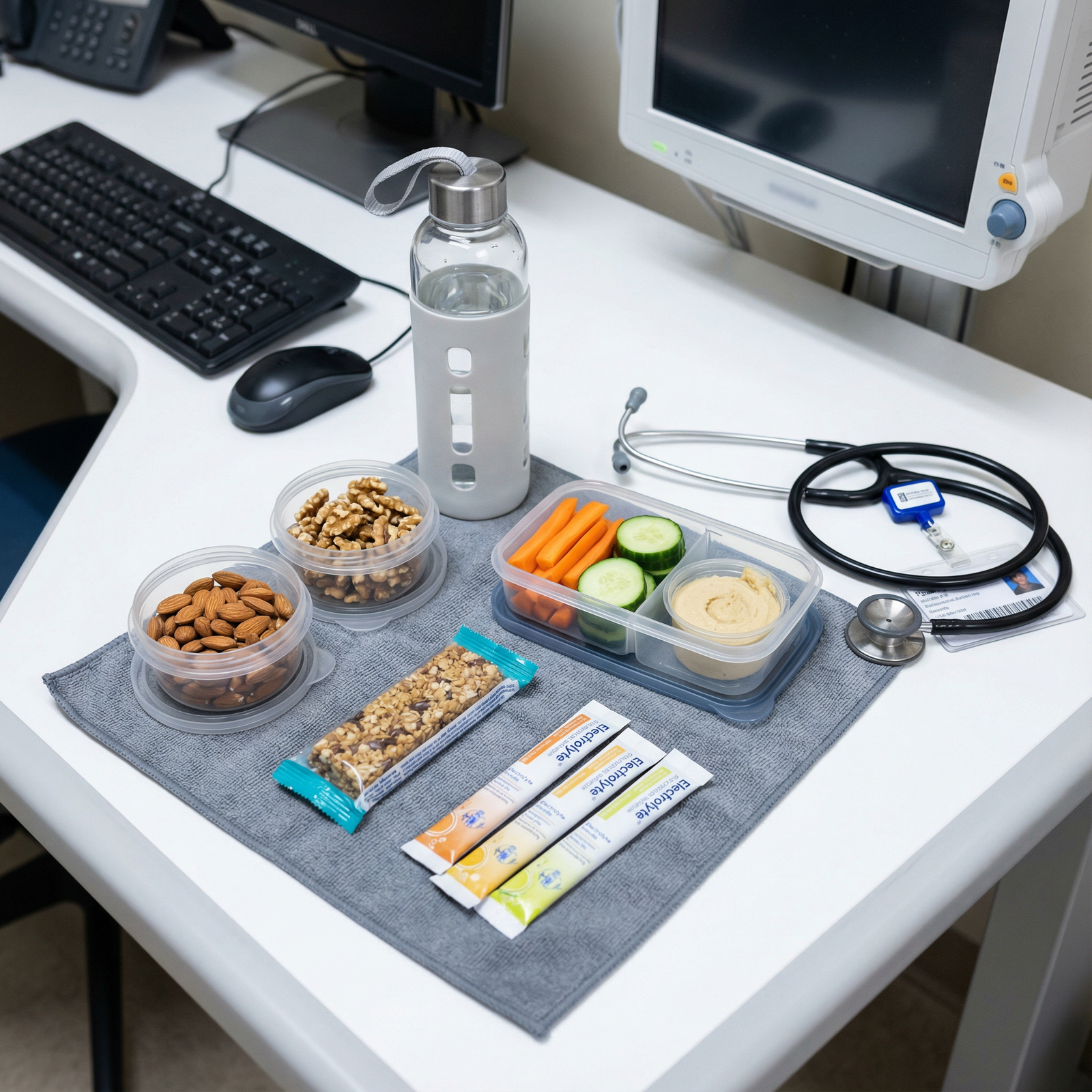
Caffeine is useful. I'm not going to pretend otherwise. On some nights, coffee is the only thing standing between you and accidentally reading the same lab value five times. But caffeine can absolutely make hydration feel more confusing than it is.
For one thing, it masks fatigue. You feel temporarily sharper, so you miss how worn down you actually are. Then the jitteriness hits, your heart feels a little too noticeable, your mouth is dry, and suddenly you're convinced you're desiccating. Sometimes it's just too much caffeine. Brutal but true. Water helps, but the real problem is often that you used coffee to outrun biology and biology eventually collected its debt.
Electrolytes are another place people get weirdly dramatic. Most night shifts do not require an electrolyte drink as standard equipment. If you're sweating heavily, doing physically intense work for long stretches, working in a hot environment, or actually losing fluids, then sure, electrolytes may help. But for the average inpatient night? Plain water is enough. Not every tired resident needs a neon sports drink like they just finished a marathon.
The environment matters more than people realize. Hospital air is dry. Masks dry your mouth out. Talking constantly dries your mouth out. Running from floor to floor while forgetting your water bottle at the workstation dries your mouth out. Irregular meal breaks make everything worse, because hunger and dehydration get mixed together into one vague miserable feeling. Then you blame the wrong thing and "treat" it badly.
That's why hydration cannot be your only survival strategy. It sits next to sleep, food, pacing, and caffeine timing. Not above them. If you're trying to solve total night-shift misery with water alone, you're asking too much from a bottle.
When to worry: red flags that mean this is more than routine night-shift thirst
This is the line anxious people struggle with most, and I get it. Panic exaggerates risk, but powering through real symptoms is also dangerous. Both mistakes happen. I've seen both.
Routine night-shift dehydration usually looks like dry mouth, thirst, a mild headache, maybe some light dizziness, and feeling generally off. It should improve with slowing down, taking fluids, eating something, and reassessing.
What worries me more is confusion, fainting, severe weakness, persistent vomiting, being unable to keep fluids down, chest pain, or palpitations that are intense or worsening. Same with symptoms that are severe, out of proportion, or just not responding. That's when "it's probably just nights" becomes a bad story you're telling yourself.
Use a simple pause-and-assess checklist. Ask: Can I think clearly? Can I stand safely? Am I keeping fluids down? Is this improving at all? Is there anything about this that feels genuinely different from my usual tired-and-dry night-shift misery? If the answers are bad, don't white-knuckle it.
Get help early. Tell someone. Step away. Be evaluated. Toughing it out is wildly overrated, especially in medicine where we love making bad decisions sound noble.
A calmer approach to night-shift hydration you can repeat every week
Night-shift hydration should be boring. That's the goal. Steady intake, not perfection. Water before the shift, small sips during, and reassess instead of spiraling.
One imperfect shift doesn't mean you failed. It doesn't mean you harmed yourself. It means you had a messy night in a system that makes basic self-care harder than it should be. That's different.
If you need a mantra, use this: hydrate before, sip during, reassess instead of spiraling.
That's enough. Really. Night-shift survival is built on consistency, not punishment.