

It is three weeks before your board exam. You are staring at the call schedule draft your chief just emailed out. Two things jump out immediately: a golden weekend the week before your test… and a string of three nights that end 24 hours before you sit for the exam.
At this point you should be asking one question:
“How do I set up my nights and call so I do not quietly destroy my own score?”
This is not just about “studying more.” It is about timing. Sleep debt. Circadian rhythm. The way night shifts poison recall if you schedule them wrong. I have watched smart residents lose 20–30 exam points because they tried to be “a team player” with call. Do not repeat that mistake.
We will walk this from 8 weeks out down to the 24 hours before test day, with very specific “at this point you should…” instructions.
8–6 Weeks Before the Exam: Set the Foundation
At 8 weeks out, you still have leverage. Schedules are flexible. Chiefs are not yet locked in stone. This is where you either protect your exam window or guarantee suffering later.
At this point you should:
Clarify the exact test date and check-in time.
Write it down. Block the entire 48 hours before it in your calendar.Know your rotation blocks around the exam.
Are you on ICU nights? Clinic? ED? A chill elective? The answer dictates how aggressive you must be.Email or talk to your chief early.
Not two weeks before. Now. The language matters. For example:- “My ABIM exam is on August 12. I need to be off nights and 24-hour call for at least 3–4 days before that so I can normalize my sleep and do final review. Can we structure my nights earlier in the month?”
Chiefs respond much better to specific, practical requests than vague “I need some lighter time.”
Decide your preferred pattern: front-load vs taper.
For most residents, I strongly prefer:
- Night-heavy and call-heavy 6–4 weeks out
- Gradual taper 3–1 weeks out
- Zero nights and no 24-hour call in the final 5–7 days
The alternative pattern (minimize early, suffer late) is how you sabotage your studying.
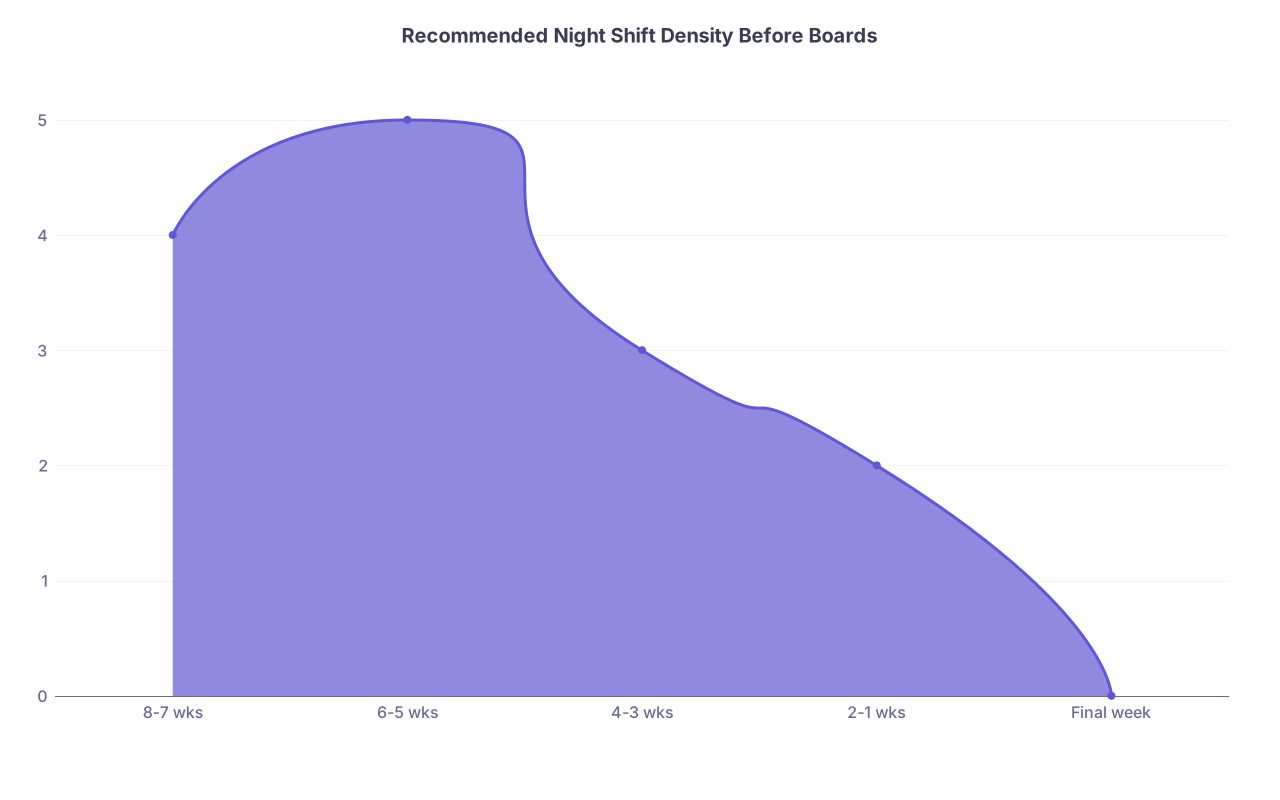
| Category | Value |
|---|---|
| 8-7 wks | 4 |
| 6-5 wks | 5 |
| 4-3 wks | 3 |
| 2-1 wks | 2 |
| Final week | 0 |
At this stage, your goal is not perfect. It is to prevent disasters: no consecutive nights landing in the 3 days before your exam, no 24+3 call the day before, no post-call exam morning.
6–4 Weeks Before: Lock the Schedule and Build the Study Framework
By 6–4 weeks out, the schedule is usually “final.” Which really means “annoying but still changeable if someone’s exam is at stake.”
At this point you should:
- Audit your existing call / night layout.
Look specifically at:
- Any shift ending within 72 hours of your exam
- Any call night or ED night within 5 days of your exam
- Whether you have any golden weekend close enough to be used as a mini boot camp
If you see this pattern:
- N, N, N, off, exam
You are in trouble. Fix it now.
- Request targeted swaps.
You are not asking for fewer calls. You are redistributing.
Good swap targets:
- Move nights from exam week to 3–4 weeks earlier
- Trade a night the week before the exam for a weekend call 2–3 weeks before
- Swap one post-call weekday near the exam for a busier but earlier date
What you say to colleagues:
- “I have my boards on [date]. I need that week to normalize sleep. I can take your [earlier night/ weekend call] if you can take my [night closer to exam].”
- Stabilize your baseline sleep on non-call days.
You cannot be wildly flipping between 5 hours and 10 hours.
Target:
- Minimum 6–7 hours on “normal” days
- A consistent anchor: same wake time within 1 hour, even post-call if possible
You want your brain used to being awake and focused at the exact time your exam is scheduled.
- Plan your study blocks around nights now, not reactively.
If you know you have:
- 3 nights in a row, then 2 days off
Plan:
- Nights: low-yield tasks → flashcards, short Q-blocks, reading review notes during slower periods
- Post-call day: 0 serious studying, just light review or nothing
- Next day: heaviest Q-bank and mixed blocks
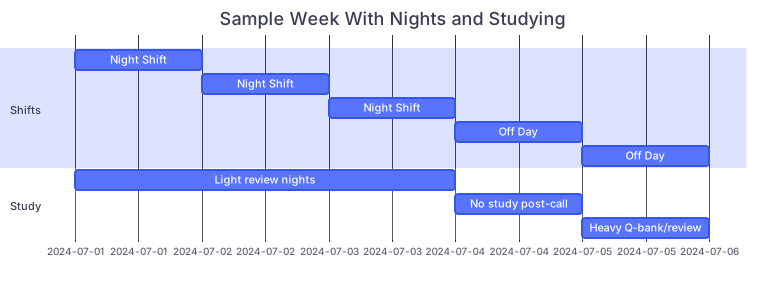
| Task | Details |
|---|---|
| Shifts: Night Shift | a1, 2024-07-01, 1d |
| Shifts: Night Shift | a2, 2024-07-02, 1d |
| Shifts: Night Shift | a3, 2024-07-03, 1d |
| Shifts: Off Day | a4, 2024-07-04, 1d |
| Shifts: Off Day | a5, 2024-07-05, 1d |
| Study: Light review nights | b1, 2024-07-01, 3d |
| Study: No study post-call | b2, 2024-07-04, 1d |
| Study: Heavy Q-bank/review | b3, 2024-07-05, 1d |
4–2 Weeks Before: High-Intensity Study With Smart Night Shift Handling
This is the crunch zone. You are doing full-length blocks, practice exams, and mixed questions. Night shifts still happen—but how you handle them matters.
If You Are On Nights During This Window
At this point you should:
- Choose: fully flip or partial adaptation.
Stop pretending you can “kind of” be a day person and also do nights. For boards, there are two strategies.
Full flip (true night schedule)
You sleep ~08:00–15:00, you are awake at night, and on days off you stay near that schedule.
Use this if your exam is still >10 days away and the nights are clustered.Partial adaptation (hybrid)
You sleep a shorter block post-call (e.g., 10:00–14:00), then another short nap in the evening, trying to keep your wake time closer to exam timing.
Use this if your exam is 7–10 days away and you are starting to think about shifting back.
For most residents, once you are inside 10 days, I want you moving gradually toward being fully awake and sharp at exam time, not at 03:00.
- Protect at least one full recovery day after a string of nights.
Do not schedule a practice exam the morning after your last night. That is just a data point in how badly sleep debt wrecks your score.
Better:
- Last night → sleep → semi-functional afternoon with light review only
- Next day → full-length practice block or exam
- Use nights for specific, lower-cognitive-load tasks.
During the actual night shifts:
- Quick topic review PDFs
- Anki / flashcards
- 10–20 question mini-blocks with detailed review
Avoid:
- 120-question self-assessment at 03:30
- Cramming new content you never touched before
You are not going to remember “weird vasculitis subtypes” learned at 04:15.
If You Are On Days / Light Rotations
At this point you should:
- Keep your sleep anchored to exam time.
If your exam is at 8:00:
- Wake at 06:00–06:30 daily
- Do your hardest cognitive work 08:00–12:00
You are training your brain: “We do hard things at this hour.”
- Do one or two practice tests at true exam time.
Not at night. Not post-call. Simulate the real thing: same wake time, same nutrition, same caffeine.
14–8 Days Before: Final Call / Night Shifts and the Sleep Pivot
This is the danger zone. Residents underestimate how long it takes to unwind from nights. They assume one day off is enough. It is not.
At this point you should have:
- All nights and 24-hour calls finished by 5–7 days before exam day as an ideal
- Absolute latest “last night” shift ending no closer than 3–4 days before if your schedule is rigid
| Last Night Ends | Recommended Earliest Exam Date |
|---|---|
| 1 day later | Unsafe |
| 2 days later | High risk |
| 3 days later | Bare minimum |
| 4 days later | Acceptable |
| 5–7 days later | Ideal |
At this point you should:
- Execute the “sleep re-entry” plan if you are just finishing nights.
If your last night ends 4–5 days before exam:
Day 1 (post final night):
- Sleep 09:00–13:00 or so (shorter nap, not full 8 hours)
- Force yourself to stay awake until 21:00–22:00
- No heavy studying. Light review at most. This day exists to shift your clock.
Day 2:
- Wake at 06:30–07:00
- Do 3–4 hours of real studying during your actual exam window
- Short 20–30 minute power nap mid-afternoon if needed, not longer
Day 3 and beyond:
- Lock into exam-time routine: wake, caffeine, breakfast, then serious blocks
- Clamp down on extra shifts, moonlighting, and “helping out.”
This is where you say no.
If someone asks you to pick up:
- A random night two days before your exam → decline
- A late evening ED swing the night before → decline
“Sorry, my boards are [date]. I was advised not to add any more night work that week. I can help out after.”
You do not get extra points on your score report for being nice.
- Shift study focus to consolidation, not expansion.
Especially if you lost days to call, it is tempting to cram new topics. That is how people fry their circuits.
Instead:
- High-yield topics you already touched
- Weak spots you have identified from prior practice tests
- Mixed Q-bank blocks, then targeted reading on questions you miss
The Final 7 Days: No Nights, No 24-Hour Call, Precision Scheduling
If you are inside a week and still have nights on the schedule, you failed the earlier steps. If you can still swap, do it. If you cannot, you pivot to damage control (we will cover that next).
Assuming you managed to clear nights:
At this point you should:
7–5 Days Before
- Run your last full-length practice exam 5–6 days before test day.
- Simulated timing
- Full block structure
- Same break and snack pattern if possible
Do not schedule this on a post-call day. Ever.
- Keep clinical days as light as possible.
If you are on an elective:
- Front-load your more intense tasks earlier in the week
- Avoid late admissions or “staying late” out of guilt the last 3–4 days
- Simplify life logistics.
This is underrated and directly affects cognitive bandwidth:
- Confirm exam center location and transit plan
- Set up snacks, water, and clothes for exam day
- Pay any bills, handle any nagging tasks that would otherwise occupy mental space

4–3 Days Before
At this point you should:
- Scale back volume but keep daily contact.
- 2–3 medium-length Q-bank blocks
- Immediate review, focused reading
- One focused pass on your personal “cheat list” (topics you consistently miss)
- Micro-adjust sleep schedule to match exam time exactly.
Each day:
- Wake at your exam wake time
- Do hard studying during the first half of the day
- Stop hard studying at least 2–3 hours before bedtime
This is also where you cut back on late caffeine. You want solid sleep.
- Avoid major schedule disruptions.
No:
- Late-night social events
- Long travel
- Last-minute swaps back onto nights “just this once”
Damage Control: If You Are Forced Into Nights Close to the Exam
Sometimes you are in a malignant schedule, or you are the only person who can cover. It happens.
If you must work nights within 3–4 days of the exam, your goal changes: you are not optimizing; you are containing damage.
Scenario: Two nights ending 2 days before exam, cannot be moved.
At this point you should:
- Use an aggressive, structured flip-back.
- Final night ends → sleep 09:00–12:00 only
- Force awake until 21:00–22:00
- Melatonin or other sleep aid if already approved by your own physician and you know how it affects you
The next day:
- Wake 06:30–07:00
- Do modest studying 08:00–11:00 to rehearse exam timing
- Light review in the afternoon
You will feel terrible. That is expected. Your body will adapt faster if you are ruthless about wake time.
- Cut study volume to protect sleep quality.
Sleep > extra questions at this point. A half-rested brain with 500 more questions done is still worse than a well-rested one with 300 fewer.
Do not overcompensate for bad nights by doubling caffeine right before bed. Use:
- A moderate morning dose (equivalent to 1–2 cups coffee)
- No caffeine after early afternoon
Then on exam morning you can get a reliable boost without tolerance issues.
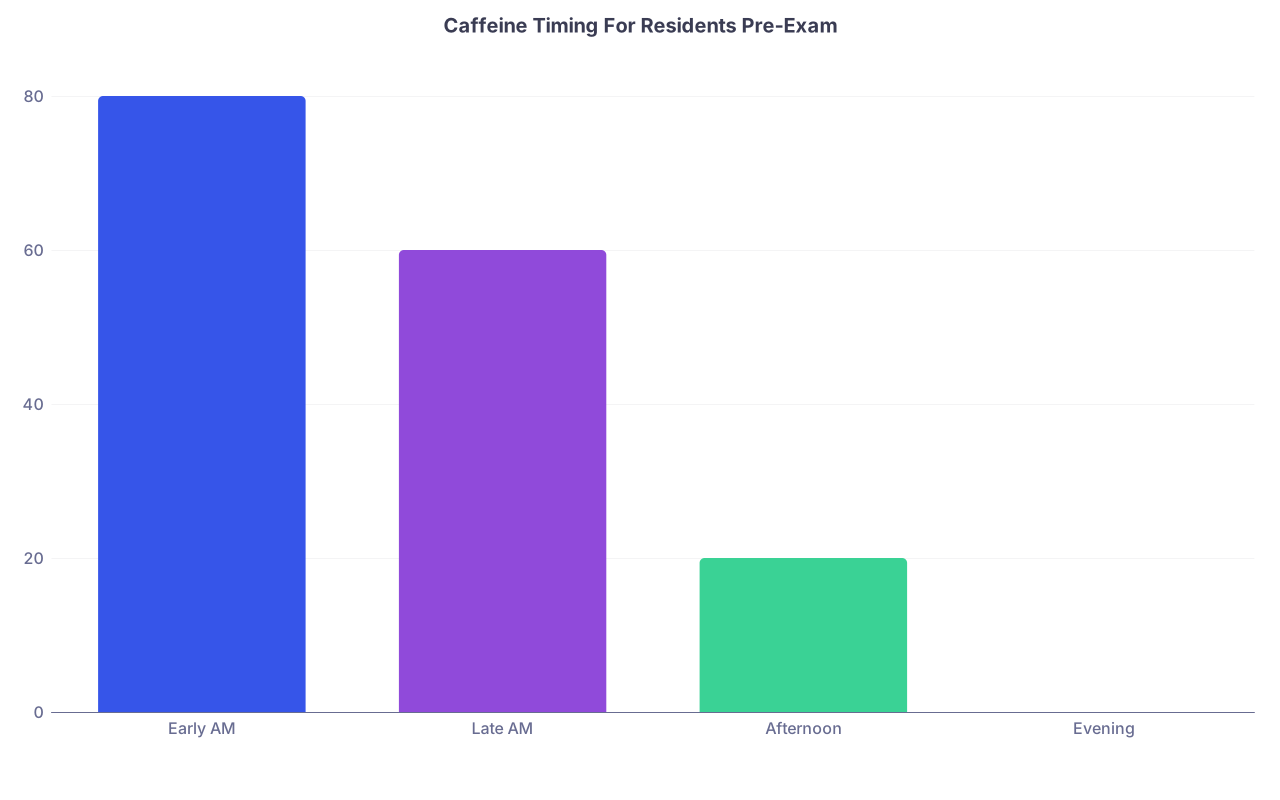
| Category | Value |
|---|---|
| Early AM | 80 |
| Late AM | 60 |
| Afternoon | 20 |
| Evening | 0 |
(Values roughly represent mg caffeine. The point is: front-loaded, nothing close to bedtime.)
The Final 48 Hours: Lockdown
Two days left. The work here is simple, but people get anxious and overdo it.
48–24 Hours Before
At this point you should:
Stop any heavy clinical shifts.
If you are somehow still on nights or 24-hour call inside this window, you are in a no-win situation. If there is any path to getting coverage, use it. This is the last point at which you fight for it.Study plan: 60–70% effort day, then a taper.
- 2–3 Q-bank blocks of 20–40 questions, mixed
- Review explanations thoroughly
- Revisit key formulas, criteria, and algorithms one last time
- Evening: structured wind-down.
- Light exercise or walk
- No new topics
- Screen cutoff 1 hour before bed
- Sleep target: your usual exam-week bedtime, 7–8 hours before wake time
The Day Before
At this point you should:
- Cap studying by early afternoon.
- Maybe 1–2 short review sessions in the morning
- Flashcards / light review before lunch
- After early afternoon: stop. The marginal gain is not worth the stress.
- Run a full exam-day rehearsal checklist.
- Print or lay out: ID, scheduling permit, directions to testing center
- Pack snacks: simple, non-messy, predictable (nothing new that may upset your stomach)
- Choose clothing: layers, comfortable, nothing distracting
- Bedtime discipline.
Go to bed at a consistent time even if you feel “not tired enough.” You are not aiming for perfect sleep, just enough. Everyone sleeps badly the night before. The cushion is built in the week before, not in some mythical perfect final night.

Exam Morning: Execution
You are not a med student showing up wide-eyed to the MCAT. You are a resident. You have done codes half-asleep. Use that discipline here.
At this point you should:
- Follow the routine you already rehearsed.
- Wake at your usual exam-week time
- Light breakfast you have eaten before on call days
- Normal caffeine dose, not suddenly doubled
- No last-minute cramming.
Skimming 2–3 flashcards is fine if it calms you. Deep-diving into renal pathology at 06:30 is not.
- Arrive early enough that logistics are a non-issue.
Plan transit as if something will go wrong, then enjoy when it does not.
Key Takeaways
- You schedule call and nights around boards by front-loading the pain 6–4 weeks out and protecting at least the final 5–7 days from nights and 24-hour call.
- Sleep timing is part of your study plan. You train your brain to be sharp at exam time and respect the 3–5 day lag needed to recover from nights.
- In the last week, you trade volume for quality: fewer questions, more sleep, no new topics, and absolutely no “heroic” extra shifts that wreck your score.


