Educational Disclaimer: This article is for medical education and general informational purposes only and does not constitute medical, financial, legal, or tax advice. Light therapy and shift-work strategies should be individualized and are not a substitute for professional guidance. For personalized medical advice, consult your own clinician, occupational health team, or a sleep specialist, and for any financial, legal, or tax questions, consult qualified professionals.
This article is for educational purposes only. It is not financial advice, not legal advice, and not tax advice. Figures vary by individual circumstances, consult a qualified professional before acting.
It's 2:17 a.m. and I'm wide awake when I'm supposed to be asleep
You get home after a night shift feeling like your bones are full of wet cement. You were tired at sign-out. Tired in the elevator. Tired walking to your car. Then the sun hits.
Suddenly it's bright, sharp, offensively cheerful. People are jogging. Someone is buying iced coffee like this is a normal life. And now your brain, which you desperately need to power down for four or five decent hours before the next shift, feels weirdly more awake. Not good awake. Jittery awake. Punished awake.
(See also: a 4-week night float roadmap for more.)
That's the moment a lot of residents start spiraling. I know I would. If light controls the body clock, then one dumb commute home can feel like a catastrophic mistake. Like: great, I looked at the sunrise for twelve minutes, now I'll never sleep, I'll be foggy tonight, I'll miss something important, and somehow this all ends with me making a medication error because I didn't wear sunglasses aggressively enough.
That fear isn't irrational. It's just incomplete.
The standard sleep advice on light therapy often sounds clean and elegant. Get bright light at the right time. Avoid it at the wrong time. Protect your sleep. Sure. In real life, night float is messy. You're doing a week of nights. Or three isolated nights. Or five nights with a mandatory noon conference stuffed in the middle because apparently circadian biology doesn't get voting rights in residency scheduling. You may have a long commute, childcare, errands, a roommate who believes daylight is morally superior, and a body that refuses to cooperate on command.
So yes, light therapy can help. Real help. But it is not magic, and this is the part people soften too much: mistimed light can absolutely make adaptation harder. On night float, the difference between "helpful" and "why am I staring at the ceiling at 11:30 a.m. with my heart racing?" is often timing, not effort.
What sleep doctors usually say about light therapy, and why that advice can feel too simple
Here's the basic pitch you'll hear: bright light at the right time can improve alertness during overnight work, shift your circadian rhythm later, and make daytime sleep a little more attainable. That's true. It's also not enough.
The biology is simple enough if you strip away the jargon. Light tells your brain what time it is. It suppresses melatonin, nudges the body toward wakefulness, and helps set the internal clock that influences sleep, alertness, temperature, hormones, hunger, and mood. The problem is that light is not just "good" or "bad." It depends on when it lands.
Light in your biological evening or early night tends to delay your clock, pushing sleep and wake timing later. That can help if you're trying to adapt to nocturnal work. Light in your biological morning tends to advance your clock, pulling you earlier. That's great if you're trying to wake up at 5 a.m. for a normal schedule. It's terrible if you just finished a 7 p.m. to 7 a.m. shift and need to sleep at 9 a.m.
What gets left out is the schedule problem. "Get bright light at work" is lazy advice if nobody asks what kind of nights you're actually doing. Three nights in a row? A full two-week night float? Rotating back to days immediately after? Still expected to show up to daytime obligations? Those are completely different situations. The same light plan should not be copied and pasted across all of them.
And this is the fear nobody says out loud enough: if you use light at the wrong time, you may feel more alert when you don't want to be, sleep worse after shift, and show up even more impaired the next night. That's not you being fragile. That's physiology.
(See also: blue light and post-shift sleep for more.)
So before you even think about a light box, ask the only question that matters: what is the goal?
Usually it's one of three things:
- Stay alert tonight
- Fully adapt to nights for a longer block
- Survive a short block without fully flipping your body clock
Those are not the same project. If you confuse them, the light plan gets sloppy fast.
The part they don't emphasize enough: on night float, the timing matters more than the lamp
(See also: short anchor sleep blocks for more.)
This is where people waste money and miss the point.
Residents will compare brands, lux numbers, blue-enriched bulbs, desk lamps, wearable gadgets. Fine. But if your timing is wrong, the fanciest light device in the world is just an expensive way to irritate your retina. On night float, timing matters more than the lamp. Full stop.
The highest-risk window is usually after the shift ends.
If you've worked all night and you want to sleep during the day, bright morning light on the commute home is often the exact thing you don't want. It tells your brain, "Good morning. Time to be awake." Which is biologically logical and personally infuriating.
I've seen the routine that defeats people over and over. Sign-out. Scroll phone in a brightly lit workroom. Cafeteria breakfast by giant windows because you "deserve a treat." Drive home in direct sunrise. Stop for groceries. Get home. Open blinds absentmindedly. Shower in bright bathroom light. Then wonder why sleep feels impossible. None of this means you ruined your life. But yes, you accidentally told your body a very clear story, and it was the opposite of the one you needed.
A better strategy is usually this:
- Use brighter light in the first half of the shift if you need help staying alert.
- Reduce stimulating light toward the end of the shift if your goal is to fall asleep after sign-out.
- Protect the commute home with light avoidance as much as is safely practical.
- Keep the bedroom dark, cool, and boring. Boring is good. Boring is sleep medicine.
For many residents on a typical 7 p.m. to 7 a.m. schedule, bright light is most useful from roughly early shift through around midnight or 1 a.m. After that, especially in the final stretch, blasting yourself with more light can be a tradeoff. Yes, it may prop up alertness. It may also make it harder to wind down after shift. That doesn't mean nobody should ever use light late. It means the decision should be intentional, not accidental.
(See also: Can Melatonin Really Fix Night Shift Sleep? for more.)
And here's the uncomfortable truth: on a short block, a lot of residents never fully adapt anyway. Trying to "perfectly reset" your circadian rhythm over three to five nights can turn into self-punishing nonsense. For short stretches, partial adaptation is often smarter. Meaning: support alertness during the shift, then aggressively protect daytime sleep, without expecting your body to become thrilled about being nocturnal.
That approach is less glamorous. It's also less stupid.
What this looks like in real life when your schedule is chaotic and your anxiety is worse
Let's make this practical, because abstract sleep advice is how people end up panic-buying gadgets at 1 a.m.
If you're doing a short 3-night stretch
Don't chase a dramatic circadian flip. Usually not worth it.
Your main goals are:
- stay functional overnight
- get enough sleep between shifts
- avoid wrecking yourself when you switch back
That means brighter light earlier in the shift can help, especially if your sleep pressure is crushing you around 10 p.m. to 1 a.m. Then start dimming your environment when possible in the back half. After sign-out, minimize bright outdoor exposure on the way home, get into a dark room quickly, and keep your pre-sleep routine ruthlessly simple.
If you're doing a 1- to 2-week night float
This is where stronger circadian delay efforts may actually pay off. More consistent bright light during the first half of the shift, more serious light avoidance after shift, and a more regular daytime sleep schedule can help your body shift later. Not perfectly. But enough to matter.
The catch? Many residents still get dragged back toward daylight living by days off, family obligations, grocery runs, noon conference nonsense, or the basic human desire to see the sun once in a while. So even here, adaptation is often partial, not total.
If your schedule is mixed or chaotic
(See also: using sleep aids after night shift for more.)
This is the hardest setup and the one generic advice handles worst. If you're expected to function during some daytime hours while still doing nights, you may need a compromise strategy rather than a full flip. Protect the most important sleep window you can, use targeted light for on-shift alertness, and stop expecting a perfect solution. There usually isn't one.
Now the common panic questions.
"If I wear sunglasses home, will I be unsafe driving?" Safety comes first. Always. If dark sunglasses make driving less safe, don't use them that way. You can try lighter wraparound lenses, a hat with a brim, the visor, avoiding unnecessary time outside, and getting home efficiently without side quests. The goal is reducing bright exposure, not creating a car accident.
"If I use bright light all night, will I never sleep?" Probably not "never," but using intense light too late can absolutely make post-shift sleep harder. This is exactly why timing matters. Early shift is different from 6:30 a.m. right before you walk into daylight.
"If I nap wrong, is the whole day ruined?" No. This is anxious brain talking. A badly timed nap can make things messier, but one imperfect nap does not destroy the entire block. Residency is not a precision laboratory. It's more like trying to stack dishes in an earthquake. You're aiming for better, not flawless.
And no, light is not the only lever. It works best as part of a package:
- Caffeine timing: useful early, dangerous late
- Meal timing: giant heavy meals at weird hours can backfire
- Sleep environment: blackout curtains, eye mask, white noise, cooler room
- Consistency: not perfect consistency, just enough that your body can predict what's coming
(See also: Night Float Reset Protocol for more.)
There are also situations where DIY light therapy deserves caution. If you have bipolar disorder or a history suggestive of mania risk, bright light interventions should be handled carefully. If bright light triggers migraines, don't bully yourself into using it like a martyr. If you have severe insomnia, major daytime sleep failure, significant visual limitations, or you're having near-miss events driving home, this is past the point of casual hacks. Get actual help. Occupational health, your PCP, or sleep medicine. That's not weakness. That's judgment.
The uncomfortable truth: light therapy can help you stay functional, but it may not make night float feel normal
This is the part I wish people said more bluntly.
A good light plan can help. It can improve alertness, reduce some sleep disruption, and make night float less brutal. But it may not make it feel normal. A lot of trainees still feel vaguely poisoned by the whole experience. Socially jet-lagged. Hungry at bizarre times. Foggy at 4 a.m. for no morally acceptable reason. Weirdly emotional. Short-tempered. Too tired to text back, too wired to sleep.
That doesn't mean the plan failed.
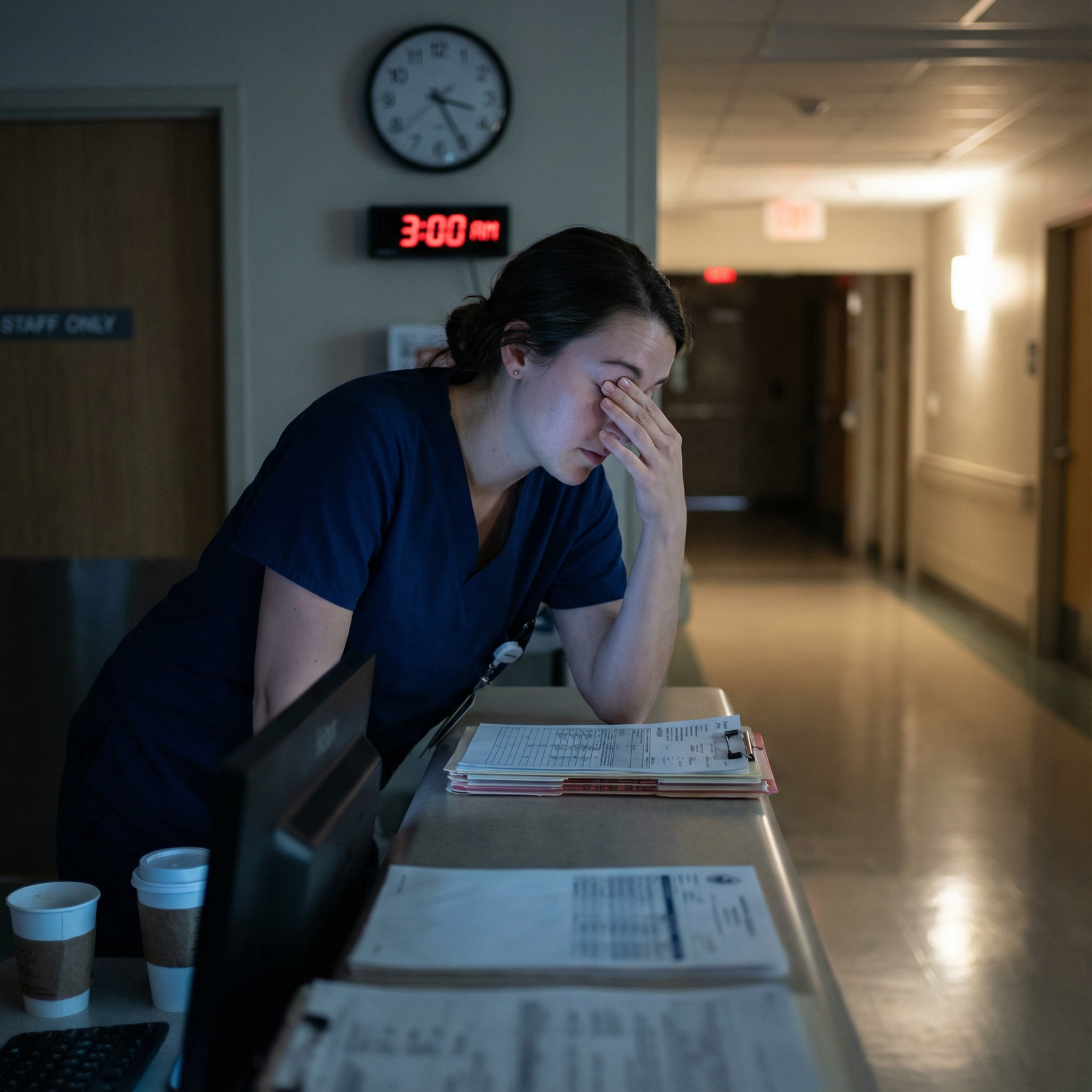
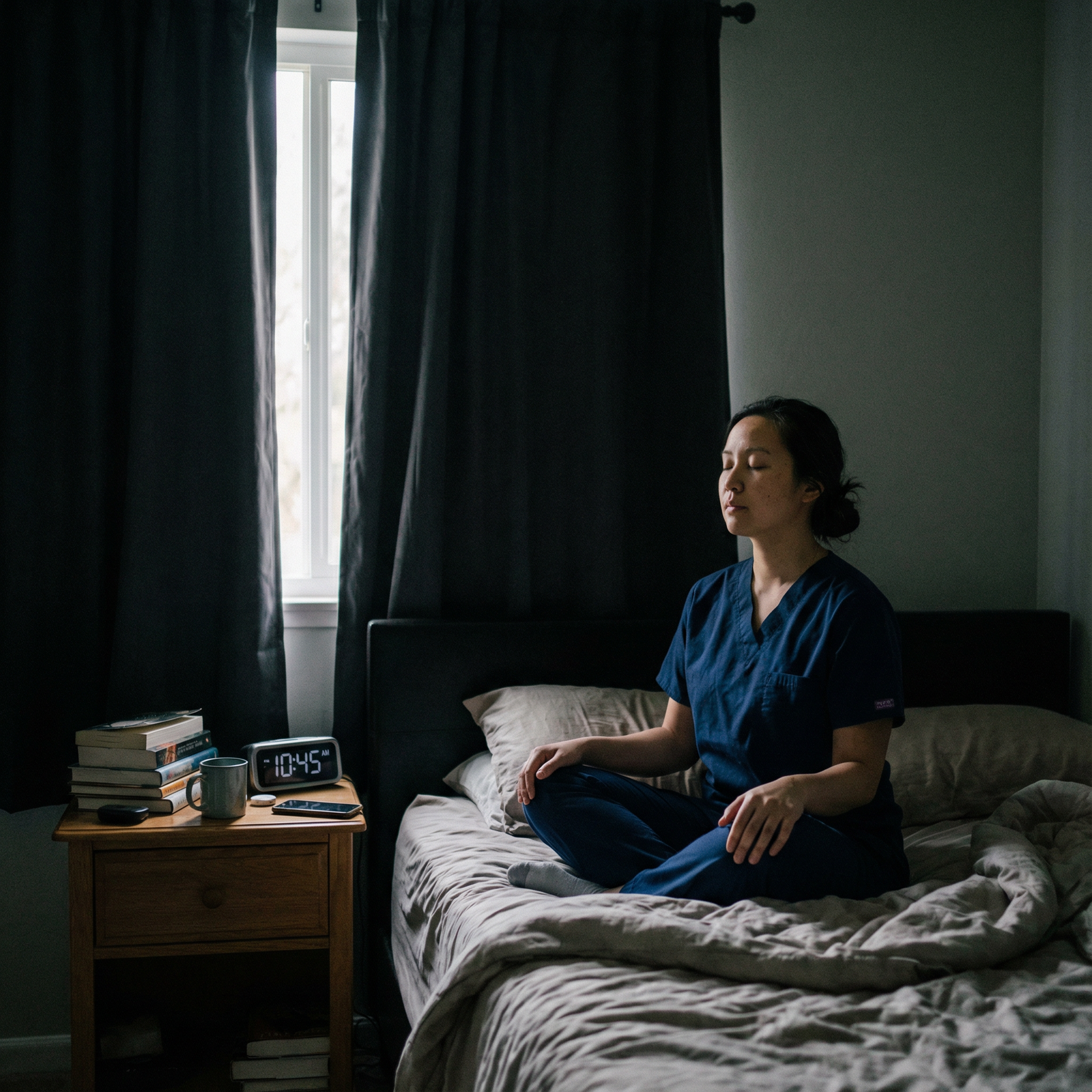
Night work is biologically hard. For many residents, adaptation stays incomplete, especially on short rotations or when days off yank them back into daylight. You can do everything "right" and still feel off. That is not a character flaw. It is not proof that you're weak, disorganized, or "bad at residency." It's proof that humans are not naturally designed to cheerfully preround at 3 a.m. under fluorescent lights and then sleep soundly at 10 a.m. while leaf blowers rage outside.
And yes, the performance concern is real. Reduced vigilance, slower thinking, driving drowsy after shift, near-miss errors. These are not dramatic fantasies. They're why this matters. Light can reduce risk. It cannot erase it.
That's why I think residents should use a harm-reduction mindset. Not perfection. Not "biohacking." Harm reduction.
If your plan gets you:
- fewer microsleeps
- better overnight alertness
- a more reliable chunk of daytime sleep
- fewer miserable commutes home
that counts. Those are meaningful wins. Big ones.
A safer, more realistic way to think about light therapy on night float
Here's the framework I trust most.
First, pick the goal. Are you trying to stay awake tonight, adapt over a longer block, or just survive three nights without self-destructing?
Then:
- Use bright light early in the shift if you need alertness support.
- Reduce light toward the end of the shift if post-shift sleep matters more than squeezing out a little extra wakefulness.
- Protect the commute home from bright morning light as much as you safely can.
- Make the bedroom dark, cool, quiet, and repeatable.
That's the core of it. Not fancy. Just effective.
Your real life matters more than idealized advice. Rotation length matters. Commute timing matters. Kids matter. Roommates matter. Baseline insomnia matters. Whether you need to switch back quickly on days off matters. A plan that works on paper but collapses by day two is not a good plan.
If fatigue is severe, if you're having near-miss driving episodes, or if daytime sleep is still impossible even when you've protected your schedule and environment, get help. That is exactly when sleep medicine or occupational health should enter the picture.
You do not need a perfect setup to survive night float. You need a plan that is safe, realistic, and repeatable. Start there. Adjust without panicking. And if it still feels hard, that doesn't mean you're failing. It means night float is hard. Which, honestly, is the most normal thing about it.