
You just walked out of the hospital at 8:05 AM after your third night float. Your brain is buzzing, your stomach is confused about whether it is breakfast or dinner, and you are doing mental math: “If I sleep now, I need to be back by 6:30 PM… how many hours can I get? And should I nap before going in, or crash right now and risk being wide awake at 3 AM?”
This is where people either survive night float or slowly disintegrate: how they handle short “anchor sleep” blocks. Not the ideal 8-hour stretches from sleep hygiene textbooks. The ugly, practical, 3–5 hour blocks you are forced into by hospital schedules and circadian biology.
Let me break this down specifically, from the perspective of a resident who does not control start times, end times, or how many times the pager goes off. You control one thing: how you structure your sleep around those shifts.
1. What “Anchor Sleep” Actually Means On Night Float
People toss around the term “anchor sleep” like it is self-explanatory. It is not. And many residents use it wrong.
Anchor sleep = a consistent block of sleep that “anchors” your circadian rhythm to a predictable schedule, even if your total sleep time is fragmented.
On night float, you almost never get textbook 7–9 hours in one block, especially:
- Post-call days with conferences or mandatory teaching
- Short turnarounds between nights
- Split stretches (e.g., 3 nights on, 1 off, 3 on)
- When you have a partner/kids/real life you are still trying to show up for
So instead, you build your schedule around a reliable core chunk. That is your anchor. Everything else (naps, strategic caffeine, light exposure) rotates around that.
For residents, anchor blocks usually fall into one of three patterns:
| Pattern | Typical Anchor Block | Common Use Case |
|---|---|---|
| Post-shift anchor | 9 AM–1 PM | Standard continuous nights |
| Pre-shift anchor | 12 PM–4 PM | Split nights, late-morning obligations |
| Split anchor | 9 AM–12 PM + 5–7 PM | Young kids, limited daytime sleep tolerance |
The trick is not “finding more sleep.” You rarely can. The trick is:
- Make one block consistent.
- Protect it viciously.
- Use naps and light strategically around it.
2. The Core Problem: You Are Fighting Two Systems At Once
You are fighting:
- Homeostatic sleep drive (how long you have been awake)
- Circadian rhythm (when your brain thinks “night” is)
On night float:
- You are awake all night when your circadian system wants you asleep.
- You try to sleep in the day when your circadian system wants you awake.
This is why “just sleep whenever you are tired” fails miserably. Your physiology is not neutral. It is actively sabotaging you.
Let me be explicit about the worst combo I see:
- Intern gets off at 8 AM.
- Drives home, scrolls phone, collapses at 10 AM.
- Wakes up at 1 PM “naturally” because circadian wake drive surges.
- Drinks coffee at 2 PM to function.
- Tries to “just nap a bit” 5–6 PM, either cannot fall asleep or wakes up groggy.
- Hits the ED at 2–4 AM like a zombie.
I have seen that cycle destroy people in less than a week. It is not about willpower. It is design failure.
You fix it by deciding which side you will lean towards:
- Commit more fully to a “night schedule” anchored in late morning / early afternoon sleep
- Or accept partial misalignment but protect a strict anchor window that repeats every day
3. Concrete Anchor Sleep Templates That Actually Work
Forget theory. Here are specific schedules I have seen residents successfully use. Adjust by an hour or two depending on your sign-out times and commute, but keep the structure.
Template A: Classic Post-Shift Anchor (Most Reliable)
Best for:
- Blocks of 3–7 consecutive nights
- Minimal daytime obligations (no kids’ school runs, few noon conferences)
- People who can sleep under bright ambient noise with blackout curtains
Structure (assuming shift ends 7–8 AM, start 7–8 PM):
8:30–9:00 AM:
- Home, very light snack if needed
- No screens unless with blue light filter / dimmed
- Room already set up: blackout curtains, white noise, 65–68°F if possible
9:00 AM–1:00 PM: ANCHOR SLEEP (non-negotiable)
- Aim for 3.5–4 hours minimum in a dark, cave-like room
- Phone on Do Not Disturb with exceptions only for true emergencies
1:00–1:30 PM: Wake, bright light exposure
- Open curtains fully or go outside for 10–20 minutes
- Hydrate, real food, caffeine OK here
1:30–5:00 PM: “Daytime Life” Block
- Errands, exercise, family time, reading, whatever
- Light caffeine allowed up to ~3–4 PM
5:00–6:00 PM: Optional top-up nap (30–90 minutes)
- Dark room again
- If you nap, set a hard wake time at least 2.5–3 hours before shift cognitive peak (usually around midnight–2 AM)
6:00–7:00 PM: Commute, pre-shift meal, bright white light exposure
- This helps push circadian rhythm slightly later
Why this works:
- Your body gets one predictable “this is night” window every day (9–1).
- You maintain some daytime functionality for life tasks.
- You avoid the mid-shift crash that happens when all your sleep was front-loaded and fragmented.
Template B: Pre-Shift Anchor for Busy Days
Best for:
- Programs that expect morning conference or mandatory teaching 8–11 AM
- Residents with school-aged kids
- People who cannot stay asleep past noon anyway
Structure (assuming same 7–8 PM start):
8:30–11:00 AM: Obligations / family / low-stakes tasks
- Light exposure, caffeine allowed
- Avoid heavy meals that will sedate you prematurely
11:30 AM–3:30 PM: ANCHOR SLEEP
- Dark, cool room, phone silenced
- This is your non-negotiable protected block
3:30–4:00 PM: Wake and bright light
- Step outside if at all possible
- First big meal now or slightly later
4:00–6:00 PM: Light activity, commute prep
- Caffeine allowed early in this window, stop ~5 PM
Short “bridge” nap option:
- If you are still absolutely exhausted at 6 PM, 20–25 minute “ultra-short nap” before driving, in a safe setting, can help.
- But do not extend past 30 minutes or you will get sleep inertia on the drive and into sign-out.
Why this works:
- You compress most of your sleep closer to your work period.
- You are more alert during the first half of the night, which is often the busiest.
- Morning obligations are front-loaded and done before your main sleep.
Template C: Split Anchor for People Who Cannot Sleep Long in Daylight
This is less ideal physiologically, but for some residents it is the only thing that is sustainable.
Best for:
- People who always wake up at noon no matter what
- Parents who must do morning school runs plus some evening presence
- Rotations with unpredictable late-afternoon demands
Structure:
- 9:00 AM–12:00 PM: First Anchor Block (3 hours)
- 12:00–5:00 PM: Awake, responsibilities, light, food, maybe a light workout
- 5:00–7:00 PM: Second Block (1.5–2 hours if you can actually fall asleep)
- Then shift 7 PM–8 AM
The physiologic benefit is weaker, but the psychological benefit (feeling less like a zombie, being present for family) is sometimes worth it. The key is consistency: keep those two windows stable across the whole block of nights.
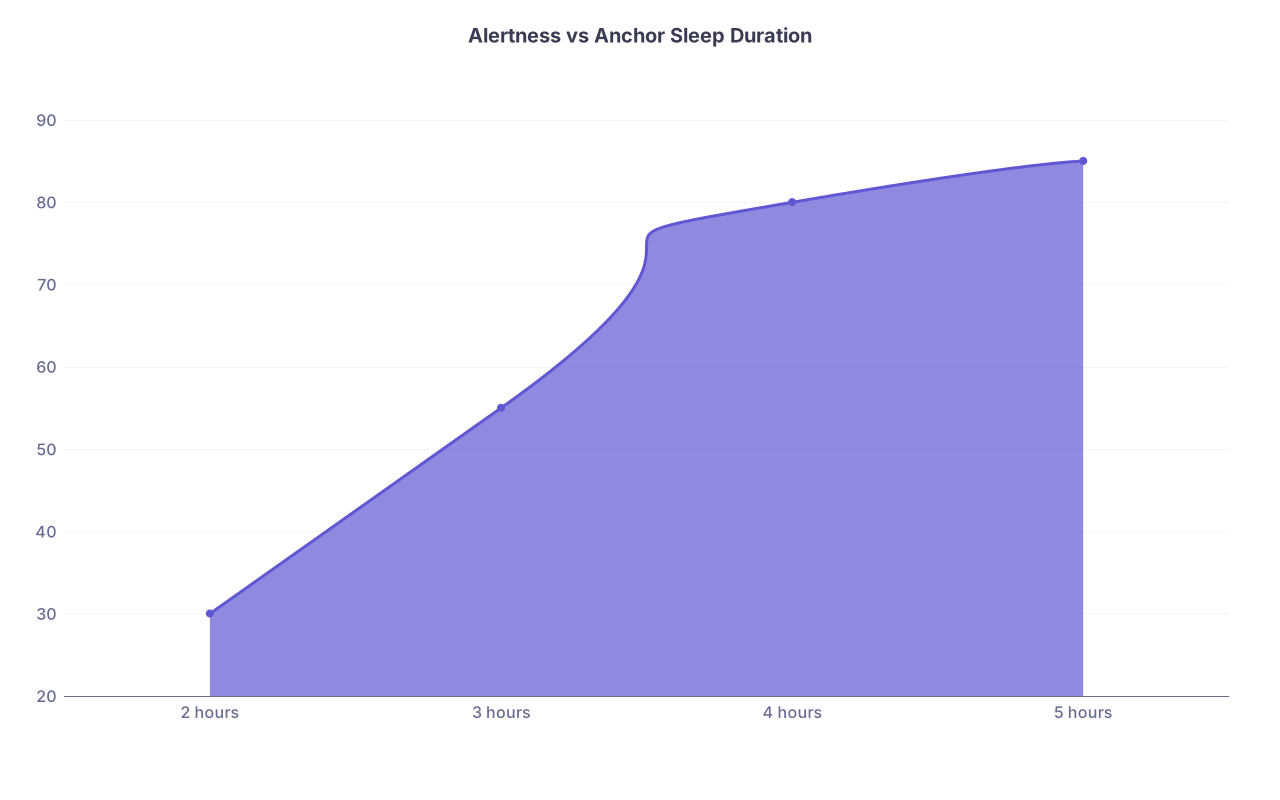
4. How Short Is Too Short For Anchor Sleep?
Let me be blunt. A 2-hour “anchor” is not an anchor. That is a nap.
You want at least:
- 3 hours minimum
- 3.5–4 hours preferred for the main anchor block
You can then top up with:
- A second 60–90 minute block later
- Or 1–2 power naps (10–25 minutes) at strategic times
| Category | Value |
|---|---|
| 2 hours | 30 |
| 3 hours | 55 |
| 4 hours | 80 |
| 5 hours | 85 |
That 4–5 hour range is usually the sweet spot: enough to hit slow-wave sleep, maybe a REM cycle or two, without wrecking your evening or killing all of your non-work life.
The mistake I see frequently:
- Resident decides, “I am going to get a full 7 hours right after shift, 9 AM–4 PM.”
- Wakes up at 2 PM wired and annoyed.
- Tosses for 2 hours, finally gets up at 4.
- Too alert to nap again before shift.
- Crashes at 3–4 AM in the ICU.
You are better off planning 4–5 hours and being pleasantly surprised if you roll over once and get an extra half hour, rather than insisting on 7 daytime hours that your circadian system will actively fight.
5. Exact Rules For Naps Around Anchor Sleep
You cannot just “nap when tired” and expect it to work. Here are the rules I give residents and actually see work in real life.
Daytime Naps (Before Night Shift)
Short naps (10–25 minutes):
- Use between 4–6 PM only if you are dangerously sleepy pre-shift or driving.
- These do not usually intrude much on later alertness.
Long naps (60–90 minutes):
- Use only if you did not get a proper anchor (e.g., your 9–1 got cut short to 9–11).
- Place them at least 3 hours before work start to allow sleep inertia to clear.
Do NOT:
- Nap for 2–3 hours starting at 4–5 PM. That is a direct grenade under your circadian rhythm. You will be wrecked around 2–4 AM.
In-Shift Naps
You will not always have this luxury, but if your night float allows a protected nap window:
- Ideal timing: ~2–4 AM for a 20–25 minute nap
- This targets the nadir of circadian alertness.
- Avoid 60–90 minute naps if you must get up and make critical decisions. Sleep inertia will punish you.
6. Light, Caffeine, and Melatonin: Use Them Like Tools, Not Snacks
Light
Here is the simple rule set:
- Bright light when you want to be awake and shift your rhythm later.
- Darkness when you want to consolidate sleep and keep it anchored.
On nights:
- Hospital overhead lights: fine. They help push your circadian clock later.
- Post-shift: wear sunglasses on the drive home if it is bright out. Helps your brain accept “this is still night.”
- At home pre-sleep: no bright white light, no sun flooding the bedroom. You want darkness starting 30 minutes before anchor sleep.
Mid-wake period (after anchor sleep):
- Get at least 10–20 minutes of bright light (outdoor or strong indoor lighting). This tells your circadian system, “this is your new pseudo-morning.”
Caffeine
Biggest mistake: drinking coffee after 2–3 AM “to make it through the shift,” then wondering why you cannot sleep at 9 AM.
Simple pattern that works:
- Front-load caffeine:
- First dose at start of shift
- Second dose around midnight–1 AM
- Hard stop: no caffeine after ~2 AM if planning a 9 AM sleep.
If you are using a pre-shift anchor (sleep 12–4 PM):
- Caffeine in the late morning is fine.
- A small dose at start of shift and another at midnight–1 AM still works. Same cutoff applies.
Melatonin
Melatonin is not a sedative. It is a timing signal. Most residents misuse it.
Use cases that actually make sense:
- You are flipping from days to nights and need to push your sleep window earlier (e.g., 7 PM–1 AM before first night).
- You cannot fall asleep post-shift because you are too wired.
Usage patterns:
- Dose: 0.5–3 mg is usually enough. Above that, side effects go up and benefit does not.
- Timing post-shift: 30–60 minutes before your anchor block. E.g., take at 8:15 AM, in bed by 9 AM.
- Do not use it at random times in the day. Keep it associated with the start of your anchor sleep attempt.
7. Start and End of Block: How to Flip Without Destroying Yourself
The transitions kill people more than the middle of night float. The first 1–2 nights and the first 2 days back on normal schedule.
Before You Start Night Float
If you know your schedule in advance, use a staged flip.
Two days before first night:

| Step | Description |
|---|---|
| Step 1 | Two days before |
| Step 2 | Sleep 1-2 hours later |
| Step 3 | Wake 1-2 hours later |
| Step 4 | Nap 4-6 PM for 60-90 minutes |
| Step 5 | Bed 1-2 AM |
| Step 6 | Day before first night |
| Step 7 | Sleep 3-4 AM to 11 AM if possible |
| Step 8 | Nap 5-7 PM if needed |
| Step 9 | Start first night |
This way, by the first night, you are not trying to stay up 24–30 hours straight.
If you get scheduled without warning (it happens):
- At least insert a 60–90 minute late afternoon nap (4–6 PM) before your first night.
- Accept that first night will be rough and treat safety (driving, procedures) as the top priority.
Coming Off Nights Back to Days
There are two sane options. The “hard reset” and the “glide path.”
Option 1: Hard reset (you have at least 2 days off)
- After your last night, go home and take a short nap 9–11 AM (no more than 3 hours).
- Force yourself up by noon.
- Light exposure, normal daytime activity, no naps after 3 PM.
- Go to bed 9–11 PM that night. It will feel like jet lag but you reset faster.
Option 2: Glide path (you have 1 day off or minimal buffer)
- After last night, sleep 9 AM–1 PM (full anchor).
- Stay up until 10–11 PM.
- Next day, push wake time earlier (8–9 AM) and normal schedule resumes.
What you do not do:
- Sleep 9 AM–4 PM after your last night, then wonder why you are awake until 3 AM and destroyed the following day.
8. Special Cases: Short Rotations, Fragmented Nights, and ICU-Level Chaos
Short Night Float Runs (1–3 Nights Only)
These are the worst from a circadian perspective. Your body cannot fully adapt. So the goal shifts: protect safety and performance; do not bother trying to fully switch your rhythm.
Strategy:
- Stick closer to your normal “day” schedule.
- Use extended morning sleep 9 AM–1 PM as needed, but do not push wake-up past ~2 PM.
- Go to bed earlier than usual the night before (10–11 PM) and include a substantial pre-shift nap (5–7 PM) before each night.
- After the last night, use the hard reset (short nap, then stay up).
You are basically running on partial, repeated jet lag. The key is structure and strict nap timing, not full circadian inversion.
Unpredictable High-Acuity Nights (ICU, Busy ED)
On some rotations, you cannot count on mid-shift breaks or calm periods. You must assume high cognitive load from 9 PM–7 AM.
Adjust:
- Give more weight to the pre-shift anchor rather than relying on “I will nap later if it is slow.”
- Protect that 3.5–4 hour block even more ruthlessly. You do not skip it to do life admin. You let things slide. Laundry can rot. Your brain cannot.
- Use a small, high-yield caffeine strategy: 100 mg at start, 100–200 mg at midnight–1 AM, cutoff afterward.
9. Real-Life Constraints: Families, Partners, and “Being a Human”
This is where ideal advice collides with reality.
You might be:
- The only one who can do preschool drop-off
- Sharing a one-bedroom apartment with a partner on days
- In a loud building, thin walls, daytime construction
So you do not get perfect alignment. Fine. You still get to optimize.
Concrete adjustments that actually help:
Protect just one room as a “sleep cave.”
- Blackout curtains or at least heavy blankets over windows
- White noise machine or loud fan
- Eye mask and earplugs as backup
Explicit agreements with roommates / partners:
- Anchor block = do not enter, do not talk, do not vacuum, do not start blender
- You trade this for being more present when you are awake
For young kids:
- Pick ONE of: morning time with them or evening pre-bedtime. Not both every day. Alternate.
- For example:
- Day 1: You do morning drop-off but keep anchor as pre-shift 12–4 PM
- Day 2: You skip morning but wake up early enough after 9–1 anchor to be present 4–6 PM before shift
Do not try to “be there for everything” and then act surprised that you are hallucinating on night 5. You are not just a parent/partner; you are the physician covering critically ill people at 3 AM. That matters too.
10. Putting It Together: Build Your Personal Anchor Plan
If you want this to actually work, you should not just vaguely “try to sleep more.” You need an explicit template for each rotation type.
Take a sheet of paper or your notes app and write:
- Rotation: “Medicine night float, 7 PM–8 AM, 6 nights in a row”
- My anchor window: “9 AM–1 PM, every day, no exceptions”
- My top-up window: “Optional 5–6 PM nap if exhausted”
- Caffeine rule: “Start of shift, midnight only, none after 2 AM”
- Light rule: “Sunglasses home, blackout bedroom, bright light 1–2 PM”
- Transition plan:
- Before rotation: “Night before first shift—nap 4–6 PM”
- After rotation: “Last day—sleep 9–12, then stay up, bed 10 PM”
You do not improvise this at 8:30 AM while half-delirious. You decide once, up front, and then run the play.
| Category | Value |
|---|---|
| Anchor Sleep | 95 |
| Caffeine Timing | 80 |
| Light Control | 75 |
| Naps | 70 |
| Supplements | 25 |
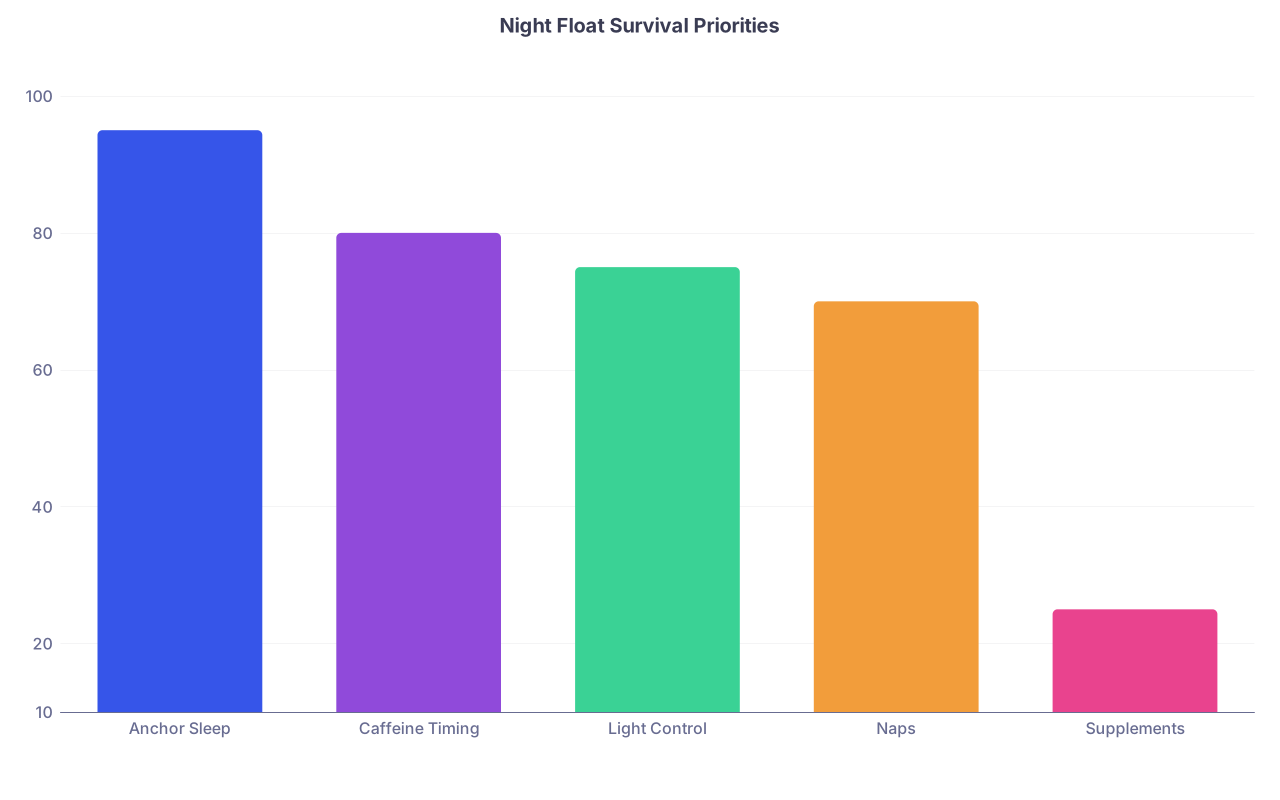
Supplements, fancy gadgets, all of that is marginal. Your anchor block, light, and caffeine strategy do most of the work.
FAQ (Exactly 4 Questions)
1. Is it better to get one 4-hour anchor or multiple 1–2 hour naps?
One 4-hour anchor wins almost every time. Short, scattered naps never give you the same depth or consolidation of slow-wave and REM sleep. Use naps as “patches” around a core 3.5–4 hour block, not as your primary sleep strategy.
2. What if I wake up after only 2–3 hours of my planned anchor and cannot fall back asleep?
Stay in low-stimulation mode for 15–20 minutes first: no bright screens, no overhead lights, minimal movement. If you are clearly fully awake, get up, get some bright light, and shift to a “split anchor” strategy: accept that you will run 2–3 hours now and plan a second 60–90 minute block later (e.g., 5–6:30 PM). Do not lie in bed for 2 hours fighting it.
3. Does taking melatonin every night on nights mess up my normal schedule later?
Not usually, if you keep doses low (0.5–3 mg) and tie them only to your anchor sleep window. When you flip back to days, stop it and let daytime light exposure do the rest. The residents who get into trouble are the ones taking high doses at random times, not those using it strategically post-shift.
4. How do I know if my anchor plan is actually working?
Two markers: your performance and your crash point. If you are consistently losing focus, making near-mistakes, or feel like your soul leaves your body at the same time every night (e.g., 3–4 AM), your anchor is mistimed or too short. Adjust by: moving the block closer to shift start (pre-shift anchor) or extending it by 30–60 minutes for a few days and reassessing.
Key points: set a specific, non-negotiable 3.5–4 hour anchor sleep window; use light and caffeine on a schedule, not instinct; and decide your transition strategy before and after the rotation instead of winging it when you are already exhausted.