

The belief that “more nights automatically make you better at rapid triage” is wrong. Repetition helps, but after a point, extra nights mostly make you sloppy, slower, and overconfident.
Let’s walk through what the data actually says, not what the loudest senior resident on nights swears is true at 3 a.m.
What “Rapid Triage Skill” Actually Is (And Isn’t)
People talk about triage like it’s a single muscle you strengthen just by “grinding nights.” That’s lazy thinking.
Rapid triage isn’t one thing. It’s a bundle of skills:
- Fast pattern recognition (who’s dying, who’s sick, who’s fine)
- Risk calibration (who looks okay but isn’t)
- Workflow and decision efficiency
- Communication under pressure
- Knowing when you’re out of your depth
That’s important because different parts of that bundle improve with practice at different rates and hit performance ceilings at different times.
There’s a clear pattern in the literature across EM, critical care, and acute care:
- Early exposure: Big, fast gains in speed and comfort.
- Moderate exposure: Gains level off; accuracy improves slowly.
- Heavy exposure with fatigue: Speed may stay high or even increase, but accuracy and safety dip, especially under sleep deprivation.
More nights alone don’t magically push you into “expert triage brain.” They push you into “faster but more error-prone unless your environment and schedule are sane.”
What The Data Actually Shows About Nights, Fatigue, and Decision-Making
No, this is not just about “feeling tired.” Sleep loss wrecks the exact cognitive functions triage depends on.
1. Sleep deprivation reliably slows reaction time and impairs judgment
Controlled sleep research is brutally consistent:
- Being awake for 17–19 hours produces performance equivalent to a blood alcohol level of about 0.05%.
- At 24 hours awake, you’re around 0.08–0.10% equivalent. That’s legally drunk in most countries.
This isn’t abstract. These are tasks that map pretty closely to what you do in triage: sustained attention, quick discrimination, response inhibition.
Now overlay that onto a typical night-float pattern: you start your shift already partially sleep-deprived, then stack multiple consecutive nights. There’s cumulative impairment over days. Your subjective sense of “I’m used to this” doesn’t track the objective decline. Residents consistently underestimate how impaired they are after multiple nights.
2. Fatigue increases diagnostic error and near-miss events
In emergency medicine and inpatient care:
- Fatigued clinicians have higher rates of diagnostic error and more “missed” abnormalities, especially subtle ones.
- They’re more likely to settle on the first plausible diagnosis (premature closure) and less likely to reconsider when new information appears.
Rapid triage is exactly where premature closure is deadly: labeling the crashing cardiogenic shock patient as “anxiety,” or the septic old lady as “UTI, stable” and parking her in the hallway.
Multiple observational studies in EDs show error and adverse event rates creeping up in the early morning hours. No surprise. That’s when your circadian drive is at its lowest, not when your “triage skill” is at its highest.
Experience vs Exposure: The Real Learning Curve
Now for the pushback you’re probably thinking:
“But I felt way better at triage mid-intern year than month one. And that came from nights.”
Yes. Early experience matters. The confusion comes from mixing up initial learning with indefinite benefit.
What improves with nights (at first)
The learning curve is steep at the beginning. With a decent volume of night work, most interns:
- Get faster at basic acuity sort: who needs a room now vs can wait.
- Develop pattern recognition: STEMI, GI bleed, septic shock, toxidromes.
- Learn local workflows: where to send what, who to call, which nurse will tell you if you’re being dumb.
You absolutely need repetitions to do this. Nobody gets sharp at triage doing only daytime case conferences and simulation.
But the key is this: those gains mostly come from varied, feedback-rich experience, not raw hours of being awake at 2 a.m.
If you see 100 short-of-breath patients with good supervision, debriefs, and feedback on who crashed, you’ll improve. If you see 100 short-of-breath patients in a poorly staffed night shift with no follow-up beyond your end-of-shift signout, your “learning” is mostly vibes and anecdotes.
Where extra nights stop helping
Skill acquisition research (in medicine and outside) shows a broader pattern:
- Performance improves quickly early on.
- Then reaches a plateau where extra unstructured repetition adds almost nothing.
- Without targeted feedback, you just groove your current habits—good or bad.
That’s exactly what I’ve seen watching junior residents over a year of nights. Around 2–3 months of consistent acute care exposure, their triage speed stabilizes. Their gestalt for “this one is bad” gets decent. Beyond that, their improvement depends far more on:
- Quality of teaching
- Feedback about missed deteriorations
- Protected rest and sane scheduling
- Structured reflection (“which triage decisions last night were borderline?”)
Not on raw “night count.”
The Overconfidence Trap: When More Nights Make You Worse
There’s a nasty psychological twist here: the more nights you survive, the more confident you feel. But confidence is a terrible proxy for accuracy under fatigue.
In multiple cognitive performance studies:
- Sleep-deprived subjects rate their performance as “fine” or “slightly off”.
- Objective measurements show substantial drops in accuracy and reaction time.
- Their self-assessment impairment is worse than their actual task performance impairment. Meaning: the more tired they are, the worse they are at judging how bad they are.
Sound familiar?
This is the PGY-2 at 4 a.m. casually triaging the borderline hypotensive GI bleed as “can probably go to the floor” because they’ve done “a million of these.” They have more pattern recognition, sure. They also have more shortcuts and more misplaced trust in their own instincts.
More nights without structured correction and without protected recovery time don’t just plateau your learning—they can regress it, by reinforcing:
- Overconfidence in pattern-matching (“all belly pain at night is constipation until proven otherwise”)
- Under-reaction to atypical presentations
- Tolerance for sloppy process (“we’ll see how they look in a couple hours” when you’re too tired to recheck)
Volume vs Quality: Why Some People Get Sharp Faster
Here’s the uncomfortable truth: two residents can work the same number of nights and have very different triage skills a year later.
Because it’s not the sheer number of shifts that matters. It’s how those shifts are structured and what happens during and after them.
The residents who actually get good at rapid triage tend to have:
Moderate but consistent acute care exposure
Not endless blocks of 14-in-a-row nights, but recurring contact with sick patients across settings—ED, ICU admits, cross-cover, codes.Feedback loops
They look up what happened to the “stable COPD” they parked in the hallway. They ask, “Did that guy I triaged as low-risk chest pain come back with a STEMI?” They review cases with attendings.Protected cognitive bandwidth
Programs that cap shift length, limit consecutive nights, and enforce days off allow your brain to consolidate learning and adapt. Chronic sleep debt kills that consolidation.
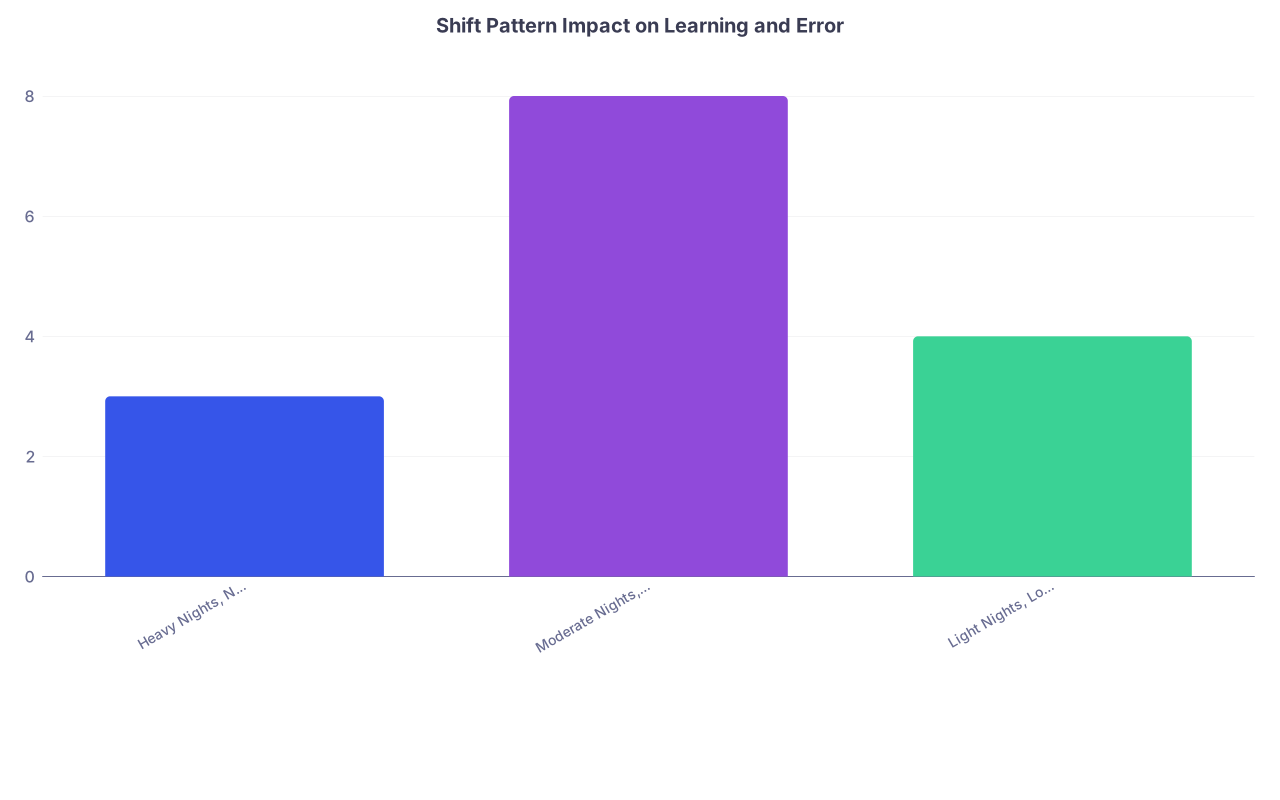
| Category | Value |
|---|---|
| Heavy Nights, No Feedback | 3 |
| Moderate Nights, Good Feedback | 8 |
| Light Nights, Low Volume | 4 |
If you want to turn nights into triage skill, you need repetition plus these conditions. Take away feedback and rest, and extra nights become just that: extra nights.
The Myth of “Callus Building”: Resident Exploitation Disguised as Training
You will hear this at some point:
“You need to do lots of nights to build callus. That’s how you toughen up and get sharp.”
No. That’s how you normalize unsafe systems and misuse cheap resident labor.
The “callus” metaphor is seductive because it makes suffering sound like growth. In reality:
- You do not build better judgment by consistently functioning at the equivalent of legal intoxication.
- You do not improve pattern recognition when your hippocampus (which needs proper sleep for memory consolidation) is repeatedly shortchanged.
- You do not learn to triage better in an environment where errors are common, untracked, and brushed off as “part of the grind.”
I’ve watched residents on manageable night schedules with real feedback leapfrog peers doing brutal call patterns. Same number of months. Fewer heroic survival stories. Much better triage instincts.
What Actually Makes You Better at Rapid Triage
Strip away the mythology and you’re left with a boring answer: smart structure beats raw volume.
1. Deliberate practice beats passive repetition
You get more out of 6 well-run, feedback-rich night shifts than 12 chaotic, undersupervised ones. So when you’re on nights:
- Flag 2–3 tricky triage decisions each shift.
- Follow those patients: what happened at 6, 12, 24 hours?
- Ask your attending or senior: “Would you have triaged that differently? Why?”
That’s deliberate practice. It turns random exposure into sharpened instinct.
2. Simulation plus real-world nights is better than nights alone
Good programs use simulation for mass casualty, cardiac arrest, and multi-patient triage. Residents who get both:
- Sim + real nights
- Feedback + rest
…end up noticeably stronger in actual chaotic shifts. Because they’ve rehearsed failure in a low-stakes environment, then tested it under real pressure.

| Step | Description |
|---|---|
| Step 1 | Initial Exposure |
| Step 2 | Moderate Night Shifts |
| Step 3 | Simulation and Drills |
| Step 4 | Feedback on Real Cases |
| Step 5 | Protected Rest and Recovery |
| Step 6 | Improved Rapid Triage Skill |
3. Sleep and schedule sanity are performance tools, not luxuries
Pretending you can “hack” sleep is childish. The data is clear: sleep-deprived brains are worse triage tools.
The residents who quietly protect their sleep—dark room, consistent pre-night nap routine, caffeine used strategically, real days off—do not become “soft.” They become accurate. Reliable. Still sharp at 5 a.m.
A Reality Check: When More Nights Actually Do Help
There is one narrow sense in which more nights help: exposure to rare but critical patterns.
You’re more likely to recognize:
- The subtle meningitis
- The high-risk-but-vaguely-sick postpartum woman
- The aortic catastrophe in “back pain”
…if you’ve seen them once before. Nights give you more at-bats for the weird and ugly.
But here’s the twist. You don’t need endless nights for that. You need:
- A baseline of varied acute care exposure, and
- The humility to log those rare cases in your mental library and revisit them (read the note, see the final diagnosis, talk about it on rounds).
Once again, the learning comes from pattern recognition plus reflection. Not from how many circadian cycles you’re forced to abuse.
How Programs and Residents Should Actually Think About Nights
If you’re in a position to influence schedules or at least argue for yourself, frame it like this:
| Schedule Pattern | Learning Quality | Error Risk |
|---|---|---|
| 6–7 nights in a row, q3–4 | Low | High |
| 3–4 nights, then real off | High | Moderate |
| Mixed days/nights same wk | Chaotic | High |
| Regular ED nights + sim | High | Moderate |
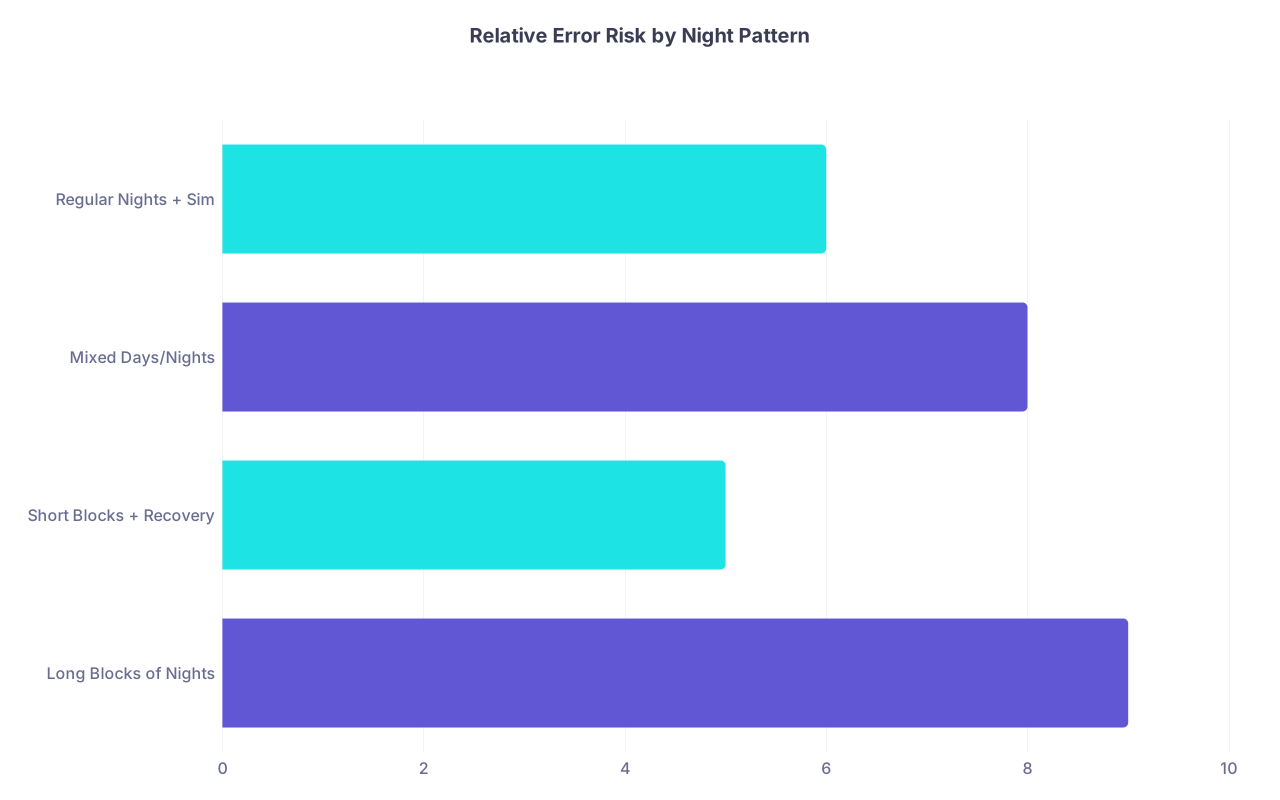
| Category | Value |
|---|---|
| Long Blocks of Nights | 9 |
| Short Blocks + Recovery | 5 |
| Mixed Days/Nights | 8 |
| Regular Nights + Sim | 6 |
Push for structures that:
- Give you consistent acute care exposure
- Limit extreme sleep debt
- Build in case review and feedback
If your program leadership starts hand-waving with “Well, we did it this way and we turned out fine,” remember: survivorship bias isn’t a curriculum.
Visualizing the Learning Curve vs Fatigue
To make the point explicit:
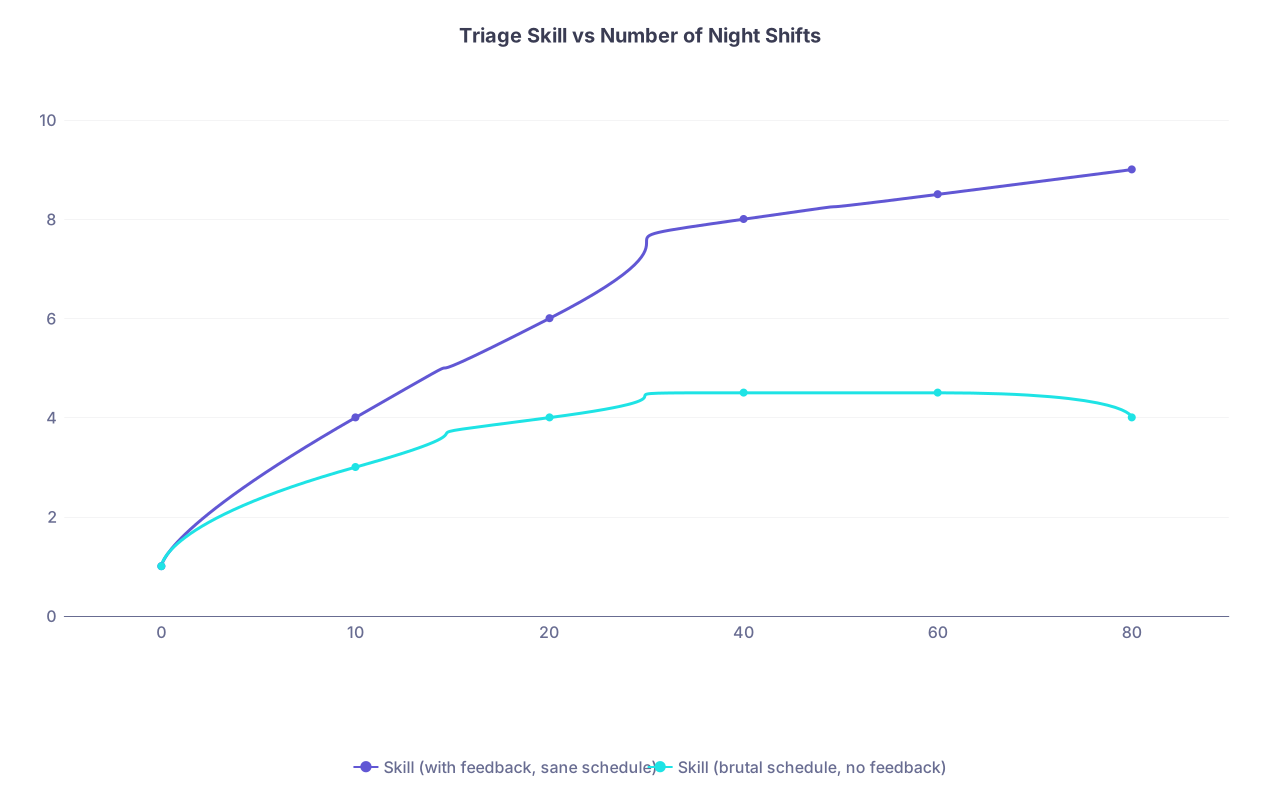
| Category | Skill (with feedback, sane schedule) | Skill (brutal schedule, no feedback) |
|---|---|---|
| 0 | 1 | 1 |
| 10 | 4 | 3 |
| 20 | 6 | 4 |
| 40 | 8 | 4.5 |
| 60 | 8.5 | 4.5 |
| 80 | 9 | 4 |
One curve climbs and then flattens high. The other climbs a bit, stalls, then erodes. Same nights. Different system.
The Bottom Line
Working nights is necessary for triage skill. But more nights, by themselves, don’t magically make you better. Here’s what actually holds up:
- Initial night exposure improves your comfort and speed; after that, extra nights without feedback or rest mostly add fatigue and error, not expertise.
- Real triage skill comes from deliberate practice—case follow-up, feedback, and simulation—layered onto moderate night exposure and protected sleep, not from “toughing it out.”
- The “more nights = better triage” mantra is mostly resident exploitation dressed up as training; smart scheduling and structured learning beat sheer grind every time.


