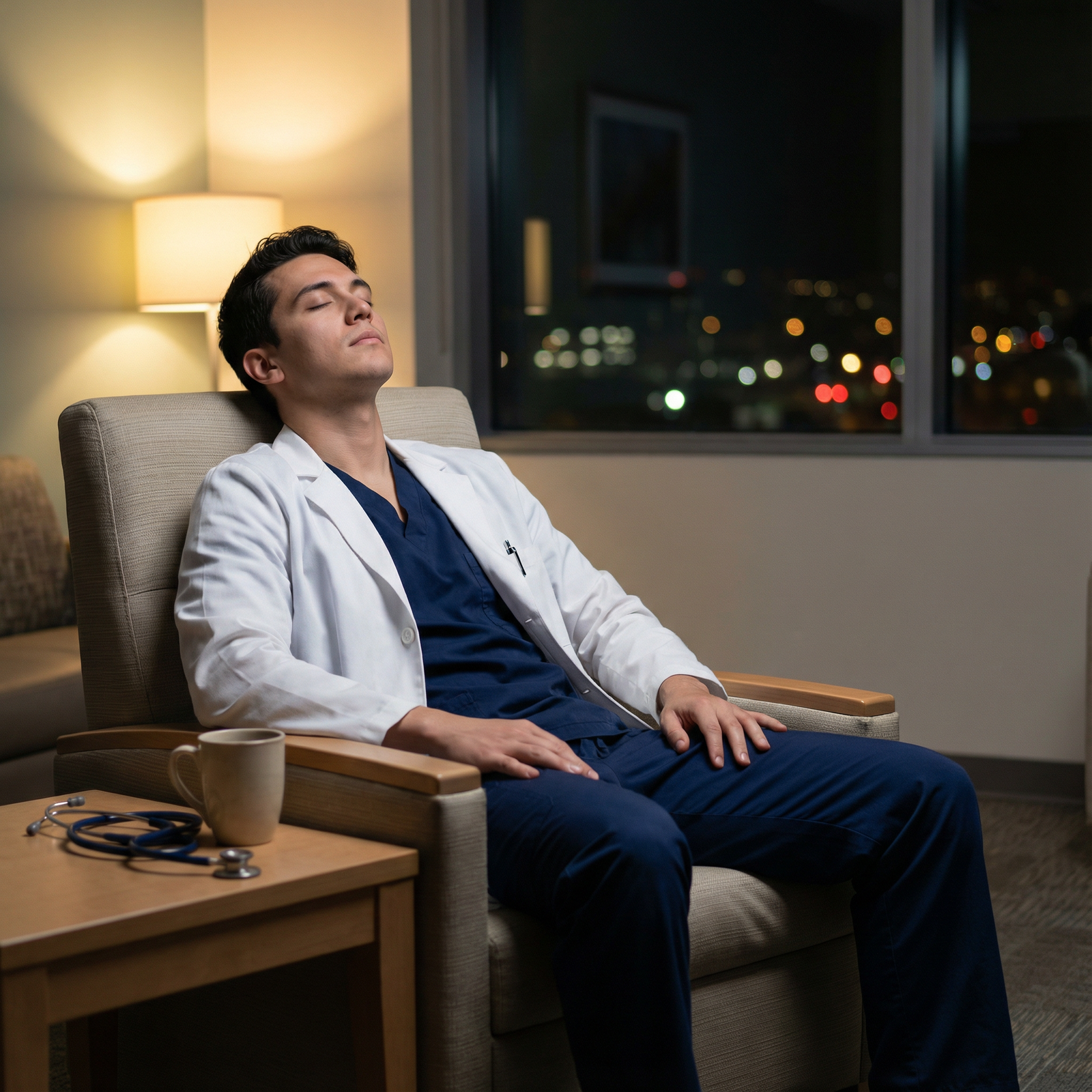
The belief that you “get used to” night shift is mostly wrong.
You get used to being tired. You do not truly adapt—biologically—to living at night. And the circadian data on residents, nurses, and night workers is brutally clear about that.
Let’s pull this out of the realm of vibes and into physiology. Because what your co-resident calls “I’m totally fine on nights now” is often just chronic sleep debt in a white coat.
The Myth: “After a Week or Two, Your Body Adjusts”
You’ve heard the script:
- “The first few nights are rough, but then you adjust.”
- “By my second week of nights I was basically nocturnal.”
- “Your body learns to like 3 AM.”
No, it does not.
Your subjective sense of coping improves. Your objective circadian biology barely budges, especially in the hospital reality of rotating schedules.
Here’s the core problem: full circadian adaptation to a night schedule requires:
- A stable night schedule (same sleep-wake timing every day, including “days off”).
- Controlled light exposure (bright light at night, minimal light in the morning).
- Enough sleep opportunity (7–9 hours in one unbroken block).
Residency gives you precisely none of those.
You get flipped back to days every few days or weeks, blasted with overhead lights at all the wrong times, and “protected sleep” that still ends when someone texts you about sign-out.
So your brain does the only thing it can: it runs in a permanent state of circadian misalignment—what researchers bluntly call social jet lag.
What Circadian Data Actually Shows
Let’s talk physiology, not folklore.
Your body has three major circadian outputs that we can easily measure:
- Melatonin onset (DLMO – dim light melatonin onset)
- Core body temperature rhythm
- Performance / alertness variation across 24 hours
In real studies of night workers and rotating residents, these markers almost never fully shift to a true “night active, day sleeping” pattern. They do this instead:
- Shift partially.
- Or don’t shift at all.
- Or oscillate somewhere in between as your schedule bounces.
So you feel a bit better than on night 1, but you’re still biologically “day-active” while trying to do critical work at 3 AM.
Here’s a simple comparison to anchor this.
| Aspect | What Residents Report | What Physiology Shows |
|---|---|---|
| Feeling on night 1–2 | Exhausted, wired, irritable | No circadian shift yet |
| Feeling after ~5–7 nights | “Getting used to it” | Small, partial phase delay at best |
| Core temp / melatonin phase | “I’m nocturnal now” | Still mostly day-oriented |
| Performance at 3–5 AM | “I’m okay” | Objectively impaired vs daytime |
Study after study on residents, nurses, and industrial night workers shows the same basic pattern: subjective adaptation outpaces biological adaptation.
You think you’re fine long before your circadian system is even close to aligned.
So How Much Can You Actually Adapt?
You can adapt—partially. Under specific conditions. Which residency almost never respects.
Let me be concrete.
In controlled lab or well-designed field studies, if you:
- Work consistent nights (not flipping back and forth).
- Use bright light (2,000–10,000 lux) during the night.
- Block morning light (dark glasses on commute, blackout curtains at home).
- Sleep late morning to afternoon consistently.
…you can shift your melatonin and temp rhythm by roughly 1–2 hours per day, gaining a partial night-oriented rhythm in around a week.
But:
- Shift workers in the wild often show only 20–60% phase shift.
- Many never shift at all and stay on a “compromise” schedule: half-aligned with days, half with nights. That’s the worst of both.
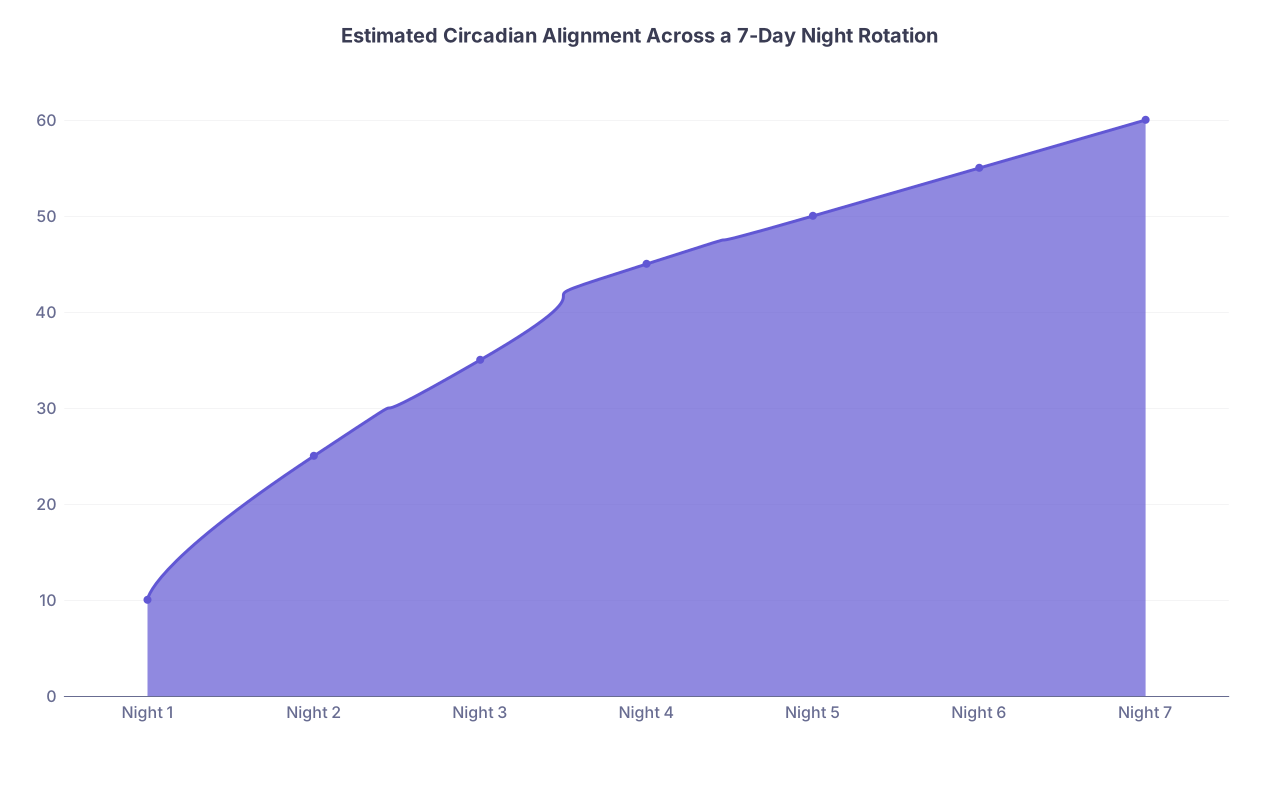
Here’s a simplified picture of what actually happens in rotating residents.
| Category | Value |
|---|---|
| Night 1 | 10 |
| Night 2 | 25 |
| Night 3 | 35 |
| Night 4 | 45 |
| Night 5 | 50 |
| Night 6 | 55 |
| Night 7 | 60 |
That “alignment” score is conceptual: 0 = totally on a day schedule, 100 = fully night-adapted. Most residents never get past 50–60 on that scale before they’re flipped back to days or have a random 24-hour call that nukes whatever adaptation they had.
So no, you don’t “become a night person” in a week. You become a partially shifted, chronically sleep-deprived person who feels more normal because your brain is good at normalizing dysfunction.
Misleading Signal: Why You Feel Adapted When You’re Not
There are three big illusions that trick people into thinking they’ve adapted:
1. You Compare to Your Own Worst Self
Night 1–2 is a disaster. You’re sleepy, irritable, your GI tract hates you, you misplace your stethoscope three times.
By night 5, you’re marginally less miserable. So your brain thinks, “See? I adapted.”
No, you just moved from catastrophic to chronically impaired. Same way people “adapt” to living with 4 hours of sleep. They stop noticing how bad they are.
2. Sleep Inertia Masquerades as “I’m Not a Morning Person”
You wake up at 4 PM after a fragmented 6-hour daytime sleep. You feel groggy, heavy, out of it for 30–60 minutes.
You interpret that as, “Wow, I really am nocturnal now, I suck at days.”
What’s actually happening: your brain’s circadian timing is still closer to “day-active,” but your sleep architecture is trashed, and you’re living in perpetual sleep inertia.
3. You Mistake Adrenaline for Alertness
ICU code at 3 AM. Trauma roll-in after midnight. NICU intubation at 4:30.
You feel sharp. Locked in. Awake.
That alertness is acute stress response, not circadian alignment. Put that same brain on a quiet night with no codes and ask it to read a CT at 4 AM, and you’ll find out very fast how “adapted” you are.
The Dangerous Window: 2–6 AM
Data from driving, anesthesia, ICU work, and industrial accidents all converge on the same thing: biological night—roughly 2–6 AM local time—is when you’re objectively worst.
Reaction time, vigilance, decision accuracy, error rates, and near-miss events all spike there.
You can subjectively feel “okay” after a week of nights and still show:
- Slower reaction times
- More lapses on sustained attention tasks
- More micro-sleeps with monotonous stimuli (charting, telemetry review, long drives home)
That’s not a hypothetical. I’ve seen residents confidently say, “I’m good to drive,” then have no memory of the last 10 minutes of the highway, because their brain simply blacked out in 3-second chunks.
If you “adapted,” that wouldn’t happen.
Why Residents Almost Never Fully Adapt
Let’s pin this down on structural factors. This isn’t a willpower problem. It’s a systems problem.
1. Rotating Blocks Prevent True Realignment
A classic month on a medicine service might look like:
- 7 days of nights
- Flip back to days after 1–2 days “off”
- Then random 24-hour calls embedded in the schedule
Your circadian system needs stability. The rotation model gives you chaos. So your brain sits in no-man’s land—never fully day, never fully night.

| Step | Description |
|---|---|
| Step 1 | Pre rotation days |
| Step 2 | Start nights |
| Step 3 | Night 1-3 - severe misalignment |
| Step 4 | Night 4-7 - partial adaptation |
| Step 5 | Post nights days off |
| Step 6 | Return to day shifts |
| Step 7 | Embedded 24h call |
| Step 8 | Chronic circadian disruption |
That “partial adaptation” window is a physiological compromise your brain pays for from both ends.
2. Light Environment in Hospitals Is Backwards
To truly shift to nights, you’d want:
- Very bright light during the shift (especially early in the night).
- Very dim light on the commute home and in your “morning” (which is actual morning outside).
What do you get instead?
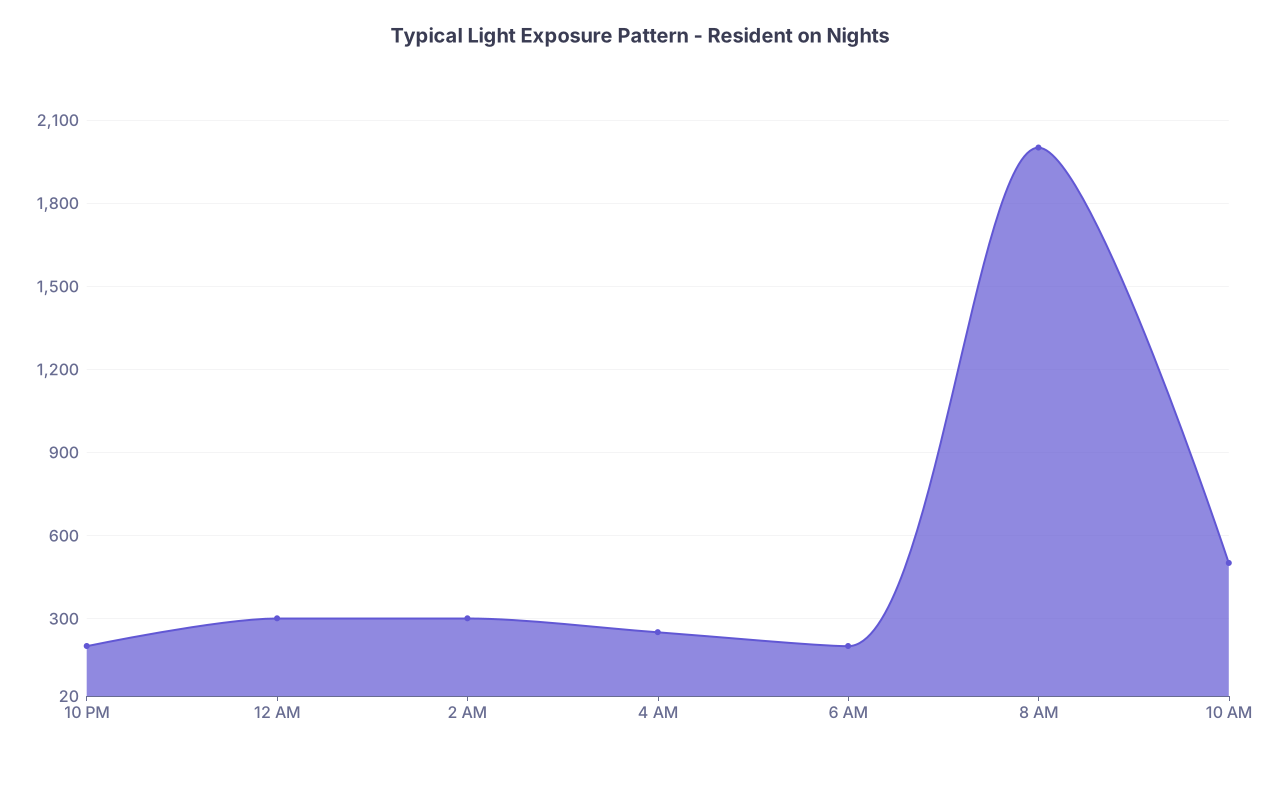
- Dim, crappy hospital lighting at 2 AM that’s nowhere near bright enough to strongly shift circadian phase.
- Full blast daylight hitting you at 7–8 AM on your drive home.
- No protection from morning light, which tells your brain, “Daytime again!”
Result: you nudge your clock a bit later, then slam it with a massive “daytime” cue at exactly the wrong moment.
| Category | Value |
|---|---|
| 10 PM | 200 |
| 12 AM | 300 |
| 2 AM | 300 |
| 4 AM | 250 |
| 6 AM | 200 |
| 8 AM | 2000 |
| 10 AM | 500 |
Those values are rough lux estimates. You want 1,000–2,000 lux inside at night and <50 lux exposure going home. What you have is the opposite.
3. You Don’t (and Often Can’t) Sleep Enough
Real residents’ “night shift sleep” looks like this:
- Get home at 8:30–9:00 AM.
- Finally asleep by 10:00–11:00 AM (after food, shower, phone, maybe chores).
- Awake by 3:00–4:00 PM because of pages, noise, sunlight, or family obligations.
That’s 4–6 hours on a good day. Fragmented. In the wrong circadian phase.
Chronic partial sleep deprivation blunts your ability to adapt. The brain that’s constantly underwater can’t easily shift gears.
So your adaptation is capped before it even starts.
What You Can Realistically Aim For
Let me be blunt: full circadian adaptation on residency-style rotating nights is fantasy.
Your goal is not perfection. Your goal is damage control.
There are three realistic targets:
- Reduce circadian misalignment on nights
- Avoid extra self-inflicted hits
- Protect critical windows (2–6 AM and post-shift drive)
You’re not going to become a nocturnal superhero. You’re going to become someone who survives nights with less collateral damage to your brain, heart, and decision-making.
Target 1: Partial, Not Total, Night Adaptation
For a 5–7 night block, think in terms of a compromise schedule:
- Push your “daytime sleep” as late as feasible (e.g., 9 AM–3 PM instead of 7 AM–1 PM).
- Use strong light the first half of your shift (midnight–3 AM), even if it’s just a bright lamp at the workstation.
- Minimize morning light with dark sunglasses on the commute and blackout curtains at home.
You won’t flip fully to nights. But you may shift enough that 2–5 AM isn’t pure neurological hell.
Target 2: Stop Fighting Your Own Biology on “Days Off”
Common resident mistake: you come off a string of nights and try to immediately live a normal day schedule on your first “off” day. Full flip in 24 hours.
That destroys whatever partial adaptation you had, then you go back to nights and re-suffer nights 1–2 all over again.
For short runs of nights (≤7 days), a smarter pattern is:
- Keep your wake time late on your “post-night” off day.
- Don’t schedule early morning obligations.
- Shift back gradually, not in one day.
You won’t be perfectly synced for brunch with your day-shift friends. Accept that. Choose less circadian chaos over pleasing everyone.
Target 3: Treat 2–6 AM and the Drive Home as High-Risk Zones
This is where good residents quietly differ from reckless ones.
Between 2–6 AM:
- Don’t schedule elective complex tasks there if you have flexibility.
- Double-check orders, doses, and handoffs more aggressively.
- Use micro-countermeasures: brief walking, bright light exposure, standing to chart.
On the drive home:
- If you’re truly nodding off, napping in your car for 15–20 minutes is safer than white-knuckling it home.
- Caffeine before you leave, not halfway through the drive when it’s too late.
- Windows down and music up are not solutions. They’re warning signs.
The Long Game: Health and Burnout
One more uncomfortable truth: chronic circadian misalignment is not just about feeling tired.
Long-term night and rotating shift work is linked (in decent-quality epidemiologic data) to:
- Increased cardiovascular risk
- Higher rates of metabolic syndrome and diabetes
- Mood disorders, especially depression
- Higher rates of certain cancers in long-term night workers (data is stronger in nurses and industrial workers than residents, but the biology is similar)
Will a few years of residency nights ruin your health? Not automatically. But pretending you “adapt” and everything’s fine is the wrong strategy.
You’re playing health Jenga. Every extra block of sleep deprivation, circadian chaos, and self-neglect raises the tower.
What “Adaptation” Really Means For You
So let’s rewrite the resident mythology into something more honest.
- You will feel less horrible after several nights on.
- Your brain will normalize the misery.
- You will not become truly nocturnal in a rotating system.
- Your risk of errors and burnout stays elevated even when you “feel adapted.”
You are not weak for struggling on nights. You’re colliding with hardwired human biology in a system designed around ignoring it.
You are also not special if you think nights “don’t affect you.” The lab data says they do. Your performance and physiology are degraded. You’ve just stopped noticing, or you’ve never tested yourself at full-rest baseline.
Key Takeaways
You do not “fully adapt” to night shift in residency-style rotating schedules; at best you achieve partial, unstable circadian alignment while staying chronically sleep-deprived.
Feeling “used to nights” is mostly subjective normalization, not objective recovery of performance—your worst cognitive window (2–6 AM) remains dangerous even when you think you’re fine.
The realistic goal is not becoming nocturnal; it’s strategic damage control: partial phase shifting, consistent light/sleep tactics, and defensive habits around high-risk times and post-shift driving.