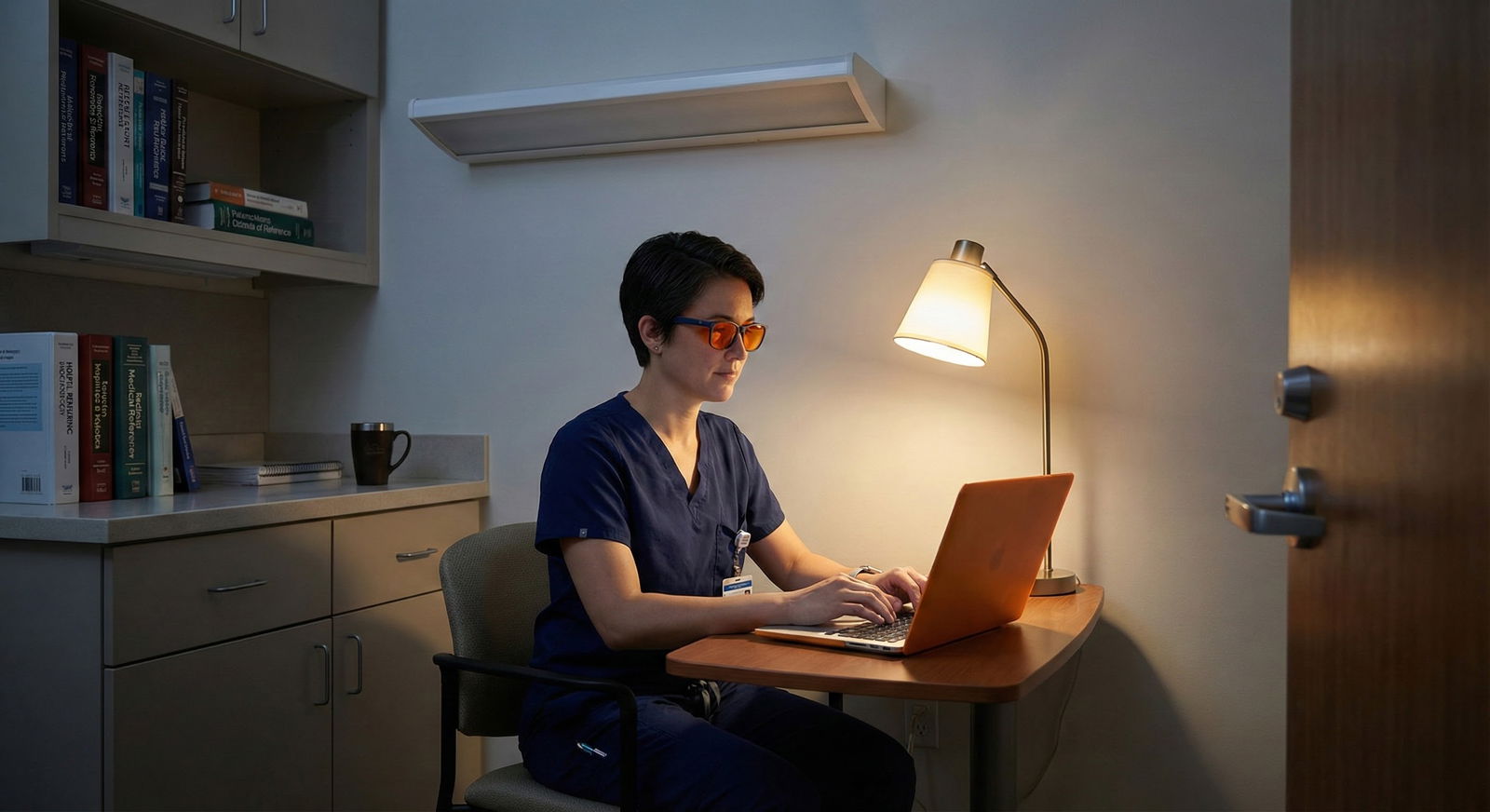
27% of resident physicians report using energy drinks on night shifts, but those who rely on them sleep worse and feel more fatigued the next day than colleagues who use plain caffeine or nothing at all.
That’s the problem in one sentence. What people reach for to “stay awake” often wrecks their alertness later, worsens sleep, and makes the second half of a string of nights miserable.
Let’s cut through the usual nonsense: “Just drink coffee,” “Energy drinks are poison,” “You can power through with grit.” Most of that is either incomplete, wrong, or based on vibes, not data.
You’re asking the right question: Caffeine, energy drinks, or nothing? What actually keeps you awake safely on nights?
What the Data Actually Says About Caffeine
If caffeine were invented today and submitted to the FDA, it would be marketed as a fatigue-countermeasure drug. Because that’s what it is. And there’s a decent amount of controlled data behind it.
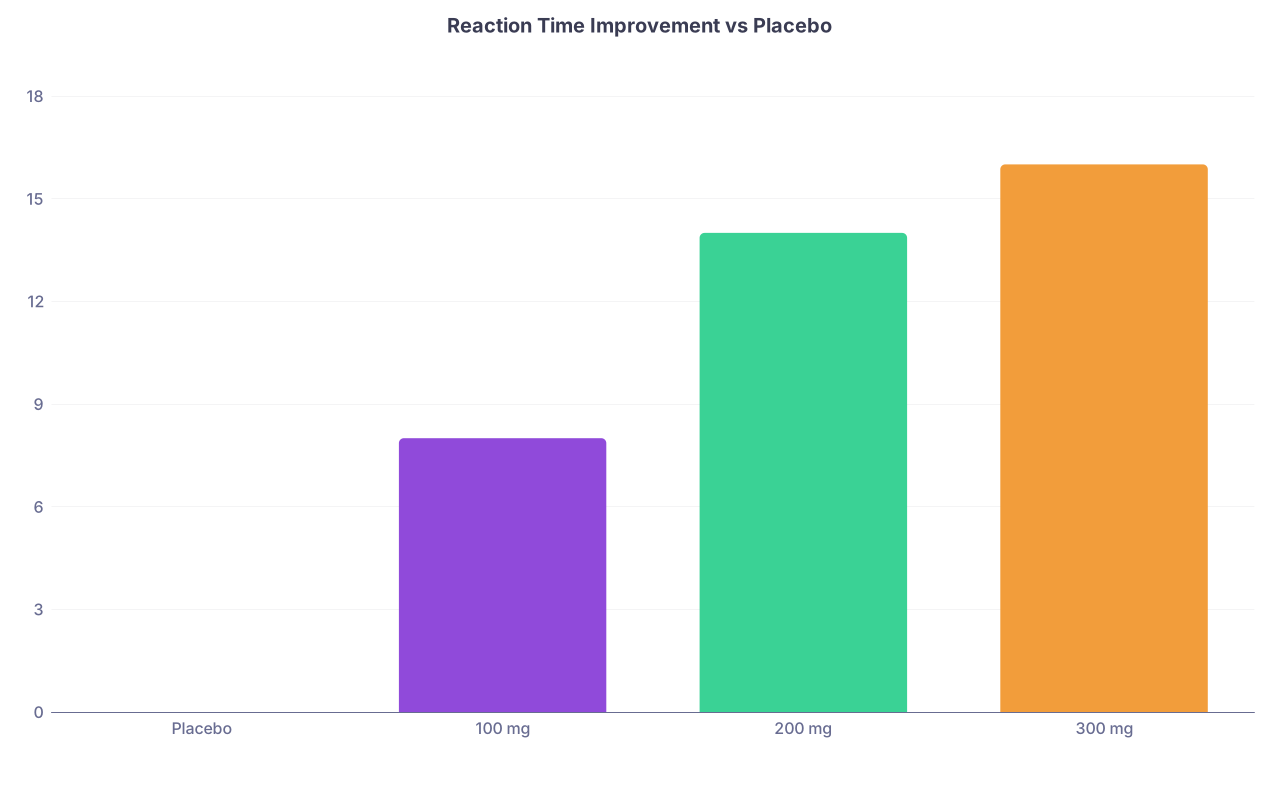
| Category | Value |
|---|---|
| Placebo | 0 |
| 100 mg | 8 |
| 200 mg | 14 |
| 300 mg | 16 |
Those numbers are ballpark percentage improvements in reaction time and vigilance from lab studies with sleep-deprived subjects. Not mythical. Real EEGs, Psychomotor Vigilance Tasks (PVT), simulated driving.
Here’s what consistent research shows:
- Doses of 100–200 mg caffeine (roughly 1–2 small coffees or a strong tea) improve vigilance, reaction time, and reduce lapses in sleep-deprived people.
- Going much above 300–400 mg at once gives diminishing returns and more side effects: jitteriness, anxiety, palpitations, GI upset.
- Caffeine taken within ~6 hours of planned sleep measurably worsens sleep latency and sleep quality, even if you “don’t feel it.” People routinely underestimate this.
The classic sleep study from Drake et al. had people take 400 mg caffeine at 0, 3, or 6 hours before bedtime. All three conditions degraded sleep. Even 6 hours before. Subjectively, people thought they were fine. Objectively, their sleep was objectively trashed.
So what does that mean for night float or a 7-on block?
If you’re doing a 7p–7a shift and hoping to sleep by 8:30–9:00 a.m.:
- 200 mg caffeine at start of shift: evidence-backed boost.
- 100–200 mg around mid-shift (around 11 p.m.–1 a.m.): still reasonable.
- After ~3–4 a.m.? You’re now gambling with your post-call sleep.
I’ve watched people pound a giant coffee at 4:30 a.m. “to get through signout” and then complain they “just can’t sleep after nights.” That’s not nights. That’s pharmacology.
You can absolutely use caffeine on nights. But past the midpoint of your shift, you’re trading immediate alertness for future misery. Sometimes that trade is necessary (ICU code at 5 a.m.). Often, it’s just habit.
Energy Drinks: Same Drug, Worse Package
Here’s the twist: the caffeine molecule in an espresso shot and in a neon-blue can is identical. The differences that matter are dose, delivery, and what comes with it.
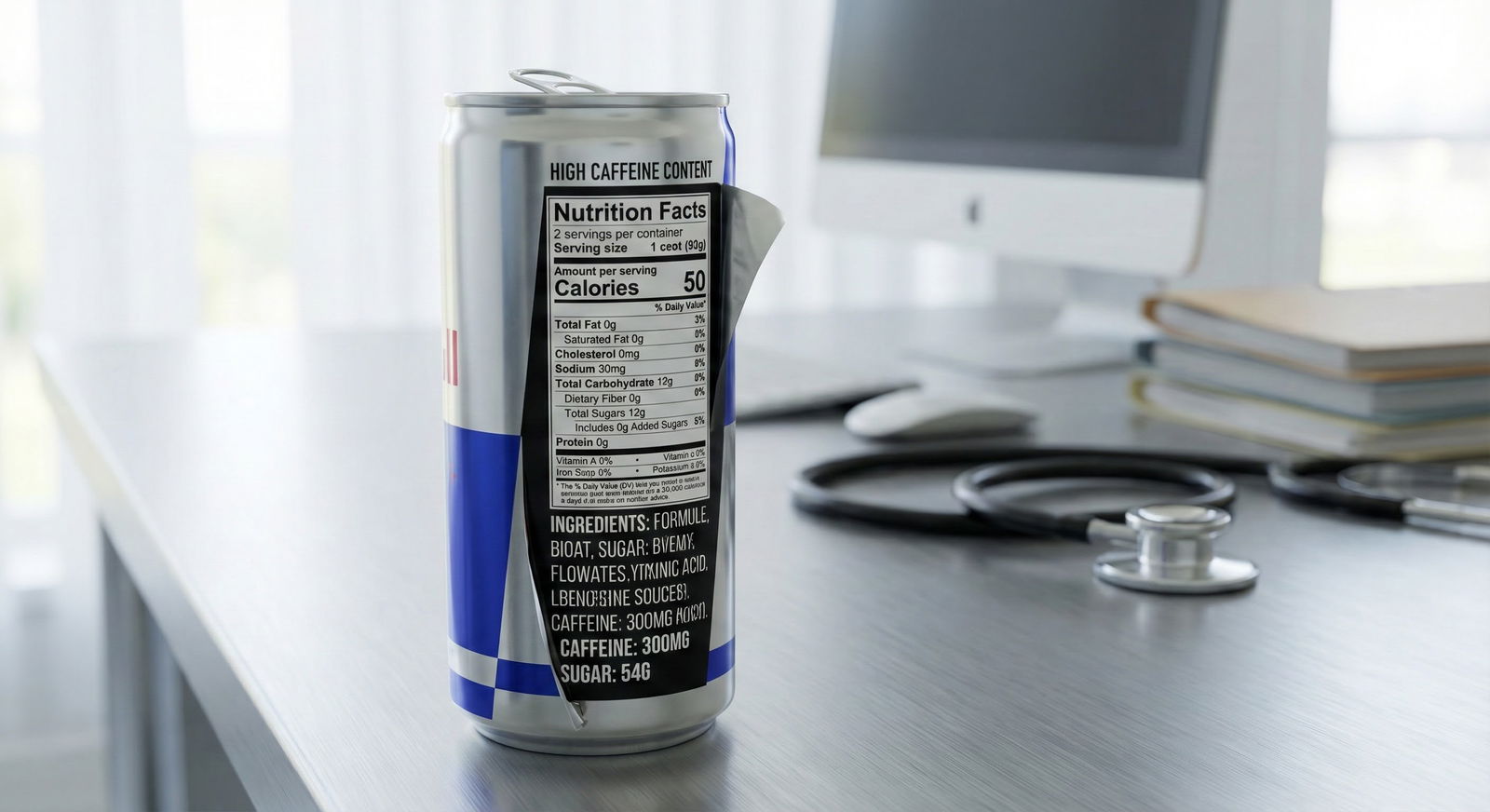
Most popular 16 oz energy drinks contain:
- Caffeine: often 150–240 mg per can
- Sugar: 25–60 g (unless sugar-free)
- Other stimulants/additives: taurine, guarana, ginseng, B-vitamins in absurd doses, sometimes yohimbine etc.
The marketing is clever: “B vitamins for energy,” “focus blend,” “performance complex.” The data is less impressive.
What studies consistently show:
- The alertness benefit of energy drinks maps almost perfectly to their caffeine content. The extras add, at best, marginal or inconsistent benefit.
- Sugar spikes give a very transient sense of energy followed by faster crash and more subjective fatigue 1–3 hours later.
- High-dose taurine + caffeine raises blood pressure and heart rate more than caffeine alone in controlled trials.
And the safety profile? In the ED, when someone rolls in tachycardic, vomiting, anxious, sometimes with arrhythmia, the story is often, “I had a few Monsters/Red Bulls and felt weird.” This is especially true in younger, smaller-bodied folks or those combining with alcohol or pre-workout.
To be clear: one 16 oz energy drink is not a death sentence. The hysteria is overblown. But for a sleep-deprived resident with borderline blood pressure, maybe some underlying anxiety, and a tendency to stack stimulants? It’s not great medicine.
Residents who rely heavily on energy drinks:
- Tend to get more fragmented daytime sleep
- Report more palpitations and anxiety
- Often overshoot caffeine doses because cans are big and easy to chug
Energy drinks are a worse packaging of caffeine for night shifts. Too much sugar, too many unnecessary additives, and very imprecise dosing.
You’d be better off with controlled caffeine (coffee/tea or tablets) and real food.
“Nothing” – The Noble But Usually Unrealistic Option
There’s a cult of toughness in residency: “I don’t use caffeine, I just power through.” I’ve heard attendings almost brag about it.
Here’s the problem: objective performance data on sleep-deprived humans without stimulants is brutal. Reaction times slow, lapses increase, microsleeps happen. And you’re not running a spreadsheet. You’re writing orders and placing lines.
In lab simulations of driving after night shifts, even medically healthy, motivated people:
- Have significantly higher crash risk
- Experience involuntary microsleeps
- Often don’t recognize how impaired they are
And that’s with caffeine in many cases. Without it, it’s worse.
Working nights with zero pharmacologic help is possible. But then you need:
- Reasonable nap opportunities
- Tight control of light exposure
- Consistent pre-shift sleep
- A life that allows that kind of discipline (which residency often doesn’t)
Most residents do not have that perfect setup. You get paged during your pre-night nap. Your neighbor decides to mow at 3 p.m. Your co-intern texts you about signout.
So the “nothing” option only works safely for a minority. The people who say, “I’m fine without caffeine,” rarely have their performance tested. If I put them on a PVT at 4 a.m., I’d probably see the truth.
If you can truly function without caffeine on nights and your PVT-equivalent (your clinical performance, your charting accuracy, your driving home) is intact? Great. But don’t force yourself into that camp on principle while your error rate climbs.
The Real Myth: That Caffeine Alone Can Fix Sleep Deprivation
This is the core misunderstanding. Caffeine doesn’t replace sleep; it masks some consequences of short-term sleep loss.
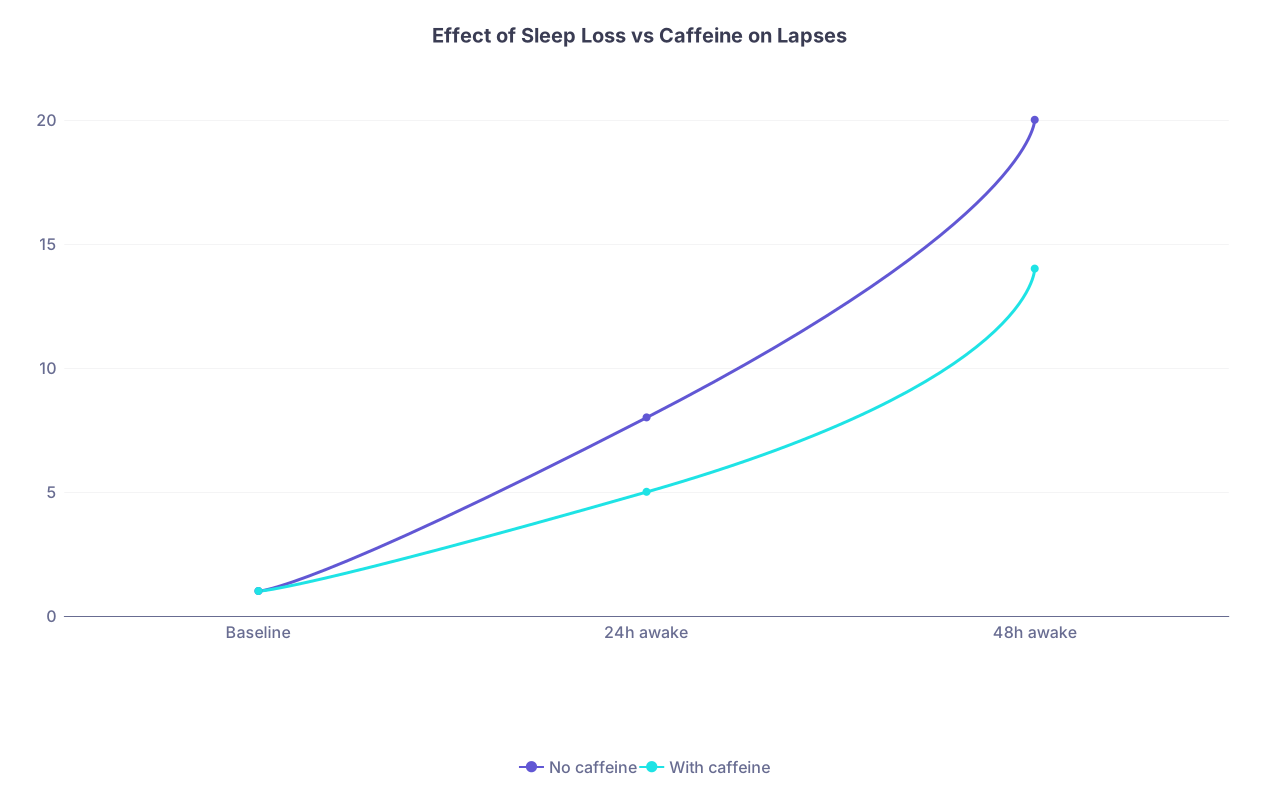
| Category | No caffeine | With caffeine |
|---|---|---|
| Baseline | 1 | 1 |
| 24h awake | 8 | 5 |
| 48h awake | 20 | 14 |
You still build sleep debt. You still accumulate cognitive impairment, especially in executive function (judgment, planning, decision-making under uncertainty). You might feel “ok” enough to keep working, but that doesn’t mean you’re at baseline.
I’ve watched residents on their 6th or 7th night say, “I feel fine, coffee fixes it,” while their signouts get sloppier, they miss trends in vitals, their notes degrade. They’re not lazy. They’re neurologically compromised in ways caffeine can’t fix.
The right mental model:
- Caffeine = temporary patch on vigilance
- Sleep = only real reset button
Once you see it this way, you stop asking, “How much should I drink to get through nights?” and start asking, “What’s the minimum effective caffeine dose I need to safely function until I can sleep, and how do I protect that sleep?”
A Reasonable, Evidence-Grounded Strategy for Nights
Let me be specific. If I were designing a “safe staying awake” plan for a typical resident on 7p–7a nights, it would look something like this:
1. Baseline Caffeine Habits
If you’re a heavy daily caffeine user (800 mg+), you’ve already shot yourself in the foot. Tolerance blunts the benefit. Scaling back on off days, aiming closer to 200–400 mg/day total, will make your night-shift doses work better.
2. Pre-Shift Sleep First, Caffeine Second
The best “stimulant” is a 90–180 minute afternoon nap before your first night.
If your first instinct is to slam coffee at 6 p.m. before signout instead of protecting a pre-night nap, your priorities are backwards.
Use caffeine after you’ve optimized sleep, not instead of sleep.
3. Dose and Timing
For a 7p–7a shift with goal sleep at 8:30–9 a.m.:
Around 6:30–7 p.m.:
100–200 mg caffeine (small coffee, strong tea, or tablet).Around 11 p.m.–1 a.m.:
Another 100–200 mg if you’re flagging.After 3 a.m.:
Only use caffeine if you’re genuinely unsafe-level sleepy, and keep it to 50–100 mg. Recognize you’re now compromising your post-call sleep.
Stacking two 16 oz Monsters between midnight and 4 a.m. is not a plan. It’s malpractice on yourself.
4. Choose Your Source Wisely
Best options for precision and fewer side effects:
- Black coffee or tea
- Caffeine tablets (100–200 mg) if you want exact doses
Acceptable but less ideal:
- Sugar-free energy drinks, if limited (e.g., one 16 oz early in shift)
- Multiple large sugary energy drinks
- Combining energy drinks with pre-workout or other stimulants
- Chugging caffeinated beverages after 3–4 a.m. routinely
5. Protect the Post-Shift Sleep
If you blast yourself with 200–300 mg at 5 a.m., don’t blame “night shifts” when you’re still staring at the ceiling at noon.
To improve daytime sleep:
- Dark, cold room
- White noise
- Phone in another room
- No caffeine once you’re off
- Short “commute nap” in your car before driving home if you’re dangerously sleepy
Yes, this is boring. But it works far better than pretending an extra can of Bang will bail you out.
Common Myths About Staying Awake on Nights
Let’s kill a few greatest hits.
“Energy drinks work better than coffee”
No. Controlled trials show most of the performance benefit tracks with caffeine dose, not brand or additives. The “extra kick” you feel is usually high caffeine + sugar spike + marketing expectation.
“I can drink caffeine anytime; I sleep fine”
Subjectively, maybe. Objectively, polysomnography shows that even caffeine 6 hours before bed:
- Increases sleep latency
- Reduces total sleep time
- Fragments sleep
You might “fall asleep” but your sleep architecture is garbage.
“If I never use caffeine, I’ll feel less tired on nights”
You will feel tired. You might feel more tired, actually. You’ll be more aware of how wrecked you are, which is honest but doesn’t magically fix your performance. The question is safety and function, not purity.
When “Nothing” Is Actually Smarter
I’m not anti-caffeine. I’m anti-stupid-caffeine.
There are situations where skipping caffeine late in the shift is the correct move, even if you’re tired:
- You’re on the last night of a block and desperate to flip back to days
- You’ve already had ~300–400 mg in the previous 12 hours
- You’re getting tachycardic, anxious, or chest-tight from earlier doses
- You’ve got a real window for a 3–4 hour uninterrupted daytime sleep and you don’t want to blow it
In those situations, walking a few flights of stairs, bright light exposure, a protein-heavy snack, and even a 10–15 minute “safety nap” (if possible) beat another 200 mg hit that just wrecks your day sleep.
The Bottom Line
If you remember nothing else:
- Caffeine works; energy drinks are just a lousy, sugary delivery system. Use the drug, not the marketing.
- Dose and timing matter more than brand. Early-shift caffeine helps; late-shift caffeine sabotages your sleep and your next night.
- Nothing at all isn’t automatically virtuous if your performance tanks. Use the minimum effective caffeine to stay safe, then defend your sleep like it’s part of your job—because it is.