
The heroic all-nighter is a lie. For residents, “powering through” nights does not make you tougher, safer, or better trained. It just makes you impaired.
The Romance of the All‑Nighter vs. Reality
There’s a script residents absorb before they ever touch a call room pillow:
- Real residents can push through the night.
- Coffee + adrenaline = enough.
- People who “can’t handle nights” are weak or not cut out for medicine.
I’ve heard attendings say, “You’ll get used to it,” as if human neurobiology cares you matched into IM at a big-name program. I’ve seen seniors brag: “I can do a 28‑hour call and then round like nothing.” Then you watch them miss a potassium of 2.3 because they “just glanced” at the labs.
Here’s what the data actually shows: staying up for 24 hours puts your cognitive function in the same ballpark as being legally drunk. And multiple studies show error rates, needle sticks, and near-miss events climb sharply with extended wakefulness and bad night schedules.
That’s not mental toughness. That’s institutionalized impairment.
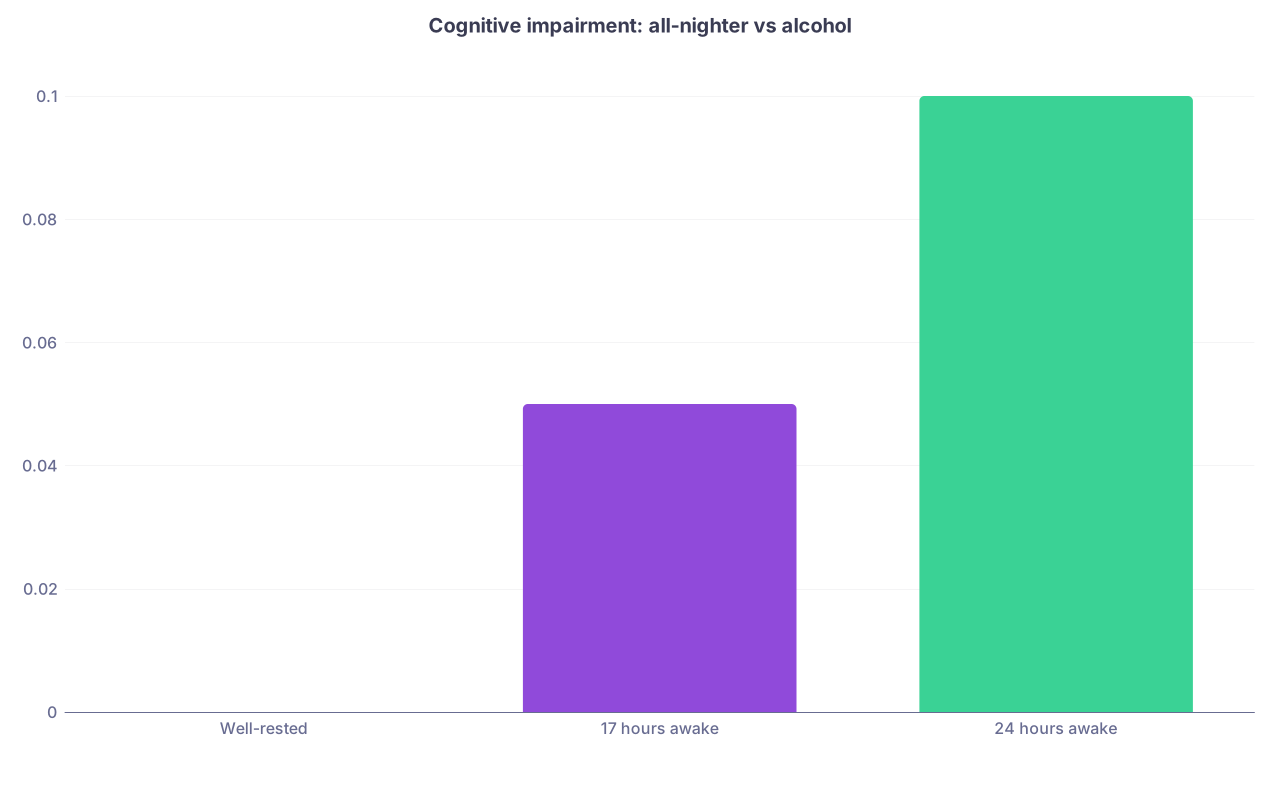
| Category | Value |
|---|---|
| Well-rested | 0 |
| 17 hours awake | 0.05 |
| 24 hours awake | 0.1 |
(Approximate equivalent blood alcohol concentration (BAC)-like performance deficit based on psychomotor studies)
What Sleep Deprivation Actually Does to a Resident Brain
This is not vague “you’ll be tired.” It’s specific, measurable damage to your performance.
Studies on extended wakefulness show:
- Around 17 hours awake, your psychomotor performance resembles a BAC of about 0.05.
- Around 24 hours awake, you perform like 0.08–0.10 BAC. That’s DUI territory.
Now translate that to residency: interpreting CT scans, making triage decisions, writing chemo orders, deciding whether to intubate. You would never say, “Sure, let the drunk intern write the vancomycin dose.” But you’re fine with the sleep‑deprived one doing it.
Sleep loss crushes the exact skills you need on nights:
- Working memory: Keeping 5–7 active problems straight on a cross-cover list.
- Attention: Noticing the subtle mental-status change or new ST depression.
- Executive function: Prioritizing which of 14 pages is actually dying.
- Risk assessment: Deciding whether that 88/50 blood pressure is “just septic” or about to tank.
Residents love to say, “Once I get going, I’m fine.” That’s subjectively true and objectively false. You feel wired. Your adrenaline masks your fatigue. Performance tests still show you’re slower and sloppier.
The worst combination? Sleep-deprived and confident.
The Hidden Error Curve of Long Calls and Stringed Nights
Let’s go straight to harm.
In one landmark trial on interns working traditional 24+ hour shifts vs shorter shifts, extended shifts were associated with more serious medical errors and more preventable adverse events. Not hypothetical. Not “might increase risk.” Actual patient harm.
Needlestick and sharp-injury risk? Residents working extended-duration shifts racked up significantly higher rates. Translation: the “I’m fine” all-nighter crowd is more likely to stick themselves with that HIV/HCV‑risk needle at 4 a.m.
And it’s not just the big “I coded the wrong patient” moment. The more common stuff is insidious:
- Forgetting to restart a home beta-blocker after surgery.
- Mis‑clicking a medication because your eyes blur and the EMR dropdown jumps.
- Misreading 3.0 as 8.0 because your brain autocompletes what it expects.
Stack those across hundreds of patients, thousands of orders, and a year of nights, and you’re looking at a systemic error machine.
| Outcome | Extended 24+ hr Calls | Shorter Shifts |
|---|---|---|
| Serious medical errors | Higher | Lower |
| Preventable adverse events | Higher | Lower |
| Needlestick injuries | Higher | Lower |
| Resident self-reported fatigue | Much higher | Lower |
When programs say, “We checked ACGME boxes, we’re in compliance,” what they usually mean is: We’re technically legal, not actually safe.
The “I’ll Just Power Through” Myth Is Physiologically Wrong
Here’s the core myth: that with enough willpower, caffeine, and training, you can push through a night shift or a 24‑hour call without meaningful performance loss.
Physiology does not negotiate.
Your circadian system is wired so that:
- You hit a major alertness dip between roughly 2–6 a.m.
- Melatonin secretion pushes your brain toward sleep.
- Reaction times slow. Microsleeps sneak in.
You can override the feeling of sleepiness a bit with light, movement, caffeine. You cannot override the underlying performance impairment.
I’ve seen residents swear they’re awake while doing “single-letter” reading tests. Then you show them their log: 2–3 second lapses where their eyes were open but their brain simply shut off. That’s a microsleep. They have zero memory of it.
Imagine that microsleep during:
- A central line placement.
- A dopamine titration.
- A 3 a.m. phone argument with an ED doc over an admission where you just want them to stop talking.
“Powering through” does not prevent that. It guarantees it.
Why Some People “Seem Fine” on Nights (They’re Not)
You know that senior who brags: “Nights don’t bother me. I function great on 4 hours of sleep.” Let me translate: I have no insight into my own impairment.
People are notoriously bad at estimating their own performance while sleep deprived. In controlled studies, subjects report they’re “doing okay” while objective tests show progressive decline.
What’s really going on with the “night owl” residents:
- Some have slightly later chronotypes – they feel less awful at 11 p.m.
- Some are running on sheer adrenaline and fear of missing things.
- Some compensate by over-relying on checklists and habit – which helps, but doesn’t fully fix the problem.
- Some just have zero insight and a strong ego.
The other piece: selection bias. You rarely hear from the resident who quietly bombed an exam, missed a subtle PE, or wrote for the wrong heparin dose and is now terrified. You hear from the ones who didn’t get obviously burned. Yet.
That doesn’t make them superhuman. It makes them lucky.
Why “Just Sleep When You Can” Is Garbage Advice
Another common myth: as long as you sleep “when you can,” the all-nighter doesn’t matter. The old lines:
“Grab a nap in the call room if it’s quiet.”
“Sleep tomorrow, you’re post‑call.”
“You can catch up this weekend.”
This is how you end up chronically wrecked.
The evidence on sleep debt is brutal: you do not fully “bank” sleep in advance, and you do not quickly “repay” chronic deficiency. Partial sleep deprivation across multiple nights causes cumulative performance decline—even if you never pull a full all-nighter.
The classic trap: three “almost” all‑nighters in a row.
- Night 1: 2 hours of fragmented call room sleep.
- Day off: You try to live like a human—groceries, laundry, partner, kids. You get 5–6 misaligned hours.
- Night 2: 3 hours of terrible sleep, interrupted.
- Night 3: You think, “I’ve done this twice, I’ll push through.”
By that third night, your brain is in a hole you can’t just caffeine your way out of. That’s when scary mistakes cluster.
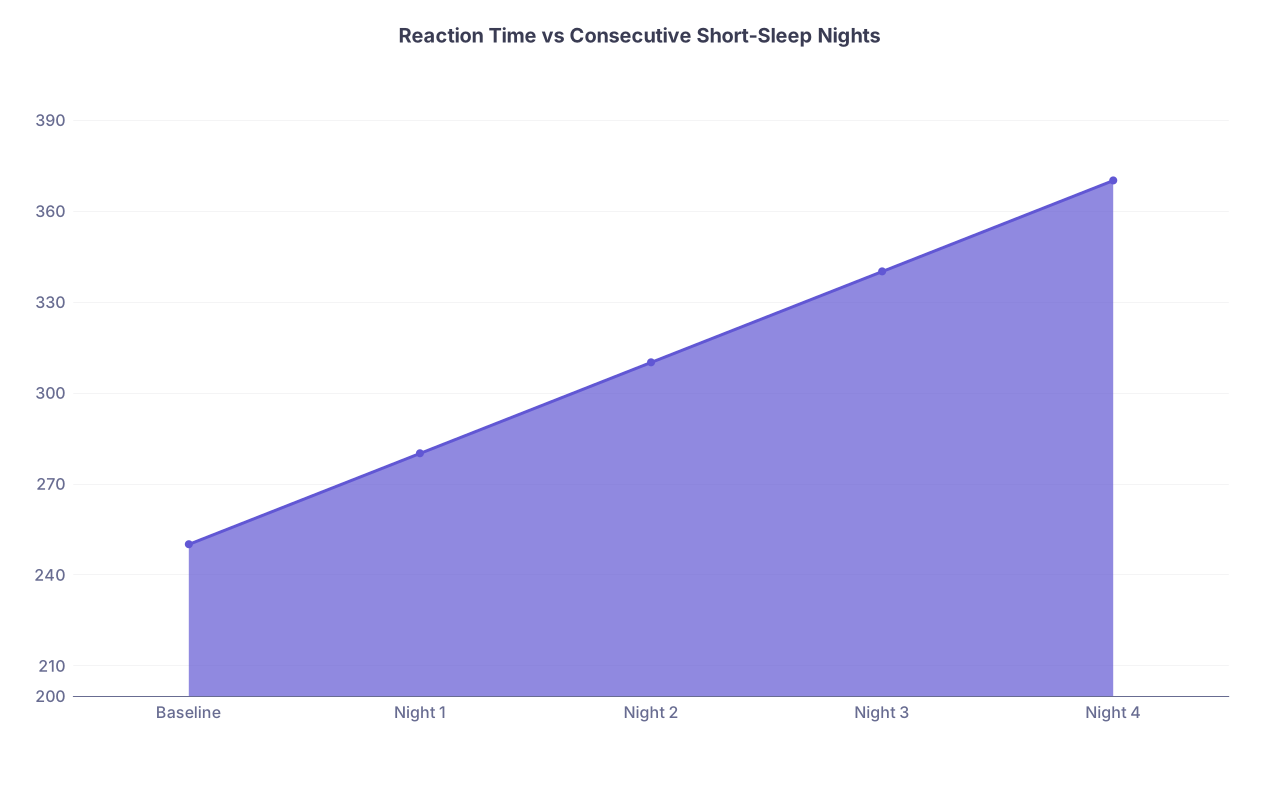
| Category | Value |
|---|---|
| Baseline | 250 |
| Night 1 | 280 |
| Night 2 | 310 |
| Night 3 | 340 |
| Night 4 | 370 |
(Reaction time in milliseconds – longer is worse; pattern similar to what chronic partial sleep experiments show)
The “sleep when you can” culture is not a strategy. It’s a shrug.
What Actually Works on Nights (And Why It’s Not “Toughing It Out”)
Let me flip this from rant to practical. Because you still have to survive nights in a system that’s not going to fix itself by next block.
There are real, evidence-aligned strategies. They’re not sexy. They do not require you to be a martyr.
1. Pre‑shift sleep is non‑negotiable, not optional
Going into a night shift after a normal “day” is basically preloading yourself with impairment. A 24‑hour straight run is the worst case.
Better pattern:
- Treat the afternoon before a night like mandatory pre‑op prep: dark room, phone off, 1–3 hours of solid sleep.
- Use a sleep mask, earplugs, white noise. No scrolling, no “just one more episode.”
This doesn’t eliminate night impairment, but it pushes your worst crash later and shrinks it.
2. Caffeine: small, early, and capped
Everyone abuses caffeine. Almost no one uses it strategically.
What evidence – and common sense – suggest:
- Front‑load modest caffeine early in the shift. 50–100 mg at the start, another small dose around midnight.
- Avoid huge single doses. They spike, then crash, and wreck any chance of post‑shift sleep.
- Hard stop several hours before you plan to sleep post‑shift.
Caffeine does not replace sleep. It only nudges wakefulness slightly. If your heart is racing and your hands are shaking, you did it wrong.
3. Light and movement are free performance enhancers
Your circadian clock responds strongly to light and movement.
- Get bright light exposure early in the shift if possible (well-lit work area, even light boxes in some call rooms).
- Don’t sit for 4 straight hours staring at the monitor. Lap the unit, go physically lay eyes on patients. It helps you and them.
- Short, brisk walks > slumping in a chair “resting your eyes” at 4 a.m.
These don’t restore you to daytime levels, but they reduce the depth of your worst dips.
4. Naps beat heroics
The myth says naps are “lazy” or “for people who can’t hack it.” The data says naps save your neck.
A 20–30 minute nap during the circadian low (roughly 2–5 a.m.) can:
- Improve alertness
- Improve reaction time
- Lower subjective fatigue
The trick is protecting it:
- Coordinate with your co‑resident: “I’m going to close my eyes for 25 minutes, can you triage pages and wake me for anything urgent?” Then trade.
- Tell the nurse at the station: “If it’s routine, page once and wait unless it’s truly urgent. I’ll be up in 25 minutes.”
No, you won’t always get this. But having permission in your own mind to try matters.
5. Hard boundaries post‑call
The “strong” resident thing to do after a brutal night is to stay for work you don’t strictly have to do. Extra rounds. More notes. Teaching sessions.
This is also how you prolong your impairment and train leadership that you can tolerate abuse.
Post‑call, your priority is: get home safely, sleep, and reset.
That may mean:
- Saying no to extra tasks that are clearly non‑essential.
- Handing off to the day team even if your perfectionism screams.
- Uber/Lyft home if you’re nodding off in the parking lot. Residents have died in post‑call car crashes. That’s not hypothetical.
The Culture Problem: Why This Myth Won’t Die Quietly
If the science on all‑nighters is this clear, why is medicine still stuck in the 1980s on this?
Because residency still worships suffering.
You’ll hear:
- “I did 36‑hour calls every third night. You have it easy.”
- “Real training means being there for the patient no matter what.”
- “Duty hours ruined continuity.”
Translation: I was abused; I rationalized it as virtue; now I’m passing it on.
There is something medicine is right about: patients need care 24/7. Nights will never be comfortable, and someone will always be tired. But that’s not a justification for pretending that pushing through nights has no cost.
The honest tradeoff is this:
- Less impairment = more handoffs, more shift work, more communication overhead.
- More “continuity” via long calls = more impaired decisions, more fatigue, more risk.
You cannot have maximum continuity and maximally safe cognitive performance with the same person awake forever. The brain will not cooperate.

| Step | Description |
|---|---|
| Step 1 | Start call well rested |
| Step 2 | 12 hours awake |
| Step 3 | 18 hours awake |
| Step 4 | 24 hours awake |
| Step 5 | Post call tasks |
| Step 6 | Error risk |
What You Can Control vs What You Can’t
You’re not going to single‑handedly rewrite your program’s call structure. But you’re not powerless either.
You cannot control:
- That your ICU uses 24‑hour calls.
- That ACGME limits are a political compromise, not optimal neurobiology.
- That some attendings will still equate struggle with strength.
You can control:
- Whether you show up to a night already partially sleep‑deprived.
- Whether you protect naps when there’s a chance.
- Whether you say “I’m not safe to drive” and act accordingly.
- Whether you internalize the myth that being wrecked is heroic.
And as you move up in seniority, you control one more thing: whether you perpetuate the mythology or start quietly dismantling it. For your interns. For the med students. For yourself.
The Bottom Line
Three points, no fluff:
- All‑nighters and “powering through” nights reliably impair residents to drunk‑adjacent performance levels. You don’t feel as bad as you actually are.
- Error rates, near misses, and self-injury all climb with extended wakefulness and long calls. The data is not ambiguous on this.
- Real professionalism on nights is not about heroic suffering; it’s about protecting your brain enough to not hurt patients—or yourself—while a broken system leans on you.