

It’s 6:42 p.m. Sign-out just ended. Everyone’s half-standing, half-escaping the room, and you glance down at the census.
You’ve got the new septic shock admit, the agitated dementia patient on soft restraints, the GI bleeder circling the drain in the unit, and—because why not—the frequent flyer with “chest pain x 5 years” parked in triage screaming for dilaudid.
Your co-intern? Two stable cross-covers and one straightforward admission for “failure to thrive.”
You’re not paranoid. You are getting the worst night assignments. And no, it’s not random. Let me tell you what actually happens behind that assignment sheet.
How Night Assignments Really Get Made
Let’s walk into the call room at 6:15 p.m., before you show up.
The senior is at the computer. Chief texted earlier: “Make sure you even out the admissions this week.” The day team is trying to sign out and escape. Everyone’s already behind. Nobody is building a perfectly balanced, ethically pure assignment matrix.
Here’s what they actually do.
The senior’s mental categories
You think they see “four interns.” They don’t. They see buckets:
- “Safe workhorse”
- “Needs hand-holding”
- “Chaos magnet”
- “Invisible / flight risk”
- “Gunner who will say yes to everything”
- “Borderline unsafe if overloaded”
Interns get tagged early. Sometimes during orientation. Sometimes after one bad call. And that mental label drives your night assignment way more than fairness, policy, or “random” rotating.
On the whiteboard or the spreadsheet, it looks equal:
- “Admits: 3 each”
- “Cap: 8 cross-covers”
But equal on paper and equal in acuity are not the same thing. And that’s where you keep getting burned.
The Hidden Logic Behind “You Get The Trainwrecks”
There are a few repeat patterns I’ve seen every year when I’ve watched seniors and chiefs carve up nights.
1. You’re seen as “the competent mule”
This is the most common, and the most infuriating.
You show up, you stay late, you don’t whine, your notes are clean, nurses like you because you answer pages. You’re not the best diagnostician yet, but you’re safe and responsive.
So what happens? The senior thinks:
“If someone has to take the septic trainwreck, I trust [you] more than the others. I know [you] won’t implode.”
They don’t hand you the mess because they hate you. They do it because they’re risk-managing the night.
The calculus is brutal and unspoken:
- X intern will miss early decompensation.
- Y intern will get defensive and call me late.
- You will grind through it, keep the ship afloat, and not wake attending for nonsense.
So the senior piles the highest-acuity admits and cross-covers on you “for safety.”
Nobody writes this out. But I’ve literally heard a chief say, scrolling through the list at 6:30 p.m.:
“Give the DKA to her, she’ll actually manage the insulin correctly. Do not give that to [name].”
You want the truth? Being competent but non-assertive is how you become the default dumping ground.
2. You have a reputation you don’t know about
This one stings because it’s often fixable, but no one tells you directly.
Every intern has a back-channel story associated with their name, and that story gets passed between seniors and chiefs faster than you’d believe:
- “Slow but safe.”
- “Panics with anything unstable.”
- “Refuses to accept sign-out tasks after 6:59.”
- “Writes great notes but disappears on the floor.”
If you’re wondering why you get the worst night assignments, your label is probably one of these two:
- “Reliable closer” = they trust you to land the plane when things get ugly.
- “Disposable mule” = you don’t push back and you don’t have allies, so it’s politically easy to overload you.
Those are very different, but they result in the same symptom: you keep getting hammered.
The ugly part: if you’re seen as a “problem intern” or “complainer,” you might also get the garbage out of spite or avoidance. A senior won’t say, “I don’t like them, load them up,” but they will unconsciously:
- Give the painful borderline cases to the intern they’re already annoyed with.
- Protect their favorites from the worst of the night.
Is that fair? No. Does it happen? Constantly.
3. You’re invisible on days
If the seniors barely interact with you on days—because you disappear to “work on notes,” hide in the charting room, or never speak up during rounds—they’re flying blind on your abilities.
And when seniors are uncertain, they don’t usually split the difference; they cluster you away from the highest-risk responsibility.
That can go one of two ways:
- You get underloaded with fluff because they don’t trust you.
- Or you get overloaded with chaos because you’re the path of least resistance—no relationship, no guilt.
I’ve seen entire months where the intern who quietly did solid work, never said much, never bonded with the team, got the junk assignments because, to the senior, they were just “bed 412’s intern” and nothing more. No personal buy-in.
Your night assignment is partly a political artifact. If nobody would stick up for you in a chief meeting, you’re vulnerable.
4. You got labeled early—and nobody revisited it
This is one of the dirtiest secrets.
People on the leadership side cling to first impressions. They formed a view of you in July. It’s now December. You’ve grown, your skills are better, your confidence is higher. But in the sign-out room, you’re still:
“The intern who missed that PE on night 2.”
or
“The one who broke down after the bad code on MICU week 1.”
So what happens?
You don’t get the borderline assignments that might actually be interesting and educational. You get the messes that no one wants, or you get sheltered to the point you only get the 2 a.m. “nausea/vomiting, rule out ACS” nonsense.
Both feel like punishment. One burns you out with chaos, the other bores you and stunts you.
And the worst part: nobody actually sits you down and says, “Hey, this is the narrative about you. Let’s change it.”
They just keep assigning you that way.
How Systems Quietly Screw You: The Call / Night Float Game
You’re not crazy if you feel like certain interns keep getting protected. They are.
There are structural games going on you never see.
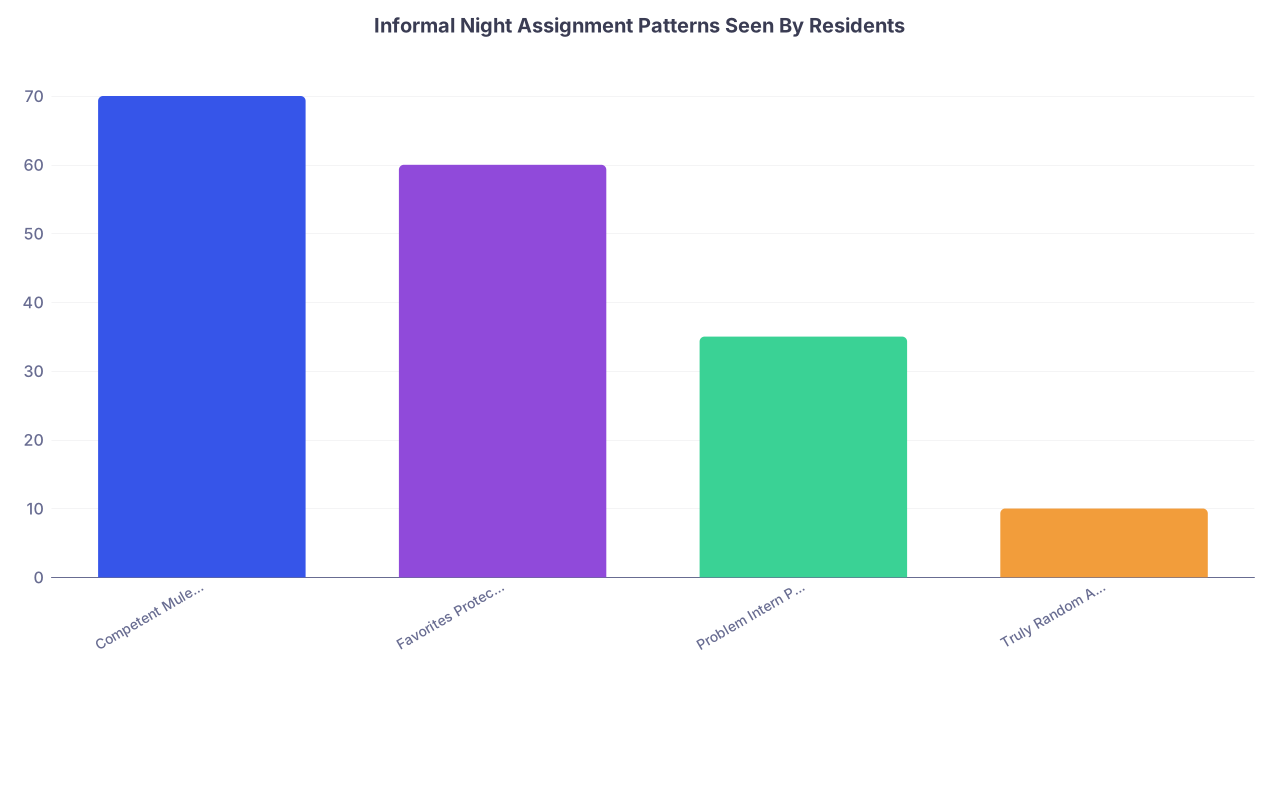
| Category | Value |
|---|---|
| Competent Mule Overloaded | 70 |
| Favorites Protected | 60 |
| Problem Intern Punished | 35 |
| Truly Random Assignments | 10 |
I’ve sat in chief meetings where the calendar gets “adjusted”:
- The strongest PGY-2 gets paired with the weakest PGY-1 for “safety.”
- The likeable but slow intern gets placed on lighter services more often.
- The intern with the loudest complaints about wellness magically has fewer weekend nights.
Then the chiefs say out loud: “But distribute the paper schedule evenly so no one can claim it’s unfair.”
So on New Innovations or Amion, it looks beautifully balanced. On the ground, everyone knows who’s getting crushed.
Night-to-night, seniors then add their own micro-adjustments:
- The favorite sub-I gets the interesting admits.
- The “solid” intern is used to buffer disasters.
- The “drama” intern gets the low-yield, annoying ones “so they can’t hurt anyone.”
You live in that downstream wash.
Your Behaviors That Accidentally Attract Garbage
Here’s the part you can actually control. There are specific patterns that make seniors unconsciously hand you the worst night assignments.
You always say “whatever works for the team”
That sounds noble. On the ground, it reads as:
“I won’t push back, you can crush me and I won’t make noise.”
The intern who says, calmly, “I can take one more sick admit safely, but if it’s unstable on pressors I’m going to need your help,” gets a different category in the senior’s brain than the intern who says, “I’m fine with whatever, I’ll manage.”
The first sounds like a colleague. The second sounds like a disposable body.
You don’t time your complaints
If the only time you ever speak up is 2 a.m. when you’re drowning and pissed, seniors file you under “dramatic and disorganized.”
The ones who get listened to are the ones who quietly pull a senior aside at 6:45 p.m. or the next day and say, with data:
“This is the third night in a row I got the unstable admits while others got simpler patients. I’m willing to work hard, but I need this to be sustainable. Can we look at how we’re dividing acuity?”
Uncomfortable? Yes. But that’s how you reprogram the label from “black hole for work” to “reasonable person I don’t want to burn.”
You look more competent than you feel—and never say it
You’re charting fast, moving fast, signing out crisply, answering pages promptly. From the outside you look like a machine. Inside, you’re hanging on by your fingernails.
If you never let your senior see any of that, they simply don’t know your bandwidth is maxed.
They’re not reading your soul. They’re reading: “Tasks completed, no meltdown, no pushback.” So they keep loading.
You do not need to cry in front of them. You do need to occasionally say something like:
“I can do this, but I’m at capacity right now. If another 2 admits hit, I’ll need help.”
That one sentence often changes who gets the next “worst” assignment.
How To Systematically Change Your Night Assignments
Let’s talk tactics. This is where you actually reclaim some control.
Step 1: Find out your unofficial label
You can’t fight a narrative you can’t see.
Ask someone you trust—an honest senior, chief, or attending who likes you enough to not blow smoke.
Try something like:
“I want to make sure I’m aware of how I’m perceived. If you had to describe my performance on nights to another senior in a sentence, what would they say?”
Or:
“Are there concerns about me that would make people hesitant to give me sicker patients? I’d rather know and fix them.”
You’ll get one of four answers:
- “You’re solid and safe, we trust you.”
- “You’re good but slow.”
- “You seem overwhelmed a lot.”
- Some vague “no, you’re great” nonsense (which usually means they haven’t thought much about you—also a problem).
That label is what’s driving your assignments.
Step 2: Start managing acuity, not just numbers
The residents who escape the worst of it aren’t “lazy.” They’re explicit about acuity.
At sign-out, when seniors are dividing patients, you can say, without whining:
“I already have the GI bleeder on pressors and the delirious ICU downgrade. I’m okay with another admit, but I’d prefer something stable so those two get the attention they need.”
That’s very different from:
- “I’m so slammed, this is unfair.”
- Or worse: saying nothing and then sulking the whole night.
Over a few weeks, seniors start to internalize: “Oh right, [your name] is tracking acuity. I should watch that.”
It’s not perfect. But it nudges their default from “dump” to “distribute.”
Step 3: Use your attendings strategically
Most residents underestimate this.
Attendings are usually two steps removed from assignment politics. But they absolutely hear:
- “Who keeps the ship afloat at night.”
- “Who complains about workload.”
- “Who melts down.”
And their offhand comments in “little” settings—morning report, rotation debriefs, evaluation forms—shape how chiefs build schedules and how seniors respect your bandwidth.
If you keep getting destroyed on nights, you can bring it up to a trusted attending in a non-whiny way:
“I’m noticing a pattern where I end up with the highest acuity loads at night, which I’m handling, but it’s starting to wear me down. I want to keep growing without burning out. Any suggestions on how to approach seniors or chiefs about this?”
The attending may do nothing. Or they might casually mention in the next meeting:
“By the way, [your name] is getting hammered on nights; maybe watch that.”
One sentence from an attending shifts your status from “anonymous mule” to “someone faculty likes and wants to protect.” That matters.
Step 4: Log your nights for leverage
If this is a pattern over weeks, build receipts. Not a manifesto. A simple, calm log.
| Date | Total Patients | High-Acuity (Pressors/ICU/Stepdown) | Code Blues | New Admits |
|---|---|---|---|---|
| 11/03 | 10 | 3 | 1 | 4 |
| 11/05 | 9 | 2 | 0 | 5 |
| 11/08 | 11 | 4 | 1 | 3 |
You’re not building a lawsuit. You’re equipping yourself for a calm, data-driven conversation with a chief or program director if this becomes chronic.
Then, if you sit down with them, you don’t say:
“I’m always getting screwed.”
You say:
“Over the last three weeks, this is how my nights have looked. I’m getting multiple high-acuity patients repeatedly. I’m okay taking a share of that—I actually want those experiences—but this density is becoming unsustainable. I’d like some help making sure this is more evenly distributed.”
Harder to ignore. Much harder to gaslight.
Step 5: Practice one line that sets a boundary
You don’t need a whole speech. You just need one line you can actually say out loud in a tense sign-out room.
Something like:
“I’m at the edge of what I can safely manage right now. I need help with either triage or redistribution.”
Notice what that is not:
- It’s not an attack.
- It’s not a complaint about other interns.
- It’s not a refusal to work.
It’s a patient-safety statement. No decent senior wants to be the one who ignored that and then had a disaster under their watch.
The Dark Truth: Sometimes It Is Favoritism
Let’s not pretend everything is rational.
There are interns who get shielded from the worst while you get dumped on, purely because:
- They’re socially close to the chiefs.
- They went to the same med school as the PD.
- They’re charismatic and fun on call.
- Or they’ve had major life stress and people are quietly protecting them.
You can’t fully fight that. Medicine is political, and residency is a small village.
What you can do is make it more uncomfortable for people to ignore your reality. Get known. Build relationships with a few seniors and attendings. Be the one people remember as “hardworking but reasonable, safe, and honest about limits.”
The faceless intern gets buried. The known entity gets at least some protection.
When You Really Are Outmatched
There’s an even less comfortable angle: sometimes you get hammered because you are slower, less organized, or more easily overwhelmed than your peers right now.
And seniors react in dumb ways:
- They either over-shelter you and give you all the junk.
- Or they throw you into chaos thinking you’ll “grow by fire,” which is nonsense.
If deep down you know your time-management, triage, or cross-cover skills are lagging, treat this as a performance project—not a moral judgment.
Ask a senior you trust:
“When you’re assigning nights, what skills do you think I’m missing that make you hesitate to give me higher-acuity but interesting patients?”
Painful to hear. Invaluable if you act on it. Because once a senior can say to the group, “They’ve really improved—much faster and more organized now,” your label actually changes, and eventually so do your assignments.
Quick Reality Check: What You’re Actually Aiming For
You’re not trying to never get hard nights. That’s fantasy. Everyone gets destroyed sometimes.
You’re aiming for:
- A reasonable share of trainwrecks.
- A floor on how bad one person gets hammered night after night.
- Enough variety that you’re learning, not just surviving.
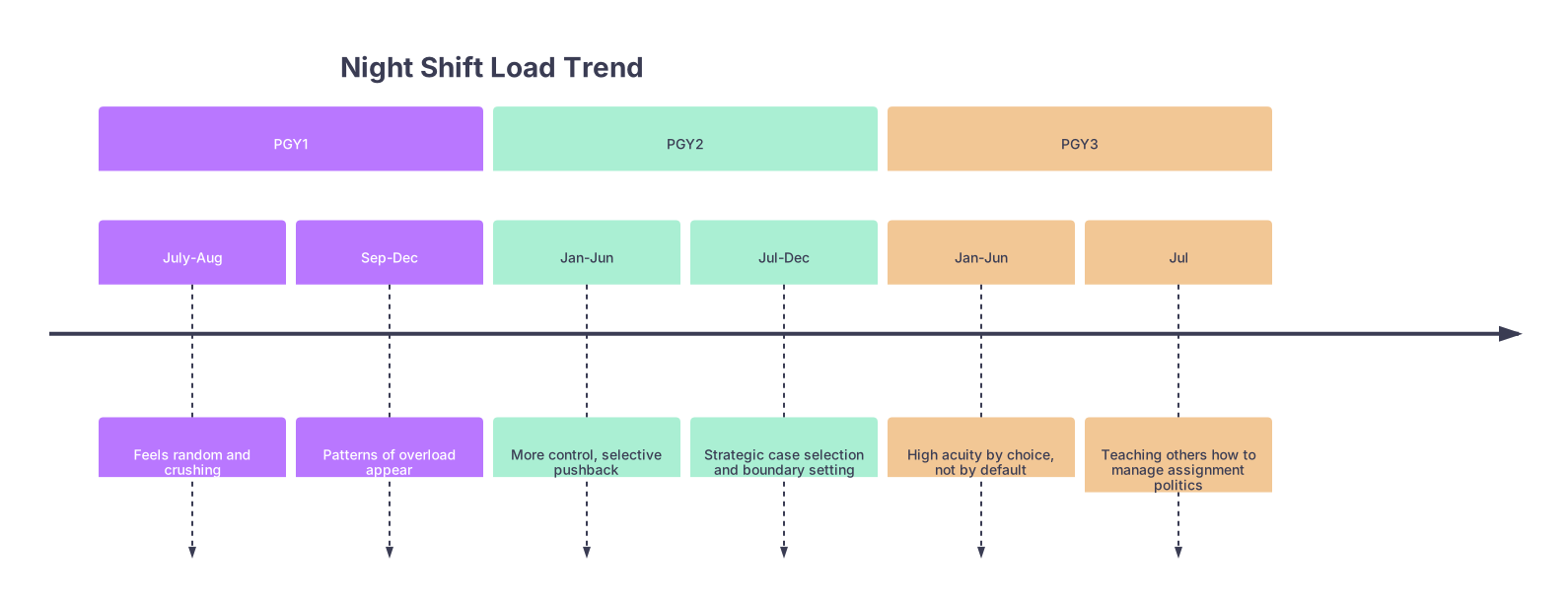
| Period | Event |
|---|---|
| PGY1 - July-Aug | Feels random and crushing |
| PGY1 - Sep-Dec | Patterns of overload appear |
| PGY2 - Jan-Jun | More control, selective pushback |
| PGY2 - Jul-Dec | Strategic case selection and boundary setting |
| PGY3 - Jan-Jun | High acuity by choice, not by default |
| PGY3 - Jul | Teaching others how to manage assignment politics |
If you’re consistently dreading the assignment sheet because you already know what’s coming, something’s off—politically, structurally, or in your own patterns. Usually all three.
What To Do Tonight, Not Next Month
You’re reading this probably before or between shifts. So here’s the short, actionable version for tonight:
- Before sign-out, silently count your current high-risk patients. If you already have two truly unstable ones, make a mental note.
- When the senior starts assigning new admits, say one clear line:
“I’ve already got two sick folks that may need a lot of attention. I can take another, but I’d prefer a more stable one if possible.” - During the night, if you’re overloaded, page your senior before you’re drowning:
“I’m at capacity with active issues on three patients. Can you help triage the next admit?” - After this block, ask one honest senior:
“If people are overloading me on nights, what story are they telling themselves about me? I want to know and fix whatever part is fair.”
Do that consistently for a month. Watch what shifts.

FAQs
1. Should I ever flat-out refuse an assignment if I think it’s unsafe?
Very rarely, but yes—there is a line. If you already have multiple actively unstable patients and you’re being handed another crashing admit with no promise of help, you can say:
“With my current load, I can’t safely take a crashing patient without additional support. We need to redistribute or you’ll have to be primary on this one.”
Use this sparingly and only when it’s genuinely a safety issue, not just a hard night. Overuse it and you’ll get labeled as fragile. Used once or twice, strategically, it can reset how seriously people take your capacity.
2. What if my senior is the problem and doesn’t care?
Then you go one level up—but not in a hysterical way. After the block, you talk to the chief or APD:
“On several nights, I was carrying X unstable patients plus Y admissions while others had notably lighter loads. I tried to communicate my limits in the moment but nothing changed. I’m concerned about safety if that pattern continues.”
You’re not ratting them out; you’re documenting a pattern. If multiple interns echo similar stories, chiefs start to pay attention. Some seniors do need to be told, bluntly, to stop dumping work on the same person.
3. Is it ever better not to push back and just eat the bad nights?
If your goal is to be liked in the short term, sure. If your goal is to survive residency with your brain and career intact, no.
Silence trains the system to keep using you as a buffer. A measured, calm, data-backed pushback trains the system to at least think before burying you. You’re not asking for a spa shift; you’re asking for sustainable, safe work. That is not weakness. That’s professionalism.
Key points:
You’re getting the worst night assignments because of unseen labels, silent politics, and your own patterns of being competent but quiet. Shift the narrative by naming acuity, showing reasonable limits, and getting a few people in your corner who see you as more than a work sink. And stop pretending it’s random. It’s not.


