
You matched into a preliminary spot. Maybe it's internal medicine. Maybe it's surgery. Either way, you're one of thousands of PGY-1s staring down twelve months that could end with a categorical contract, or with you scrambling again next spring. Here's how to make sure it's the former.
The Reality Check: Why You're Here and What's Next
A preliminary year is a one-year, non-trackable graduate medical education position designed to build foundational clinical skills. Internists and surgeons run most of them. You'll get broad exposure, no specialty commitment, and no guaranteed next step.
If you didn't match categorically the first time around, you're in the "Open Slot" group. Stop calling this a failure. It isn't. It's a pivot point, and pivots only work if you move on purpose.
The stakes are simple: finish this year with a categorical match for PGY-2 in Dermatology, Radiology, Neurology, Ophthalmology, or whatever advanced specialty you actually want. That's the goal. Everything else is noise.
The mindset shift happens on day one. Stop thinking like an intern who needs hand-holding. You're a resident now. Program directors from other specialties will judge you on competency, communication, and whether you can lead a team. Act like it.
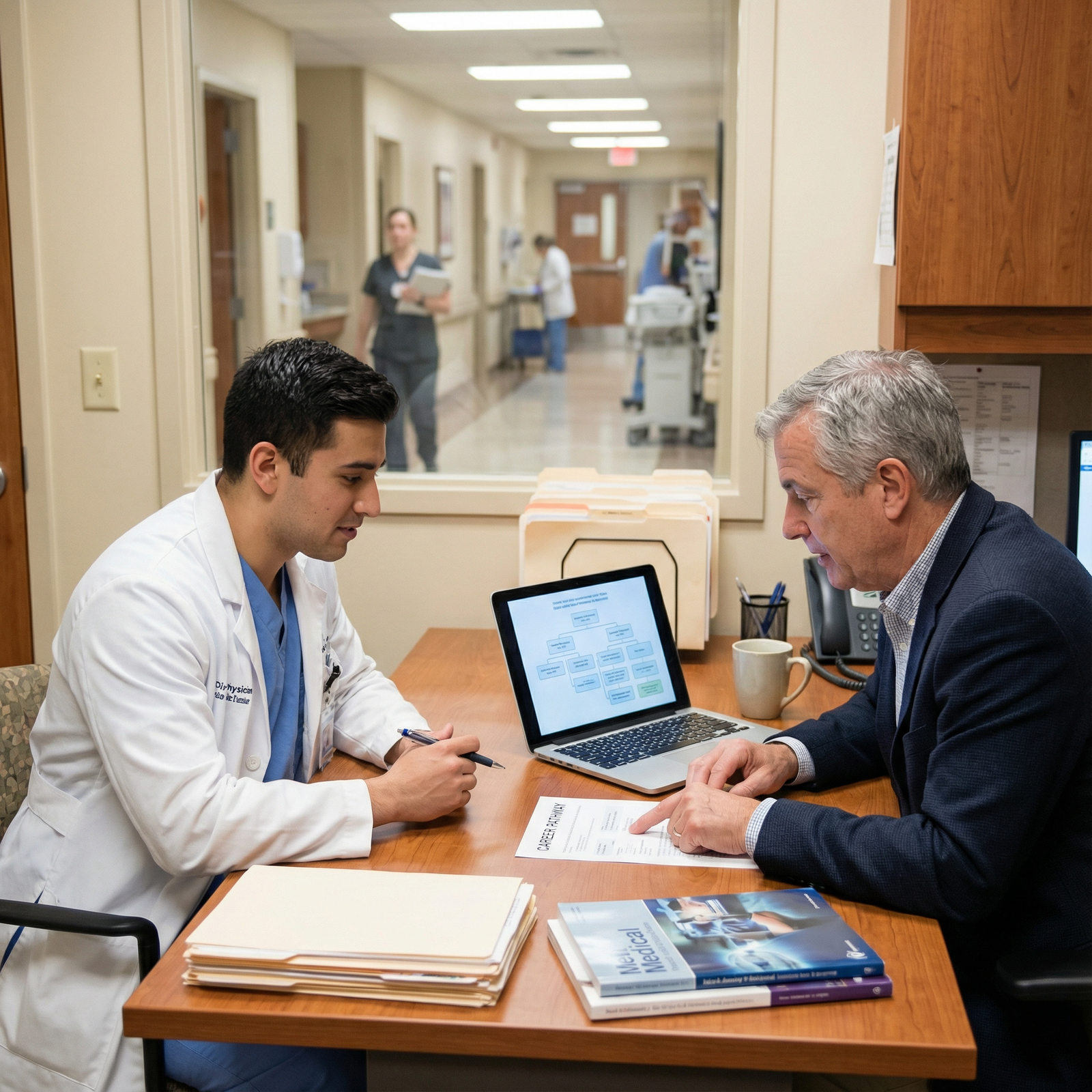
Audit Your Current Standing Before Day One
Before your first shift, do a brutal self-assessment. Pretend your career depends on it, because it does.
Step scores matter. If your Step 2 CK sits below the typical cutoff for your target specialty, accept that reality now. Some programs use hard filters. Others look at trajectory. Your prelim year is your chance to demonstrate academic recovery through clinical performance, high In-Training Exam scores, strong evaluations, case presentations. But you can't fake Step scores on paper. Be honest with yourself about which doors are still open.
(For more details on converting within your own program, see also: 6 Steps to Maximize the Same-System Conversion Opportunity During a Prelim Year.)
LoR landscape. Do you have a mentor in your target specialty? If not, you're starting from zero. The prelim year is your one window to build those relationships. Reach out early. Before July. I mean it.
CV gaps. Lack of publications? A quality improvement project that actually changes a workflow on your prelim service can substitute for bench research in many specialties. Programs want to see you can complete a project, not just assist on one. Own a QI initiative. Present it locally. Done.
Interview history. Go back and re-read your rejection notes from the cycle you didn't match. Were programs concerned about clinical exposure? Communication style? Specific deficits? Write these down. They're your roadmap for the next twelve months.
Don't skip this audit. Residents who skip it waste months spinning their wheels on the wrong priorities.
Navigating the IM Prelim: Maximizing Clinical Exposure
Internal medicine prelims rotate through ICU, floor medicine, ER, and consult services. Every single one of these is a networking opportunity, even if your target specialty seems far removed.
Treat each service strategically. On cardiology consults, express interest to the attending. On pulmonary, ask to present an interesting case at morning report. On nephrology, volunteer for the difficult admissions. You don't have to be a future cardiologist, but the attending writing your eval might know the cardiology PD who knows the PD in your actual target field. Medicine is small. Smaller than you think.
Master the handoff. This is non-negotiable. Competitive programs value residents who communicate clearly under pressure. Document meticulously. Verbalize your thought process during rounds, don't just read off the note. When you hand off a patient, the receiving team should know everything important within 90 seconds. Practice this until it's muscle memory.
Volunteer for the hard cases. Complex admissions, sick patients, family meetings, raise your hand. Show resilience and clinical reasoning under pressure. The intern who volunteers for the crashing ICU patient and survives the night earns a different kind of evaluation than the one who hides in the workroom.
The radar chart above shows what to aim toward. Passive interns hit baseline competence and call it a day. Active applicants push every dimension.
Navigating the Surgery Prelim: Proving Technical and Mental Fortitude
Surgery prelims operate under different rules. Precision, speed, anticipation, these are the currency. Culture matters as much as skill.
Be early. Stay late. Sounds cliché, but it's true. Surgical attendings notice the prelim who shows up fifteen minutes before the case starts and stays to close. They also notice the one who disappears the moment the attending leaves the room.
Develop technical skills aggressively. Practice knot tying, laparoscopic pegboard tasks, and basic suturing in the simulation lab during off-hours. When you're in the OR and the attending says "close the skin," you want your closure to be clean, fast, and tight. Show initiative in the sim lab. Sign up for FLS training modules. Make yourself useful.
Build relationships across surgical sub-specialties. Here's something people miss: Urology, ENT, Plastic Surgery, and Orthopedic Surgery attendings all work in the same ORs as general surgeons. The plastic surgeon you scrub with today might be the person interviewing you next year. Treat everyone, residents, attendings, scrub techs, nurses, with the same respect. Word travels fast in surgical departments.
Demonstrate non-technical skills. Teamwork under stress. Conflict resolution between disagreeing consultants. Calmness when a patient codes on the floor. Surgical sub-specialty interviews heavily weight these. Be the resident everyone wants on their team.
Building Your Subspecialty Network During the Open Slots
Networking during a prelim year isn't optional. It's the job.
Begin outreach in month three. Not month six. Not "after I settle in." By March of your intern year, you should be contacting programs in your target specialty. Why? Because interview slots fill. Because programs need time to evaluate you. Because the application cycle for PGY-2 categorical positions often opens earlier than the regular match.
Craft targeted emails. Attach your CV. Highlight specific rotations or projects relevant to the field. Mention explicitly that you're a prelim PGY-1 seeking a categorical spot for the following year. Don't bury the lede, program directors need to understand your situation immediately.
Attend conferences strategically. If you've got an abstract, present it. Even without a presentation, show up to local or national meetings in your target specialty. Stand at the booth. Talk to program directors. Yes, in person. Yes, it's awkward. Do it anyway.
Leverage the residents in your target specialty. Connect with PGY-2s and PGY-3s. Ask what their program director values. Ask about open spots. Ask if they'd refer you internally when a categorical position opens mid-year. Residents know before anyone else when positions become available.
The timeline above assumes a smooth process. Most aren't. Some prelims secure categorical spots through mid-year openings rather than the formal match. Build relationships continuously, you never know when someone will call.
Crafting Your Narrative: Turning the Pivot into Strength
The interview is where prelim applicants lose. Not because they lack credentials, because they apologize for their path. Stop that immediately.
Own your journey. You're not a "re-applicant." You're a resident who chose a preliminary year to gain broader clinical maturity before specializing. That's the frame. Hold it firmly.
Show growth metrics. Specific progression. "In month one, I managed routine floor patients. By month six, I led a code blue and ran a family meeting for an end-of-life decision." Demonstrate trajectory, not stasis. Programs want to see the arrow pointing up.
Connect experiences explicitly to your target specialty. Applying for Neurology? Talk about your neuro-consults. Applying for Radiology? Reference your pulmonary cases where imaging dictated management. Make the link concrete and obvious. Don't assume they'll connect the dots.
Prove commitment. Programs fear prelim graduates are "unmatched rejects" who'll jump ship. Show through consistent engagement, research projects, conference attendance, longitudinal mentorship in the field, that you're in this for the long haul. Reassurance is part of the interview.** Demonstrate it through actions, not just words.
Action Plan: The Final Months Before Match Week
The last stretch is where careers are made or lost. Don't coast.
Lock down strong letters of recommendation. Request LoRs specifically from leaders in your target specialty, not just your prelim program director. Ask early. Provide your CV, personal statement draft, and a brief summary of your goals. Make their job easy.
Refine your personal statement. It should reflect the unique perspective gained during your prelim year. Resilience. Adaptability. Refined clinical focus. Avoid clichés. Programs read hundreds of these, stand out with a specific patient story or a clear professional turning point.
Prepare for behavioral questions. Expect the hard ones: handling a patient death, working in an unfamiliar team, why you chose this specialty, what you learned from your prelim year. Have specific examples ready. Use the CAR method, Challenge, Action, Result. Practice out loud. Practicing silently doesn't count.
Stay healthy. Avoid burnout. The last six months of intern year break more people than the first six. Maintain sleep hygiene, exercise regularly, and protect your social connections. You cannot perform well in interviews if you're running on fumes.
The prelim year is a high-stakes audition. Treat every rotation as a networking opportunity for your next specialty. Start proactive outreach by month three or four, passive waiting guarantees continued instability. Frame your prelim status as a strategic advantage, not a deficit.
You've got twelve months. Make a plan this week. Email one program director. Volunteer for one rotation outside your comfort zone. Start the QI project you've been thinking about.
The difference between another year of limbo and a categorical contract comes down to what you do between now and Match Day. Stop waiting for someone to notice you. Go make it impossible to ignore you.
For more situation-specific residency guidance, subscribe below or explore our other match strategy articles.