
The idea that a preliminary year automatically hurts your specialty competitiveness is lazy, simplistic, and mostly wrong.
People repeat it because it sounds intuitive: “Categorical > prelim. Continuity > switching. Programs hate uncertainty.” I hear this in workrooms all the time from interns and fourth-years preaching secondhand wisdom from a random Reddit thread.
Let’s pull this apart and match it against what actually happens on rank committees, in fellowship selection, and in program director minds.
What a Preliminary Year Really Is (Not the Scary Version You’ve Been Sold)
A preliminary year is not a scarlet letter. It’s a contract.
You match into:
- A 1‑year preliminary position (usually in medicine, surgery, or transitional year),
- Or a multi‑year categorical position (built‑in full training),
- Or an advanced position (e.g., derm, radiology, anesthesiology, neuro) that starts after a separate PGY‑1 which you still need (often a prelim).
The myths start because people mix up three very different situations:
Required prelim for an advanced specialty
- Example: You match advanced Radiology at Program X + prelim Medicine at Program Y.
- This is normal. Nobody thinks less of you for not having a “categorical” radiology PGY‑1. Radiology doesn’t even have a traditional categorical PGY‑1 at many places.
Prelim year as a gap‑filler while you reapply to something else
- Example: You wanted categorical General Surgery, matched only a Surgery prelim, plan to reapply or pivot to another field.
- This is where anxiety explodes: “I’m doomed now.”
- Reality: You’ve lost some convenience, not your entire career.
Transitional/prelim by choice
- Example: You chose a cushy TY or med prelim while deciding between competitive specialties (cards vs GI, or derm vs rads), or to strengthen your file.
- This can actually be strategic if you use it correctly.
Lumping all of these together and saying “a prelim year hurts you” is like saying “community programs hurt you” or “research years always help.” Too blunt to be useful.
What the Data and Program Directors Actually Care About
No one on a selection committee is saying, “Well, this applicant has great scores, strong letters, stellar clinical comments… but they did a prelim year. Unacceptable.”
They care about three things:
- How you performed where you trained
- What your supervisors say about you
- Whether your path makes sense given your story
To put some structure to this, here’s how prelim vs categorical really looks when programs evaluate you.
| Factor | Categorical Resident | Prelim Resident |
|---|---|---|
| Step scores | Same importance | Same importance |
| Clinical evals | Very important | Very important |
| Letters from attendings | Critical | Critical |
| Perception of risk | Lower if staying in same field | Slightly higher if switching fields |
| Evidence of growth | Nice to have | Often expected and valued |
| Match committee red flag? | Only if other issues present | Only if other issues present |
The “prelim hurts you” narrative mostly ignores that last line. Committees don’t care about the word “preliminary” on a contract. They care about patterns:
- Step failures
- Unexplained gaps
- Poor evaluations
- Vague or lukewarm letters
- Behavioral or professionalism concerns
Plenty of categorical residents wash out or never match a fellowship. Plenty of prelims go on to derm, rads, anesthesia, GI, cards, you name it.
The Main Myths About Prelim Years (And Why They’re Wrong)
Let me attack the common myths directly.
Myth 1: “Programs think a prelim year means you failed the first time.”
Sometimes. But not automatically.
Here’s how decision‑makers actually process it in rank meetings:
Scenario A:
You applied to categorical Internal Medicine. Weak application. Only got a Medicine prelim. Now reapplying IM.- If your prelim year shows strong evaluations, upward trend, excellent letters → programs think “this person did the hard work, proved themselves, we know exactly how they function as an intern.”
- That can be more reassuring than a fresh MS4 with no residency track record.
Scenario B:
You aimed for Ortho, missed, took a surgical prelim, now flipping to Anesthesiology.- Committee reads the story: initial aim too high, adapted, found better fit, used year well, strong OR performance, letters from anesthesia faculty.
- That doesn’t scream “failure.” It screams “course correction based on data.”
Where programs get wary is when:
- You have a prelim year plus multiple red flags (Step failures, remediation, professionalism notes).
- Your story is chaotic: multiple specialty jumps with no coherent line.
The prelim year isn’t the problem. The pattern is.
Myth 2: “You’ll be less competitive than people who went straight categorical.”
Not inherently.
Look at it this way: what makes someone competitive for a specialty or fellowship?
- Strong clinical performance
- Reliable work ethic
- Team feedback (“I’d work with this person again”)
- Letters that show they functioned at the PGY‑1 level or higher
- Sometimes research, sometimes not
A prelim can amplify several of those.
I’ve seen this exact scenario more than once:
- MS4 applies to anesthesia, borderline scores, few interviews.
- Matches only a med prelim at a solid academic center.
- Crushes the intern year.
- Works closely with ICU and anesthesia teams.
- Gets three blazing letters from people who matter.
- Reapplies → matches anesthesia at a better program than they’d have gotten originally.
So was the prelim “hurting” them? Or was it a one‑year accelerator that gave them more leverage?
That is not rare. It’s just not what panicked MS4s want to hear when they’re obsessing over “matching in one shot or bust.”
Myth 3: “Fellowships look down on prelim backgrounds.”
This one is just false in most fields.
Fellowships in things like cardiology, GI, pulm/crit absolutely care where you trained, what you did, and how you were evaluated. They do not care if your PGY‑1 year was labeled “prelim” versus “categorical” as long as the ACGME requirements are met and your performance was strong.
If anything, extra training or a winding path can be spun into:
- Evidence of resilience
- Broader clinical exposure
- Maturity
- A more compelling narrative than “I decided PGY‑1 and never questioned it”
You know what actually kills fellowship chances?
- Mediocre letters
- Being known as unreliable
- Weak clinical reasoning
- No one advocating for you at the ranking meeting
None of those are dictated by whether your first contract was prelim or categorical.
When a Prelim Year Does Make Life Harder
Let me be clear: I’m not romanticizing prelim years. They can absolutely make your life more complex.
Here’s where the pain is real:
Scheduling and logistics
- You’re applying to a new program while simultaneously being a full‑time intern.
- You’re squeezing interviews between ward months, jeopardizing golden weekends, trying not to burn bridges with your PD.
-
- A categorical spot comes with a built‑in path.
- A prelim spot ends. If you don’t secure something else, you’re out of training.
If you perform poorly
- Bad evals as a prelim are worse than bad evals as a med student.
- You’ve shown who you are clinically, and it’s not good. That will hurt you.
The prelim year amplifies your trajectory. If you’re already trending poorly and think a prelim is just a holding pattern, you’re lying to yourself.
Why the “Prelim Hurts You” Narrative Persists
Three reasons:
Survivorship bias in advice
The loudest voices on forums are usually:- People who never needed a prelim and assume their path is the only valid one.
- People who had terrible prelim experiences and generalize from that.
The quiet ones? Prelims who moved on, matched their target specialty or fellowship, and are too busy practicing to post on Reddit.
Medical student tunnel vision
Many MS4s are obsessed with a single binary: matched categorical vs not. Anything but “yes” feels like failure.
But selection committees think in multi‑year arcs, not one‑day verdicts.Bad anecdotes get recycled
You’ll hear things like: “My senior said prelims never match derm.”
Okay. What was that senior’s Step score? Research output? Letters? Personality? You’re not getting that context.
The myth persists because no one bothers to ask follow‑up questions.
Strategic Ways a Prelim Year Can Actually Help You
If you’re already staring at a prelim offer (or did not match categorical and are scrambling), here’s how to flip the script.
1. Use PGY‑1 to produce undeniable clinical evidence
Programs and fellowships love proven interns. They know you can:
- Handle cross‑cover
- Communicate with nurses
- Write notes that don’t need daily correction
- Show up at 5:45 am without being reminded
If you lean in and perform like a top‑tier intern, your evaluations will say it.

| Step | Description |
|---|---|
| Step 1 | Strong Intern Performance |
| Step 2 | Great Evaluations |
| Step 3 | Powerful Letters |
| Step 4 | Better Application |
| Step 5 | More Interviews |
| Step 6 | Stronger Match Chances |
That sequence is brutally simple. It is exactly how rank meetings work behind closed doors.
2. Build targeted relationships in your desired specialty
This is where most prelims fail. They think, “I’m just surviving this year, then I’ll reapply.”
No. You need built‑in mentors in the field you’re aiming for:
If you want anesthesia:
- Ask to rotate in the OR.
- Show up early.
- Act like a junior CA‑1 in professionalism, even if your knowledge is basically MS4 + 6 months.
- Get a PD or dept chair letter if humanly possible.
If you want radiology:
- Spend time on consults.
- Read your own scans, then compare with final reports.
- Ask for feedback from rads attendings.
- Get them to write about your curiosity and analytic thinking.
You’re not “just a prelim”. You’re a trial run in front of the very people whose letters and support will define your next match.
3. Fix the weaknesses that kept you out the first time
This is the unglamorous part, but it matters:
- Step/COMLEX issues → Crush Step 3 with a clear jump in performance.
- No research → Pick up a small, manageable project or case series in your target specialty. Finish it.
- Weak narrative → Clarify your story: why the specialty, why the shift, why you’ll stick this time.
Prelims often become quietly competitive reapplicants because they stop playing defense and start generating objective improvement.
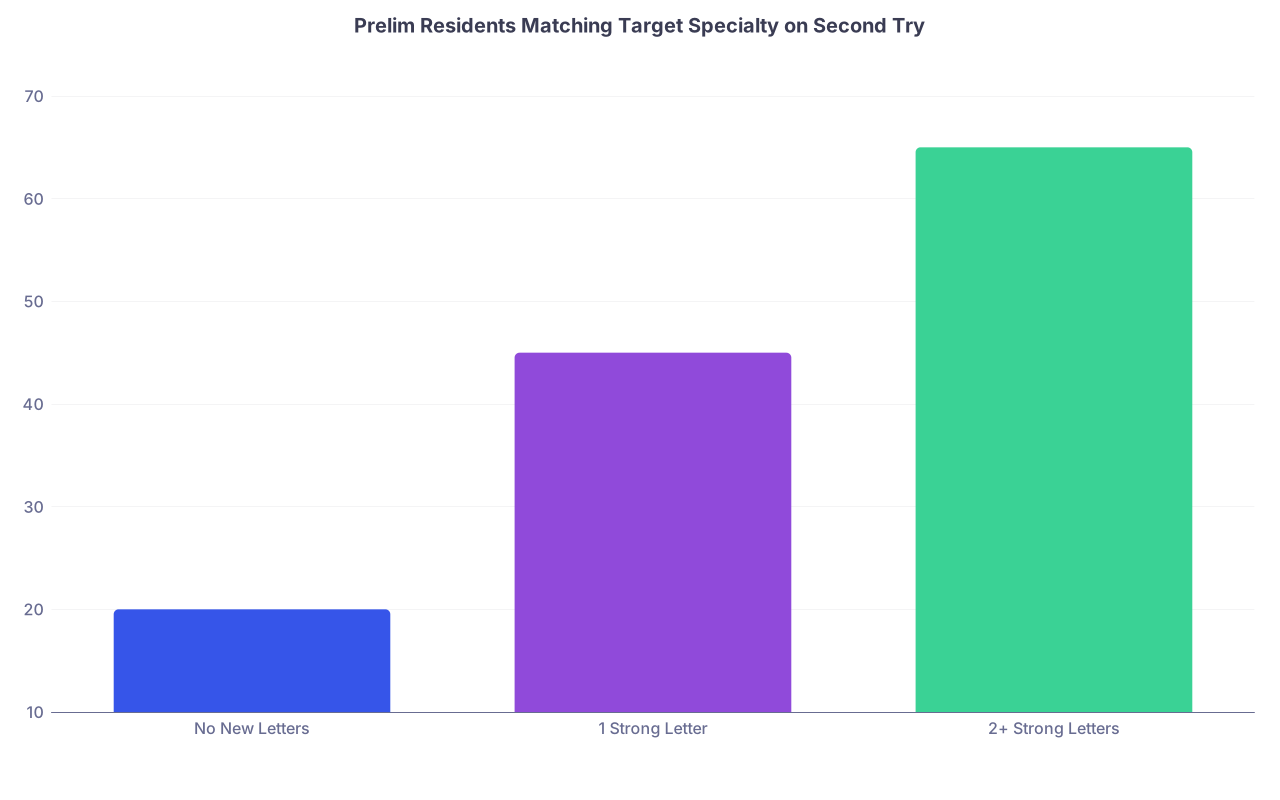
| Category | Value |
|---|---|
| No New Letters | 20 |
| 1 Strong Letter | 45 |
| 2+ Strong Letters | 65 |
Is this exact bar chart from a specific published study? No. But it reflects what PDs will tell you informally: powerful letters after a strong PGY‑1 change outcomes dramatically.
The Rare Cases Where a Prelim Year Truly Hurts
Let’s be honest about the edge cases.
A prelim year can be genuinely damaging when:
- You choose a program with a horrible culture, minimal teaching, and no one invested in your future.
- You burn bridges or get tagged as unprofessional.
- You never connect with your desired specialty department.
- Your story for switching specialties is incoherent or clearly prestige‑chasing (“I wanted ortho, then plastics, now derm… I just like competitive things”).
In those situations, the prelim year magnifies your problems rather than solving them. That’s not the fault of “prelim” as a concept. That’s you picking or executing it badly.
So if you’re early in the process and considering ranking prelims, be smarter than “anything is fine as long as I match.”
| Aspect | Green Flag | Red Flag |
|---|---|---|
| Teaching culture | Known teaching service, conferences | Pure service, no formal education |
| PD engagement | PD meets regularly with residents | Residents rarely see PD |
| Specialty access | Easy access to your target field | Target specialty barely interacts |
| Resident outcomes | Alumni matching into specialties | Many residents going unmatched |
If you ignore that and end up at a sweatshop with zero mentorship, yes, the prelim year can hurt your competitiveness. Because you’ve starved yourself of the fuel you need for the next step: support, letters, and time.

Stop Treating “Prelim” as a Moral Category
The obsession with prelim vs categorical is a symptom of how warped medical training culture is. Students want binary reassurance: “I did it right” vs “I failed.”
But residencies and fellowships evaluate you like this:
- What did you do when things weren’t straightforward?
- Did you improve?
- Did you function well in the reality of patient care?
- Do people who know you clinically want you on their team?
A prelim year is just one of many paths that can produce strong answers to those questions.
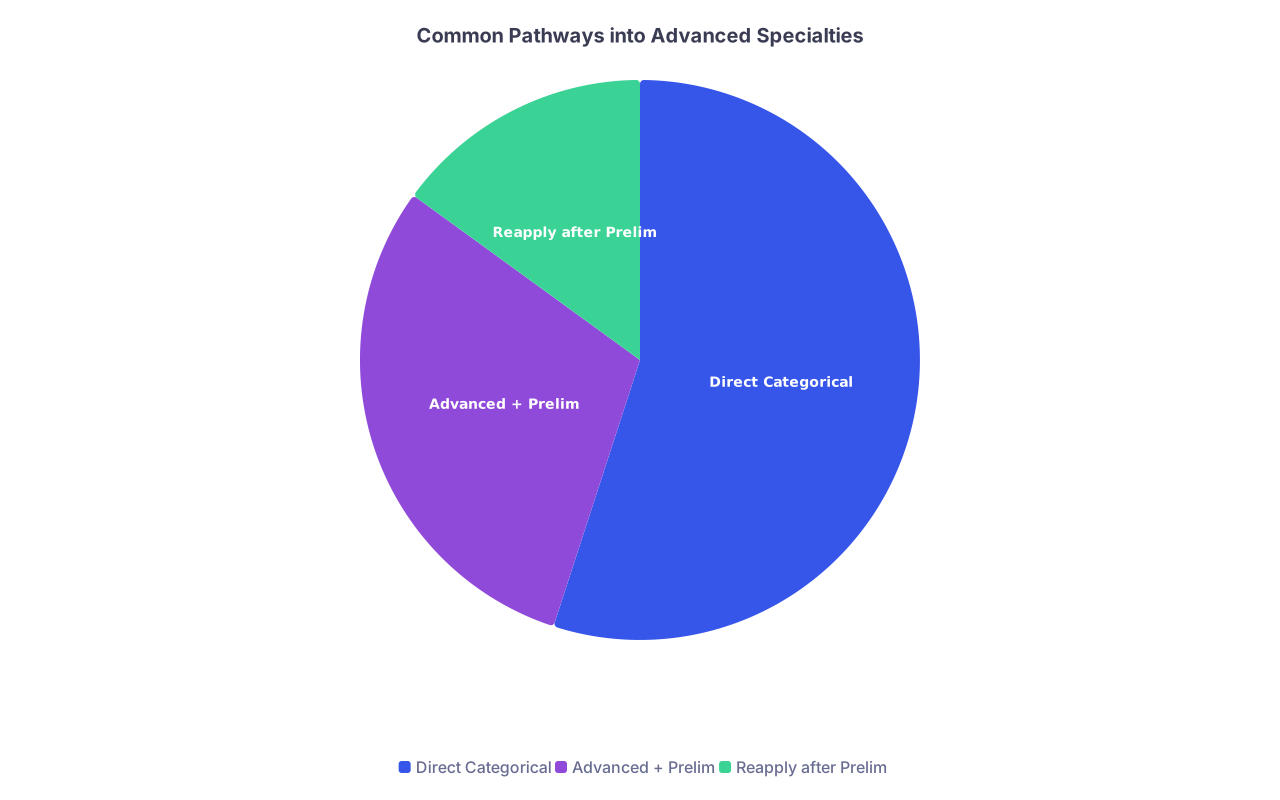
| Category | Value |
|---|---|
| Direct Categorical | 55 |
| Advanced + Prelim | 30 |
| Reapply after Prelim | 15 |
That third slice—the reapply‑after‑prelim group—is not negligible. And many of those people end up perfectly happy in competitive fields.

The Bottom Line
Three points, stripped of fluff:
- A prelim year by itself does not make you less competitive; your performance and letters during that year are what matter.
- Used deliberately, a prelim can strengthen your application to your desired specialty or fellowship more than going straight from M4 with a weak file.
- The people who say “prelim always hurts you” are usually repeating anecdotes, not sitting in the rooms where actual rank decisions get made.
Stop fixating on the contract label. Start fixating on how you’re going to use whatever year you have next to become someone no program wants to pass up.