
What if I told you your “easy” transitional year might be the most miserable, disorganized year of your training—and that a “brutal” medicine prelim could actually be more predictable and safer for your sanity?
Let’s dismantle the fantasy marketing around prelim and TY years.
Everyone in the match talks the same way:
- “Transitional year is the chill lifestyle option.”
- “Medicine prelim is for masochists who like notes and cross-cover.”
- “If you can, just rank any TY over a prelim year.”
This is how people talk on Reddit, in group chats, and yes, in some advising meetings when folks are being “off the record.”
It’s also wrong. Or at least massively oversimplified.
If you’re applying to advanced specialties (derm, rad onc, rads, anesthesia, ophtho, neuro, PM&R, etc.) and you need a prelim year, you’re about to make one of the highest-stakes decisions of your training based on half-true clichés.
Let’s fix that.
What a Preliminary Year Actually Is (Not the Fantasy Version)
A preliminary (prelim) year is a 1-year PGY-1 position that does not lead to completion of a full residency in that specialty. You do it before starting your advanced program.
Two common flavors you’re staring at:
- Transitional Year (TY)
- Preliminary Internal Medicine (Medicine Prelim)
There are also surgical prelims, but I’ll stay focused on TY vs medicine prelim since that’s where the “lifestyle” myth gets weaponized.
Here’s the hard truth:
You cannot generalize lifestyle from the label “TY” or “prelim IM.”
You can only generalize from:
- The rotation schedule
- The call structure
- The program culture and expectations
- The hospital’s patient volume and staffing
But let’s lay out the structural differences first.
| Feature | Transitional Year (TY) | Medicine Prelim |
|---|---|---|
| Core identity | Mixed disciplines, broad base | Pure internal medicine platform |
| Typical inpatient | Less than IM (varies a lot) | Heavy inpatient IM |
| Outpatient block | Usually more | Usually less |
| Elective time | Often more | More limited |
| Ownership of patients | Shared / variable | High, primary team responsibility |
Now let’s smash the myths.
Myth 1: “Transitional Year is Always Easier”
This is the big one. People say it like it’s a law of physics.
Here’s what the data actually shows from real schedules I’ve seen and residents I’ve worked with:
- Some TYs are legit easier: more electives, lighter call, minimal nights, lots of outpatient.
- Some TYs are indistinguishable from hard medicine prelims: Q4–Q5 call, heavy floor months, frequent admits, toxic scut culture.
- A few TYs are worse than medicine prelims: chaotic rotation mix, zero ownership, constant adjustment to new teams and systems, and no unified identity as “your people.”
The variability is massive. More than for medicine prelims.
I’ve seen this play out:
A “cush” community TY:
- 3–4 months inpatient medicine
- 1 month ER
- 1 ICU
- 4–5 months electives (including research, radiology, clinic blocks)
- Home call or no call on several rotations
A malignant TY at a busy hospital:
- 5–6 months inpatient (medicine, nights, ICU)
- Q4 call, lots of cross-cover
- Minimal elective flexibility
- Residents function as extra bodies to plug service gaps
Same label: “Transitional Year.” Very different lives.
So no, TY ≠ easy.
TY = variable.
If you rank purely based on the word “transitional” without scrutinizing the schedule, you’re gambling, not planning.
Myth 2: “Medicine Prelim is Guaranteed Misery”
The opposite myth: that a prelim medicine year is a guaranteed burnout factory.
Let’s be blunt. Many medicine prelim years are rough:
- Lots of inpatient ward months
- Nights
- Admitting and cross-covering for services that barely know your name
- Often treated as disposable because you’re not categorical
But “hard” is not the whole story. You need to separate:
- Workload from
- Predictability and structure
Many medicine prelim programs:
- Have a clear rotation template for prelims
- Know exactly what to do with one-year residents
- Integrate prelims into resident education and conferences
- Run on a system that’s been stable for years
In other words: they’re hard but coherent.
Sometimes that’s actually less painful than a dysfunctional “chill” TY where:
- Nobody owns you
- Schedules shift last minute
- Expectations vary wildly each month
- You’re constantly learning new workflows and EMR layouts
I’ve heard more than one PGY-2 say, “My prelim IM year was brutal, but I knew what my life looked like month to month. It was survivable.”
Meanwhile, some TY grads describe the year as “death by disorganization.”
Workload is not the only variable that drives suffering. Chaos matters. Lack of identity matters. Feeling like an afterthought matters.
Prelim medicine is rarely easy, but it’s often consistent. That counts.
Myth 3: “Transitional Year is the Better Lifestyle Choice for Every Advanced Specialty”
This is the lazy advising line:
“If you’re going into derm, rads, rad onc, etc., just do a TY. Better lifestyle.”
Let’s drag that into the light.
Here’s what programs actually tend to care about:
- You can handle inpatient medicine.
- You can manage common emergencies.
- You can function independently by day one of PGY-2.
- You didn’t spend your entire PGY-1 year hiding from responsibility.
An easy, outpatient-heavy TY can be amazing for your sanity. But there’s a trade-off:
- If you do almost no true inpatient work:
- You’ll be rusty managing sepsis, DKA, CHF, GI bleeds.
- Your “sick patient” radar will be dimmer.
- Your comfort with overnight cross-cover or consults will lag.
Some advanced programs know this and quietly prefer:
- Medicine-heavy TYs or
- Straight-up prelim IM
Not all will say it out loud. But they notice.
And some of the top TYs (think established academic TYs that radiology and derm folks hoard) are not that light. They’re just well-structured and not malignant.
Lifestyle is not just “less inpatient.” Lifestyle is:
- Reasonable caps
- Not getting destroyed on nights
- Attendings who teach instead of bark
- A program that doesn’t treat you like a warm body
I’ve seen a supposedly “easy” TY with constant last-minute schedule changes, random weekend add-ons, and no backup when someone calls out. Residents were fried.
Meanwhile, a high-volume prelim IM at a well-run academic center had:
- Packed days
- But protected days off
- Stable rotation templates
- A culture where seniors actually helped
Who has the better lifestyle? The label won’t tell you.
Myth 4: “You Just Need Any PGY-1 — Advanced Programs Don’t Care Which”
Another comforting lie:
“As long as you get a PGY-1 somewhere, your advanced program won’t care if it’s TY or prelim.”
Not true.
Some advanced programs explicitly say they require or strongly prefer:
- An intern year with significant internal medicine exposure
(often at least 6 months inpatient or combined wards + ICU)
Others unofficially rank applicants from:
- Solid medicine heavy TY / prelim IM at reputable places
- Questionable TYs with almost no real inpatient exposure
They may not reject you for a cush TY, but you can absolutely start PGY-2 behind your co-residents in clinical chops.
Also, if you’re applying to a competitive advanced field, the prestige and rigor of your intern year can matter for fellowships and job hunting later.
I’ve seen CVs where a respected prelim IM or TY at a big academic place was clearly a plus.
Is that fair? Not always. But it happens.
You’re not “just getting a PGY-1 box checked.” You’re setting up your clinical reputation.
What Actually Matters: Specific, Boring Details
Here’s where you should stop thinking in labels and start acting like someone who reads contracts:

Ask for the rotation breakdown. Scrutinize it.
| Rotation Type | Example TY Program | Example Prelim IM Program |
|---|---|---|
| Inpatient Medicine | 3 months | 6 months |
| ICU | 1 month | 1–2 months |
| Nights | 1 month | 1–2 months |
| ED | 1 month | 0–1 month |
| Electives/Outpatient | 6 months | 2–3 months |
Now the real questions:
- What’s the night float vs 24-hour call breakdown?
- What’s the cap on patients per intern?
- Are prelims/TYs used as filler on bad services?
- Are you attending same-site as your advanced program? (huge benefit for continuity and reputation)
- Do prelims/TYs attend morning report, didactics, conferences like categoricals?
If a program won’t give you honest, concrete answers about these, that’s data too.
Now look at this from a high level:
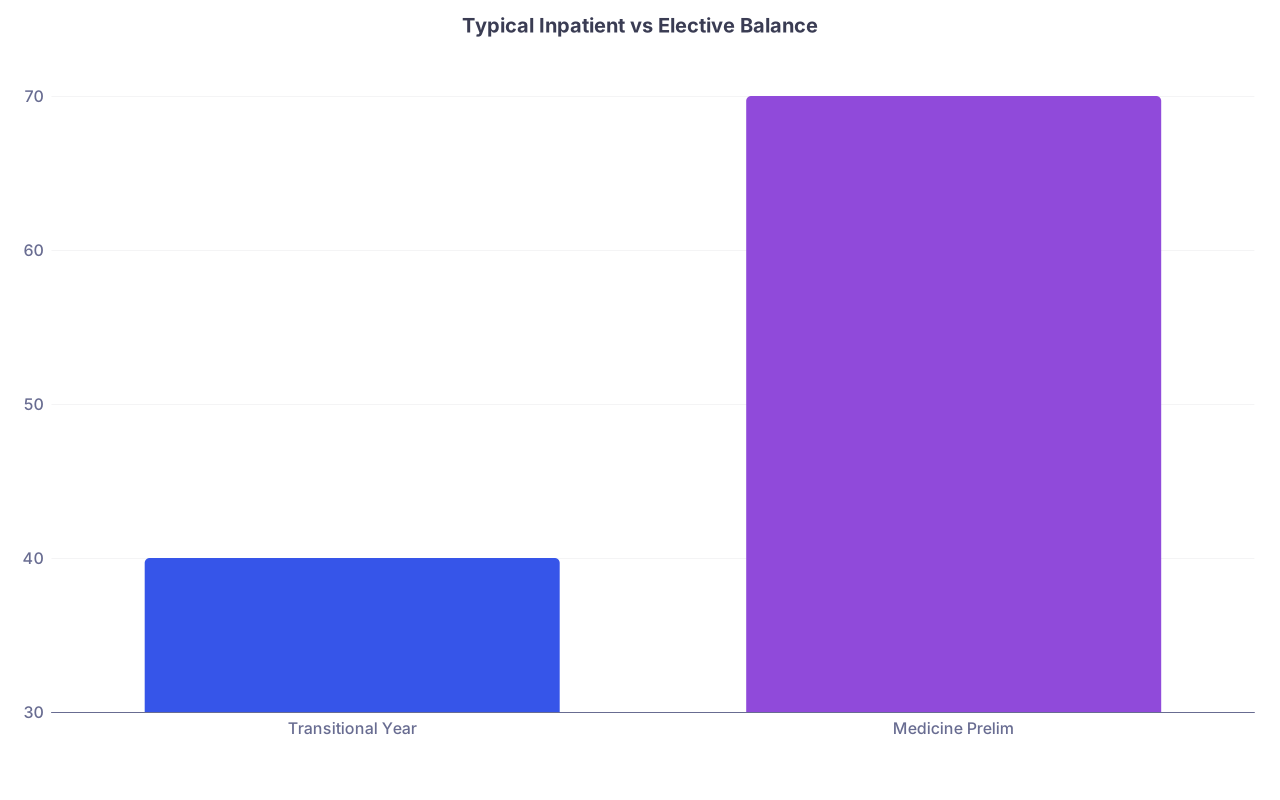
| Category | Value |
|---|---|
| Transitional Year | 40 |
| Medicine Prelim | 70 |
Think: those “40” vs “70” percent inpatient months don’t tell you call intensity, culture, or chaos—but they hint at training focus. You fill in the rest with real conversations.
The Quiet Factor: Identity and Cohesion
This part nobody talks about on SDN spreadsheets.
In a prelim IM year, you:
- Have a home department (medicine)
- Have a group of co-residents doing the same basic job
- Attend the same conferences
- Often feel like a slightly-shorter-term version of the categoricals
In many TYs, you:
- Bounce between departments (medicine, surgery, ER, subspecialties)
- Rarely feel anchored to one resident class
- May not have a clear “we’re your people” group
For some personalities, the variety is fantastic.
For others, it’s isolating and exhausting.
I’ve seen TY residents say they felt like guests everywhere and belong nowhere. That wears on you during a tough year.
Predictable misery with a tribe sometimes beats “lighter” chaos as an orphan.
A Process That Actually Works: How to Choose
Here’s a sane way to decide between TY vs prelim medicine that doesn’t rely on myths.

| Step | Description |
|---|---|
| Step 1 | Need PGY 1 year |
| Step 2 | Lean to Prelim IM or IM heavy TY |
| Step 3 | Consider reputable TY with structure |
| Step 4 | Prelim IM at well run program |
| Step 5 | Rank higher |
| Step 6 | Drop down rank list |
| Step 7 | Advanced program preference? |
| Step 8 | You want more electives? |
| Step 9 | Schedule and call reasonable? |
Key filters I’d use:
Location with your advanced program
- Same institution or integrated? Big plus.
- You get continuity, familiarity, better evals.
Rotation map > label
- More ICU/wards = more pain now, more competence later.
- More electives = more lifestyle, but pick your poison intelligently.
Program reputation among residents
- Ask: “How are prelims/TYs treated here?” Not attendings—residents.
Call structure and night coverage
- Q4 28-hour call vs night float vs home call makes or breaks “lifestyle.”
How much true medicine do you want before PGY-2?
- If you’re nervous about sick patients: maybe skew to more IM, not less.
The Real Bottom Line

Let me strip it down.
A Transitional Year can be:
- A gem of a year: balanced, humane, with electives and time for life.
- Or a disorganized dumpster fire with random coverage and no identity.
A Medicine Prelim can be:
- A grind with long days and short nights, but stable, coherent, and respected.
- Or malignant and exploitative, like any bad residency.
The myths—
- “TY = easy lifestyle”
- “Prelim medicine = guaranteed misery”
- “Any PGY-1 is fine; programs don’t care which”
—are lazy shortcuts that ignore the reality: program-level variation dwarfs label-level differences.
If you want a usable mental model, use this one:
- Pick the best-run, least-malignant program you can find that:
- Gives you enough medicine to not be dangerous.
- Has a call structure you can survive.
- Treats one-year residents as actual trainees, not disposable coverage.
If that’s a TY, great.
If that’s a prelim IM, also great.
Key takeaways
- Don’t rank based on “Transitional” vs “Preliminary Medicine” on the ERAS header; rank based on the actual rotation schedule, call burden, and culture.
- Some TYs are harder than some prelim IMs; the idea that TYs are automatically easier or better lifestyle is a myth that will burn you if you believe it blindly.
- Your PGY-1 year sets your clinical foundation and reputation—choose structure, sanity, and solid medicine exposure over seductive but vague promises of an “easy” year.