
No, a preliminary year is not your magical backdoor into a categorical residency. Most of the time, it is exactly what the contract says: a one‑year job that ends.
If you’re treating a prelim year as a “trial run” that guarantees you a categorical spot later, you’re already in dangerous territory.
Let’s dismantle this fantasy properly.
What a Preliminary Year Actually Is (Not the Story You Hear on Reddit)
A preliminary year is a time‑limited, non‑renewable resident position. You are hired for one year. Full stop.
Prelim IM, prelim surgery, prelim transitional. Different flavors, same core truth: there is no built‑in promise of continuation. Even when programs imply they love to “take care of our own,” the actual contracts are deliberately structured so they don’t have to.
Here’s the core distinction people gloss over:
- Categorical position: multi‑year track, designed to take you all the way to board‑eligibility (e.g., 3 years IM, 5 years gen surg).
- Preliminary position: one‑year slot, often created for:
- Advanced specialties that require an intern year (radiology, anesthesia, neuro, derm, ophtho).
- Extra service coverage (cheap labor) for medicine or surgery without future obligation.
I’ve heard PDs explain it bluntly in closed‑door meetings: “Prelims cover our service needs. If we get a strong one and a spot opens, we might move them up. But we do not promise anything.”
That “might” is doing all the work, and applicants keep pretending it means “probably.”
The Big Myth: “Do a Prelim, Prove Yourself, They’ll Upgrade You”
Here’s the narrative applicants tell each other:
“I’ll take a prelim at a strong academic program. I’ll work hard, impress them, and once they see me in action they’ll convert me to categorical or help me slide into next year’s class.”
Reality: this happens, but it’s the exception, not the norm.
Programs use prelims as flexible workforce. They like the optionality. You want a guarantee. Your incentives are misaligned.
| Feature | Preliminary Year | Categorical Spot |
|---|---|---|
| Contract length | 1 year | 3–7 years |
| Implied continuation | None | Yes (barring problems) |
| Designed for board eligibility | No | Yes |
| Priority for resources | Lower | Higher |
| Built‑in back‑up plan | No | Yes (finish training) |
Have I seen prelims upgraded to categorical? Yes.
- The surgery prelim who got bumped into a PGY‑2 spot when someone quit.
- The prelim IM intern who was converted because an incoming categorical backed out last minute.
But let’s be clear: both of those were program emergencies, not promised plans. Those interns got lucky and happened to be competent and pleasant. If those vacancies hadn’t appeared, no conversion. No matter how “hard they worked.”
You can’t build a career strategy on other people quitting.
Programs’ Real Incentives (Not Their Interview‑Day Sales Pitch)
On interview day, you’ll hear lines like:
- “We consider our prelims part of the family.”
- “Several of our current categoricals started as prelims.”
- “We always advocate for our prelims.”
What you will not hear: actual numbers or probabilities.
Here’s why: structurally, prelims are designed to be disposable. That sounds harsh, but look at how programs use them.
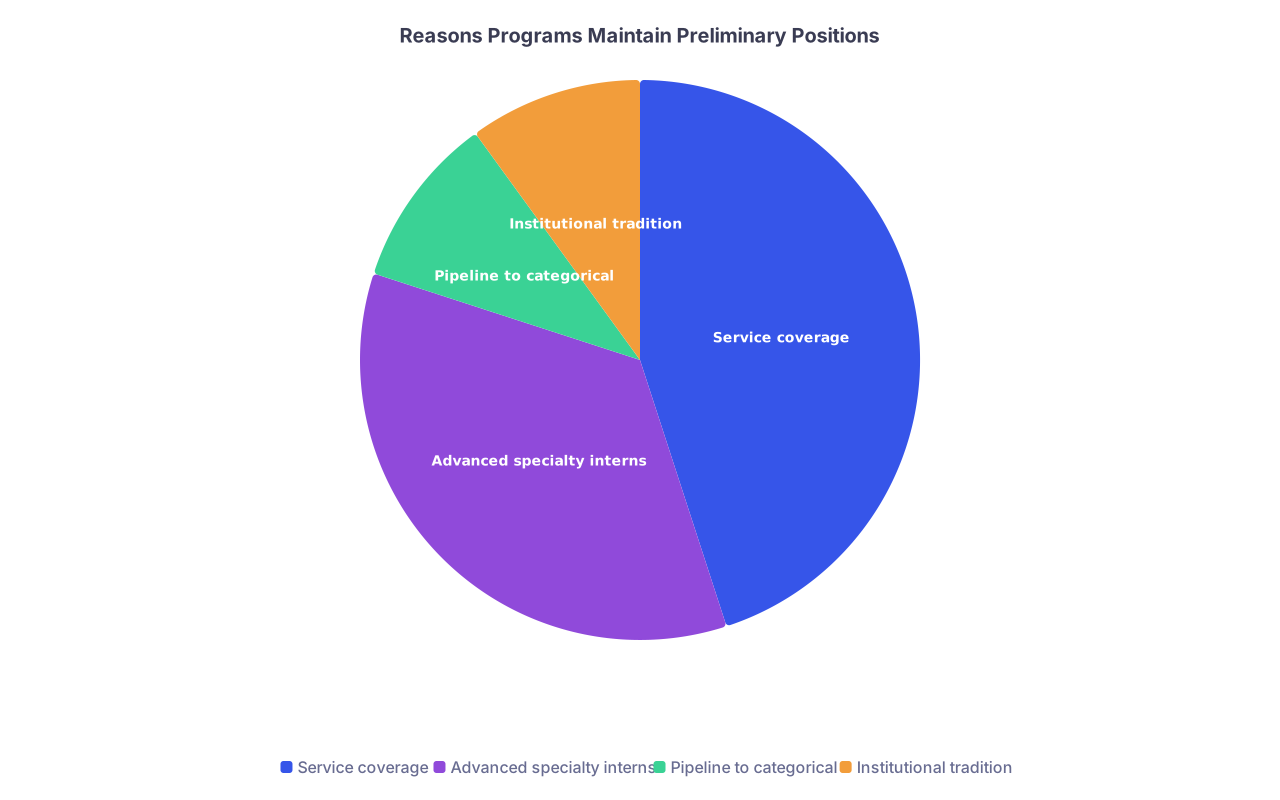
| Category | Value |
|---|---|
| Service coverage | 45 |
| Advanced specialty interns | 35 |
| Pipeline to categorical | 10 |
| Institutional tradition | 10 |
The pipeline angle—“we turn strong prelims into categoricals”—is the smallest slice.
Ask a straight question the next time you interview:
“How many prelims in the last 3 years have transitioned into categorical positions here?”
Watch how often you get:
- “Oh, I don’t have the exact numbers…”
- “It really depends on openings…”
- “We’ve had some success with that in the past…”
Translation: it is opportunistic, not systematic. You are an extra pair of hands in the call pool, not a protected, long‑term trainee.
I’ve heard chiefs assign schedules and literally say, “Give that rotation to the prelim; the categoricals need it for boards.” That’s your status in one sentence.
What the Match Data and Outcomes Actually Show
No, there isn’t a single neat NRMP table labeled “Prelims Upgraded to Categoricals Per Program.” But you can piece together the pattern from multiple sources and what happens on the ground.
Let’s look at a few realities:
Categorical spots are tightly controlled.
GME funding, specialty caps, and accreditation all limit how many residents a program can carry. They don’t just “create” categorical spots because they like you.Positions usually open for bad reasons.
People get fired. People quit for family, health, or burnout. Visas fall through. Couples match chaos. That’s when prelims sometimes have a shot. Sometimes.Most prelims do not stay at their prelim program for full training.
Ask around any large IM or surgery department. Most prelims are there one year, then scatter:- Some go into advanced positions they already matched.
- Some reapply and land categorical elsewhere.
- Some do a second prelim.
- Some leave medicine entirely.
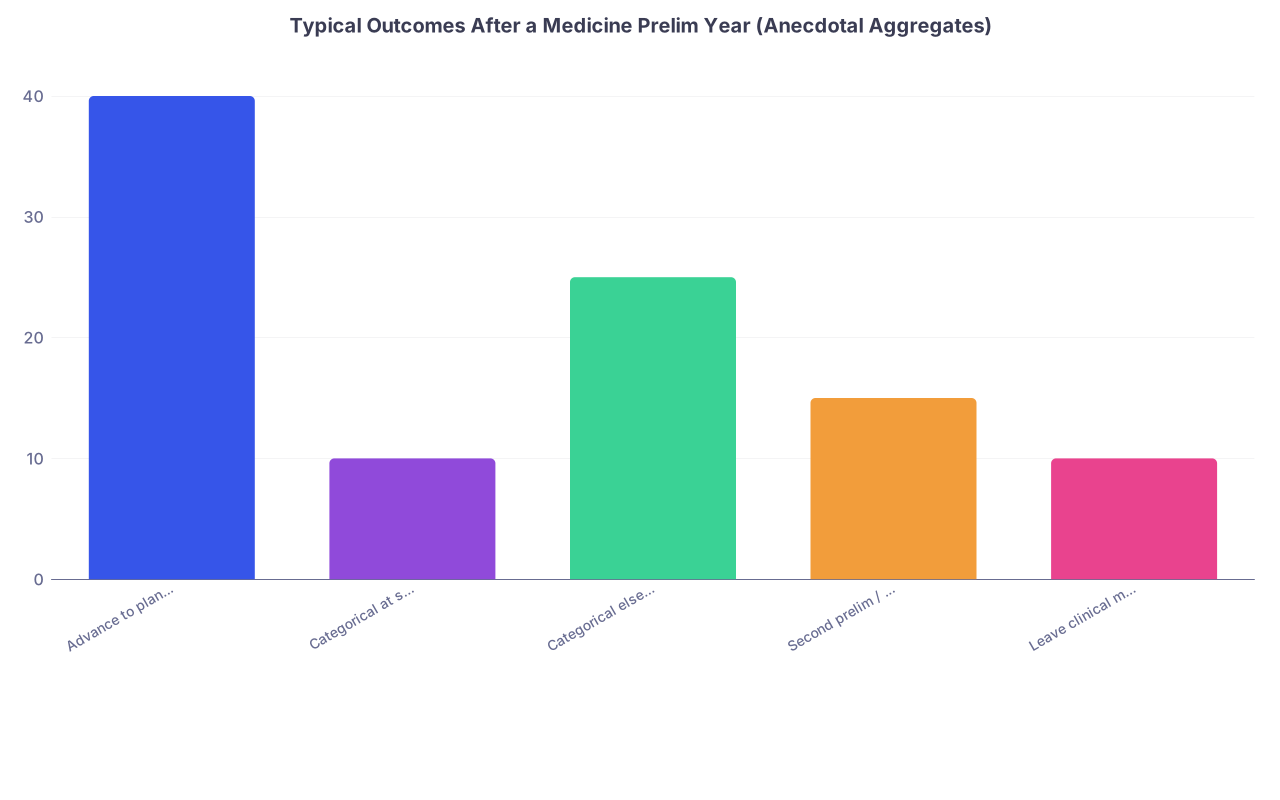
| Category | Value |
|---|---|
| Advance to planned specialty | 40 |
| Categorical at same hospital | 10 |
| Categorical elsewhere | 25 |
| Second prelim / delay | 15 |
| Leave clinical medicine | 10 |
These aren’t from a single dataset; they’re a composite of what you see across institutions: maybe 10–15% of prelims end up categorical at the same place. It varies a lot, but it is nowhere near “most,” and definitely not guaranteed.
If a dean or advisor tells you, “Just do a prelim there and they’ll probably take you,” they’re selling you a story that isn’t backed up by how programs actually function.
When a Prelim Makes Sense vs When It’s Self‑Sabotage
A prelim year is not automatically bad. It’s just often misused.
Here’s when a prelim year does make strategic sense:
You already matched into an advanced specialty (Rads, Anesthesia, Derm, etc.), and your prelim is simply your required PGY‑1.
In this case, you’re not trying to “convert” anything. You already have your categorical‑equivalent advanced spot.You didn’t match, but you truly have no other categorical offers and want to stay clinically active while reapplying.
But even then, you go in with clear eyes: this is a bridge, not a built‑in backdoor.You have a concrete plan to reapply during your intern year, and your prelim PD knows and supports that.
You’re not quietly hoping they’ll fall in love with you and magically create a slot.
Now the more common situation that gets people burned:
You rank a prelim IM or surgery position high thinking, “I’ll get my foot in the door at a big‑name place, prove myself, then they’ll take me as categorical next year.”
That’s fantasy. Especially at name‑brand programs where the categorical pipelines are insanely competitive and packed with AMGs, PhDs, research fellows, you name it.
Here’s the more honest version: if you’re using a prelim at a prestigious hospital as your “Plan A,” you don’t have a Plan A.
The Daily Reality of Being a Prelim (That No One Puts on Brochures)
The difference in status is not just on paper. You feel it.
Ask any prelim who’s been through it. The stories repeat:
- “All the categoricals had continuity clinic schedules carefully built to meet requirements. I got tossed wherever coverage was thin.”
- “I didn’t get priority for electives. The categoricals got the prime subspecialty months; I filled holes.”
- “Faculty kept asking me, ‘So what are you actually going into?’ with this subtle undertone of ‘you don’t really belong to us.’”

You’re there, but you’re not fully “of” the program. It’s like renting a room in a house where everyone else is on the mortgage.
Even well‑meaning programs fall into this. Their duty is to graduate their categoricals ready for boards. When rotation slots, procedure logs, research mentorship, or letter‑writing bandwidth are scarce, guess who gets deprioritized.
You.
If you go into a prelim banking on heroic mentorship and special favors that override institutional priorities, you’re setting yourself up for resentment.
The Reapplication Trap: “I’ll Just Reapply From My Prelim”
People also misjudge how brutal it is to reapply while doing a prelim.
You are working 60–80 hours a week, often with night float and q4 call, and somehow you’re supposed to:
- Re‑write and update your ERAS.
- Re‑request letters (again) from faculty who are busy and may barely remember you from med school.
- Interview on your rare golden weekends post‑call.
- Keep your performance solid enough that your prelim PD will write you a strong letter instead of a lukewarm “adequate but not exceptional.”
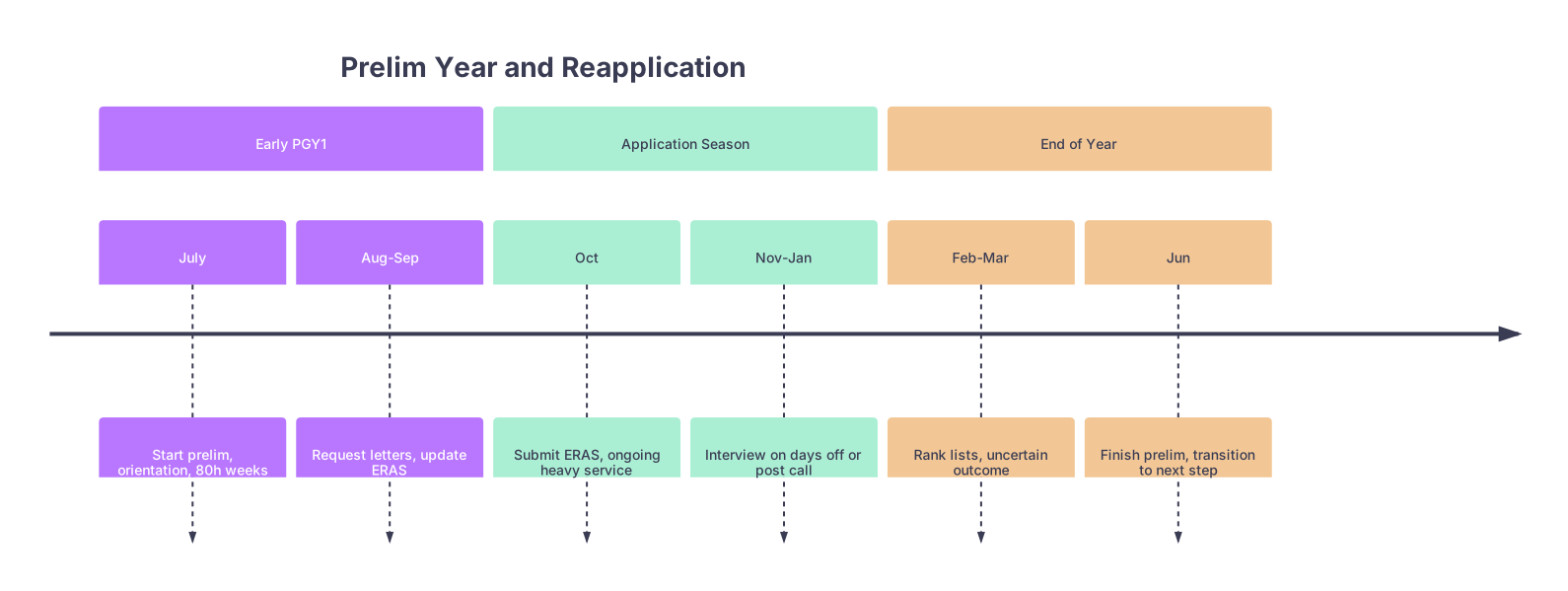
| Period | Event |
|---|---|
| Early PGY1 - July | Start prelim, orientation, 80h weeks |
| Early PGY1 - Aug-Sep | Request letters, update ERAS |
| Application Season - Oct | Submit ERAS, ongoing heavy service |
| Application Season - Nov-Jan | Interview on days off or post call |
| End of Year - Feb-Mar | Rank lists, uncertain outcome |
| End of Year - Jun | Finish prelim, transition to next step |
I’ve watched prelims try to attend Zoom interviews at 8 p.m. post‑call, looking half‑dead, apologizing for pager interruptions. They’re not less capable than their categorical co‑applicants. They’re just exhausted.
That exhaustion shows. Program directors see it.
If you’re going to play this game, you need to be brutally organized and clear‑eyed. And you still shouldn’t pretend the prelim program is your security blanket.
How to Use a Prelim Year Intelligently (If You End Up There)
If you match into a prelim year without a secure advanced or categorical spot lined up, you’re in a high‑risk, high‑uncertainty situation. Not doomed. But precarious.
Here’s how to handle it like an adult, not a wishful thinker:
First, get the truth from your program leadership early. Ask your PD directly:
- How many prelims in the last 3 years got categorical spots here?
- Was that planned or just when people left?
- Do you see any realistic chance of internal conversion for me, given your projected numbers?
If they dodge, assume the answer is: “We like you, but probably not.”
Second, prioritize broad, strong letters and networks beyond your prelim program. That might mean:
- Connecting with faculty who are well‑known in the specialty you’re targeting.
- Getting on projects that can actually finish in 6–9 months.
- Making sure your PD can honestly write “top third” instead of “solid performance” on your letter.
Third, be mentally prepared that your next categorical home is more likely somewhere else. That means you don’t cling emotionally to the idea that “I have to stay here.” The system doesn’t care that you like the cafeteria food and know the nurses’ names.

Fourth, if your application had major issues (red flags, multiple fails), do not assume “a strong prelim year will erase this.” It helps, but it doesn’t rewrite history. Programs are conservative. They’re not going to ignore step failures because you were a good worker bee for a year.
The One Thing You Should Never Do With a Prelim Offer
Never treat a prelim offer as “basically categorical, just with an extra step.” It isn’t.
I’ve watched students rank a single categorical program and then a bunch of prelims, assuming they’ll “fight their way up” later. They end up with:
- One exhausting year.
- No clear next step lined up.
- CV that still has the same underlying issues that put them in prelim territory to begin with.
If you’re going to accept a prelim, you need a sober risk–benefit calculation:
- What happens if I do not get categorical after this year?
- Can I stomach a second prelim? Moving cities? Switching specialties?
- Would I be better off reapplying from the sidelines (research year, extra degree, home country practice) instead?
I can’t answer that for you. But pretending the prelim year guarantees a soft landing is how people walk into real career harm.
Bottom Line
Three things you should remember:
A preliminary year is a one‑year job, not a secret pipeline. Conversions to categorical at the same program happen, but they are opportunistic and uncommon, not promised.
Programs use prelims to solve their problems—service coverage, advanced‑specialty interns—not to give you a second chance at the dream specialty.
If you take a prelim without a secured advanced or categorical spot, treat it as a high‑risk bridge year. Plan proactively for reapplication elsewhere, and stop telling yourself the prelim alone will rescue your trajectory.
Believe the contract, not the story people tell about it.