The idea that a transitional year is always better than a traditional prelim year is lazy advice dressed up as wisdom. It is wrong often enough to hurt people’s applications and careers.
If you’re planning to match into radiology, anesthesiology, derm, PM&R, or any other advanced specialty, you’ve probably heard some version of: “Just do a cush TY. It’s way better than a medicine or surgery prelim.” That line gets repeated by classmates, Reddit, and sometimes even attendings who have not looked at a GME requirements document in twenty years.
Let’s tear this apart properly.
What a Transitional Year Actually Is (And Is Not)
A transitional year (TY) is a one‑year ACGME‑accredited program designed to give broad-based clinical training. That’s the brochure language. In reality it means: a mix of medicine, surgery, ER, electives, and usually some required inpatient time. The exact mix varies wildly.
Some TYs are essentially “medicine-lite” with a friendly schedule and tons of electives. Others are essentially full-blown internal medicine internship with a prettier website and the word “transitional” pasted on top.
A traditional prelim year, on the other hand, is usually one of three things:
- Preliminary internal medicine
- Preliminary surgery
- Less commonly, prelim in fields like pediatrics
Same accreditation, same PGY‑1 level. Just a different structure and label.
Here’s the part people skip: advanced specialties and boards do not care about your label. They care about whether your PGY‑1 meets their requirements.
| Specialty | TY Accepted? | Strong Preference |
|---|---|---|
| Diagnostic Radiology | Usually yes | TY or prelim IM |
| Anesthesiology | Yes | TY or prelim IM |
| Dermatology | Yes | Medicine-heavy TY or prelim IM |
| PM&R | Yes | Mix of IM, Neuro, Ortho, TY ok |
| Radiation Oncology | Yes | Medicine-structured year |
Programs read your block schedule. They do not blindly assume “TY = fine.”
Myth: “Transitional Years Are Always Easier and Happier”
No. Some are. Some are absolutely not.
I’ve seen two TY programs in the same city, both with good reputations. One had 5–6 months of electives, q4 call at worst, and firmly enforced duty hours. The interns moonlighted in radiology reading rooms and had time for research. They were reasonably happy.
The other? Six months of inpatient medicine, a month of ICU, one “elective” that was actually night float, and a busy ED month. It functioned like a straight medicine prelim but with less continuity clinic. Those interns were not talking about how “cush” their TY was.
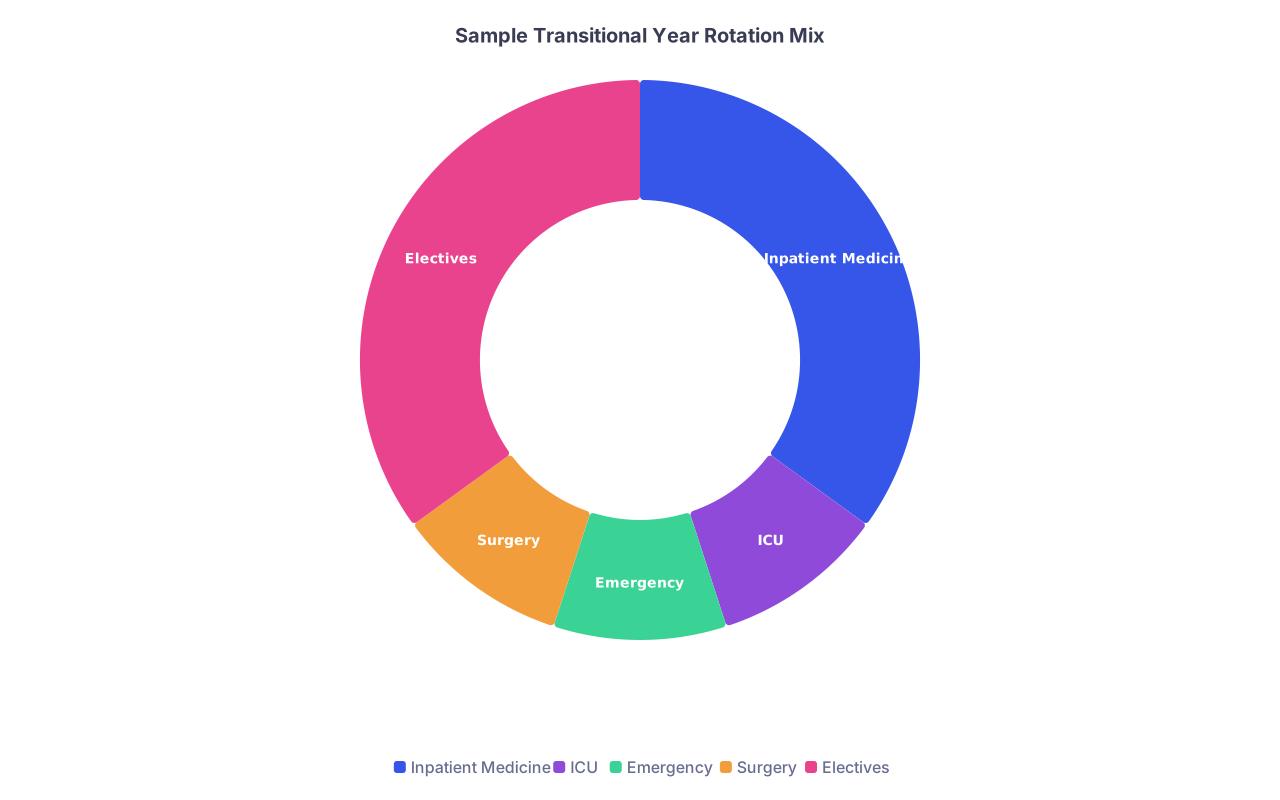
| Category | Value |
|---|---|
| Inpatient Medicine | 35 |
| ICU | 10 |
| Emergency | 10 |
| Surgery | 10 |
| Electives | 35 |
Compare that to a well-run medicine prelim at a community program: 3–4 months wards, 1 ICU, decent electives, and a culture that doesn’t treat prelims as disposable.
The real myth isn’t that TYs can be nice. Some are. The myth is that the word “transitional” guarantees easier hours, better treatment, or more time for research. It does not. You have to read the schedule and talk to residents, not just swallow the reputation.
If your only criteria for PGY‑1 is “least painful,” fine. But if you’re trying to build a real foundation for a demanding specialty, that oversimplification can backfire.
Where a Transitional Year Is Often Better
Let’s be fair. There are contexts where a good TY is legitimately superior.
If you’re entering a diagnostic specialty—radiology, rad onc, pathology-adjacent work, maybe anesthesiology—having broader exposure and more elective time can be a net advantage. You can rotate with your future department, build relationships, knock out some research, and still learn enough inpatient medicine to function.
Well-designed TYs also help if you’re a late bloomer academically. You can rebuild your CV: get letters from non-medicine attendings, show yourself functioning well, have time for a serious project. Try pulling that off while covering 18–20 admissions overnight in July in a malignant surgery prelim.
And yes, if the TY genuinely has a better culture, humane call structure, and supportive leadership, that matters. Burnout is real. I’ve watched great residents hit their advanced specialty already jaded because their prelim year treated them like fill-in labor.

| Step | Description |
|---|---|
| Step 1 | Advanced Specialty Applicant |
| Step 2 | Check board/program criteria |
| Step 3 | Compare schedules and culture |
| Step 4 | Prefer Prelim IM/Surg |
| Step 5 | TY or Prelim both ok |
| Step 6 | Talk to current interns |
| Step 7 | Rank based on fit not label |
| Step 8 | Have specific PGY1 requirements? |
| Step 9 | Need heavy IM or Surgery? |
So yes, there are genuinely excellent TYs that are better than plenty of prelim programs. But that is not the same thing as “TY always better.”
Where a Traditional Prelim Beats a Transitional Year
Let me flip the script, because this is the part nobody on Reddit wants to hear.
If your future field requires you to function as an internist or surgeon in real life—think cards, GI, heme/onc off a medicine base; IR with heavy procedural medicine; pain with complex inpatients—then a strong prelim medicine or surgery year is often the better training.
Not cuter on paper. Better.
I’ve seen anesthesia CA‑1s from “cush” TYs struggle with sick ICU transfers because they never really learned to run a team on wards. I’ve seen PM&R residents who feel shaky managing complex multi-morbid inpatients because their TY was mostly outpatient electives and dermatology consults.
On the flip side, a resident who fought through a real medicine prelim—managing DKA, sepsis, cirrhotics, complex heart failure—walks into advanced training with actual reps under pressure. That matters when you’re the only anesthesiologist in-house at 3 am.
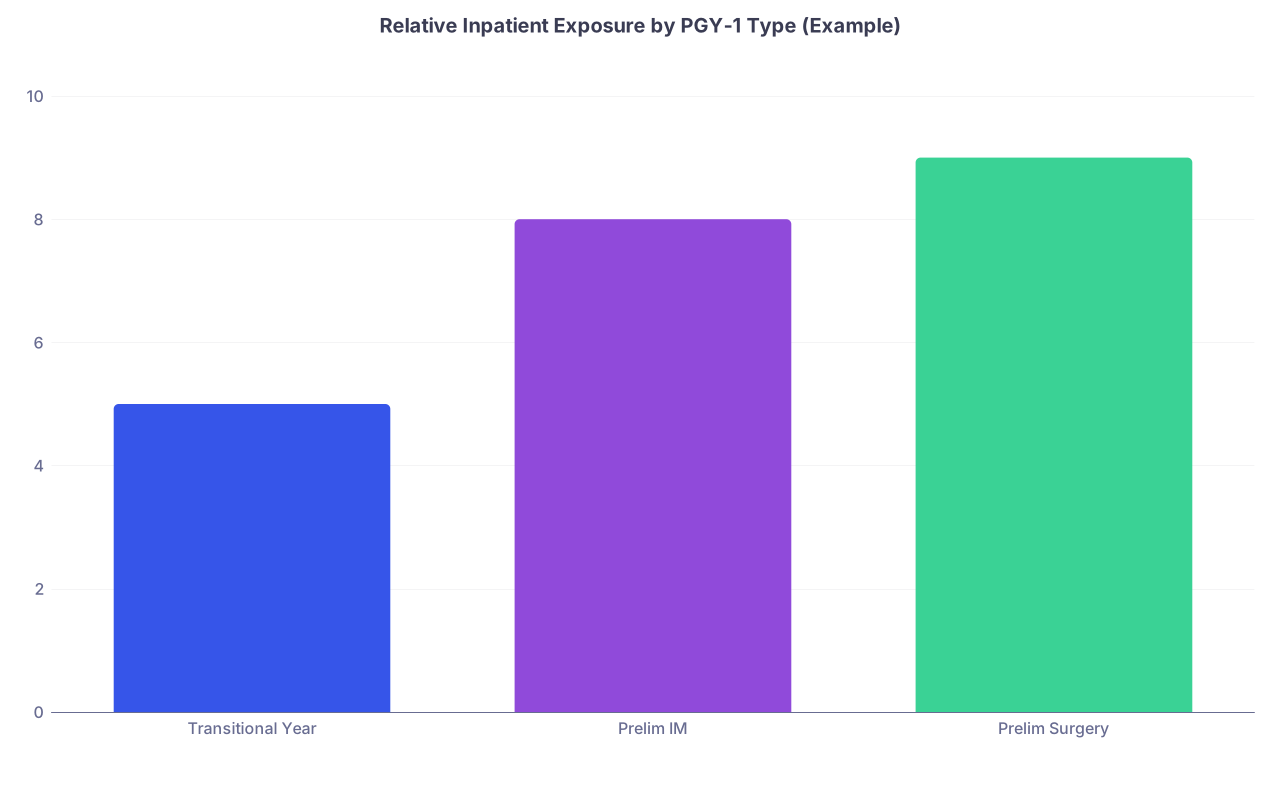
| Category | Value |
|---|---|
| Transitional Year | 5 |
| Prelim IM | 8 |
| Prelim Surgery | 9 |
(Think of 10 as “maximal constant ICU/wards hell.” Yes, this is illustrative, not a universal law.)
There’s also the credibility factor. Some fellowship directors in heavy clinical specialties quietly prefer applicants who did a solid prelim medicine or surgery year because they know exactly what that training looks like. A fluffy TY with 50% electives sends a different signal, fair or not.
The Part Everyone Forgets: Requirements and Red Tape
The most dangerous version of the “TY is always better” myth is when applicants ignore the fine print.
Not all advanced programs accept all TYs. Some radiology or rad onc programs explicitly want medicine-heavy PGY‑1s, or even prefer categorical internal medicine interns who transfer. More importantly, board eligibility for your specialty may require certain types or amounts of PGY‑1 training.
I’ve seen this mistake up close. A student locks in a very light TY, thrilled about the lifestyle, then gets an email from their future advanced program a few months before orientation:
“We need to review whether your PGY‑1 year satisfies the specialty board requirements.”
That is not an email you want.
Here’s what you actually need to check:
- The American Board requirements for your specialty (ABR for radiology, ABA for anesthesia, etc.)
- The ACGME program requirements for that advanced field
- The specific advanced program’s own policies about acceptable PGY‑1 structures
Then, match those up against your TY or prelim’s rotation schedule on paper. Not the website banner. The actual block schedule.
| Specialty Board | Wants From PGY-1 | Risk With Fluffy TY |
|---|---|---|
| ABA (Anesthesiology) | Broad clinical base, including medicine | Too much outpatient, weak ICU |
| ABR (Radiology) | 12 months clinical, no more than 2 months radiology | Overloaded with radiology electives |
| ABPMR (PM&R) | At least 6 months direct patient care | Excessive research or non-clinical time |
You do not want to be scrambling in February of intern year to add an ICU month because someone finally read the rules.
Culture, Exploitation, and the “Prelim as Peasant” Problem
One legitimate knock against traditional prelim years: some departments treat prelims like expendable warm bodies. I’ve seen the dynamic.
Prelim medicine interns covering extra nights so categoricals “can focus on continuity clinic.” Prelim surgery interns getting the worst scut and almost no OR time. Performance feedback? Barely. Career mentorship? Forget it, “you’re not staying anyway.”
That’s real. And it’s toxic.
But here’s the contrarian part: some TY programs do the exact same thing. They just smile more while they do it.
If a TY is structurally positioned to cover all the terrible off-service work that categorical programs do not want, you can end up just as exploited—just with a different label on your badge.
I always tell applicants: call current interns, not just chiefs.
Ask them directly:
- Who takes the bulk of nights and holiday call?
- Are prelims/TY interns included in teaching conferences and mentorship, or are they afterthoughts?
- Do people match well into your intended advanced field from this program?
If they dodge, that’s your answer.

The Tyranny of Lifestyle Advice
A lot of the pro‑TY propaganda is actually just lifestyle advice in disguise. “You’ve worked so hard; you deserve an easier year.” “No one remembers your intern year, just survive it.” That kind of thing.
I get the sentiment. But it’s shallow.
Intern year is the only time in your life where the entire system is designed to teach you how to be a doctor with training wheels still on. If you choose to offload as much difficulty as possible, you are not gaming the system; you’re just shifting the pain to later, when the stakes are higher and the safety net is smaller.
I’ve watched multiple CA‑1s and R2s say, “I wish my intern year had pushed me more; I’m playing catch-up now.” I have never heard anyone say, “My intern year was too strong clinically, and now I’m overprepared.”
Does that mean you must pick the most malignant prelim possible? No. Masochism is not a virtue. But blindly chasing the “cush TY” meme is not intelligent career planning.
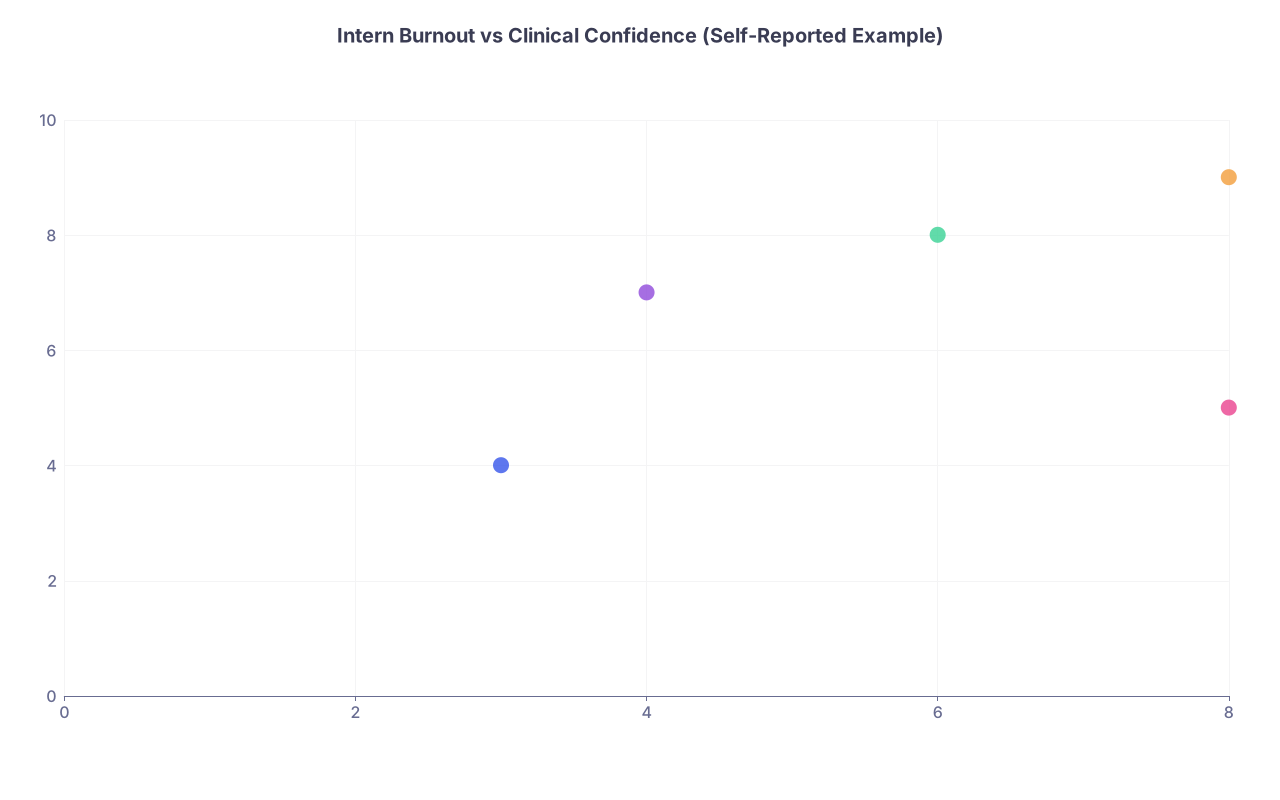
| Category | Value |
|---|---|
| TY Light | 3,4 |
| TY Balanced | 4,7 |
| Prelim IM | 6,8 |
| Prelim Surg | 8,9 |
| TY Malignant | 8,5 |
(X-axis = burnout; Y-axis = clinical confidence. Imagine how those tradeoffs feel two years later.)
When “Any” TY Is Actually a Bad Idea
Here’s where the myth really hurts: mid-tier or weaker applicants who treat any TY as an upgrade over a solid prelim.
If your advanced specialty is competitive—derm, rad onc, IR pathway, some rads and anesthesia programs—you’re going to be compared on the strength of your training environment and letters.
A random, unknown TY with no connection to your target specialty, no research opportunities, and a sleepy faculty roster is not helping you. A respectable prelim medicine program at an academic center with well-known attendings absolutely might.
Letters from people who are known and respected in your field beat “nice” schedules every time.
I’ve seen applicants with strong USMLE scores but generic TY letters lose out to slightly lower‑scoring peers with glowing medicine prelim letters from heavy‑hitting faculty who actually pick up the phone for them.

So no, you should not reflexively rank “any TY” above “any prelim.” That’s just a different flavor of herd thinking.
The Only Sensible Way to Decide
Strip away the branding, and you’re choosing between specific, real programs with specific, real pros and cons.
The adult way to do this:
- Start with requirements: what does your future specialty and target program actually require or prefer from PGY‑1?
- Look at case mix and intensity: will this program give you enough real responsibility to make you competent, without destroying you?
- Evaluate mentorship and reputation within your intended field: who’s writing your letters, and do they matter?
- Consider culture and support: are interns treated as learners or as labor? Prelim vs TY label does not answer this.
- Then, and only then, factor in lifestyle: call, location, pay, support system.
Label comes last. Always.

If you walk through that honestly, you’ll end up with some TYs above some prelims. And some prelims clearly above some TYs. Which is exactly the point.
The Bottom Line
A transitional year is not a magic upgrade over a traditional prelim. It can be better, worse, or identical, depending on the actual program in front of you.
Three things to keep in your head:
- Labels are marketing; requirements, schedules, and outcomes are reality. Read the block schedule, check board rules, and talk to current interns.
- For many advanced specialties, a strong prelim medicine or surgery year gives better long-term skills and credibility than a fluffy TY that looks good only on lifestyle.
- Choose the specific program that best balances training, mentorship, culture, and requirements for your specialty—not the one that fits a lazy “TY > prelim” meme.
If someone tells you “Always pick a transitional year,” what they’re really saying is “I haven’t bothered to look at the details.” You can do better than that.