
7–12% of residents in competitive advanced specialties did not complete the “standard” prelim year their field supposedly requires.
So no, the system is not as rigid as people on Reddit and in premed Discords like to claim.
Let’s tear apart one of the most persistent myths in residency applications: that every advanced specialty (like radiology, anesthesia, derm, ophtho, PM&R, neuro, rad onc) has one correct prelim year and everything else will destroy your chances, make you “untrainable,” or get you auto-filtered.
That story is clean. Programs are not.
What a Preliminary Year Actually Is (Not the Fantasy Version)
A preliminary year is a PGY-1 year that stands alone. You match into it separately from your advanced specialty (which usually starts at PGY-2).
Most advanced specialties accept applicants who have done one of three basic PGY-1 options:
Plus a small minority get in via:
- A categorical year in something else (e.g., categorical IM then switch into radiology)
- Less common paths like prior training, international training, or an unexpected transfer
So when students say: “Derm absolutely requires a prelim medicine year” or “Anesthesia programs won’t consider you without TY,” they’re making up rules that don’t actually exist in the accreditation documents and usually don’t exist in program policies either.
Let’s look at what the governing bodies actually say rather than what a fourth-year on Instagram says.
What the ACGME and Specialty Requirements Actually Say
Most advanced specialties have ACGME program requirements that specify what kinds of PGY-1 years are acceptable.
Here’s the key pattern: They almost all list multiple acceptable options.
| Specialty | Commonly Accepted PGY-1 Types |
|---|---|
| Anesthesiology | TY, Prelim IM, Prelim Surg, Categorical IM |
| Radiology (DR) | TY, Prelim IM, Prelim Surg, Categorical IM |
| Radiation Onc | TY, Prelim IM, Prelim Surg |
| PM&R | TY, Prelim IM, Prelim Surg, Pediatrics |
| Neurology | TY, Prelim IM (often prefer IM but not always) |
Is there variation by specialty and even by program? Absolutely. But the idea that each field has one “real” prelim option and everything else is wrong is mythology.
If you’re skeptical, that’s good. Go to a few program websites for anesthesiology or diagnostic radiology. The language is usually something like:
“Applicants must complete a clinical PGY-1 year in internal medicine, surgery, or a transitional year program accredited by the ACGME.”
Not “must be transitional year and anything else is unacceptable.”
The Big Myth: “X Specialty Requires Y Specific Prelim”
Let me go specialty by specialty and show you where the dogma diverges from reality.
Anesthesiology
Myth you hear:
“Anesthesia requires a transitional year or medicine prelim. Surgery prelim is a red flag.”
Reality:
ACGME Anesthesiology requirements allow:
- Transitional year
- Preliminary internal medicine
- Preliminary surgery
- Or a categorical year in another clinical specialty
I’ve seen anesthesia residents who came from:
- TY at community hospitals
- Prelim IM at big academic places
- Prelim Surg because they thought they wanted ortho then switched
Do some programs prefer TY or IM because it's better preparation for ICU, hemodynamics, and medically complex patients? Yes. Some chairs will say that openly at pre-interview dinners. But “prefer” is not “require.”
The real factors that matter for anesthesia:
- Solid clinical letters (especially from ICU, IM, or anesthesia themselves)
- Demonstrated ability to handle acutely ill patients
- No red-flag behavior (chronic lateness, professionalism issues, disasters on the wards)
Whether your PGY-1 label was “prelim surg” or “TY” is secondary to how you performed.
Diagnostic Radiology
Myth you hear:
“Radiology wants only transitional year, otherwise your life will suck.”
Reality:
Radiology residents come from all three: TY, Prelim IM, and Prelim Surg. And many programs explicitly say: “Any clinical PGY-1 in an ACGME-accredited program is acceptable.”
There are differences in lifestyle and intensity:
- TY: usually more electives, fewer nights, often regarded as a “cushier” intern year
- Prelim IM: heavier on wards, good for learning medicine and reading charts fast
- Prelim Surg: more call, more floor chaos, less didactic time
But radiology program directors care more about:
- Your USMLE scores and clinical evaluations
- Your ability to work up a patient clinically when you get a weird CT or MRI finding
- Whether you can communicate clearly with consult teams
None of that is mechanically determined by picking TY vs IM vs Surg.
Dermatology
Myth you hear:
“Derm requires a medicine prelim; they’ll look down on anything else.”
Reality:
Derm program requirements typically allow:
- Transitional year
- Preliminary internal medicine
- Preliminary surgery
Do many derm residents happen to have prelim IM or TY? Yes. But the match data doesn’t show a formal exclusion of other paths.
What derm PDs really care about:
- Research and academic productivity
- Letters from derm faculty who know your work
- Professionalism, attention to detail, and good clinical judgment
Your PGY-1 year is more about not screwing up than about its exact label.
I’ve seen derm residents come out of surgery-heavy PGY-1 years and be excellent at procedures because they’ve actually held instruments and sutured at 3 a.m. That’s not a weakness.
Ophthalmology
Ophtho is a bit different because it uses SF Match, but the PGY-1 logic is the same.
Myth:
“Ophtho demands a medicine prelim. TY isn’t respected.”
Reality:
Most ophtho programs accept any ACGME-accredited clinical PGY-1: TY, Prelim IM, or Prelim Surg. Some will state a preference for medicine-heavy years because ophtho calls can involve systemic disease (giant cell arteritis, diabetic eye disease, etc.). But again—preference, not universal rule.
PM&R (Physical Medicine & Rehabilitation)
Here’s a place where the nuance really matters.
Myth:
“PM&R wants a transitional year only” or “PM&R only wants IM prelims.”
Reality:
ACGME PM&R allows:
- Preliminary year in internal medicine
- Preliminary year in surgery
- Transitional year
- Or even a full year in pediatrics (for pediatric rehab pathways especially)
Different PM&R programs emphasize different things. Some are highly neuro-heavy and like IM or neuro-flavored years. Others lean more ortho/musculoskeletal and are perfectly happy with surgical or TY backgrounds.
This is one of the clearer cases where the “one right prelim” story is just lazy advice.
Neurology
Neurology has historically leaned toward:
- Prelim Internal Medicine
- Or a medicine-based transitional year
And many programs will indeed explicitly say they strongly prefer or require a medicine-based PGY-1. Some even have built-in linked prelim IM spots.
So is neurology “stricter” than, say, anesthesiology? In many places, yes. But even here, it’s not “every program, no exceptions.” There are neurology residents who came in after mixed TY programs that still met the ACGME core clinical exposure requirements.
What Actually Matters to Programs More Than Prelim Type
Here’s the part people miss while obsessing over whether TY > prelim IM > prelim surg.
Program directors care about risk. Your prelim year is mostly a risk signal.
They’re asking:
- Can this person handle sick patients without falling apart?
- Are they safe, reliable, and teachable?
- Do they play well with a team, or are they a walking complaint generator?
- Will they show up to their PGY-2 specialty with real clinical maturity?
Your prelim type is a very rough proxy for that. But your performance in that year is a much sharper tool.
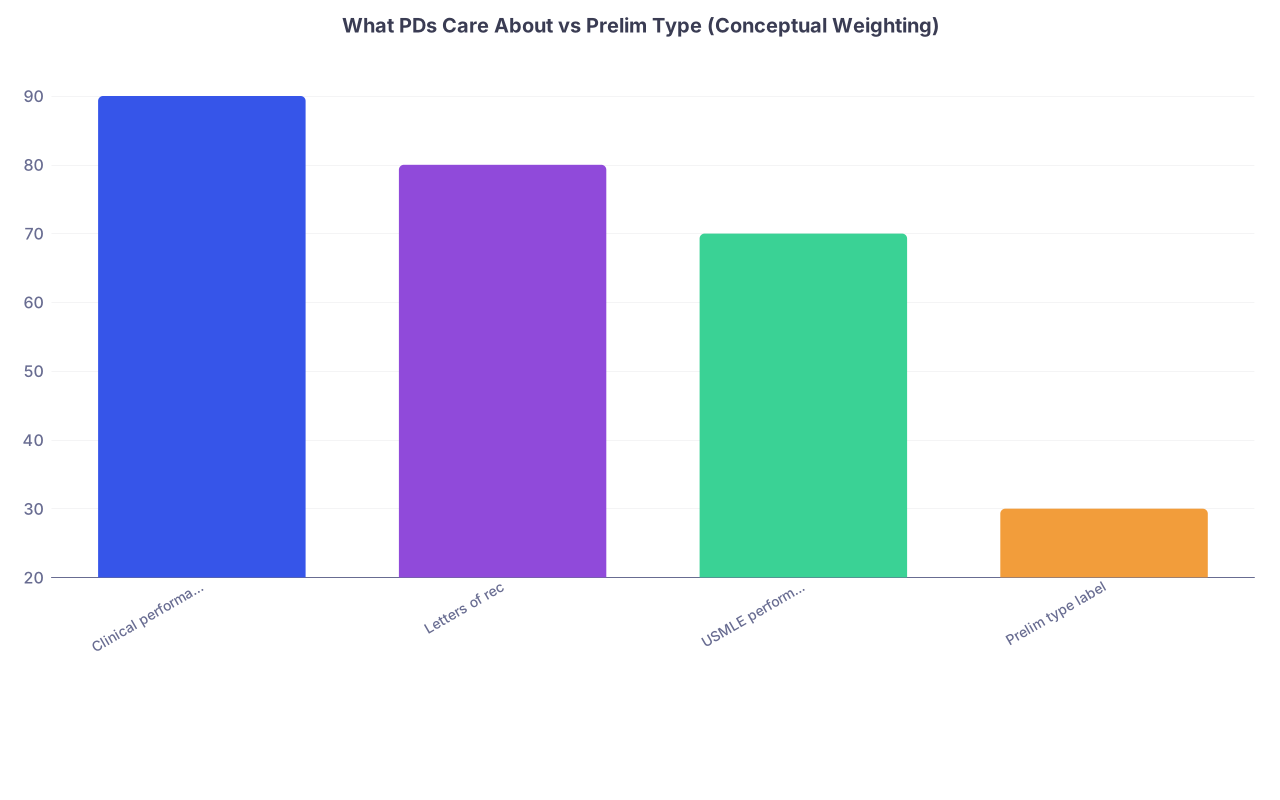
| Category | Value |
|---|---|
| Clinical performance | 90 |
| Letters of rec | 80 |
| USMLE performance | 70 |
| Prelim type label | 30 |
If you do a TY and coast, generate mediocre evals, and get lukewarm letters, you’ve gained nothing from “gaming” the prelim selection.
If you do a tough prelim surg year, crush it, earn strong letters that say you’re calm under pressure and great with patients, that carries heavy weight—sometimes more than a generic “cushy” TY.
The One Place Prelim Type Really Does Bite You
There is one domain where prelim type genuinely matters and people under-appreciate it: licensure and ACGME minimum content.
Certain states and boards care that your PGY-1 year included a minimum set of rotations:
- Medicine months
- Emergency medicine exposure
- ICU or critical care
- Sometimes pediatrics or OB/GYN exposure, depending on the path
Most TY and prelim IM programs are built to satisfy these without thinking about it. Some prelim surgery programs are too OR-heavy and shortchange core medicine rotations.
That can cause headaches later if:
- Your specialty program expects you to come in with basic medicine exposure you never got
- A licensure board asks for documentation of certain rotations
So yes, structure matters more than the name of the prelim. A well-designed TY or prelim IM almost always covers you. A random prelim surg at a program that treats interns like OR scut machines might not.
You don’t fix that by parroting “TY is best.” You fix that by reading the actual curriculum of the prelim programs you rank.
How Applicants Get This So Wrong
There are three main drivers of bad prelim-year advice:
Selection bias.
You look at a handful of residents in a field. Many of them did TY or prelim IM. You decide “that must be the rule,” ignoring all the other routes.Comfort projection.
Students want an easier or more lifestyle-friendly intern year. So they elevate TY to “objectively best” and post that as fact. It’s not objective; it’s just what they personally want.Anecdote inflation.
One person with a surgery prelim had a bad derm application cycle. Suddenly the story becomes “derm hates prelim surgery,” even if their issue was Step scores, research, or terrible letters.
I’ve heard anesthesia PDs say in meetings: “I don’t care what their prelim is called if their letters show they’re good with sick patients and not a problem child.” That line never makes it to Reddit.
A Practical Way to Think About Prelim Choice
Instead of asking, “What is the one correct prelim for my specialty?” you should be asking:
- What kind of clinical foundation do I want?
- What volume of call and nights am I honestly able to tolerate?
- Who writes the letters from that PGY-1, and how respected are they?
- Does this prelim’s curriculum meet ACGME and state board expectations cleanly?
If you’re going into:
- Anesthesia, radiology, derm, ophtho, rad onc, PM&R – any of the main three (TY, prelim IM, prelim Surg) can work. Choose based on training quality and your own stamina.
- Neurology – usually bias toward medicine-heavy TY or prelim IM unless a specific program says otherwise.
And don’t get cute trying to pick the absolutely lightest PGY-1 year you can find. If your intern year is a joke, your PGY-2 transition into an ICU, angio suite, or complex consult-heavy role will be miserable. Programs notice that mismatch.

| Step | Description |
|---|---|
| Step 1 | Match into advanced specialty |
| Step 2 | Choose PGY1 type |
| Step 3 | Transitional year |
| Step 4 | Prelim medicine |
| Step 5 | Prelim surgery |
| Step 6 | PGY2 in advanced specialty |

FAQ (3 Questions)
1. Will choosing a “wrong” prelim year automatically get me rejected from advanced specialty programs?
No. There is no universal “wrong” prelim among TY, prelim IM, and prelim Surg for most advanced specialties. Some individual programs state preferences (often medicine-heavy), and neurology is the strictest, but outright rejection solely based on prelim type is rare if your PGY-1 is ACGME-accredited and clinically solid.
2. Is transitional year always the best option if I can get it?
Not always. TY can be great for lifestyle and electives, but some TYs are weak on core medicine and ICU exposure. If you want strong foundational skills—and respect from future colleagues—a well-run prelim IM (or even a rigorous TY) can serve you better than a “vacation year” that leaves you underprepared for PGY-2.
3. Can I switch into an advanced specialty after starting a categorical year in something else?
Yes. Many residents enter radiology, anesthesia, PM&R, and even derm after beginning categorical IM, surgery, or pediatrics. That categorical PGY-1 often satisfies the “prelim” requirement. The limiting factor is not the label on your year, but timing, open PGY-2 spots, and whether your performance and letters are strong enough to make you a low-risk transfer.
Key points:
Most advanced specialties accept multiple types of prelim years; the single “correct” option is largely a myth. Your performance, letters, and clinical maturity from that PGY-1 matter more than whether it’s labeled TY, prelim IM, or prelim Surg. The smart move is to choose a prelim with solid clinical exposure and leadership who will fight for you—not just the one the loudest person online swears is “required.”