
The belief that programs do not care where you did your prelim year is wrong. Not subtly wrong. Flat‑out, systematically, provably wrong.
People repeat that line because it’s comforting. Especially when they’ve already locked in a less‑than‑ideal preliminary year and need a story that lets them sleep. But it does not match how PDs talk behind closed doors, how rank lists get made, or how interview filters are set.
Let me be blunt: your prelim year is not everything. But it is not “just a checkbox” either. Where you do it, how you perform, and who can vouch for you absolutely influence your shot at a categorical spot, especially in the more competitive specialties.
Let’s unwind the myth and look at what actually happens.
What A Preliminary Year Really Is (Not the Brochure Version)
A preliminary year is a one‑year residency position, usually in internal medicine, surgery, or transitional year, that you complete before entering an advanced specialty like radiology, anesthesiology, dermatology, neurology, PM&R, radiation oncology, or ophthalmology.
On paper, it’s simple:
- Prelim IM or TY = PGY‑1 before your PGY‑2 advanced start
- Prelim surgery = for things like urology, integrated programs, or as “gap year” when you do not match categorical
In reality, for many people, the prelim year serves three roles:
- A survival year so you are technically employed, paid, and licensed.
- A second audition in a new environment — with completely new attendings writing letters.
- A live, year‑long performance review that other programs do care about, especially if you are reapplying or switching fields.
If you matched advanced radiology at a strong university and your PGY‑2 is guaranteed, your prelim program matters less to radiology. But it can still matter for your life, confidence, mentorship, and any future pivot.
If you did not match advanced and you’re using a prelim year to try again, the idea that “programs don’t care where you did prelim” is fantasy. They care. They just won’t say it that bluntly in the brochure.
Where You Do Your Prelim Year: What Actually Changes
Here’s the part everyone glosses over: not all prelim years are viewed the same by downstream programs. Some programs are honest about this. Most are not.
I’ve sat in rank meetings where comments sound like:
- “He did prelim at [small community hospital]. Do we know anything about their training or letters?”
- “She’s a prelim at [well‑known academic IM program]. Their chair wrote this letter — that’s a strong signal.”
- “This TY program has a reputation for being cushy. I’m not sure how much to trust ‘top third’ in their class.”
Nobody is saying “community bad, academic good” in a binary way. But they absolutely weigh the signal quality of your prelim environment.
A strong prelim program gives other PDs:
- A known grading culture (they know what “excellent” means there)
- Recognizable letter writers (chairs, PDs, big‑name subspecialists)
- Confidence that you’ve been exposed to real, high‑acuity medicine or surgery
- Evidence that you can survive — and preferably thrive — in a demanding setting
A very unknown or chaotic prelim program raises questions:
- Was this just the only place that would take them?
- How inflated are these “outstanding” comments?
- Did anyone push them? Or did they hide in an easy schedule?
No one line in ERAS says “we discount unknown prelims,” but behavior tells the story.
The Myth: “Programs Don’t Care Where You Did Your Prelim Year”
The common story you hear in resident lounges goes like this:
“If you are reapplying, it doesn’t really matter where you do your prelim year. Just don’t kill yourself. Programs only look at Step scores and med school. Prelim is just a checkbox.”
This story gets repeated by:
- Interns who already matched advanced and haven't re‑applied to anything
- Well‑meaning upper years who never sat in on selection meetings
- Advisers who have not matched anyone into competitive specialties in years
- Anonymous internet posters trying to justify their own choice
Here’s the problem: the data we do have and the real selection behavior tell a very different story.
What The Data and Behavior Actually Show
Nobody publishes “Prelim Program Prestige Coefficient” tables. But we can triangulate from a few hard realities and consistent patterns.
1. Programs screen heavily on current training
Look at how often applications get sorted by:
- “Currently in ACGME accredited residency?”
- “US graduate vs international + current US training?”
- “Completed or in progress PGY‑1 in same specialty or strong internal medicine?”
In near‑competitive and competitive fields (derm, ophtho, rads, anesthesia in certain regions, PM&R at top programs), having a prelim year at a program they recognize functionally boosts your “floor.” You are not just a name with a score; you are “the intern from [X program] with [Y faculty] letter.”
I have watched lower‑Step applicants land interviews because they bring a glowing letter from an internal medicine PD at a nationally respected program, vouching for them as “top 10% of our interns.”
Flip side: applicants with slightly better board scores but unremarkable prelim environments get passed over because their letters feel generic or inflated.
2. Letters from known programs move the needle
This is the most obvious one, but people still pretend it doesn’t matter.
If a radiology PD sees:
- Letter 1: “Outstanding intern, strong clinical skills, excellent team player” from a community IM PD they’ve never met
- Letter 2: “Top 5% of interns I’ve worked with, strong clinical reasoning, dependable on call” from a PD at a nationally known IM department they sit on committees with
Those are not equal. They are not “both strong letters.” They carry different predictive weight because the writer and the grading culture are known.
Do good residents get trained in smaller or less known prelim programs? Of course. But admissions decisions are about probability, not philosophy. Programs lean on signals they trust.
3. Performance during prelim can rescue or sink you
Programs absolutely care what you did after graduation. If your med school record was mediocre but your prelim PD writes:
“This intern is among the most promising residents we’ve had in years; I would rank them to match in my own specialty without hesitation.”
That’s not “just a checkbox.” That’s a reset button.
I’ve seen neurology PDs pulled aside at meetings: “This prelim medicine intern is incredible. You should look at them for your open PGY‑2.”
Conversely, a prelim year with spotty evaluations, professionalism concerns, or weak letters can quietly close doors. Even if your Step score was nice. Because programs have learned the hard way that a good test taker who is a disaster on the wards costs everyone a lot of pain.
Where Prelim Location Matters A Lot vs. A Little
Now, nuance. It’s not all or nothing.
| Scenario | How Much It Matters |
|---|---|
| Already matched advanced at solid program | Low |
| Reapplying to *more* competitive specialty | Very High |
| Reapplying to same or slightly less competitive specialty | High |
| Switching specialties unexpectedly (e.g., surgery → anesthesia) | High |
| IMG reapplying in the US | Very High |
If your PGY‑2 advanced spot is locked (e.g., you matched Rads at a strong university), your prelim program’s name won’t drastically change your radiology career trajectory. It may still affect lifestyle, mentorship, and how miserable PGY‑1 feels, but not your matching odds.
If you’re:
- SOAPing into a prelim
- Doing a prelim as a “gap” while reapplying
- An IMG trying to build US credibility
- Pivoting specialties after an unplanned disaster in PGY‑1
Then yes, where you do your prelim year is strategic, not random.
The Quiet Hierarchy of Prelim Years
There is an unofficial, never‑written‑down hierarchy programs use when assessing prelim training. They won’t publish this on their websites, but I’ve heard variations of it in selection rooms.
Roughly:
- Strong academic IM/TY at university programs with solid reputations
- Academic‑affiliated community programs with known PDs and stable training cultures
- Smaller or insular community programs that other PDs rarely interface with
- Problematic programs with known toxicity, chaos, or LCME/ACGME issues
The gap between #1 and #2 is often smaller than people think. The gap between #2 and #3 can be enormous if the letters from #3 are all generic and the selection committee has zero mental anchor for that program’s rigor.
For certain fields, transitional years with well‑built curricula and known directors can be gold. For others, a brutal, high‑volume prelim surgery year at a name‑brand institution signals that you can handle extreme work and acuity.
The common denominator: visibility and credibility. Programs like to know how to interpret your environment.
What Programs Actually Look At From Your Prelim Year
They don’t care which EMR you used. They care about a few specific signals.
1. Summative PD letter
This is huge. Programs want a clear, comparative statement:
- “Top third” vs “average intern” vs “one of the best I’ve trained”
- Concrete behaviors: initiative, ownership, reliability, teamwork
- Any concerns: communication, documentation, professionalism
A PD letter from a known, respected program carries significant weight. From an unknown or notoriously lenient program, it gets mentally discounted.
2. Rotation comments and consistency
When they bother to read your rotation evaluations (and yes, for borderline or reapplicants, they do), they look for:
- Pattern: solid across multiple rotations vs “great on one, weak on others”
- Concerns: “needs close supervision,” “slow to respond to feedback,” “struggles with prioritization”
- Health of the narrative: do your comments and letters match your personal statement story?
If your prelim year story is “I grew a ton, became more independent, improved communication,” and your evaluations back that up, that is persuasive. If they don’t, programs notice.
3. Evidence you can function as a PGY‑2
Residencies are tired of PGY‑2s who cannot cross‑cover safely, call consults, or manage night float. Your prelim year is the only real data point they have for that.
That’s why you’ll hear PDs say things like:
- “At least this candidate has a strong intern year under their belt; the risk is lower.”
- “If [X PD] says they can handle nights independently, I believe it.”
Again, that trust rests partly on where you trained.
The Dangerous Advice You’ll Hear (And Why It’s Wrong)
Three specific bad takes I hear way too often.
“Just pick the easiest prelim year, it doesn’t matter.”
Wrong for anyone who is not already guaranteed an advanced spot and never planning to move or reapply.
An “easy” prelim year that gives you:
- No real responsibility
- Inflated evaluations
- PDs who barely know you
…is actually harder to sell when you need a strong letter later. Programs are not idiots; they know which TYs are vacation years and which are real training.
A moderate‑intensity, well‑run program where faculty actually watch you work, push you, and then go to bat for you is far better than a pseudo‑cush spot where you disappear and collect generic praise.
“Programs only care about your med school record and scores.”
They start there. But for reapplicants and PGY‑1s, recency bias is real. Your latest performance is the freshest data.
A mediocre med student who shines during a demanding prelim year with credible letters often beats a strong med student who sleepwalked through a weak prelim without any champion.
“As an IMG, just get any US prelim. The name doesn’t matter.”
For IMGs, the prelim program name and letter writer matter more, not less. Because PDs are using your current US training to calibrate everything else:
- How well you adapted to US clinical culture
- How you function in a system they recognize
- Whether a US PD is willing to stake their reputation on you
If you had to scramble and land in a small, obscure program, all is not lost. But you must treat that year like an extended, aggressive audition and actively seek out letter writers with real credibility — not just “whoever signed your schedule.”
So How Should You Actually Think About Prelim Year Choice?
No, you do not need a top‑10 IM department for your prelim year to have a career. That’s another myth. But you do need to drop the idea that location is irrelevant.
Think about three questions.
Will people outside this hospital know how to interpret my training here?
This is about reputation and affiliation. University programs or well‑known community affiliates are easier to interpret.Can I get close, specific, honest supervision from attendings who will remember me?
Massive programs where you are one of 60 prelims and never see the PD can be as useless as no‑name hospitals where no one understands the outside world.If I needed to reapply or pivot, who here has the clout and credibility to help me?
That might be a PD, an associate PD, or a subspecialty chief others know and respect.
If a prelim program scores decently on those three, even if it is not “prestige,” it can be a powerful asset. If it scores poorly on all three, then yes — downstream programs will quietly care, and not in your favor.
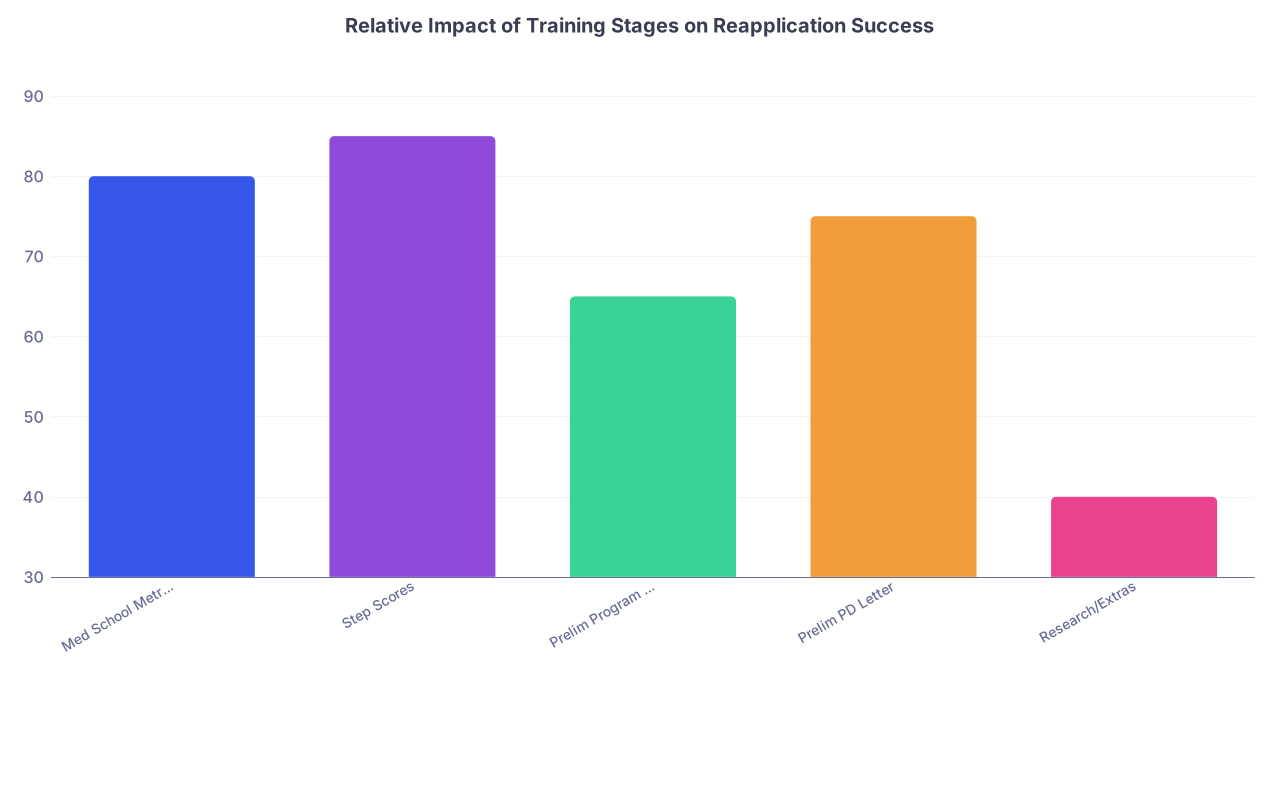
| Category | Value |
|---|---|
| Med School Metrics | 80 |
| Step Scores | 85 |
| Prelim Program Reputation | 65 |
| Prelim PD Letter | 75 |
| Research/Extras | 40 |

| Step | Description |
|---|---|
| Step 1 | Prelim Program Choice |
| Step 2 | Clinical Training Quality |
| Step 3 | Letter Writer Credibility |
| Step 4 | Strong Evaluations |
| Step 5 | Persuasive PD Letter |
| Step 6 | Program Trust in Readiness |
| Step 7 | Interview Offers and Rank |

How To Use This Reality Without Losing Your Mind
You do not control the whole system. You control how you play the hand you’ve got.
If you already matched an advanced spot and your prelim is set at a smaller or less known place, you don’t need to panic. You already have what most people are chasing. Use the year to:
- Become a legitimately competent PGY‑1
- Build good habits, protect your sanity, and gather one or two solid letters for the future
If you matched only a prelim and are reapplying or planning to:
- Treat your prelim program like a 12‑month audition.
- Seek out the hardest‑working, best‑respected attendings on each rotation. Tell them explicitly you’re reapplying and want feedback.
- Ask for letters from people who both know you and have real reputational currency. A generic “hard worker” letter from someone obscure is less useful than a detailed, comparative letter from someone whose name PDs recognize or whose program they respect.
If you’re an M4 deciding between multiple prelim options, stop asking “Which is easiest?” and start asking, “Where will I be seen, trained, and advocated for in a way other programs actually trust?”

Years from now, you won’t be obsessing over whether your PGY‑1 was at Big‑Name University or Decent Community Hospital. You’ll remember whether someone in that year actually saw your potential and put their name next to yours. Programs do care where you did your prelim — not because of the logo on your badge, but because of what that logo signals about how much they can trust the story you’re telling.