
Prelim Year as a ‘Backup Plan’: Separating Smart Strategy from Wishful Thinking
62% of applicants who match into a preliminary-only position never go on to complete categorical training in the same specialty.
That’s the part almost nobody tells you when they say, “You can always do a prelim year as a backup.”
Let’s tear this apart.
A prelim year can be smart. Strategic. Life‑saving for your career in some scenarios.
It can also be a trap that leaves you tired, boxed in, and no closer to your long‑term goal than you were on Match Day—just with more debt and burnout.
The difference isn’t luck. It’s whether you understand what a prelim year actually is, how programs really use these spots, and what your realistic pathways look like on the other side.
You asked about prelim year as a “backup plan.” So I’m going to be blunt about when that’s intelligent risk management—and when it’s wishful thinking in a white coat.
What a Preliminary Year Really Is (Not the Brochure Version)
First, definitions. Because people mix up prelim, transitional, and categorical constantly.
- Categorical position = full residency track in that specialty (e.g., IM PGY‑1 → PGY‑3).
- Preliminary year = 1‑year stand‑alone PGY‑1, usually in internal medicine, surgery, or a surgical subspecialty. No guarantee of continuation.
- Transitional year (TY) = more flexible 1‑year rotating internship (often cushier, more elective time), usually paired with advanced specialties like derm, rad onc, neuro, radiology, ophtho, anesthesia.
Programs don’t create prelim spots out of the goodness of their hearts. They exist because:
- Advanced specialties need an intern year upstream (neuro, radiology, anesthesia, derm, ophtho, rad onc).
- Hospitals want cheap labor on wards and surgical services.
- Departments like having a buffer of interns to cover call and nights without committing to training all of them to graduation.
So your prelim spot may be:
- A paired position (e.g., you matched neuro + a linked prelim IM year).
- A free‑standing prelim slot with no promised spot afterwards.
If you’re thinking “backup,” you’re almost always talking about those stand‑alone prelims. And that’s where the myths start.
Myth #1: “A prelim IM year helps me reapply for ANY specialty”
No. It really doesn’t. At least not equally.
A prelim year is not some generic XP boost you can cash in for whatever specialty you want next year.
Here’s the uncomfortable breakdown.
| Target Specialty | Prelim Year Impact | Comment |
|---|---|---|
| Categorical IM | Strong | Directly relevant, familiar program directors |
| Neurology | Moderate | Accepts prior IM training, overlapping content |
| Anesthesiology | Moderate | Helpful if strong letters, ICU exposure |
| Radiology | Mild | Less clinically relevant, more Step/research driven |
| EM | Mild–Moderate | Needs EM‑specific exposure, SLOEs |
| Surgical Fields | Weak | IM prelim does little to prove surgical skill |
Reality:
- For categorical internal medicine, a strong prelim IM year can be a decent bridge. PDs know what they’re getting: someone who has already functioned as an intern.
- For neurology and anesthesia, it can help—especially if you’re at a place with those departments and can hustle your way into connections, electives, letters.
- For radiology, derm, plastics, ortho, ENT, urology? Your IM prelim year doesn’t move the needle much. Those fields care far more about Step scores, research, and specialty‑specific mentorship.
I’ve watched people bank on “I’ll just do a prelim IM year and then switch into ortho/rads/derm.” They worked hard, got good evaluations, and still got exactly nowhere because their underlying metrics and CV for that competitive field never changed.
A prelim year amplifies your existing application. It doesn’t reinvent it.
If your scores, research, and letters weren’t competitive enough to match first time into a highly competitive field, doing floor work and night float in IM isn’t the magic patch.
Myth #2: “I’ll be more competitive after a prelim year because programs will see my ‘work ethic’”
Here’s what program directors actually say when you’re not in the room:
- “Why didn’t they match the first time?”
- “Did they have professionalism issues as a student?”
- “If they were passed over once, what’s different now?”
Your story matters. But “I did a prelim year” by itself is not an automatic upgrade. Programs look for specific changes:
- Did your Step 2 score improve (if applicable)?
- Did you gain specialty‑relevant letters from respected faculty?
- Did you produce meaningful, targeted research in the field?
- Did you demonstrate clear fit with that specialty (electives, away rotations, involvement)?
And here’s the kicker: during a heavy prelim IM or surgery year, you may not have the time or support to do those things well.
You can absolutely become less competitive:
- You’re exhausted, your application feels rushed.
- You can’t get time off for away rotations or interviews.
- Your only new letter is from an IM hospitalist when you’re trying to reapply ortho.
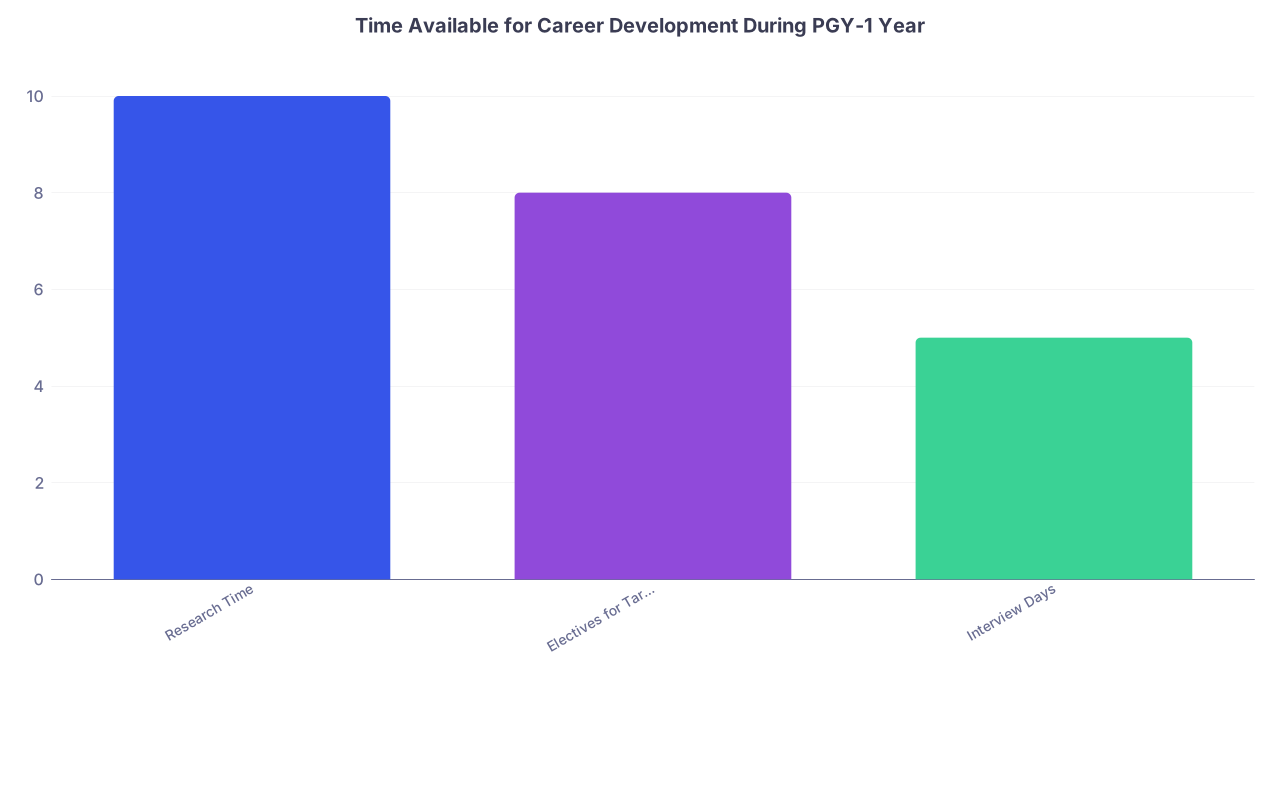
| Category | Value |
|---|---|
| Research Time | 10 |
| Electives for Target Specialty | 8 |
| Interview Days | 5 |
Those numbers are roughly what residents think they’ll have. Reality is often worse.
PDs don’t sit there in awe because you survived 28‑hour calls. Every intern did. What matters is how much your application specifically improved toward their field.
So yes, a prelim year can strengthen your case—if you have a precise plan, cooperative leadership, and enough raw opportunity. Going in with “I’ll just work hard and they’ll see” is fantasy.
Myth #3: “Worst case, I’ll just slide into a categorical spot where I did my prelim”
This one causes a lot of tears.
Programs sometimes convert prelims to categoricals. Sometimes. But using that as your “backup plan” is like budgeting around the hope your attending will randomly hand you a bonus check.
What’s actually happening behind those conversions:
- A categorical resident leaves (performance, health, family, switch of specialty).
- The program suddenly has an open PGY‑2 spot.
- They look at their own prelims first because they know them and it’s administratively easy.
- They choose the one prelim who’s the strongest fit and least likely to cause trouble.
If you’re one of 8 prelims in IM, maybe 1 gets that call. Some years, zero.
In surgery it’s even more brutal. I’ve seen prelim surgery classes where:
- 12 prelims start.
- 0 are offered a categorical spot in that department.
- 3 manage to scramble into IM or anesthesia elsewhere.
- The rest either reapply into something else entirely or leave training.
Banking on being “the chosen one” is not a plan. It’s a lottery ticket.
Myth #4: “A prelim year is safer than going unmatched and taking a research year”
Not automatically. They’re different risks.
Let’s compare the two for someone who struck out applying to a moderately competitive specialty.
| Factor | Prelim Year | Research Year |
|---|---|---|
| Income | Resident salary | Usually low stipend or unpaid |
| Debt Accrual | Slower (some salary) | Often continues without income |
| Time for Research | Limited | High |
| Time for Networking | Limited, local | High (if chosen well) |
| Clinical Skills | Strong improvement | Minimal |
| Specialty Signal | Weak–moderate unless at target dept | Strong if in that specialty’s lab |
| Burnout Risk | High | Moderate |
| Flexibility to Pivot | Moderate | High |
| Chance of Major CV Change | Low–moderate | High (publications, letters) |
For competitive, research‑heavy specialties (derm, rad onc, some surgical fields, academic neurology/radiology), a well‑chosen research year in that field often changes your trajectory far more than a generic prelim IM year.
Because then you can actually fix the reason you didn’t match:
- Weak specialty‑specific research → you now have 2–3 papers.
- No mentoring → now you have a chair or PI advocating for you.
- Vague specialty interest → now you have a clear narrative and concrete work to show.
With a prelim year, you’re mostly proving you can function clinically. Which PDs in competitive, non‑IM fields already assumed if you graduated med school.
So no, a prelim year is not universally “safer.” It’s just a different kind of risk with a monthly paycheck attached.
Myth #5: “If I hate it, I can just reapply into something totally different”
You can. But it often goes badly if it’s impulsive.
I’ve seen this pattern repeat:
- Student didn’t match EM.
- Takes prelim IM “as backup.”
- Hates nights, hates floor work, hates the culture.
- Mid‑PGY‑1 decides “I’ll reapply FM or anesthesia or psych.”
- Submits rushed applications with generic letters, minimal exposure, weak narrative.
Programs smell the desperation and lack of direction. They pass.
If you’re going to use a prelim year as a pivot, it has to be:
- Deliberate – You’ve actually explored the new field, not just “anything but this.”
- Documented – Electives, shadowing, concrete reasons, and tailored letters.
- Explained – You can clearly articulate why you’re switching and why it’s not just running away from difficulty.
Your story has to make sense on paper and in the interview room. “I didn’t match X, tried prelim, hated it, now I want Y” rarely sells unless there’s a well‑argued arc underneath.
What a Prelim Year Is Good For (When Used Correctly)
Let me flip it. Here’s when I actually think a prelim year is a smart, strategic move:
You already matched an advanced spot (e.g., radiology, anesthesia, neuro) and just need the intern year. Easy. This is what prelims were designed for.
You’re aiming for categorical internal medicine and:
- You have decent scores, but weak clinical performance or shaky MS3/MS4 narrative.
- You can match a prelim IM spot at a place with strong IM and a history of absorbing prelims when positions open.
- You have explicit conversations with leadership about your goals and what they will realistically support (letters, advocacy, interview flexibility).
You need ANY accredited clinical year to stay in the system:
- For visa reasons.
- To keep your CV from going dark while you regroup.
- To prove professionalism/clinical competence after a concerning eval or leave.
But even in those scenarios, it has to be part of a coherent plan, not “I didn’t get what I want so I’ll just take something.”
What You Should Ask Before Ranking Prelim Programs as “Backup”
If you’re thinking about ranking prelim spots on your list, you should be interrogating them harder than they interrogate you.
Here’s what you ask residents off the record:
- “Of last year’s prelims, how many got categorical spots here or elsewhere?”
- “Does the program usually write strong letters and proactively help prelims reapply?”
- “How often do prelims get time off for interviews?”
- “What’s the call schedule like? Nights? ICU? How survivable is this if I also need to work on applications?”
- “Are there people who did a prelim here and successfully switched into [your target specialty]? Can I talk to them?”
And directly to leadership:
- “If a PGY‑2 spot opens, are prelims considered first?”
- “What proportion of your prelims match into categorical positions the following year?”
- “Do you see a prelim year as a viable bridge to [target specialty], realistically?”
If their answers sound vague, overly rosy, or data‑free—believe the silence, not the sales pitch.

The Emotional Trap: “Something is Better Than Nothing”
This part is less about data and more about psychology. But it drives bad decisions.
Going unmatched hurts. It feels like your entire identity got publicly rejected. So when someone says, “Just rank prelims low on your list as a backup—at least you’ll have something,” it’s incredibly tempting.
Here’s the problem: not all “somethings” are better than nothing.
Sometimes:
- A targeted research year.
- A structured plan to reapply with a fixed Step 2 score.
- A year of deliberate retooling with mentorship…
…will put you in a much better position than grinding through 80‑hour weeks in a prelim spot that doesn’t move your actual goal forward.
And if you do end up unmatched, you won’t be the first or the last. Programs know how to read that story. They’re much more skeptical of a messy, misaligned path than of a clean, thoughtfully used “gap” year.
If You Still Want to Use a Prelim Year as a Backup, Here’s the Sane Way to Do It
You’re an adult; you’re going to make your own call. So here’s how to make that call less disastrous.
Be brutally honest about your competitiveness.
If you applied ortho with a 230 Step 2 and no research, a prelim IM year is not going to magically get you into ortho. Period. Consider pivoting specialties now rather than burning a year pretending.Pick prelim programs that align with your real Plan A or Plan B.
Want IM long term? Choose strong IM prelim programs.
Want neuro? Choose prelims at places with big neuro departments and a track record of working with prelims.
Want anesthesia? You need ICU exposure and anesthesiologists who know you.Plan the year before it starts.
- Which rotations will give you contact with your target field?
- Which attendings do you want letters from?
- When will you carve out time for ERAS, personal statement, and interviews?
Get clarity in writing when possible.
If leadership says they frequently convert prelims or strongly support reapplicants, ask for data: “How many in the last 3 years?”Be ready to walk away after the year.
If you still don’t match into something that fits you, don’t just keep doing random prelims or non‑advancing positions. That’s how people end up three years in with no board eligibility and no clear exit.

| Step | Description |
|---|---|
| Step 1 | Did you match? |
| Step 2 | Use linked prelim, done |
| Step 3 | Target specialty realistic after 1 year? |
| Step 4 | Pivot specialty or research year |
| Step 5 | Prelim or research year? |
| Step 6 | Consider targeted prelim |
| Step 7 | Choose research year |
| Step 8 | Pick prelim with track record and plan |
Key Takeaways
- A prelim year is not a generic “backup” that automatically makes you more competitive; it amplifies what you already bring and only helps certain paths.
- Many prelims never convert to categorical spots or the original target specialty—treat conversion as a windfall, not a plan.
- Used deliberately—with the right program, specialty alignment, and clear goals—a prelim year can be strategic. Used out of panic, it’s just an expensive detour.