
The biggest mistake applicants make with prelim years is thinking, “I’ll just grab any PGY‑1 spot and figure out the rest later.” That’s how people end up unmatched for their advanced spot, stuck in the wrong city, or scrambling for SOAP. You cannot bolt a prelim year onto an advanced position at the last minute. You have to engineer the pair from day one.
Here’s a month‑by‑month plan so you do not become that cautionary story.
First, Understand the Moving Parts (Before You Touch ERAS)
Before we go month‑by‑month, you need the frame. Otherwise the timeline won’t make sense.
There are three different kinds of PGY‑1 situations you’re dealing with:
- Categorical program – You match once and it covers PGY‑1 through completion (e.g., Internal Medicine categorical, General Surgery categorical).
- Advanced program – Starts at PGY‑2; you must arrange your own PGY‑1 (e.g., Radiology, Anesthesiology, Dermatology, PM&R).
- Preliminary / Transitional Year – One‑year PGY‑1 designed to “pair” with an advanced position or to give medicine/surgery experience.
Within prelims:
- Preliminary Internal Medicine – Heavier ward time, often at academic centers, good for Radiology, Neuro, Cards‑bound folks.
- Preliminary Surgery – Intense, procedural, brutal hours; used for radiology, anesthesia, sometimes EM, but not always necessary.
- Transitional Year (TY) – Mix of medicine, electives, sometimes cush. Most competitive of the three because… quality of life.
You will create two separate rank lists in the NRMP:
- Primary ROL – Where you rank:
- Categorical positions
- Advanced positions
- Categorical + advanced mixed in one main list
- Supplemental ROLs (SROLs) – Where you attach:
- Prelim or TY programs to each advanced program on your list, in order of preference
If you misunderstand that structure, your “pairing” falls apart on Match Day. So keep that in your head as we go.
12–10 Months Before Rank List (June–August): Set Your Basic Strategy
At this point you should not be thinking “Maybe I’ll see what’s out there.” You should be deciding which of these three strategies you’re running:
- Advanced specialty only (with prelim/TY)
Example: Radiology advanced + TY or prelim medicine. - Categorical and advanced both
Example: Apply to Anesthesia (advanced) + IM categorical as backup. - Advanced + prelim in same institution when possible
Example: PM&R advanced plus linked TY at the same hospital.
June–July (Before ERAS Opens)
At this point you should:
- Decide:
- Are you OK doing a separate prelim year in a different city?
- Or do you strongly prefer being in the same metro from PGY‑1 through completion?
- Research your specialty on FREIDA and program websites:
- Which programs are advanced only?
- Which are categorical (e.g., Anesthesia categorical exists at some places)?
- Which institutions have linked TY or prelim spots that historically go to their advanced residents?
- Talk to seniors in your specialty:
- Ask explicitly: “Where did you do your prelim/TY? Would you recommend that path again?”
- Ask about cities where the separation between prelim and advanced was a disaster (I’ve seen people commute 2 hours between cities weekly because they didn’t think this through).
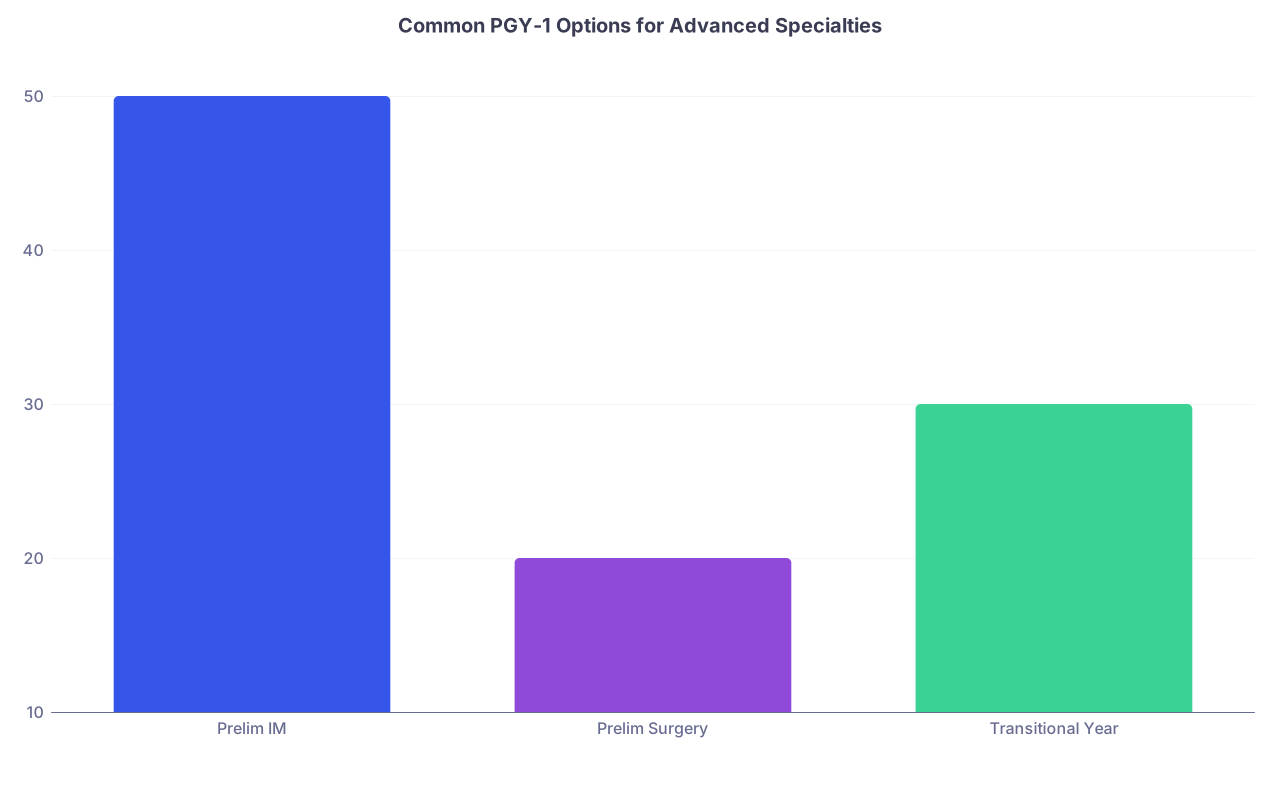
| Category | Value |
|---|---|
| Prelim IM | 50 |
| Prelim Surgery | 20 |
| Transitional Year | 30 |
By August, you should know:
- Which advanced specialties you’re applying to.
- Whether you’re treating prelim as a formality or as a critical quality‑of‑life year (for radiology and derm folks this matters a lot).
- Your geographic priorities for both PGY‑1 and PGY‑2+.
9–7 Months Before Rank List (September–November): Application Season
Early September – ERAS Submission
At this point you should:
- Finalize your ERAS list with three buckets:
- Advanced programs in your specialty.
- Prelim/TY programs (IM, Surgery, TY).
- Categorical programs if you want a backup.
Strategic numbers (for a typical competitive advanced field like Anesthesia or Radiology):
| Program Type | Low Risk Applicant | Moderate Risk | Higher Risk |
|---|---|---|---|
| Advanced | 15–20 | 20–30 | 30+ |
| Prelim/TY | 8–10 | 10–15 | 15–20 |
| Categorical | 0–5 | 5–10 | 10–15 |
- Don’t be cute and apply to 3 prelims because “I’m sure it’ll work out.” Prelim/TY spots can be cutthroat, especially TYs.
- Tailor your personal statement:
- For advanced programs, emphasize the specialty.
- For prelim/TY, emphasize being a safe, hardworking intern who won’t cause drama and understands the year is clinically heavy.
October–November – Interview Invitations Start
At this point you should:
- Track every single invite in a spreadsheet with columns for:
- Advanced / prelim / TY / categorical
- City
- Program style (malignant/benign based on reputation)
- Whether they’re in the same institution or health system

- Prioritize interview acceptance like this:
- Advanced in your desired specialty.
- High‑quality prelim/TY in same city or region as your strongest advanced options.
- Categorical backups in locations you’d actually live in.
If you start to see a pattern – for example, a lot of anesthesia advanced interviews in the Midwest and very few on the coasts – you should adjust prelim/TY applications via ERAS add‑ons toward that region now, not in January.
6–4 Months Before Rank List (December–January): Two Parallel Interview Seasons
You’re now in the thick of interviews.
At this point you should think of your life as two overlapping match cycles:
- One for your advanced specialty
- One for your PGY‑1 year
December – Advanced Interviews
At this point you should:
- Use each advanced interview day to ask:
- “Where do your incoming residents typically do their prelim or TY?”
- “Do you have affiliated prelim/TY spots that tend to go to your applicants?”
- “Do your residents usually stay in the same city for intern year?”
- Write this down immediately after the interview. Do not trust memory in January.
If a program director casually says, “Most of our folks match at Hospital X for prelim IM; we have a good relationship there,” that’s code for:
- You should strongly consider ranking that prelim IM high on the supplemental list for this advanced program.
- If you have not applied there, add it now while interview invites are still flowing.
January – Prelim/TY Interviews
This is where a lot of people make bad decisions because they’re exhausted. Do not.
At this point you should:
- Evaluate prelim/TY programs with different criteria than your advanced specialty:
- Call schedule
- Elective time vs. floor time
- Scut and note‑writing burden
- Culture around prelims (second‑class citizens or integrated?)
- Ask current residents questions that actually reveal pain points:
- “How many nights in a typical month?”
- “How many months of electives?”
- “Would you choose this prelim/TY again if you were going into [your specialty]?”
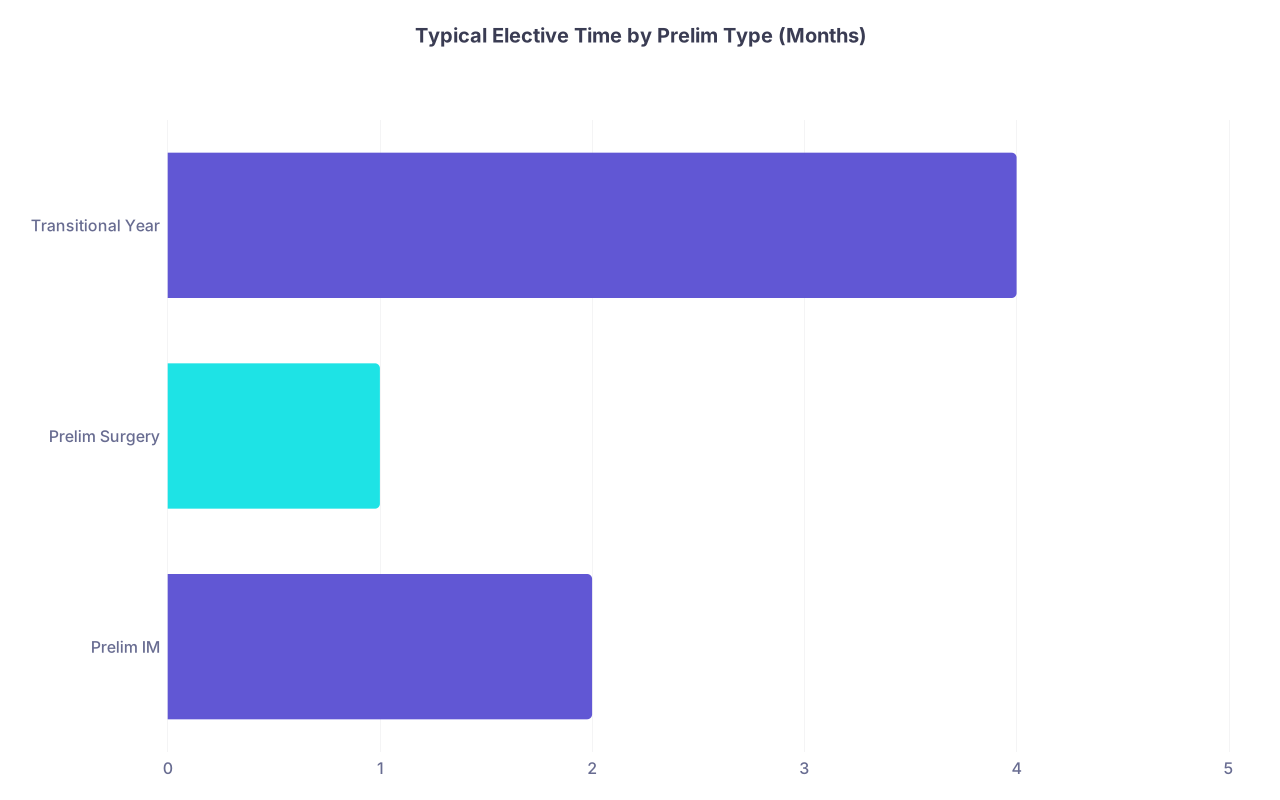
| Category | Value |
|---|---|
| Prelim IM | 2 |
| Prelim Surgery | 1 |
| Transitional Year | 4 |
By the end of January you should:
- Have a reasonable number of prelim/TY interviews (ideally 8–12 if you’re in a competitive advanced field).
- Know which combinations of cities are realistic:
- Example of good pairing: TY in Phoenix + Radiology advanced in Phoenix or Tucson.
- Example of bad pairing: Prelim Surgery in NYC + Anesthesia advanced in rural Midwest with July start and June orientation. Commute nightmare.
3 Months Before Rank List (Early February): Build the Pairing on Paper First
Now you move from “collecting options” to engineering combinations.
At this point you should:
Open a spreadsheet and create three tabs:
- Tab 1 – Advanced Programs (ranked roughly how you feel now)
- Tab 2 – Prelim/TY Programs (with notes on location, workload, vibes)
- Tab 3 – Combinations (what pairings are realistic and desirable)
For each advanced program, list 3–6 prelim/TY options in order of preference:
- Same institution first (if available)
- Same city or integrated health system next
- Same region last
This is your “draft” for the supplemental rank lists you’ll build in NRMP soon.
6–4 Weeks Before Rank List (Mid–Late February): Enter NRMP Rank Lists Correctly
This is where people screw up technically. Do not rush this step.
Step 1: Primary Rank Order List (ROL)
At this point you should:
- Log into NRMP and create your Primary ROL:
- All categorical programs you’re serious about
- All advanced programs you’re serious about
Order them exactly based on where you’d actually want to train, ignoring prelim concerns for the moment. The algorithm helps you when you rank by true preference.
Example (Primary ROL):
- Radiology – Big Academic Center A (Advanced)
- Radiology – Midwestern Program B (Advanced)
- Anesthesia – Coastal Program C (Advanced)
- IM – State U (Categorical)
- IM – Community D (Categorical)
Step 2: Supplemental Rank Order Lists (SROLs) for Each Advanced Program
Now you attach the prelim years.
At this point you should:
- For each advanced program on your Primary ROL, create a separate SROL:
- SROL for Radiology – Big Academic A
- SROL for Radiology – Midwest B
- SROL for Anesthesia – Coastal C
Each SROL includes only prelim/TY programs.
Example – Supplemental List for Radiology – Big Academic A:
- Transitional Year – Same Hospital A
- Prelim IM – Partner Hospital across town
- Prelim IM – Other City in same metro
- Prelim IM – Slightly further but commutable
For Radiology – Midwest B, your SROL may be completely different.
Key rule:
If you do not attach an SROL to an advanced program, the system assumes you’re OK matching there without a PGY‑1. You’ll be in trouble. Double‑check you’ve paired every advanced program with a prelim/TY list.

| Step | Description |
|---|---|
| Step 1 | Primary ROL |
| Step 2 | Advanced Program 1 |
| Step 3 | Advanced Program 2 |
| Step 4 | Categorical Programs |
| Step 5 | Supplemental List 1 - Prelim TY |
| Step 6 | Supplemental List 2 - Prelim IM |
2–3 Weeks Before Rank List (Late February–Early March): Stress‑Test Your Pairings
At this point you should assume the match gives you any one of the advanced programs on your list and ask:
“If I match here, will I be OK with any of the prelim/TY programs on the attached SROL?”
Walk through a few scenarios:
- Scenario A – You match at your #1 Radiology program:
- Does the SROL start with the linked TY that everyone wants? Good.
- Do you have 3–5 realistic backup prelims in that same metro/region? Also good.
- Scenario B – You fall to your #3 Anesthesia program:
- Did you lazily attach only one prelim you interviewed at in that city?
- If you fail to match that prelim, are you OK scrambling in SOAP for a PGY‑1?
If you find a weak spot (like only 1–2 prelims for a given advanced program):
- Re‑order your Primary ROL to prioritize pairings that actually work in real life, not just brand names.
- Or strengthen that SROL with additional prelims if you interviewed more broadly in that region.
Match Week: Interpreting Your Result (and the Disaster Scenarios)
If You Match to Both Advanced + Prelim/TY
Best‑case scenario.
At this point you should:
- Confirm start dates and orientation dates for both:
- Make sure PGY‑1 ends before PGY‑2 orientation starts.
- Coordinate logistics:
- Housing that works for both years if in same city.
- Or accept that you’ll move between PGY‑1 and PGY‑2 and plan ahead.
If You Match to Advanced but Not Prelim/TY
This is rare if you ranked responsibly, but it happens.
At this point you should:
- You’ll enter SOAP for prelim/TY only.
- Your advanced spot is reserved; you just need a PGY‑1 somewhere.
- Focus your SOAP list on:
- Prelim IM, Prelim Surgery, or TY that start on time.
- Locations where you can physically move between June and July.
You do not give up the advanced match in this scenario. But the year will get messy.
If You Match to Prelim/TY but Not Advanced
Harder scenario.
At this point you should:
- You have a secured PGY‑1 but no specialty spot after.
- Options:
- SOAP into a categorical if available and if you’re willing.
- Complete prelim/TY year, then reapply for advanced spots as a PGY‑2 applicant.
- Your strategy one year earlier should have anticipated this:
This is why having some categorical interviews as backup matters for moderately risky applicants.
1–3 Months Before PGY‑1 Start: Make the Year Work for Your Advanced Specialty
Once the dust settles, you’ve got a matched pair (or at least a prelim + a plan).
At this point you should:
- If your prelim/TY is in the same institution as your advanced:
- Get to know your future department early.
- Ask chiefs or PDs what rotations are most useful for you.
- If your prelim/TY is in a different institution or city:
- Keep in regular touch with your advanced program coordinator.
- Watch for:
- Credentialing forms
- Licensing timelines
- Any onboarding that crosses over with last month of PGY‑1

You should also be honest with yourself: this year is not your endgame specialty. You are there to:
- Be safe.
- Learn core medicine or surgery.
- Avoid burning bridges in a small specialty world.
How This Looks as a Full Timeline
Here’s the entire arc in one view.
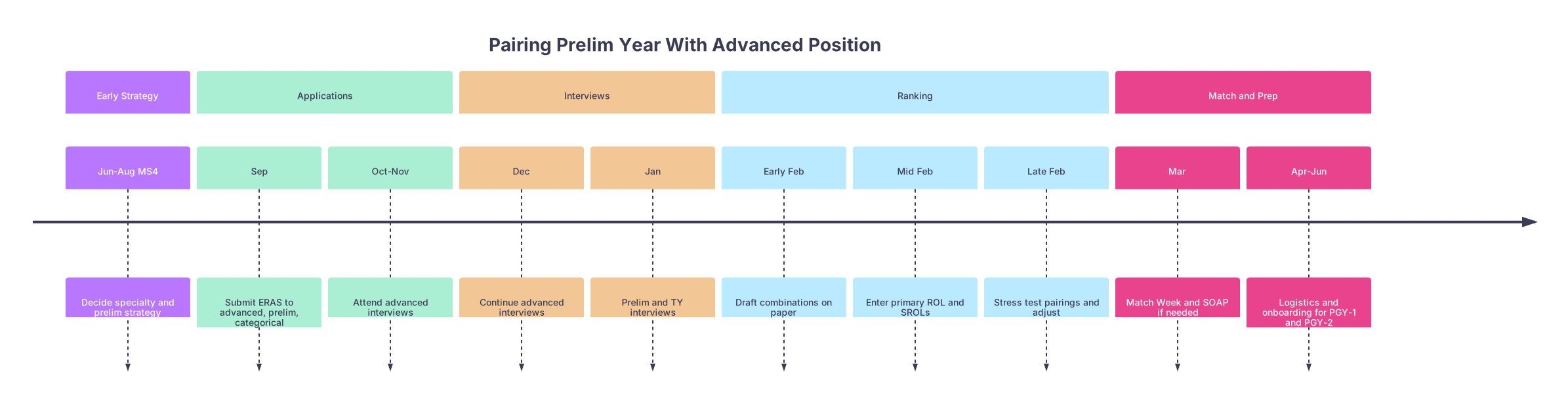
| Period | Event |
|---|---|
| Early Strategy - Jun-Aug MS4 | Decide specialty and prelim strategy |
| Applications - Sep | Submit ERAS to advanced, prelim, categorical |
| Applications - Oct-Nov | Attend advanced interviews |
| Interviews - Dec | Continue advanced interviews |
| Interviews - Jan | Prelim and TY interviews |
| Ranking - Early Feb | Draft combinations on paper |
| Ranking - Mid Feb | Enter primary ROL and SROLs |
| Ranking - Late Feb | Stress test pairings and adjust |
| Match and Prep - Mar | Match Week and SOAP if needed |
| Match and Prep - Apr-Jun | Logistics and onboarding for PGY-1 and PGY-2 |

Final Checkpoints
Three big points you should walk away with:
- You are running two parallel matches – advanced and PGY‑1 – and you must engineer how they interact months before rank lists.
- Every advanced program you rank needs a real supplemental list of prelim/TY options you’d actually accept, in the same city or region whenever possible.
- Your rank list should reflect livable combinations, not just prestige; a “dream” advanced program paired with a nightmare prelim situation is not a win.
Follow the timeline, do the unglamorous spreadsheet work, and you’ll end up with a pair – prelim and advanced – that actually works in real life, not just on a Match Day slide.