
You are in late M3. You are tired, your scrub pants have permanent coffee stains, and everyone suddenly keeps asking: “Are you going categorical or doing a prelim year?” You nod like you understand. You mostly do not. You just finished surgery and you are not sure if you love it or hate it.
This is where the timeline matters. If you decide late, you waste time and money on the wrong mix of applications. If you decide too early, you lock yourself into a path you might regret. So we will walk month by month—M3 into M4—on exactly when you should decide between categorical and prelim strategies and what decisions lock in your path.
Big picture: What “categorical vs prelim” actually changes
Before the timeline, you need a clear definition. Thirty seconds, no fluff.
Categorical position
A full residency from PGY-1 to completion in the same specialty.
Examples:- Internal Medicine (3 years)
- Categorical Surgery (5+ years)
- Pediatrics (3 years)
You match once and, if you do not get fired, you are done.
Preliminary position
A one-year internship (mostly PGY-1) that is:- Required as the first year for advanced specialties
- Neurology
- Anesthesiology
- Radiology (diagnostic, IR, DR/IR)
- PM&R
- Derm
- Rad Onc
- Ophtho (through SF Match but still need a prelim/transition year)
- Or used as a “gap” year / foothold when you:
- Did not match into your desired categorical
- Want more US clinical experience (IMGs)
- Want more time to strengthen application
- Required as the first year for advanced specialties
| Feature | Categorical | Preliminary Year |
|---|---|---|
| Length | Full residency | 1 year (PGY-1) |
| Guarantees PGY-2+? | Yes | No |
| Needed for advanced? | Not usually | Often required |
| Reapply needed? | No (if progressing) | Yes for PGY-2+ |
The strategy question for you:
Do you commit to applying mainly/only to categorical spots?
Or do you deliberately build a prelim + advanced application strategy?
And if you are on the fence—how long can you realistically stay undecided?
M3: Month-by-month – when this choice first appears
Think of M3 as the “data-gathering” year with some hard decision points.
January–March of M3: Quiet phase, internal scoreboard
At this point you should:
Be tracking:
- Step/Level scores (or predicted if not taken)
- Clinical eval trends (honors vs passes, any red flags)
- How competitive your probable specialty is
Have a rough specialty cluster, even if not final:
- “Primary care-ish” (FM, IM, Peds)
- “Surgical-ish” (Gen surg, Ortho, ENT, Urology)
- “Advanced-required” (Rads, Anesthesia, Neurology, Derm, PM&R, Ophtho, Rad Onc)
Here is the first fork:
- If your top interests are all categorical specialties only (IM, Peds, FM, OB, Psych, EM), prelim vs categorical is mostly irrelevant. You just go categorical.
- If one or more of your serious interests are advanced specialties, the prelim vs categorical strategy is absolutely on your horizon. You will probably need:
- Categorical: as backup (IM, Surgery, Transitional)
- Prelim: to pair with advanced positions
At this point you should not commit yet. Just recognize whether advanced specialties are in play.
April–June of M3: Core clerkships finish, reality check
This window is where most people’s plans either solidify or implode.
At this point you should:
Finish or be close to finishing big anchor rotations:
- Medicine
- Surgery
- At least one of: OB, Peds, Psych, Neuro
Have a brutally honest competitiveness check:
- Advanced fields (Derm, Plastics, Ortho, ENT, Rad Onc) are unforgiving. If you are mid-class with average scores, matching directly is rough.
- Slightly less brutal but still selective (Anesthesia, Radiology, PM&R, Neurology) are realistic for many, but borderline candidates must think carefully.
Identify if a “prelim then reapply” path might be your insurance:
- Example: You want Anesthesia, but scores are borderline. You might:
- Apply straight Anesthesia plus
- Prelim Medicine or a Transitional Year as backup
- And be mentally ready to reapply for CA-1 spots
- Example: You want Anesthesia, but scores are borderline. You might:
At this point you should decide if advanced specialties will remain in the running into M4.
If yes → you are very likely heading toward some version of prelim strategy.
If no → you can probably ignore prelim entirely and go pure categorical.
Late M3 to Early M4: The commitment window (when choices start locking)
Now the decisions begin to cost you time, letters, and audition slots.
June–July between M3 and M4: Schedule + Letters = Strategy
By now, you are often:
- Scheduling away rotations / sub-Is
- Planning when to take:
- Step 2 CK / Level 2
- Key electives
At this point you should:
Lock your primary specialty target.
You can have:- 1 main specialty
- 1 true backup
More than that and your entire application becomes diluted and incoherent.
Decide where prelim fits in your structure:
- If your main target is advanced (e.g., Radiology):
- Strategy likely = Advanced + Prelim
- Most will NOT also pursue categorical in a different core specialty because that is two completely different lives.
- If your main target is a competitive categorical (e.g., General Surgery) and you are worried:
- Strategy often = Categorical Surgery + handful of Prelim Surgery spots as safety.
- If you are uncertain between an advanced field and a categorical backup (e.g., Anesthesia vs IM):
- Hybrid strategy:
- Apply Advanced Anesthesia spots
- Apply Categorical IM spots
- Maybe a few Prelim Medicine spots
- This is stressful but done all the time.
- Hybrid strategy:
- If your main target is advanced (e.g., Radiology):
Align letters and sub-Is with that strategy:
- If you are still “exploring” and request generic letters not anchored to a field, that is a red flag later.
- By late June / early July, letter writers should know your primary intended field.
Here is the truth: your M4 schedule and letters essentially decide your strategy. Once sub-Is and auditions are committed, switching from “prelim + advanced” to “pure categorical in something different” in September is painful and messy. Not impossible. But ugly.
July–August of M4: ERAS prep – your last clean pivot point
ERAS opens in early September (date varies, but think mid–late September for submission and mid-October for programs to access).
July–August is when your application skeleton is built.
At this point you should:
Have your personal statements drafted:
- One for your primary specialty
- If doing a separate backup categorical field, a second statement
- Prelim-only statements are usually not required; they align with your core field (e.g., Prelim Medicine PS talks like an IM applicant, not “I just want any prelim spot”).
Have decided which types of programs you will list:
- Category 1: Categorical only
- Category 2: Advanced + Prelim
- Category 3: Hybrid (advanced + prelim + categorical backup)
This is your realistic last point to switch from:
- “I am going all-in on advanced with prelims”
to - “I am abandoning advanced and going all categorical in something else.”
Once ERAS opens and you start populating program lists, every shift in strategy means:
- Rewriting personal statements
- Rebalancing program counts
- Possibly scrambling for different letters
Could you flip in September? You can. It just gets messier and your application will look confused.
ERAS Season: Week-by-week decisions
Now we zoom tighter.
Early September (ERAS opens for applicants)
At this point you should:
- Finalize your program list structure:
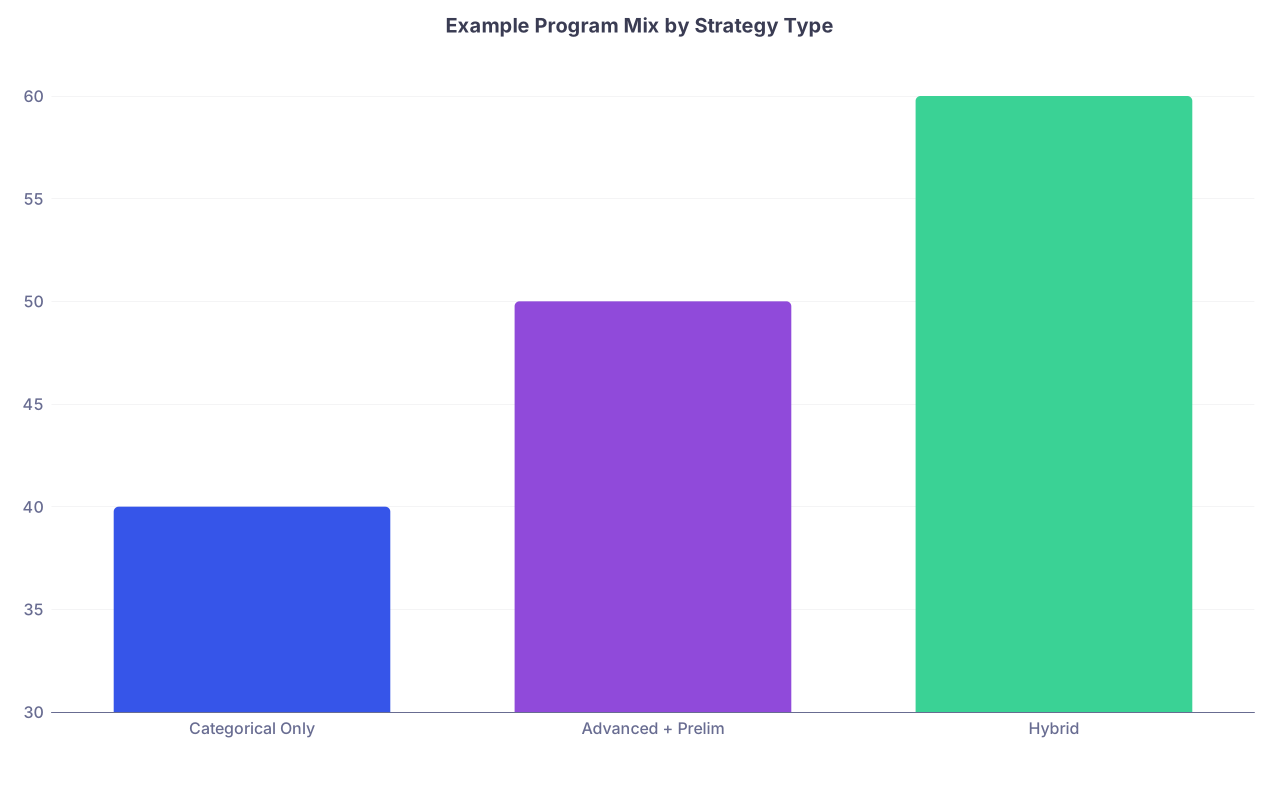
| Category | Value |
|---|---|
| Categorical Only | 40 |
| Advanced + Prelim | 50 |
| Hybrid | 60 |
Concrete examples:
Categorical-only strategy (no prelim)
- IM applicant:
- 40–50 categorical IM programs
- 0 prelim
- Surgery applicant:
- 35–45 categorical Surgery programs
- Maybe 5–10 prelim Surgery as safety (common)
- IM applicant:
Advanced + prelim strategy
- Neurology, Anesthesia, Radiology, PM&R:
- 30–50 advanced programs in the field
- 15–25 prelim Medicine / Surgery / Transitional programs
- Neurology, Anesthesia, Radiology, PM&R:
Hybrid
- Example: borderline Anesthesia
- 25–35 advanced Anesthesia programs
- 10–15 prelim Medicine or TY
- 10–20 categorical Internal Medicine programs as backup
- Example: borderline Anesthesia
You cannot seriously run all three routes at high volume. It will drain your time and money and your application will look unfocused. Two coherent tracks max.
Mid–Late September: ERAS submission week
At this point you should:
- Submit with a clear hierarchy in your head:
- If both advanced and categorical backup hit → which do you really want?
- If you get advanced interviews but few categorical → are you OK committing to advanced + prelim and giving up backup?
- If you only get categorical backup interviews → will you abandon advanced entirely this year?
This is where people lie to themselves.
You need honest priority ordering before interview invites hit.
You will also be asked about this in interviews. Faculty can tell if you are “shopping” fields with no anchor.
Interview Season: How prelim vs categorical plays out
Now you are in October–January.
October–December: You start seeing which path is actually viable
At this point you should:
- Track interview patterns in a simple grid:
| Type | Invites | Goal Range |
|---|---|---|
| Advanced | 0–10 | 12–15 |
| Prelim | 0–10 | 10–15 |
| Categorical | 0–10 | 12–15 |
Patterns I see constantly:
Strong advanced, weak prelim
- You have 12 Radiology interviews and 2 prelim Medicine invites.
- Problem: Advanced positions usually require you to already have or concurrently match a PGY-1.
- At this point you should:
- Aggressively add more prelim apps in November if possible
- Contact programs with open prelim spots
- Consider Transitional Years if you have not
Decent categorical backup, mediocre advanced
- You have 8 Anesthesia + 15 categorical IM interviews.
- This is the classic pivot point.
- At this point you should decide:
- Do you rank IM higher and effectively walk away from Anesthesia this cycle?
- Or do you rank Anesthesia + prelim combos above all, accept the risk, and keep IM as deep backup on the list?
Mostly prelim, almost no advanced or categorical
- Common in IMGs or late-deciders.
- You may be staring at the reality of a one-year job with mandatory reapply.
- At this point you should:
- Honestly ask if a research year or an additional degree would be a better reset than a random prelim spot with no path to PGY-2.
January–February: Rank list construction – final commit
Here is where you must stop waffling. The algorithm does not care that you are conflicted.
At this point you should:
Decide what outcome you would be willing to live with for the next 3–7 years:
- A full categorical in a field that is not your dream but stable
- Or a prelim + advanced path in your dream or near-dream field, with some risk
- Or a prelim without guaranteed PGY-2, meaning more uncertainty
Build your rank list accordingly:
- If advanced is your clear top choice and you have viable interviews:
- Rank all complete (advanced + prelim) combinations first
- Then any categorical backup programs
- If you have real doubts about the advanced field:
- Rank categorical programs you would truly be happy in above fringe advanced options
- If you only have prelim + a few weak categorical options in fields you dislike:
- This is where people sometimes choose to intentionally go unmatched, then plan a structured research/strengthening year instead of a random prelim year.
- If advanced is your clear top choice and you have viable interviews:
Recognize that ranking prelim alone (without a secured CA-1 or PGY-2 future home) is a conscious choice to re-enter the match, scramble, or SOAP later. That is not automatically bad. Just not something to sleepwalk into.
Visual: How the decision window actually looks
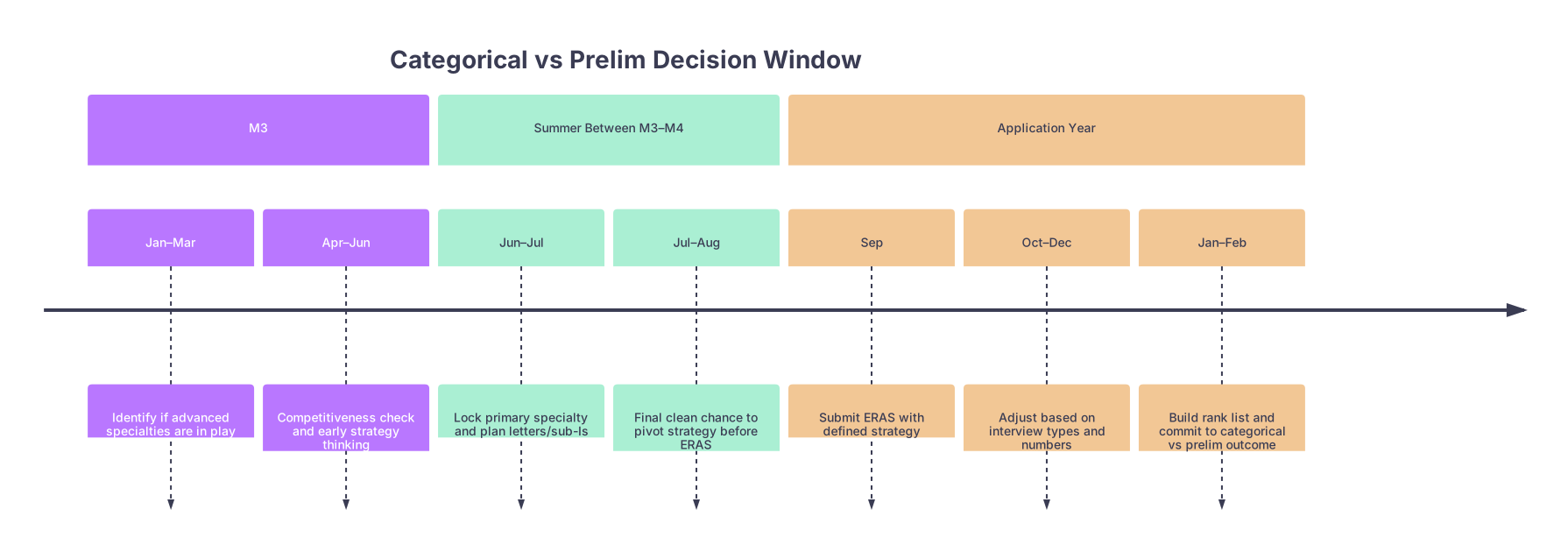
| Period | Event |
|---|---|
| M3 - Jan–Mar | Identify if advanced specialties are in play |
| M3 - Apr–Jun | Competitiveness check and early strategy thinking |
| Summer Between M3–M4 - Jun–Jul | Lock primary specialty and plan letters/sub-Is |
| Summer Between M3–M4 - Jul–Aug | Final clean chance to pivot strategy before ERAS |
| Application Year - Sep | Submit ERAS with defined strategy |
| Application Year - Oct–Dec | Adjust based on interview types and numbers |
| Application Year - Jan–Feb | Build rank list and commit to categorical vs prelim outcome |
Common patterns by specialty group
1. Advanced specialties (Anesthesia, Radiology, Neuro, PM&R, Derm, Ophtho, Rad Onc)
For these, at this point in M3–M4 you should:
- Accept that prelim is not optional. You must actively plan:
- Where you want to intern (Medicine vs Transitional vs Surgery)
- Geographic alignment between prelim and advanced programs
- Decide by July of M4 if you are really applying:
- Only advanced + prelim
- Or advanced + prelim + categorical backup
You should not drift into September still unsure whether you will submit apps for a categorical backup field.
2. Surgical applicants
- Strong applicants:
- Mostly categorical spots, with a modest number of prelim Surgery as a true safety net.
- Borderline applicants:
- Often lean heavily on prelim Surgery to get a foot in the door.
- Here’s the catch: many prelim Surgery spots never convert to categorical at that same institution.
Do not romanticize this. Ask explicitly during interviews.
For surgery especially, you should decide by ERAS submission if you are willing to:
- Do a prelim year and then reapply vs
- Pivot to a categorical field like IM, Anesthesia, EM, etc.
3. Primary care / core categorical fields (IM, Peds, FM, Psych, OB)
For most of you:
- Categorical should be your default.
- Prelim Medicine is occasionally a “rescue” path for:
- IMGs needing a foothold
- Applicants needing one more year to prove themselves
But unless you are using prelim intentionally to reset, you should not be building a prelim-heavy strategy for these fields.
FAQ (exactly 3 questions)
1. How late can I realistically change from an advanced + prelim plan to a pure categorical strategy?
You can technically add categorical programs even after ERAS submission, but the last clean pivot is July–August of M4, before personal statements, letters, and sub-Is are fully locked in. After that, your application will start to look mismatched—letters written for one field, personal statement for another, schedule not aligned. I have seen people pivot as late as November and still match, but they were fixing a mess in real time. Avoid that if you can.
2. Is a prelim year ever better than taking a research year if I am not competitive yet?
Sometimes, but not automatically. A prelim year gives you a paycheck, real clinical exposure, and new letters. It also exhausts you and leaves little protected time to substantially improve your application (research, Step scores, etc.). A research year, especially in your target specialty at a strong institution, can be more powerful for competitiveness. If your biggest gaps are scores or publications, research usually wins. If your biggest gap is U.S. clinical experience and “someone vouching for me in real clinical settings,” a prelim can help.
3. Should I rank categorical backup programs above or below my dream advanced + prelim combinations?
This is a values question, not a statistics question. If you rank categorical backup above advanced + prelim, you are effectively choosing stability over dream field. If you rank advanced + prelim first, you are accepting a bit more risk—especially if your prelim is not at the same institution as the advanced spot or if the advanced interviews are at lower-tier places with shaky reputations. The right answer: decide which outcome you will regret more in 5 years. Make the rank list match that, and stop trying to game the algorithm; it will always act on your declared priorities.
Key takeaways
- By late M3, you should know if advanced specialties are seriously in play; that alone puts prelim strategy on your radar.
- By July–August of M4, you should have committed to a coherent plan: categorical only, advanced + prelim, or a true hybrid. That is your last clean pivot point.
- By rank list time, you are not “deciding prelim vs categorical” anymore—you are deciding what kind of career risk and trajectory you are willing to live with. Build the list to match that reality.