
Six‑Month Countdown: Preparing to Reapply Midway Through a Prelim Year
It is October 1st. You are three months into a preliminary medicine year. You are holding a pager that never stops, pre‑rounding in the dark, and between notes you are checking your email for interview invites that are not coming.
You did the thing everyone warns about: “I will fix my application during prelim.” But the days disappear into cross‑cover and discharge summaries. Now you are six months from when next year’s applications open, and you finally admit it: you need a real plan.
That is what this is. A six‑month, point‑by‑point timeline for reapplying while you are in the middle of a prelim year.
We will move chronologically. At each point, I will tell you:
- What you should be doing this month or week
- What to stop doing that is wasting your time
- How a prelim year is viewed by programs (and how to weaponize that instead of hiding it)
First, very briefly, where you stand.
You are here: What a Preliminary Year Actually Is (And How It Looks on Paper)
A preliminary year is a one‑year internship in a core specialty (usually Internal Medicine, Surgery, or Transitional Year) that does not guarantee continuation in that program’s advanced track.
- Categorical IM: 3‑year commitment
- Prelim IM: 1 year only
- Transitional Year: rotating internship, also 1 year
- Prelim Surgery: 1 year of surgical internship, no guarantee of PGY‑2
To residency selection committees, a prelim year signals one of a few stories:
| Scenario | Common Program Interpretation |
|---|---|
| Prelim before competitive field | Ambitious, maybe over‑reached first time |
| SOAPed into prelim after no match | Red flag, but salvageable with growth |
| Step gaps or low scores + prelim | Using year to prove clinical ability |
| Switching from one field to another | Re‑calibrating career path |
Programs do not hate prelims. They hate vague narratives and sloppy planning. A strong prelim year with clean evaluations, clear letters, and a believable story is a major asset. A chaotic prelim year with missed opportunities becomes an anchor.
You have six months to make it the former.
Month 1: Reality Check and Strategy (6 Months Before Applications Open)
Let us assume ERAS will open in early June and submission will be mid‑September. You are now in early January of your intern year, six months from app open.
At this point, you should:
1. Define your target: same specialty or pivot?
You cannot “see what happens.” Not at this stage.
Decide in the next 2–3 weeks:
- Are you reapplying into the same specialty?
- Or switching? (e.g., from prelim surgery to categorical IM)
Make that decision using three hard pieces of data:
- Scores and attempts (USMLE/COMLEX; any fails are critical context)
- Current cycle feedback (number/quality of invites, rejections)
- Program adviser reality check (not your co‑interns, not SDN threads)
At this point, you should:
- Book a single, honest meeting with:
- Your program director (PD) or associate PD, and
- A mentor in your desired specialty (even if at another institution)
In those meetings, you ask:
- “If I keep applying to [specialty], am I competitive anywhere?”
- “If no, where am I realistically competitive?”
- “What would you need to see in my application by June for you to rank me confidently?”
Take notes. Assume they are being more optimistic than reality and still adjust down half a notch.
2. Map your weaknesses against what can be fixed in 6 months
You cannot change:
- Step scores
- Medical school grades
- Gaps in training
You can change:
- Letters of recommendation quality
- Program director endorsement
- Narrative coherence (why prelim, why now, why this specialty)
- Evidence of performance (evaluations, mini projects, small QI)
Write a brutally simple grid:
| Area | Current Status | Realistic Goal in 6 Months |
|---|---|---|
| Letters | 1 generic, 1 okay | 3 strong, specialty‑aligned |
| PD Support | Unknown | Enthusiastic, written in MSPE |
| Research/QI | None | 1 small QI or case accepted |
| Narrative | Confused, scattered | Clear reapplication story |
This becomes your roadmap.
Months 2–3: Build the Foundation While You Are Still Drowning (4–5 Months Before ERAS Opens)
You are now in February–March of your prelim year. You are more efficient, but still exhausted. This is when people say, “I will fix my personal statement on my vacation block” and then never touch it.
At this point, you should focus on three pillars:
Pillar 1: Lock in rotations and letter‑writers
You need 3–4 letters for your new application:
- 1 from your prelim program director or associate PD
- 2 from attendings in your chosen specialty
- 1 optional extra if switching fields or if you have an important research mentor
Between February and March:
Look ahead at your remaining schedule.
- Identify which months you are on rotations with letter‑worthy attendings:
- For IM: wards, ICU, electives with core faculty
- For Surgery: services with program leadership or high‑volume educators
- For TY: any month in your target specialty
- Identify which months you are on rotations with letter‑worthy attendings:
If your schedule does not give you time with the right people:
- Ask chief residents or PD for targeted swaps:
- “I am planning to reapply in internal medicine and would benefit from working with Dr. X on wards in April instead of night float. Is a switch possible?”
- You do not ask this in June. You ask now.
- Ask chief residents or PD for targeted swaps:
By end of Month 3 you should have:
- A list of 3–5 attendings you plan to ask for letters
- A tentative letter timeline:
- “I will ask Dr. A at end of March”
- “Dr. B after ICU in May”
- “PD letter request in May–June once I have compiled my CV and draft PS”
Pillar 2: Start your QI/research or academic “signal”
You are not writing an R01. You just need evidence that you used the year thoughtfully.
Between February and March, at this point you should:
- Find one realistic project:
- A QI project on discharge summaries, readmissions, or sepsis pathways
- A case report of an unusual patient you actually took care of
- A brief retrospective review already in motion where you can join late
The easiest: a QI project. Every residency program is drowning in them.
Ask your chief or a friendly faculty member:
- “Is there an ongoing QI project where I can take ownership of a small piece and work it up for a poster or internal presentation by summer?”
Your goal is not “publish in NEJM.” It is:
- One abstract submission (local, regional, or national meeting)
- Or one poster at your institution
- Or one case report submitted, even if not yet accepted
You want something to list under “Experiences since last application” in ERAS.
Pillar 3: Quietly gather evaluation data
You need proof that you are a strong intern, not barely holding on.
Between February–March:
- Request mid‑year feedback from your PD or faculty adviser.
- Ask chiefs for insight on your reputation:
- “If a program director from another IM program called you about me, what would you say?”
If feedback is mixed, this is your window to fix behavior:
- Chronic late notes
- Missed pages
- Poor communication with nurses
- Abrupt tone with consultants
By the end of Month 3, you want to be on an upward trajectory in evaluations. Not perfect. Upward.
Months 4–5: Application Build Phase (2–3 Months Before ERAS Opens)
It is April–May. ERAS opens in about six weeks. You are likely hitting your most intense blocks (ICU, q4 call, night float). This is where most interns blow it and “just re-use last year’s application.”
At this point, you should:
1. Draft your new narrative (personal statement + reapplicant story)
You are not allowed to say, “I have always been passionate about [specialty].” You had an entire match cycle and ended up in a prelim. Programs can read.
You must answer three questions clearly:
- Why are you reapplying now?
- What did you learn during the prelim year that changed or strengthened your direction?
- Why should they believe the outcome will be different this time?
Timeline for April–May:
Week 1–2 (of Month 4):
- Pull your old application.
- Highlight everything that no longer fits your story.
- Write a 1‑page “memo to self”:
- “Last year I applied to X programs in Y specialty, had Z interviews, and did/did not match. The honest reasons: [scores, late app, no home program, lack of research, unrealistic list]. Since then, I have…”
This memo is for you, not for ERAS. It forces honesty.
Week 3–4:
- Draft the new personal statement.
- 70% about what you did and learned this year on the wards, with patients, with teams.
- 30% about the future and what you want in a categorical program.
Concrete example of tone:
- Bad: “I did not match last year, but I am resilient and passionate.”
- Better: “Last cycle, I applied heavily to top‑tier university programs and underestimated how my single Step failure would be viewed. During this preliminary year, managing high‑acuity patients on night float and leading rounds as a senior‑style intern have clarified that my skills and satisfaction align best with community‑focused internal medicine programs with strong inpatient training.”
You are allowed to be blunt. Program directors read hundreds of essays; they can smell evasiveness.
2. Secure and schedule your letters
By end of May, you need:
- Verbal yes from:
- PD or APD
- 2 specialty‑specific attendings
How to ask efficiently:
End of rotation, in person if possible:
“Dr. Smith, I am planning to reapply to categorical internal medicine this upcoming cycle. Working with you on wards was one of the most formative experiences this year. Would you feel comfortable writing me a strong letter of recommendation commenting on my performance as an intern?”
Then:
- Email within 24 hours:
- Updated CV
- Draft personal statement (even if rough)
- Bullet list of 4–5 specific patient care examples from that rotation they might reference
Set a soft deadline:
- “ERAS opens in June; would you be able to upload the letter by July 15?”
You are not being demanding. You are being clear.
3. Build your program list for your actual profile, not your ego
This is where people repeat the same mistake and end up in SOAP again.
In late Month 4 and during Month 5, you should:
Categorize programs:
- High‑probability: community or mid‑tier academic programs in less competitive locations that have historically taken prelims or reapplicants
- Moderate: regionally desirable but realistic
- Reach: where your application is clearly below average but you have a plausible story or connection
Be ruthless. If you had:
- < 5 interviews last cycle
- Or a Step failure
- Or visa complications
- Or major red flags
Then 50–60% of your list should be high‑probability programs.
Month 6: ERAS Opening Month (0–1 Month Before Submission)
ERAS usually opens early June. You are now at the starting line.
At this point, you should:
Week 1–2 of June: Data entry and polishing
Update every ERAS section:
- Current training: clearly mark that you are in a Preliminary PGY‑1 position
- Experiences: add prelim year, QI work, case reports, presentations
- “Significant experiences since last application” box: this is where your prelim year story goes in structured form
Request MSPE and updated transcript if needed:
- Some schools automatically update with prelim info; others do not. Verify.
Confirm that letters are requested and assigned correctly for each specialty.
This is mindless but time‑consuming. Do it now, not the night before submission.
Week 3–4 of June: Final narrative alignment
- Re‑read:
- Personal statement
- CV
- Experiences descriptions
They should all tell one coherent story:
- Who you were before prelim
- What happened during the prelim
- Who you are now as an intern applying for categorical training
If you are switching specialties (e.g., prelim surgery → categorical IM):
- Do not pretend you never liked surgery. Own it:
- “I entered surgical training confident that the operating room would be my professional home. Over the course of my preliminary year, I noticed my strongest fulfillment came from longitudinal management of complex medical patients and team‑based problem solving outside the OR…”
Commit to the pivot. Half‑hearted switches look flaky.
July–September: Submission, Letters, and Interview Prep While Still a Prelim
Applications typically can be submitted mid‑September. The summer is your final stretch.
At this point, you should:
July: Lock it in and check letters
By early July:
- Your PS should be in near‑final form
- Your program list should be built, with reasonable breadth
- QI/case work should be at least in abstract/submission stage, so you can truthfully list it
Your tasks:
Confirm letters are uploaded
- Log in and check ERAS for each letter.
- If missing, send a single polite reminder:
- “Dr. X, I hope you are well. ERAS is now open and I will be submitting my application by mid‑September. I wanted to gently check whether you anticipate being able to upload the letter in the next few weeks. Thank you again for your support.”
Meet with your PD one more time
- Update them:
- “I am applying to [number] programs in [specialty], primarily community programs in [regions]. I very much appreciate your support and am happy to provide my final personal statement and CV if helpful.”
- Update them:
You want your PD to be ready when they get a phone call about you.
August: Final edits and interview preparation (light version)
You are still an intern. Time is not your friend.
In August, at this point you should:
- Do two mock interviews, max:
- One with a faculty member
- One with a peer or mentor who will actually give blunt feedback
Focus on:
- “Tell me about yourself”
- “Why did you not match last cycle?”
- “Why are you leaving your current program?”
- “What did you learn from your prelim year?”
You must have clean, practiced answers that:
- Do not trash your current program
- Do not sound bitter
- Do not blame everyone else
Example framing:
- “Last year, my application was not competitive for the programs I targeted, largely because [brief specific reason]. During this preliminary year, I have focused on strengthening my clinical performance, seeking mentorship, and clarifying that I want a long‑term role in [specialty]. I am grateful for the training I have received here, and I am now looking for a program where I can continue in a categorical position.”
That is the tone: accountable, grateful, forward‑looking.
September: Submission week
Aim to submit close to the opening of ERAS submissions, not weeks later. You can still tweak your program list after initial submission if needed, but the core application should be in early.
At this point, you should:
- Block off a single half‑day (trade a shift if necessary) to:
- Do a final pass on ERAS
- Check all letters and documents
- Pay and submit
Then stop tinkering. Late applications from prelims look unserious.
During Interview Season: Working as a Prelim While Selling Your Future
If your strategy and timing are reasonable, you will start to see interview invitations between October and January. You will be:
- Post‑call
- On night float
- Charting at 11 pm
At this point, you should:
- Respond to invites within hours, not days
- Be transparent early with your chief residents:
- “I am reapplying this year and may need several days off for interviews. I will give you as much notice as possible and am willing to pick up extra shifts to compensate.”
On interviews themselves, your prelim year is both your best selling point and the awkward elephant in the room. Do not hide it.
Be ready, succinctly, for:
- “Why prelim?”
- “Why did you not stay at your current institution?”
- “If we match you, can you start as a PGY‑2? Or are you aiming for PGY‑1 again?”
The answer depends on:
- Whether your prelim year is ACGME‑accredited in the same field
- Gaps or concerns in your performance
Many IM programs will happily take a strong prelim into PGY‑2. Some will require repeating PGY‑1 if there are concerns. Have your PD’s view on this nailed down in advance so you do not guess on the spot.
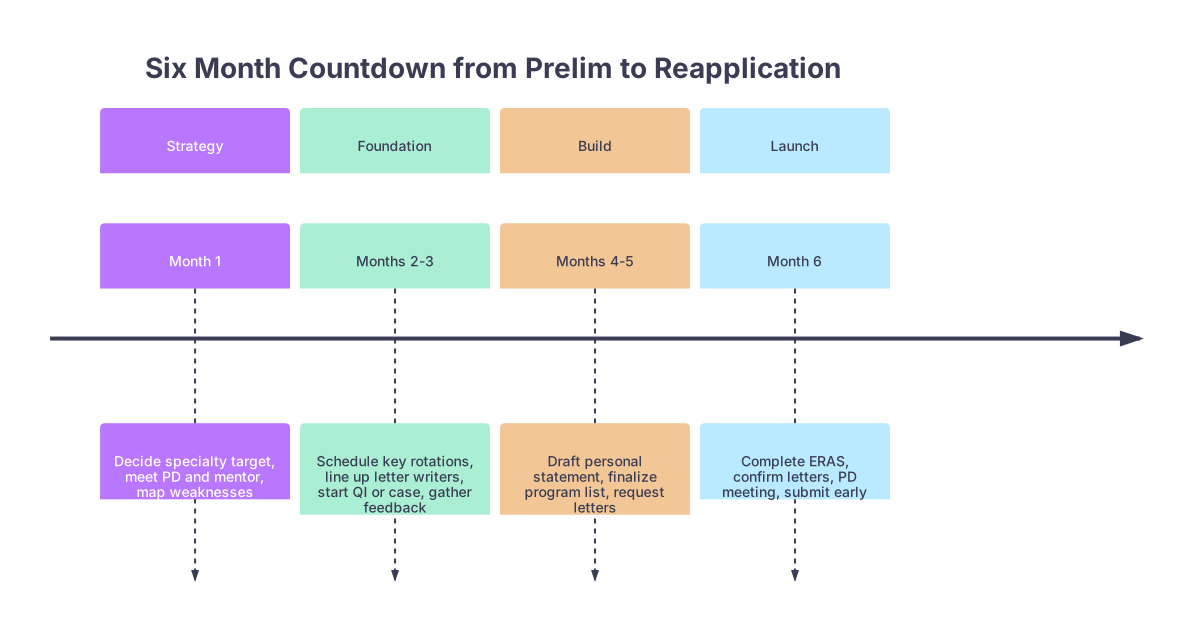
Quick Visual: Six‑Month Reapplication Timeline from Prelim Year
| Period | Event |
|---|---|
| Strategy - Month 1 | Decide specialty target, meet PD and mentor, map weaknesses |
| Foundation - Months 2-3 | Schedule key rotations, line up letter writers, start QI or case, gather feedback |
| Build - Months 4-5 | Draft personal statement, finalize program list, request letters |
| Launch - Month 6 | Complete ERAS, confirm letters, PD meeting, submit early |
One More Thing: When You Should Not Reapply This Cycle
I will say the uncomfortable part too.
If, by Month 4:
- Your evaluations are poor or spotty
- Your PD will not clearly support you
- Your scores and prior application already put you on the margins, and nothing substantial has changed
Then you may be better off:
- Finishing your prelim year
- Taking a targeted research/clinical gap year with demonstrable output
- Reapplying with a truly different application in two cycles, not one
Reapplying with a nearly identical profile and a vague “I worked hard as an intern” story rarely ends well. Programs remember.
What You Should Do Today
Do not “save this for a lighter week.” You do not get lighter weeks. You get different varieties of chaos.
Today, within the next 30 minutes:
- Open a blank document and write three headings:
- “Why I did not match last time”
- “What I have actually done during this prelim year”
- “What will be objectively different about my application in 6 months”
Under each, write bullet points. No wordsmithing. Just truth.
That one page becomes the backbone of your conversations with mentors, your PD, and ultimately your entire reapplication.