
The biggest mistake applicants make with prelim and categorical tracks is pretending they are one application. They are not. They are two overlapping but distinct strategies that must be planned month by month.
You want a blueprint. Here it is, in time order, with checklists at every stage.
Big Picture: How Prelim and Categorical Fit Together
Let me anchor you first.
- Categorical position = full residency from PGY-1 to completion (e.g., Internal Medicine categorical, General Surgery categorical).
- Preliminary position = 1-year PGY-1 only (often medicine or surgery) that you pair with:
- A separate advanced position (e.g., Radiology, Anesthesiology, Derm, Neuro, PM&R) or
- A “backup year” if your categorical plans do not work out.
| Track Type | Length | Example Listing | Goal |
|---|---|---|---|
| Categorical | Full 3–7 yr | Internal Med (Cat) | Complete residency in one program |
| Preliminary | 1 year | Surgery (Prelim) | PGY1 only, then move on |
| Advanced | Starts PGY2 | Radiology (Adv) | Needs separate PGY1 |
If you are applying to:
- Radiology, Anesthesia, Derm, Neuro, PM&R, Ophtho: you probably need advanced + prelim.
- General Surgery but worried about competitiveness: you may do surgery categorical + surgery prelim backup, sometimes with a medicine prelim as floor.
- Transitional Year (TY): think of it as a cushier, more general version of a prelim year, often also paired with advanced matches.
Now let’s walk the calendar. I will assume a typical ERAS cycle with:
- ERAS submission: mid-September
- Programs download: late September
- Interview season: October–January
- Rank list due: February
- Match: mid-March
Shift by a week or two for any given year, but the sequence holds.
12–9 Months Before ERAS: Strategy and Reality Check
Timeline: March–May (MS3 spring / early MS4, or equivalent)
At this point you should stop thinking vaguely and decide your lanes.
Step 1: Choose Your Primary Path and Backup Philosophy
By late spring you should be very clear on:
Your primary target specialty
- Example: Diagnostic Radiology (advanced)
- Example: General Surgery (categorical)
Your backup structure
Common patterns:- Advanced + many prelims + a realistic categorical backup (e.g., Radiology + IM prelims + IM categorical)
- Competitive categorical + prelim in same field (e.g., Ortho cat + Surgery prelim)
- Slightly less competitive categorical backup (e.g., EM cat + IM cat + IM prelims)
If you cannot explain your path in one sentence, you are not ready:
“I am applying Radiology advanced with IM prelims and IM categorical as backup.”
That level of clarity.
Step 2: Understand How Many Applications You Are Actually Doing
You are not “just applying to 40 programs.”
You are applying to:
- X categorical programs
- Y advanced programs (if applicable)
- Z prelim / TY programs
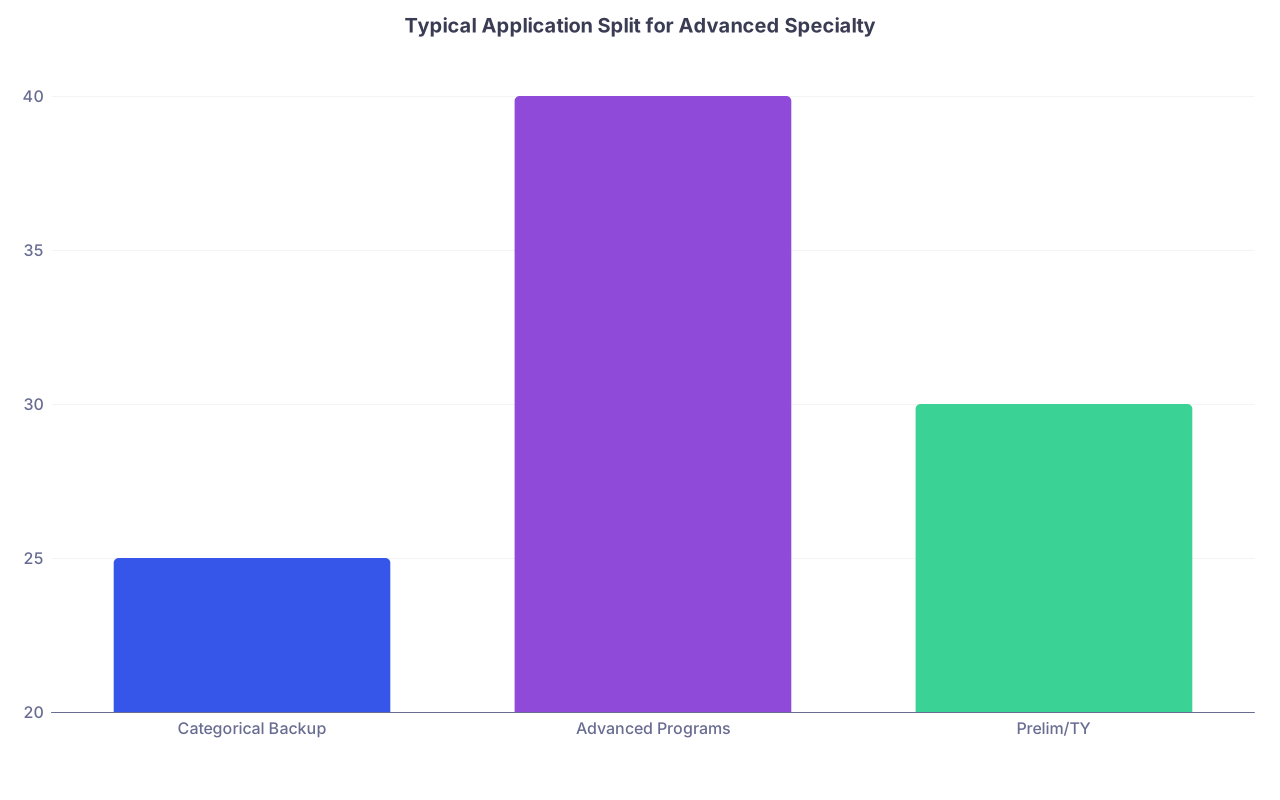
| Category | Value |
|---|---|
| Categorical Backup | 25 |
| Advanced Programs | 40 |
| Prelim/TY | 30 |
Rough ranges I see often for an advanced specialty (average applicant, not superstar, not disaster):
- 30–50 advanced
- 20–40 prelim/TY
- 10–30 categorical backup
For a surgery applicant hedging with prelim:
- 30–60 surgery categorical
- 15–30 surgery prelim
- 10–20 medicine prelim or IM categorical backup
If you are significantly below these numbers and not extremely strong on paper, you are gambling.
9–6 Months Before ERAS: Letters, Rotations, and ERAS Build
Timeline: June–August
You are starting to lock in the pieces you will present to both prelim and categorical programs.
At This Point You Should:
-
- If you need strong surgery letters: frontload surgery sub-I.
- If you need medicine prelim options: get at least one IM sub-I. Think ahead: prelim medicine programs want to see that you have done real inpatient IM, not just a 2-week elective.
Define your letter strategy for dual applications.
You generally want:- 1–2 letters in your primary advanced/categorical field
- 1–2 letters in Internal Medicine (if using IM prelim or IM categorical backup)
- 1 surgery letter if doing surgery prelims or categorical surgery backup.
You can and should use different letter sets for different program types in ERAS.
Building ERAS with Prelim + Categorical in Mind
By August you will be drafting:
- One core Personal Statement for your main specialty.
- One separate Personal Statement for prelim/TY (and possibly a third for categorical backup if a different field).
Do not make your prelim PS sound like, “I am only here because I need a PGY-1 to get into Radiology.”
Wrong tone. Lazy. I have seen prelim program directors toss applications over this.
Prelim / TY statement should:
- Emphasize your interest in broad clinical training, patient care, and being a solid intern.
- Acknowledge (briefly) that you plan to continue into your chosen specialty, but not with disdain for the prelim year.
Example structure for an Anesthesia applicant:
- Anesthesia PS: focus on OR, physiology, peri-op care.
- Prelim IM PS: focus on inpatient medicine, building foundations to be an excellent future anesthesiologist.
1 Month Before ERAS Opens: Fine-Tuning Track Lists
Timeline: Late August – Early September
At this point you should have a working spreadsheet that separates:
- Advanced programs (if relevant)
- Categorical programs in your primary field
- Categorical backup programs (different field)
- Prelim IM
- Prelim Surgery
- Transitional Year
For each group, track:
- Program name
- City/state
- ACGME ID
- Track type (prelim/categorical/advanced/TY)
- Relative competitiveness (from FREIDA, Doximity, advisors, upperclassmen)
- Your approximate fit (home program, geographic ties, etc.)
This is where people miss details and mislabel things in ERAS. I have seen applicants accidentally apply only to advanced spots with no prelims in a region and discover it in December. That is not a good day.
ERAS Opening to Submission: Final Build and Submission Week
Timeline: Early–Mid September
At This Point You Should:
Finalize different Personal Statements in ERAS:
- PS #1: Main specialty (e.g., Radiology advanced & Radiology categorical backup if you have it)
- PS #2: Prelim / TY (IM or Surgery)
- PS #3 (if needed): True categorical backup (e.g., IM categorical)
Map which PS and letters go to which program type.
Do not send a Radiology-heavy PS to a pure IM categorical program that you are supposedly “seriously interested in” as a backup. They see through it and you look unserious.Double-check every program’s track type.
Common landmines:- Programs that have both prelim and categorical IM – you must select the right one.
- Surgery programs with multiple tracks (categorical, prelim non-designated, prelim designated).
- Advanced programs that do not include an intern year.
Late September–October: Application Downloads and Early Responses
Programs download applications shortly after you submit. Now the split path actually matters.
Week 1–2 After Submission
At this point you should:
Confirm ERAS shows:
- All applied advanced programs.
- All applied prelim/TY programs.
- All applied categorical programs.
Start tracking interview invitations by category:
- Advanced
- Categorical main specialty
- Categorical backup
- Prelim / TY
This is your early signal.
If by late October you have:
- Several advanced invites but almost no prelims → increase prelim applications.
- Only prelim/TY invites and no advanced/categorical in your main specialty → you are likely leaning on prelim + backup field; consider more categorical backup apps if still open.
October–January: Interview Season – Managing Two Parallel Paths
This is where applicants get tangled. Especially with scheduling.

| Step | Description |
|---|---|
| Step 1 | ERAS Submitted |
| Step 2 | Advanced Invites |
| Step 3 | Categorical Invites |
| Step 4 | Prelim TY Invites |
| Step 5 | Schedule Priority 1 |
| Step 6 | Schedule Priority 2 |
| Step 7 | Fill Open Days |
| Step 8 | Reassess Strategy |
Prioritizing Interviews
Rough priority order for most advanced-track applicants:
- Advanced programs in your chosen specialty
- Categorical backup in core fields (IM, FM, etc.)
- Prelim/TY spots
For competitive surgery applicants hedging with prelim:
- Surgery categorical
- Strong surgery prelims and/or solid IM categorical backup
- Extra prelims
If you start running low on advanced invites:
- Do not cancel categorical backup or prelim interviews. They may be what gets you a job in March.
December–Early January: Reality Check and List Balancing
By mid-December you usually have the bulk of your interview invites.
At this point you should sit down with actual numbers:
- Advanced: how many interviewed?
- Categorical primary: how many interviewed?
- Categorical backup: how many interviewed?
- Prelim/TY: how many interviewed?
You need a realistic match floor. For most US grads:
- 10–12 solid interviews in any single track (e.g., IM categorical) is reasonably safe.
- 4–6 interviews in a very competitive advanced field is shaky unless you are an extremely strong applicant.
If you are sitting on:
- 4 advanced + 2 categorical primary + 8 prelims + 4 IM categorical backup → your likely match path is either IM categorical or prelim, not the advanced field. Adjust your expectations and how you talk during interviews accordingly.
January–Early February: Constructing Dual Rank Lists Intelligently
This is where prelim + categorical gets truly confusing.
There are two rank lists in NRMP when you combine advanced + prelim:
Primary rank list – where you rank:
- Categorical spots
- Advanced spots
Supplemental rank list(s) – where you pair each advanced program with:
- Prelim IM
- Prelim Surgery
- TY programs
These supplemental lists do not matter if you end up matching a categorical spot.
Two Common Scenarios
Scenario 1: Advanced Specialty + Prelim
Example: Radiology advanced + IM prelim + IM categorical backup.
Your primary rank list might look like:
- Radiology Advanced – Program A
- Radiology Advanced – Program B
- Radiology Advanced – Program C
- IM Categorical – Program D
- IM Categorical – Program E
- IM Categorical – Program F
Then, for each advanced entry, you create a supplemental prelim list:
For “Radiology Advanced – Program A”:
- IM Prelim – Program X (same city)
- TY – Program Y (nearby)
- IM Prelim – Program Z (geographically acceptable)
For “Radiology Advanced – Program B”:
- TY – Program Y
- IM Prelim – Program X
- IM Prelim – Program Z
You can re-use the same prelim programs on multiple supplemental lists in different orders.
If you match Radiology Advanced at Program B, NRMP then tries to match you to your highest ranked prelim/TY on that supplemental list that also ranks you.
Scenario 2: Categorical Only + Prelim Backup
Example: General Surgery categorical + Surgery/IM prelim as “I just need a job” backup.
Your primary rank list:
- Surg Categorical – Program A
- Surg Categorical – Program B
- Surg Categorical – Program C
- IM Categorical – Program D
- Surg Prelim – Program E
- IM Prelim – Program F
No supplemental lists needed here, because there are no advanced positions.
The key rule:
Rank what you truly prefer higher, regardless of perceived competitiveness.
Do not drop your dream categorical spot below a prelim “for safety.” That is not how the algorithm works.
Late February–Early March: SOAP Contingency Planning
If you are in a riskier situation (few interviews, mostly prelims, or only one track with limited invites), you should plan your SOAP playbook before Match Week.
At this point you should create:
- A shortlist of uncontested backup specialties you would accept in SOAP (IM, FM, Psych, etc. depending on your priorities).
- A list of documents you might update or reframe:
- New personal statement angled more toward broad categorical fields.
- Short paragraph you can adapt as a message to unfilled programs.
If on the Monday of Match Week you discover:
- Matched to an advanced but not prelim → you will be scrambling in SOAP to get a PGY-1.
- Matched only to prelim → you are secure for PGY-1 but must reapply for PGY-2+ later.
- Unmatched entirely → you are full SOAP mode for both prelim and categorical spots.
Do not wait until that Monday to understand how prelim + categorical interact in the Match.
Practical Checklists by Phase
Pre-ERAS (Spring–Summer) Checklist
By August 31 you should:
- Have a clear primary specialty and backup plan.
- Know whether you are applying to advanced + prelim or categorical + prelim or both.
- Secure letters that cover:
- Primary specialty
- Medicine
- Surgery (if doing surgery prelim/cat)
- Plan at least one IM sub-I if relying on IM prelims or IM categorical backup.
- Build your school/program spreadsheet dividing categorical vs prelim vs advanced vs TY.
ERAS Submission Week Checklist
Before you hit submit:
- Distinct PS for:
- Main specialty
- Prelim/TY (and backup specialty if needed)
- Correct letter combinations assigned per program type.
- Every advanced application paired with a plan for enough prelim/TY applications in the same or acceptable regions.
- Double-check track type selection for each program (cat vs prelim vs advanced).
Rank List Week Checklist
Before certifying your list:
- Count interviews in each category (advanced / cat primary / cat backup / prelim).
- Decide your true priority between:
- Advanced dream vs categorical backup
- Categorical main vs categorical backup vs “any prelim” job
- For advanced positions:
- Create supplemental prelim/TY lists for each advanced program.
- Order prelims by realistic preference (location + workload + reputation).
- Ensure no prelim-only rank is above a categorical that you would actually rather have.
FAQ (Exactly 3 Questions)
1. How many prelim programs should I apply to if I am going for an advanced specialty?
For a typical US grad in a moderately competitive advanced field (Radiology, Anesthesia, PM&R), 20–40 prelim/TY applications is a reasonable starting range. If your school has a strong home prelim program likely to take you, you can be closer to 20. If you are weaker on paper or have no strong home base, push toward 35–40, especially in IM and TY. The real test is how many interviews you receive by December; you want enough prelim interviews (8–10+) to reasonably assume you will match a PGY-1 somewhere.
2. Can I use the same personal statement for both my categorical and prelim applications?
You can, but it is usually a bad idea. Prelim programs do not want to read an entire essay about how your one true calling is Radiology and you see the prelim year only as a hurdle to tolerate. That reads as disdain. Better approach: use a main specialty statement for categorical/advanced spots and a separate, more broadly clinical statement for prelim/TY and categorical back-up. You can re-use 60–70 percent of content; just shift the emphasis and tone.
3. If I match to an advanced program but not to a prelim, am I completely unmatched?
No, but you are in a precarious spot. NRMP considers that a partial match. You have a guaranteed PGY-2+ position but no PGY-1 yet. You will be eligible and highly motivated to enter SOAP to obtain a prelim or TY position. Programs often like such candidates because they already hold an advanced spot and are clearly going somewhere. That said, there is no guarantee. This is why you must apply broadly enough to prelim/TY programs and build strong supplemental rank lists so the algorithm has multiple shots to seat you in a PGY-1.