
The biggest mistake prelim + advanced applicants make is pretending they’re on a normal interview schedule. You are not. You’re running two parallel seasons that can absolutely wreck each other if you do not plan them like a military operation.
This is your chronological roadmap. Follow it and you dramatically cut the risk of:
- Matching advanced and going unmatched in prelim
- Overbooking, canceling late, and burning bridges
- Blowing all your money and vacation days on a chaotic, overlapping schedule
You’re targeting preliminary and advanced spots (think prelim medicine/surgery + advanced anesthesiology, radiology, derm, ophtho, neuro, etc.). That means:
- Two rank lists
- Two interview streams
- One limited calendar
Let’s walk the timeline the way you’ll actually live it: month-by-month, then week-by-week once interviews hit.
July–August: Foundation for a Two-Track Season
At this point you should be:
- Finalizing your specialty choice
- Mapping your prelim strategy (IM vs surgery vs transitional year)
- Building a target list for both tracks
You’re not “just applying broadly.” That’s how people end up with 40 interviews and no idea what they’re doing.
Step 1 – Define your advanced specialty risk level (now).
Rough categories:
- High risk: Derm, plastics, ENT, ortho, ophtho, uro
- Moderate: Radiology, anesthesia, neurology, PM&R
- Lower (but still competitive in good markets): Neurology at mid/lower-tier, less-competitive rads/anesthesia programs
This determines how aggressive you must be with prelim programs.
| Advanced Specialty Risk | Prelim Volume Strategy |
|---|---|
| High (derm, plastics, ENT, ophtho) | 25–40 prelims, prioritize TY + cush IM |
| Moderate (rads, gas, neuro, PM&R) | 15–25 prelims, mix TY/IM, few surgery |
| Lower/moderate | 10–20 prelims, mostly IM, a few TY |
Step 2 – Rough school list (by late August).
You should have:
- 15–40 advanced programs (depending on specialty and competitiveness)
- 10–35 prelim programs across 2–3 states/regions you’d actually live in
- Clear preference: TY > prelim IM > prelim surgery (for lifestyle) unless you specifically want surgery
Step 3 – Understand your calendar constraints.
Grab your school calendar now:
- Core rotations?
- Required sub‑I?
- Dedicated vacation/elective blocks?
Mark:
- Weeks you cannot miss
- Weeks you can flex (outpatient rotations usually)
- Any “no more than X days off” policies
This shapes everything later.
September: Application Prep With Prelim in Mind
At this point you should be:
- Building ERAS with dual-audience content
- Getting letters that work for both advanced and prelim
Personal statement strategy (by mid–late September).
You have three options:
- One PS for both (only if advanced = IM or surgery and prelim is same field)
- One PS for advanced, a shorter variant for prelim IM/TY
- One for advanced, another very short, practical prelim PS (“I will be a reliable intern who shows up and does the work”)
Do not send a hardcore derm-anatomy-story PS to a prelim IM program in a community hospital. It screams “I don’t want to be here.”
Letters of recommendation (LOR).
Aim for:
- Advanced programs: 3–4 specialty-specific letters
- Prelim IM/TY: at least 1 strong IM or general medicine letter
- Prelim surgery: at least 1 surgery letter
If you’re tight on letters, prioritize one very strong general medicine/surgery attending who can say: “This person will be safe and dependable as an intern.”
Early October: ERAS Submitted – Pre-Interview Prep
At this point you should be:
- Submitted to both advanced and prelim programs
- Lining up logistics before invites fly
Create a master tracking sheet
- Columns for: Program, Type (advanced/prelim), City, Region, Interview offer date, Interview date, Notes, Priority (High/Med/Low)
Decide priority tiers now
- Tier 1: Dream/region-critical (you will do almost anything to attend)
- Tier 2: Solid options
- Tier 3: Likely cancels if schedule gets tight
Set hard rules
- Max interviews per week (3–4 is usually sane)
- No back-to-back cross-country jumps unless absolutely needed
- At least one recovery day every 10–14 days or you’ll start making dumb mistakes
Late October–Early November: The First Wave of Invites
This is where people panic. You will not.
At this point you should be:
- Responding to invitations almost immediately
- Looking ahead 3–4 weeks when choosing dates
Week-by-Week Behavior in Early Invite Season
Week 1–2 of Invite Wave (often late Oct/early Nov):
- Answer emails within minutes when possible. Many advanced spots fill within an hour.
- Take earlier dates at advanced programs if you’re competitive. Earlier usually helps you avoid conflicts later.
- For prelim: it’s fine to push some into December/January to leave November open for advanced.
Key move:
Leave one or two “flex weeks” mostly open in late November / early December to absorb high-priority advanced invites that come later.
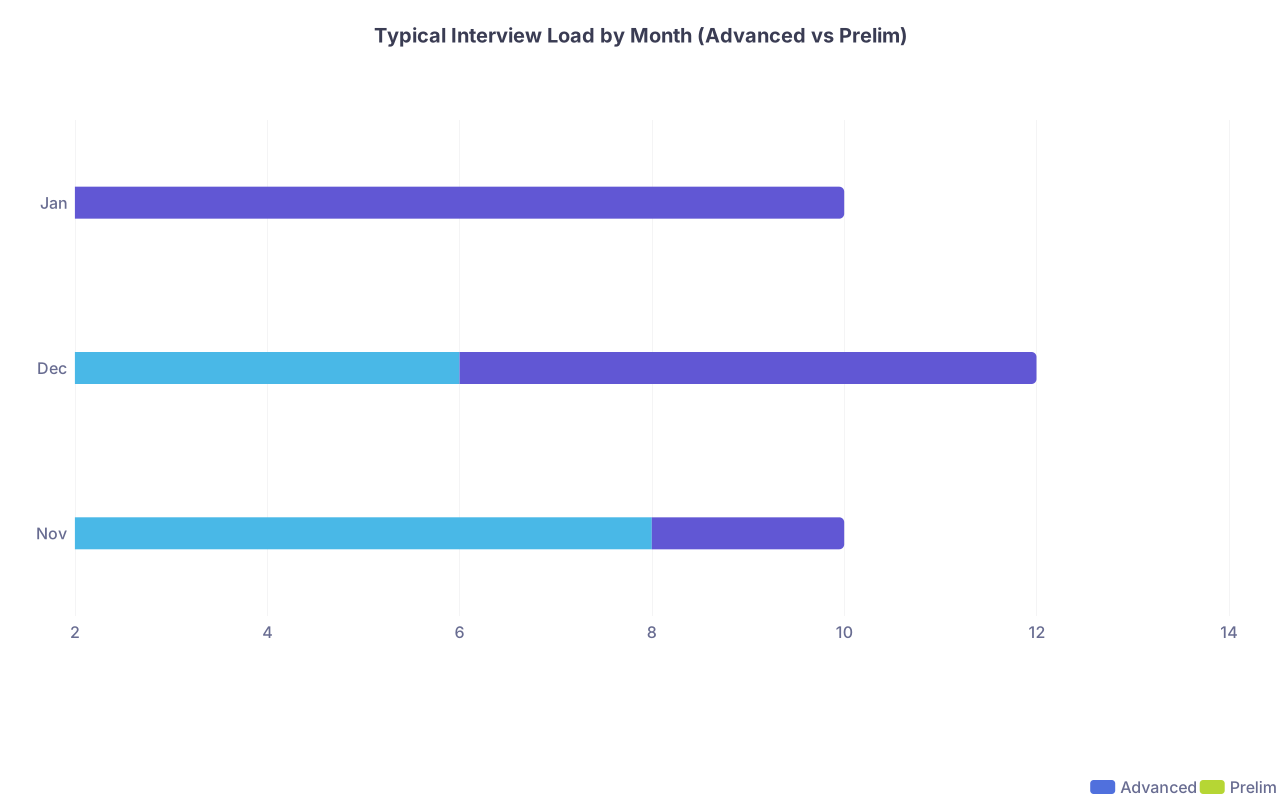
| Category | Advanced | Prelim |
|---|---|---|
| Nov | 8 | 2 |
| Dec | 6 | 6 |
| Jan | 2 | 8 |
You want something like this shape: earlier advanced-heavy, later prelim-heavy.
Mid November–Mid December: Peak Chaos, Peak Opportunity
At this point you should be:
- Actively shaping your calendar, not passively accepting every invite
- Consciously clustering interviews by geography
Week-by-Week Tactics
Every Sunday evening:
Open your tracking sheet
Color-code the next 4–6 weeks
- Green: Locked must-attend interviews
- Yellow: Nice-to-have, could cancel if necessary
- Red: Overbooked or likely to cancel
Check travel:
- Try to bundle city/region (e.g., do three Northeast programs in one week instead of three separate flights)
- Build in arrival buffers (don’t land at midnight for an 8 am interview, even virtual still needs you rested)
Every time you get a new invite (ongoing):
Ask:
- Is this advanced or prelim? Advanced generally wins over prelim.
- Where does it sit in my tier list?
- Does it conflict with a lower-tier interview that I can cancel now instead of later?
You will cancel some interviews. That’s fine. What’s not fine is canceling 24 hours before because you did not want to make a decision two weeks ago.
Late December–Early January: The Prelim Push
By late December, you usually have a clear sense of where you stand with advanced programs:
- Multiple advanced interviews? You’re probably in the game.
- Few or no advanced interviews? You shift strategy hard to prelim security.
At this point you should be:
- Front-loading any remaining advanced interviews into early January
- Filling the rest with prelims and backup safety nets
Strategic Adjustments
If you have:
10+ advanced interviews in a moderate specialty (e.g., anesthesia, rads):
- You can afford to be a bit pickier with distant, low-yield prelims. Focus on regions that geographically match your advanced interviews.
3–6 advanced interviews:
- You treat prelims as serious lifeboats.
- Attend more prelim interviews in areas where you’d be okay doing a grim intern year even if unmatched advanced.
0–2 advanced interviews:
- You pivot.
- Maximize prelim IM/TY interviews. Consider also applying categorical IM if deadlines still allow. Your priority is not to be unmatched.
Daily Logistics Once Interviews Start (Any Month)
At this point you should be managing each interview week as a small project.
One week before each interview:
- Confirm date/time and time zone (yes, even for virtual)
- Poke around faculty lists and residents – write 3–4 bullets you can drop in conversation
- Prepare two narratives:
- Advanced story: why this specialty, why that specific department
- Prelim story: why you’ll be a low-drama, high-output intern they never have to chase
Night before:
- Print or save notes for that specific program only (don’t confuse yourself with details from three hospitals)
- Pack: minimal but safe – suit, shoes, backup shirt, portable charger, headphones for virtual
Day of:
- Treat virtual the same as in-person:
- Neutral background
- Camera at eye level
- No weird audio issues (test 10 minutes before)
January: Final Interviews, Triage, and Early Rank Thinking
At this point you should be:
- Completing your last round of prelim interviews
- Dropping truly low-yield interviews to conserve energy
- Starting to think about your two rank lists in parallel
Week-by-Week in January
Early January:
- Finish remaining advanced interviews
- Prelim interviews ramp up – especially IM and TY
- Begin jotting post‑interview notes each day:
- Vibe with residents
- Call schedule
- Geographic fit with likely advanced spots
- Any red flags (“everyone seems exhausted,” “no one knows the program director”)
Mid January:
- You’ll start to see where your advanced list will top out.
- Begin aligning prelim ranks with likely advanced locations:
- If most of your advanced interviews are in the Midwest, it’s foolish to rank a California prelim first unless you genuinely don’t care where you live for a year.
Late January:
- Guard your time. Resist the urge to keep adding interviews “just because.”
- Focus on quality: arrive prepared, rested, and consistent on your story.
Early–Mid February: Building Your Rank Lists (Advanced + Prelim)
This phase is where applicants targeting prelim and advanced spots either lock in a safe year or create a disaster.
At this point you should be:
- Creating two rank lists in conversation with each other
- Thinking through the what-if scenarios explicitly
How the Match Treats You
For advanced + prelim applicants:
- You submit:
- One rank list for advanced programs (e.g., Radiology PGY‑2)
- One rank list for prelim/TY (PGY‑1)
- You can pair specific advanced programs with specific prelims using “supplemental rank order lists” (if available that year) or just by general strategy
Big warning:
You can match advanced without prelim. If that happens and you didn’t match prelim, you hunt in the Supplemental Offer and Acceptance Program (SOAP) for a PGY‑1. It’s stressful.
You want to reduce that chance.

| Step | Description |
|---|---|
| Step 1 | Submit Advanced Rank List |
| Step 2 | Run Match |
| Step 3 | Submit Prelim Rank List |
| Step 4 | Consider Categorical or Reapply |
| Step 5 | Both Years Secured |
| Step 6 | Need PGY1 in SOAP |
| Step 7 | Advanced Matched |
| Step 8 | Prelim Matched |
Step-by-Step Rank Construction (Week-by-Week)
Week 1 of Rank Period:
- Draft your advanced rank list first. This is your career.
- For each advanced program on your tentative top 5–8:
- Mark geographic radius you’d tolerate for prelim (same city? same state? 1–2 hour drive?)
- Note nearby prelim programs where you interviewed.
Week 2 of Rank Period:
Build your prelim/TY rank list with logic:
- Tier 1 prelims:
- In same city/region as your top advanced programs
- Reasonable schedule, good teaching, survivable call
- Tier 2:
- Slightly further away but still makes sense
- Tier 3:
- Places you’d tolerate only if nothing else hits (keep them, but recognize them honestly)
Make sure your prelim list is long enough for your risk category. Short prelim list + competitive advanced specialty = terrible idea.
Late February–Early March: Final Checks, Communication, and Mentally Letting Go
At this point you should be:
- Finalizing rank lists
- Doing sanity checks on worst-case scenarios
Final 10–14 Days Before Rank Deadline
Checklist:
- Cross-check: For each of your top 5–10 advanced ranks, do you have at least a couple prelims you’d accept that are geographically or logistically compatible?
- Confirm: No program is ranked higher than you’d actually want to go. Don’t “game” distance or reputation. The algorithm already favors your preferences.
- Decide: Whether you’re sending any “I will rank you #1” messages (and if you do, mean it and send to one program only per track).

Rank list submission day:
- Submit both advanced and prelim lists at least 24 hours before the deadline. Servers get hammered. People have logged in at 8:55 pm thinking they had time and watched the system freeze.
- Screenshot confirmation pages. Just do it.
Match Week Contingencies for Prelim + Advanced Applicants
If everything goes beautifully:
- You match advanced and prelim in compatible locations.
- You celebrate and start transitioning mental energy toward intern year basics.
If you match advanced but not prelim:
- You go into SOAP hunting for PGY‑1 spots only.
- Your priority is any legitimate prelim/TY that will fulfill your PGY‑1 requirement, even if it’s not glamorous.
- You’re not trying to be picky; you’re trying to not lose your advanced spot.
If you match prelim but not advanced:
- You do your intern year, then reapply to your advanced specialty or pivot.
- Not ideal, but far better than unmatched. Use intern year to get strong letters and show seriousness.
If you go unmatched in both:
- Meet with your dean and mentors immediately.
- Look at SOAP categorical IM or other viable backup paths.
- The timeline compresses dramatically; you will be making decisions in hours, not days.

Quick Visual: Your Season at 10,000 Feet
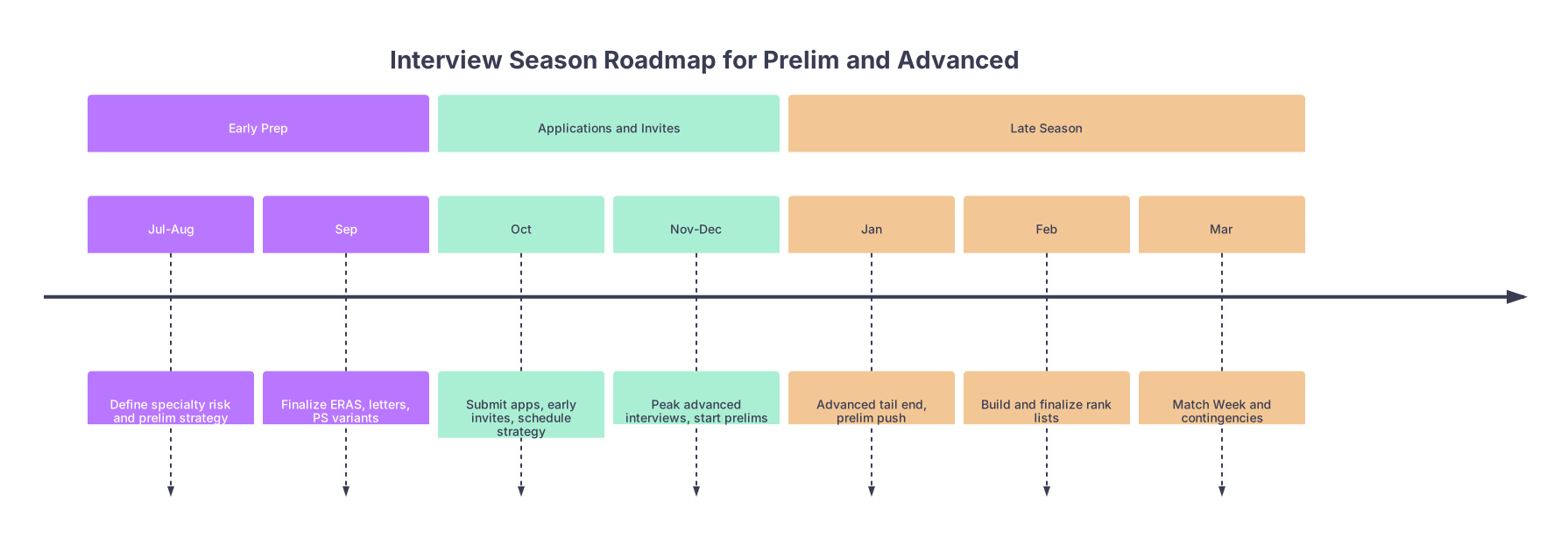
| Period | Event |
|---|---|
| Early Prep - Jul-Aug | Define specialty risk and prelim strategy |
| Early Prep - Sep | Finalize ERAS, letters, PS variants |
| Applications and Invites - Oct | Submit apps, early invites, schedule strategy |
| Applications and Invites - Nov-Dec | Peak advanced interviews, start prelims |
| Late Season - Jan | Advanced tail end, prelim push |
| Late Season - Feb | Build and finalize rank lists |
| Late Season - Mar | Match Week and contingencies |
Final Takeaways
- You’re running two parallel seasons, not one. Build your calendar and rank lists with advanced and prelim programs talking to each other, not in separate silos.
- Early advanced-heavy, later prelim-heavy works best. Protect November/early December for advanced, January for prelims, and keep strict weekly limits so you stay sane.
- Your prelim list is your safety net. Make it long enough, geographically aligned with your advanced targets, and anchored in places where you can survive a hard year without resenting every shift.
Stick to that framework, and you give yourself the best odds of walking into Match Day with both years covered instead of scrambling in SOAP.