
Most residents ask program directors about converting prelim to categorical at the wrong time—and in the wrong way.
You’re not just asking for a favor. You’re asking a PD to reshuffle their entire roster, budget, and future call schedules. Timing is everything. So let’s walk this in the only way that makes sense: chronologically.
This guide assumes:
- You’ve matched (or are about to start) a preliminary year (medicine, surgery, transitional, etc.)
- You’re trying to figure out when and how to ask about converting to a categorical spot in the same program.
We’ll go from pre-Match through intern year month-by-month, and I’ll flag clearly:
“At this point you should…” each step of the way.
Big Picture: The Windows When PDs Can Actually Say Yes
Before we zoom into the timeline, you need the reality check.
There are only a few scenarios where a PD can convert you from prelim to categorical:
| Scenario | Odds | Typical Timing |
|---|---|---|
| Known upcoming categorical vacancy | Highest | Before or early PGY-1 |
| Unexpected resident resignation/firing | Moderate | Any time during year |
| Program expansion (new funded spot) | Variable | Late fall–spring |
| PD “just making a spot” for you | Very low | Rare, case-by-case |
Everything you do is about being the first person the PD thinks of when one of those boxes lights up.
Stage 1: Before Match Day – Reality Check, Not Negotiation
Time frame: December–March (application/interview season + pre-Match)
If you’re still in the application phase and considering ranking a prelim at a place you’d love to stay categorical:
At this point you should:
- Clarify the structure & history of prelim → categorical in that program.
- Stop assuming “they always take one prelim internal” unless someone says it on the record.
Specific actions, by time period:
During Interview Season (Dec–Jan)
You do not ask: “Will you convert my prelim spot to categorical?” That’s premature and a bit tone-deaf.
Instead, you:
- Ask the PD or chief residents:
- “How often do your prelims stay on as categorical?”
- “Do you have a formal or informal pathway for strong prelims to convert?”
- “In the last 3 years, how many prelims have stayed?”
Red flags:
- Vague answers like “Oh, sometimes, depends…” with no numbers.
- “Our prelims usually go elsewhere for advanced positions.”
Green-ish flags:
- “Every year we’ve had at least one prelim convert,” and they can name where those people are.
Rank List Time (Feb–early March)
At this point you should:
- Use their history to help set expectations, not to negotiate.
You do not email a week before rank list certification asking, “If I rank you highly, can you promise to convert me?” That’s not how this works; they can’t commit NRMP violations for you.
Your job now is:
- Decide: “Is this prelim worth it even if I never get categorical here?”
If no → adjust your list.
Stage 2: Late Spring / Early Summer Before PGY-1 Starts
Time frame: April–June (after Match, before orientation)
You’ve matched prelim. Now what?
At this point you should:
- Gather intel. Not ask for conversion. Yet.
Email or ask the coordinator/Chief:
- “Do you have current prelims or recent graduates I could talk to about their experience?”
- Then actually talk to them.
Questions to ask current prelims:
- “Did anyone in your class convert to categorical?”
- “How approachable is the PD about internal candidates?”
- “When did people who converted usually bring it up?”
You’re building a program-specific timeline in your head before day 1.
Stage 3: The First 4–6 Weeks of Intern Year (PGY-1)
Time frame: July–mid August
This is the observation window. For you and for them.
At this point you should:
- Keep your head down.
- Be excellent.
- Say nothing to the PD about conversion unless they bring it up first.
You’re being judged on:
- Work ethic
- Team behavior
- How you handle cross-cover chaos
- How often you need hand-holding vs. figure things out
Big mistake I’ve watched people make:
Week 1, they’re still asking where the supply room is, and they’re already in the PD’s office talking about a categorical spot. Instant red flag.
What you can do in this phase:
- Mention casually to seniors/chiefs: “I really like it here; I’d love to stay if something opened.”
- Make it obvious through your behavior that you’re a net positive on the team.
Stage 4: Late Summer – The First Soft Approach
Time frame: Mid August–September (Months 2–3 of intern year)
This is usually the earliest I recommend initiating any direct conversation with leadership about conversion, unless:
- Someone has already resigned
- The PD or APD has already hinted about “keeping you on”
At this point you should:
- Schedule a brief check-in meeting with an APD or PD.
Script for email (keep it short):
Subject: Short check-in as new prelim
Dear Dr. [Name],
I’m really enjoying working with the team and would appreciate a brief check-in at your convenience for any feedback on how I’m doing so far and how I can best contribute this year.
Best,
[Name], PGY-1 Preliminary [Medicine/Surgery/etc.]
In the meeting:
- Lead with feedback.
- “I’d appreciate any feedback on how things are going and where I can improve.”
- Then, lightly flag your interest.
- “I’ve really enjoyed the program and could absolutely see myself here long-term if a categorical opportunity ever opened up. What would be the best way to position myself if that were to happen?”
You are not asking: “Can you convert me now?” You’re planting the seed and asking for process.
Best outcome:
- They say something like, “Actually, sometimes we have spots; I’ll keep you in mind. Keep doing what you’re doing, and we’ll touch base again in a few months.”
Worst outcome:
- “We almost never convert prelims and expect our census to remain stable.”
That’s a data point. Not a death sentence, but don’t ignore it.
Stage 5: Fall – When Real Openings Usually Start To Surface
Time frame: October–December (Months 4–6)
By now:
- They’ve seen you on at least a couple of rotations.
- You’ve accumulated evals.
- Advanced spots elsewhere have their own drama; people drop, switch specialties, etc.
This is the time when:
- Residents who are truly unhappy quietly start talking about leaving.
- PDs start seeing which categorical residents may not make it.
At this point you should:
- Make yourself formally visible as a candidate.
- Tighten your ask slightly, but still stay professional.
Steps:
Ask chiefs/seniors for honest feedback.
- “If a categorical spot opened, would you feel comfortable advocating for me?”
- If they hesitate or give lukewarm noise, you have work to do. Better to know now.
Schedule a second, more direct PD/APD meeting.
Email:
Dear Dr. [Name],
I was hoping to schedule a brief follow-up meeting regarding my progress so far and my longer-term plans after this preliminary year.
Thank you,
[Name]
In that meeting:
- Start with performance:
- “I’ve really appreciated the opportunities so far. Feedback from [specific attendings] has been [brief summary]. I’m continuing to work on [one real improvement area].”
- Then clear, reasonable ask:
- “Long term, I’d very much like to stay here for categorical training if a spot becomes available. Could you let me know how those decisions are usually made, and whether there’s anything specific I should be doing now to be considered?”
If the PD likes you, this is often where you’ll hear:
- “We may have a second-year spot depending on X.”
- Or “If someone leaves, we usually prioritize strong prelims like you.”
If they say:
- “We have no flexibility, our numbers are locked,”
take that seriously and ramp up external applications.
Stage 6: Winter – The Hard Ask Window
Time frame: January–March (Months 7–9)
Now we’re at the business end of intern year. Decisions about next year’s rosters crystalize.
Also relevant:
- ERAS for the next cycle, SOAP, off-cycle openings elsewhere.
- Some programs have MD/PhD residents returning, others expanding, others losing people.
At this point you should:
- Make a direct, explicit ask if not already done and if you’re still interested.
This is when “When to approach PDs” becomes “You’re late if you haven’t yet.”
Your approach now:
Confirm known/felt openings.
- Quietly: “I heard X is leaving after this year; do you know if there will be a backfill?”
- Do not gossip. Keep it clean.
Request a focused meeting:
Subject: “Interest in categorical opportunity if available”
Body:
Dear Dr. [Name],
As we head into the latter half of the year, I wanted to express my strong interest in remaining here as a categorical [specialty] resident if a position becomes available for the upcoming academic year.
I’d appreciate the chance to discuss whether there might be any opportunities and how I might best position myself.
Best regards,
[Name], PGY-1 Preliminary [Specialty]
In that meeting, be very clear:
- “I’d like to be considered for any categorical PGY-1 or PGY-2 position that might open for next year. This program is my top choice, and I’d choose to stay here over other options if given the chance.”
Then stop. Let them respond.
This is the key window.
By this time, PDs typically:
- Know if they will have a departing resident.
- Know if GME has funded an extra spot.
- Have an internal ranking of prelims in their heads.
They may not give you an immediate yes or no, but you should walk out with:
- “If something opens, you’re at the top of my list.”
- Or “I do not anticipate any positions; you should absolutely proceed with applying elsewhere.”
Stage 7: Late Spring – Last-Minute and Off-Cycle Conversions
Time frame: April–June (Months 10–12)
A surprising number of conversions happen late:
- A categorical PGY-1 decides to switch specialties.
- Someone fails to renew a visa.
- Personal/family circumstances force a departure.
PDs scramble. They don’t want an empty slot.
At this point you should:
- Keep doing your job like you’re staying.
- Be ready on short notice if something shakes loose, but assume nothing.
If you had strong conversations earlier, the PD already knows:
- You’re interested.
- You’re committed to the program.
- You’re competent.
When a spot suddenly opens in May:
- They don’t have time to start interviewing strangers.
- They pull from the “short list” of prelims they already trust.
If you’ve been passive all year and then in May say, “Can you convert me?” you’re behind.
Special Situations: When To Approach Sooner
There are a few cases where you move faster than the general timeline:
1. Resident Resigns Early (Aug–Oct)
If you hear (formally, not gossip) that a categorical resident has resigned or is leaving:
At this point you should:
- Within 1–2 weeks, ask for a brief PD meeting and say directly:
- “I heard there may be an unexpected opening. I’d like to express interest in being considered for that categorical spot if it’s being refilled.”
Do not wait months. PDs fill emergency gaps quickly.
2. PD Makes Positive Noise Early
If by September you’re getting:
- “We’d love to keep you”
from multiple attendings or APDs…
Lean into it. Email the PD saying:
“Several faculty have mentioned the possibility of staying on as categorical if a spot opened; I’d love to talk briefly about whether that might be realistic and what steps I should take.”
You’re not being pushy. You’re responding to explicit signals.
How Often To Bring It Up (Without Being Annoying)
Here’s the rough cadence that works:
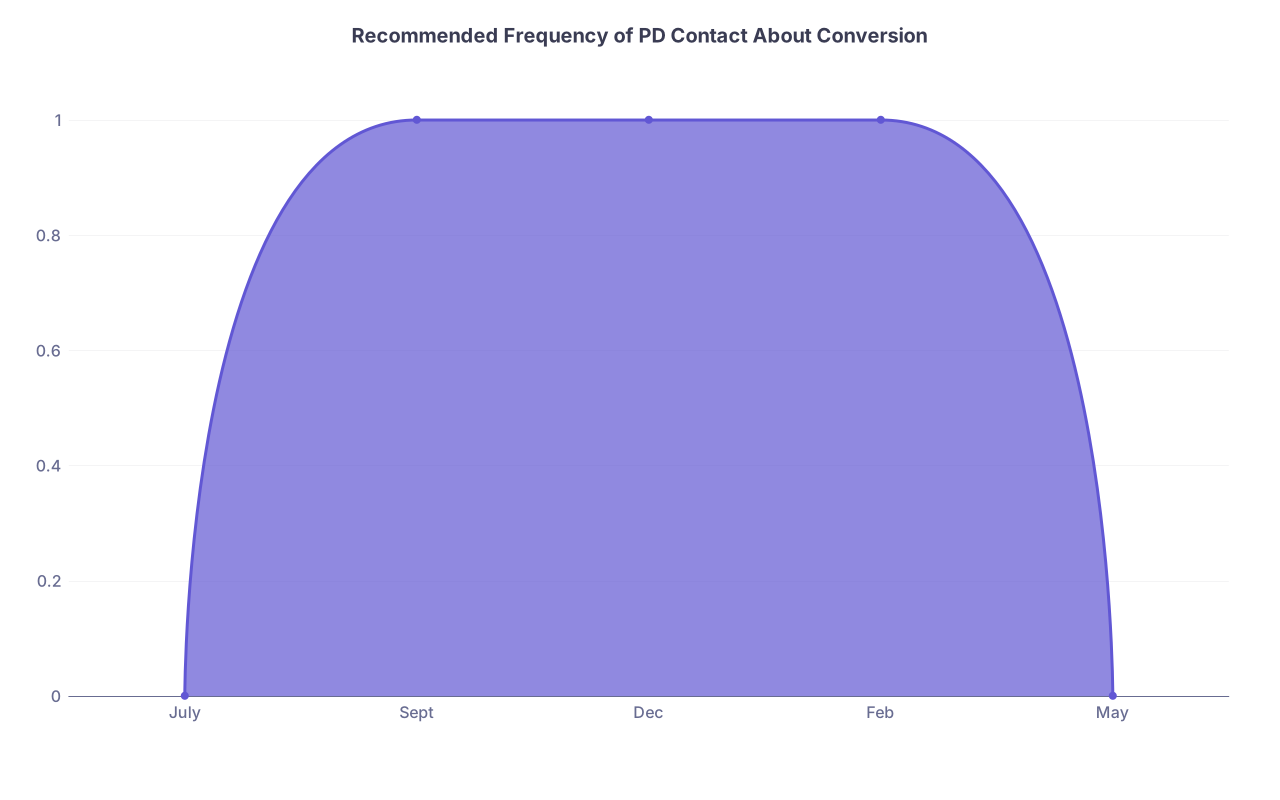
| Category | Value |
|---|---|
| July | 0 |
| Sept | 1 |
| Dec | 1 |
| Feb | 1 |
| May | 0 |
- Formal meetings specifically about your future: ~2–3 during the year.
- Casual mentions with chiefs/faculty: as they naturally arise, not every shift.
- Email flurries and repeated “any updates?” messages? That gets old fast.
A simple rule:
- Every time you bring it up formally, bring new information:
- New evals, new feedback, new known opening, new timeline pressure.
Quick Behavioral Checklist Before Each Ask
Before you walk into the PD’s office asking about categorical:
At this point you should be able to say “yes” to most of these:
- I’m consistently on time, notes done, calls returned.
- Nurses don’t hate working with me.
- At least 2–3 attendings know me by name and would vouch for me.
- I’ve had at least one above-average or glowing written evaluation.
- I’m not on remediation, professionalism watch, or chronically behind on duty hours documentation.
If not, fix that first. Your timing doesn’t matter if your reputation is weak.
Visual: Year Timeline – When To Do What
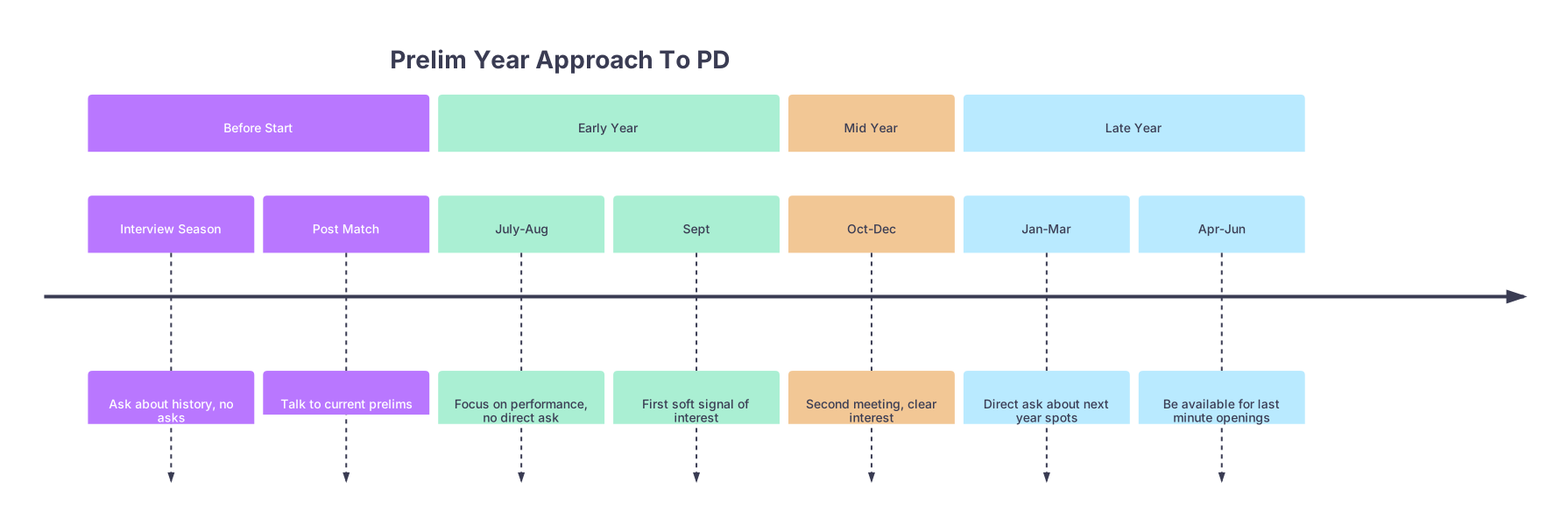
| Period | Event |
|---|---|
| Before Start - Interview Season | Ask about history, no asks |
| Before Start - Post Match | Talk to current prelims |
| Early Year - July-Aug | Focus on performance, no direct ask |
| Early Year - Sept | First soft signal of interest |
| Mid Year - Oct-Dec | Second meeting, clear interest |
| Late Year - Jan-Mar | Direct ask about next year spots |
| Late Year - Apr-Jun | Be available for last minute openings |
Common Mistakes To Avoid (By Timing)

Too early:
- Week 1–2 of July: “So, can I get a categorical spot?”
You haven’t proven anything yet.
Too often:
- Monthly emails: “Any updates?” with no new context.
Too late:
- May: first time PD hears you’re even interested, and another prelim has been advocating since October.
Too vague:
- “I’m just keeping my options open”
vs - “If a categorical spot here opened, this would be my top choice.”
Too transactional:
- “If you give me a categorical spot, I’ll commit to extra call / chief / research.”
You’re not buying a used car. Don’t barter like that.
Quick Reference Table: When To Do What
| Month | Primary Focus | PD Contact Level |
|---|---|---|
| July | Prove competence | None (unless they initiate) |
| Aug | Build reputation | None or informal feedback |
| Sept | Soft interest | 1st feedback meeting + light signal |
| Oct–Dec | Consolidate performance | 2nd meeting, clear interest |
| Jan–Mar | Decision time | Direct ask about next year |
| Apr–Jun | Finish strong | Stay ready, minimal follow-up |
FAQ (Exactly 4 Questions)
1. Should I tell the PD I would choose their categorical spot over my planned advanced position elsewhere?
If it’s true, yes—at the right time (usually winter). PDs hate being a backup plan. Saying, “If a categorical position here were available, I’d choose it over my current advanced spot,” is powerful, but only say it if you’re actually willing to follow through. They remember who waffled last year.
2. What if I’m applying out through ERAS at the same time?
That’s normal. By January–February, many prelims are doing that. You can say: “I’m applying to categorical spots elsewhere as well, but this program is my top choice if something opens.” PDs understand hedging; they just need to know where they rank in your personal list.
3. How much do my evaluations matter versus PD/chief impressions?
Both matter, but I’ll be blunt: informal reputation often wins. If your written evals are solid but every night senior says you’re slow or hard to work with, that will sink you. You want aligned signals: written evals, chief impressions, nursing feedback, and at least a couple of attendings quietly saying, “We should keep this one.”
4. Can a program convert me from prelim to categorical in the same year (e.g., mid-PGY-1)?
Occasionally, yes, especially in medicine and surgery. Sometimes a categorical PGY-1 leaves in October, and the PD simply re-labels your spot and moves funding around. But you don’t bank on that. Your timeline strategy is the same: show value early, signal interest by fall, and be clearly in the PD’s mind before any mid-year crisis hits.
Key points:
- Don’t ask too early. Prove you’re good for 2–3 months before your first soft approach.
- Hit the fall and winter windows. September for the first signal, October–March for clear, direct interest.
- Make it easy for the PD. Strong performance, clear commitment, and the right timing put you at the top of the list when a spot finally opens.