
The dirty little secret is this: a lot of specialties say they’re “fine” with you doing a separate prelim year…but behind closed doors, many quietly prefer categorical training and will favor those applicants every time they can.
You will not hear this on program websites. You will hear it in the conference room, after you’ve left the interview day, when the rank list committee actually starts talking.
Let me walk you through what really happens.
What a Prelim Year Actually Is (From the PD’s Side of the Table)
Students think of a preliminary year as “that intern year I have to do before my real specialty.” Program directors see it very differently.
A prelim year (usually prelim medicine or surgery) is:
- A one‑year contract
- For someone who’s either:
- Going on to an advanced specialty (neurology, radiology, anesthesia, PM&R, derm, ophtho, rad onc, etc.), or
- Couldn’t match categorical and is trying to stay in the system
Here’s the part you don’t see: prelim slots are often used as “buffer” positions. Less protected. Easier to cut. Filled later. Sometimes with lower priority applicants when the categorical spots are already locked with stronger candidates.
Meanwhile, a categorical position is a multi‑year investment. The program is committing to train you from day one of internship through graduation in that same specialty. They plan their service coverage, their call schedules, even their chief resident pipeline around those categorical bodies.
So when a specialty has a choice between:
- A trainee they control from PGY‑1 through PGY‑4/5/6
vs - Someone wandering in after a separate prelim year done at another institution with other habits, other evaluations, and other loyalties
They very often prefer Door #1.
Not always. But more than they’ll ever tell you.
Why Some Specialties Quietly Dislike Separate Prelim Years
Here’s what faculty will say publicly:
“We’re happy to take applicants from both categorical and separate prelim paths.”
Here’s what they’ll say in a smaller room when ranking you:
“Given the choice, I’d rather have someone we train from day one.”
There are five big reasons.
1. Control, Culture, and Conditioning
Programs care about culture way more than applicants realize. They want to shape how you:
- Present on rounds
- Handle consults
- Write notes
- Escalate concerns
- Talk to nurses
A categorical resident is acculturated in‑house from the start. The intern year is where the “this is how we do it here” gets drilled in.
With a separate prelim year, they’re inheriting someone trained to another hospital’s norms. That might mean:
- Different thresholds for calling an attending
- Different expectations for autonomy
- Sloppy or overly verbose notes
- Bad handoff habits
- OR time etiquette that clashes with their surgeons
I’ve heard a PD in anesthesia say flat-out:
“I do not want to spend six months untraining someone else’s habits.”
They still accept people with outside prelims. But when they were comparing two otherwise similar candidates, the home categorical track often got the nudge.
2. Reliability and Retention
Programs hate flight risk. They despise drama. A categorical resident is, by design, locked in. If you match categorical neurology, they’re expecting you to be there for four years unless something catastrophic happens.
A separate prelim year adds moving parts: two institutions, two sets of evaluations, two GME offices. More chances for something to go wrong.
I’ve watched rank committees say things like:
- “We’ve had people disappear after prelim when they didn’t get the advanced spot they wanted.”
- “I’d rather not deal with an outside prelim resident who might try to switch mid‑year.”
- “We got burned last year when the prelim program failed someone and we had to scramble.”
They remember those headaches for years. And it colors how they think about prelim‑dependent paths.
3. The Hidden Risk: Performance in Someone Else’s House
Here’s a scenario that actually happened:
Applicant A: 250+ Step 2, strong letters, matched an advanced specialty (think radiology) but needed a separate prelim medicine year. Started prelim IM at a mid‑tier community program. Struggled with time management, rubbed a senior resident the wrong way, ended up with a mediocre final evaluation and a “needs improvement” comment on professionalism.
That evaluation made its way to the advanced program. Faculty there were furious. They had thought they were getting a star. They got a problem intern instead.
That PD, in the next recruitment cycle, in a closed door ranking meeting:
“No more ‘trust me, they’ll be fine after prelim’ situations. If we can fill with categoricals, we do it.”
That’s the level of paranoia that an outside prelim year creates. A categorical PD controls your rotations, the chiefs, the mentorship you’re given. They can intervene early if you’re sliding. With a separate prelim, they’re basically praying someone else doesn’t screw this up.
4. Continuity of Education and Evaluation
From the training side, categorical residents are easy to track:
- Same EMR
- Same hospital protocols
- Same evaluation tools
- Same faculty watching you grow over years
When you arrive post‑prelim, you show up as a PGY‑2 or PGY‑3 with a one‑page summary letter and a few faculty comments from somewhere else. That’s not much data. Programs hate limited data.
I’ve heard variations of this line so many times:
“I know my categoricals. I watched them as interns, I know how they respond on call, I know how they handle stress. An outside prelim? I have a PDF and a Step score.”
When it comes time to choose:
- The resident who gets the complex rotations
- The early sub‑specialty exposure
- The “this is my future chief” grooming
Categoricals usually win those internal competitions.
Specialties Where This Really Matters
Now, not every specialty cares equally. Some literally can’t avoid relying on prelim years because of how their training pathways are structured.
But several specialties have been actively shifting toward more categorical positions for a reason: they want you from day one.
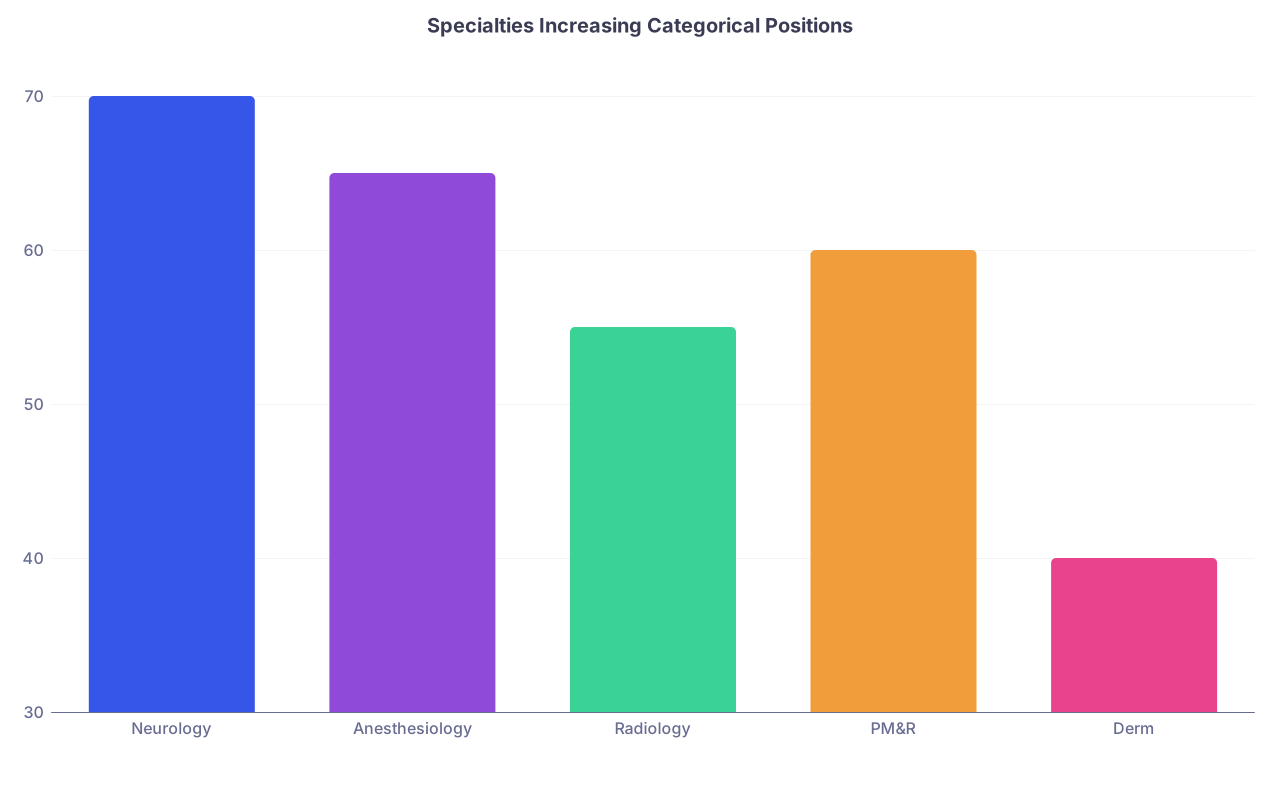
| Category | Value |
|---|---|
| Neurology | 70 |
| Anesthesiology | 65 |
| Radiology | 55 |
| PM&R | 60 |
| Derm | 40 |
Those percentages are an approximation of how much internal talk I’ve heard about “we should be more categorical.” Not official NRMP data. The vibe in PD meetings.
Neurology
Neurology is the poster child. A decade ago, tons of programs were advanced-only; you needed a separate prelim medicine year. Now, an increasing number are categorical. Why?
Because they were sick of inheriting PGY‑2s who:
- Did weak prelim years with minimal neuro exposure
- Arrived with poor medicine foundations
- Were already burned out or disillusioned
- Showed up mid‑trajectory and never really bonded with the department
I sat in on a neurology program retreat where one attending said:
“The best PGY‑3s we have are the ones we recruited as categoricals. They’re our people. The worst variability is from the outside prelim crowd.”
That program converted almost all of its spots to categorical over the next 3 years.
Anesthesiology
Anesthesia likes prelims less than they admit.
They hate when PGY‑2 anesthesia residents show up after a brutal surgical prelim year completely burned out, hating the hospital, and having spent a year doing nothing related to airway management or pharmacology.
Categorical anesthesia programs can:
- Give you early OR exposure as an intern
- Control how heavy your ward months are
- Integrate ICU and pain rotations in a more thoughtful arc
I’ve heard anesthesia PDs say during rank list discussions:
“All else equal, I’d rather have someone who did our tailored intern year than someone crushed by a malign prelim surgery program.”
They will still rank independent prelim folks highly if you’re strong. But when they’re designing their program long-term, they keep pushing the institution to approve more categorical lines.
Radiology and Radiation Oncology
Radiology and rad onc often pretend they’re agnostic: “We don’t care where you do your intern year.”
Internally? It’s more complicated.
They know a bad prelim surg year can wreck a resident’s mental health before they ever hit the reading room or treatment planning. They know a fluff transitional year can create bad habits around volume and urgency.
Programs that have added categorical tracks usually do it for two reasons:
- Integration: they want to sprinkle early rads exposure into PGY‑1
- Stability: they don’t want to gamble on someone else’s internship drama blowing back on them
I’ve literally heard: “Our categoricals are just more invested in us from the start. They show up as PGY‑2 already aligned.”
The Harsh Reality of Many Stand‑Alone Prelim Programs
Here’s something few students fully understand before they sign up for a separate prelim year.
Prelim positions, especially prelim surgery in some places, are often the workhorse spots of the hospital. They carry:
- The worst call schedules
- The most scut
- The least say in education priorities
A categorical resident has future bargaining power: “In three years this person will be our fellow, our chief, our grad with our program name on their CV.” That buys them some protection.
A prelim? You’re gone in 12 months. Honestly, some services treat you like a disposable resource.

I’ve watched this pattern play out:
- Prelim medicine residents doing endless admissions, no continuity clinic, minimal conference time
- Prelim surgery residents doing consults, floor work, missing OR time so categoricals can operate
- Transitional year residents with wildly different experiences depending on the site—some great, some barely real training
From the advanced specialty’s perspective, this variance is a nightmare. They may explicitly prefer:
- Categorical
- Or at least transitional years at certain “trusted” programs
And yes, advanced program directors absolutely have informal lists: “We like interns from X and Y prelim programs. We’re wary of Z.”
They won’t publish that list. But they pass it to each other in emails and hallway conversations every year at national meetings.
Why Programs Don’t Broadcast Their Preference
If so many specialties quietly like categorical better, why don’t they say so?
Because they can’t. Politically, it’s messy.
Here’s what’s going on behind the scenes:
They need to keep prelim programs alive.
Internal medicine and surgery departments rely on prelim residents to staff services. If neurology, anesthesia, and radiology publicly say “we prefer categorical,” it undercuts their colleagues.They don’t want to limit their own applicant pool.
In a competitive specialty, telling people “we strongly prefer categorical” would scare off some excellent applicants at schools where only prelim pathways are common.They legally and ethically can’t create a formal two‑tier system.
The NRMP doesn’t love anything that smells like bias based on training path rather than merit. So preferences stay…informal.
So what do they do instead?
- Build more categorical slots quietly over time
- Favor categoricals subtly in rank meetings
- Nudge students at their home med school: “If you can come in categorical, do that.”
When a Separate Prelim Year Actually Helps You
Now for the nuance. It’s not all downside.
There are very real situations where a separate prelim year is not only fine, it’s strategically smart.
Here are the big ones:
Late Specialty Switch
You decided on radiology in December of MS4 after spending two years aiming at surgery. Separate prelim year buys you time, keeps you in the system, and gives you a story: “I confirmed my interest while working closely with radiology during my intern year.”You Need to Fix Weaknesses
A solid prelim IM year with strong evaluations can partially offset a weaker Step 2 or lackluster MS3 performance. PDs do respect: “They were a workhorse intern and everyone loved them.”You Want a Different Geographic Footprint
If you did med school in the Midwest but want West Coast for life, a prelim plus advanced match there can anchor you. But only if you pick the prelim program very carefully.You Couldn’t Match Categorical This Cycle
Matching a prelim year instead of going unmatched keeps doors open. Then you re‑apply stronger, with real attending advocates who can call programs for you.
So no, a separate prelim year isn’t automatically a red flag. But you have to leverage it. That means:
- Picking a prelim program with a real track record of sending people into the specialty you want
- Crushing that year—top of the class evaluations, allies in the PD’s office
- Making sure your advanced program sees you as upgraded, not damaged, by the experience
How This Affects Your Application Strategy
Here’s what this all boils down to: if your target specialty offers both categorical and advanced positions, and if your record is even remotely competitive, you should assume categorical is the cleaner, safer, more desirable path.
I’ll be blunt. I’ve watched this happen in rank meetings multiple times:
Two applicants. Similar metrics. One applied categorical neurology. One applied to the same program’s advanced neuro spot needing a prelim. Someone at the table says:
“Why not just take the one we get from day one?”
That’s it. That’s the argument. And it wins a lot.
So practically:
- Favor programs that offer categorical tracks in your specialty
- If you apply both categorical and advanced, signal categoricals first when talking to programs
- Treat the prelim choice like a major decision, not an afterthought—it can shape your reputation more than MS3 ever did
| Factor | Categorical Preferred | Separate Prelim Risk |
|---|---|---|
| Culture fit | High control | Variable |
| Performance data | Longitudinal | Limited |
| Scheduling & coverage | Predictable | More moving parts |
| Education continuity | Strong | Fragmented |
| Flight risk | Lower | Higher |
And if you must do a separate prelim year:
- Avoid malignant surgery prelims unless you’re very certain and very resilient
- Vet transitional years carefully—some are jokes, some are gold
- Ask directly: “Where have your prelims matched for advanced training in the last 3 years?” If they dodge, that’s your answer

| Step | Description |
|---|---|
| Step 1 | Choose Specialty |
| Step 2 | Must Do Separate Prelim |
| Step 3 | Apply Categorical |
| Step 4 | Prioritize Categorical |
| Step 5 | Apply Mix of Categorical and Advanced+Prelim |
| Step 6 | Select High Quality Prelim |
| Step 7 | Categorical Spots Exist |
| Step 8 | Competitive Applicant |
The Unspoken Hierarchy Once You Arrive
One last uncomfortable truth.
In some departments, there’s a silent hierarchy:
- Home‑grown categoricals
- Outside categoricals from similar systems
- Separate prelim pathway folks
No one will say that to your face. But you’ll feel it in:
- Who gets first pick of elective blocks
- Who’s tapped early for leadership roles
- Who attendings “invest in” for research, letters, and fellowships
I’ve seen outstanding residents from separate prelims break this pattern completely—and become chiefs, star fellows, academic hires. It can absolutely be done.
But they had to be undeniably good. No question marks. No “maybe the prelim messed with them” narrative.
If you walk in through the more complicated path, you don’t get much benefit of the doubt. That’s the tradeoff.

FAQ (Exactly 3 Questions)
1. If my dream program only offers advanced spots, should I still go for it or prioritize categorical elsewhere?
If the program is truly your top choice and has a strong reputation for supporting residents, absolutely apply there. But do not build a rank list entirely out of “advanced only” programs. Mix in solid categorical options at slightly less competitive places. From the director side, I’d rather see you in a categorical at a very good program than gambling your whole future on a single advanced spot plus a random prelim.
2. Is a transitional year better than a prelim medicine or surgery year for advanced specialties?
Depends who you ask. Many rads, ophtho, and derm PDs like transitional years from specific, trusted programs because they tend to preserve sanity and give broad exposure. Others quietly prefer a rigorous prelim medicine year because they know you can handle real inpatient work. What they universally dislike are fluff TYs with weak evaluations. Ask your target specialty’s faculty: “If you had to choose, what type of intern year would you trust most?”
3. Will doing a separate prelim year hurt my chances for competitive fellowships later on?
Not automatically. Fellowship directors care about your performance in core residency, letters, research, and reputation. But if your prelim year is a mess—poor evaluations, professionalism flags, or a PD who won’t go to bat for you—that stain can follow you. If you take the separate prelim route, treat that year as part one of your CV, not a disposable 12 months. Every attending you impress there is one more person who might bail you out with a phone call later.