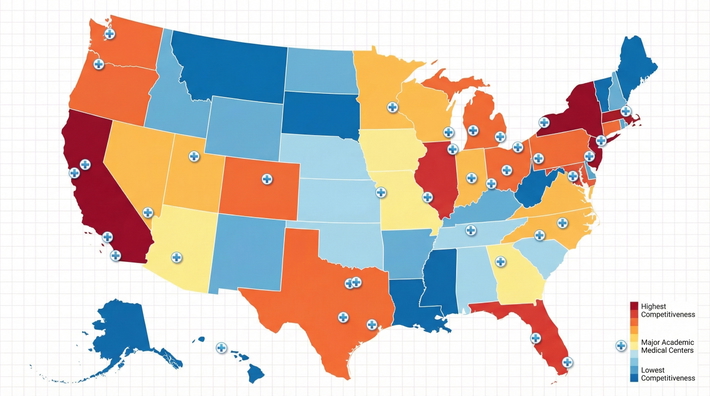
The data is unambiguous. A resident earning the national average of $65,000 keeps thousands more dollars each year simply by training in Texas instead of California. Ignore the lifestyle brochures and the "cost of living is relative" hand-waving. Run the numbers first.
This article is for educational purposes only. It is not financial advice, not legal advice, and not tax advice. Figures vary by individual circumstances; consult a qualified professional before making residency ranking decisions.
The Raw Numbers: Average Resident Salary and State Tax Rates
ACGME 2023 data puts the average resident salary at $65,000. That figure is the baseline for every comparison that follows. No-income-tax states, Texas, Florida, Washington, Nevada, and a handful of others, subtract nothing. High-tax states, California, New York, Oregon, Minnesota, Hawaii, take a meaningful cut at exactly the income band where residents live.
Look at the marginal rates that apply around $65k:
- California: 9.3 %
- Oregon: 9.9 %
- Hawaii: 8.25 %-9 %
- New York: 6.33 %
- Minnesota: 6.8 %-7.85 %
- Texas, Florida, Washington, Nevada: 0 %
For a deeper dive into how geography shapes your bottom line, see regional time-to-break-even calculations.
Learn more about cost-of-living adjusted PGY-1 salaries to see how different cities stack up.
Marginal rates alone mislead. After the standard deduction, the effective state income tax rate on a single filer earning $65,000 drops to roughly 6.5 % in California, 4.5 % in New York, 8.1 % in Oregon, 5.9 % in Minnesota, and 7.2 % in Hawaii. Zero remains zero in the no-tax states.
I have run these calculations for dozens of residents. The pattern never changes: the first $4,000-$5,300 of difference appears before anyone even mentions rent.
Net Income Comparison Before Cost of Living Adjustments
Start with $65,000 gross. Federal income tax for a single filer taking the standard deduction lands near $8,000. FICA (Social Security + Medicare) removes another $4,972.50. That leaves a common base of roughly $52,027 before any state tax.
For a deeper look at the trade-offs, see whether it is worth moving states just for a higher physician salary.
Curious about which regions offer the best moonlighting opportunities? Moonlighting opportunities by region can supplement your income.
Subtract state tax and the ranking becomes clear:
- Texas / Florida: $0 state tax → ~$52,000 net
- New York: ~$2,925 → ~$49,075 net
- California: ~$4,225 → ~$47,775 net
- Oregon: ~$5,265 → ~$46,735 net
The pure tax gap between a no-tax state and Oregon is $5,265 per year. Between Texas and California it is $4,225. Over a three-year residency that is $12,675-$15,795. Over a seven-year surgical residency the same differential compounds to $29,575-$36,855. That is real cash that can hit principal on student loans or sit in a high-yield savings account.
I have watched residents in Los Angeles open their first full paycheck and immediately ask why the number looks so small. The answer is sitting in the state withholding line.
Cost of Living Adjustment: The Real Net Income Picture
Raw take-home is only half the story. High-tax states almost always carry higher cost-of-living indexes. Using widely published indexes (national average = 100):
- Texas: 93
- Florida: 97
- Oregon: 115
- New York: 125
- California: 130
Real purchasing power equals net take-home divided by (index/100).
- Texas: $52,000 / 0.93 = $55,914
- Florida: $52,000 / 0.97 = $53,608
- New York: $49,075 / 1.25 = $39,260
- California: $47,775 / 1.30 = $36,750
- Oregon: $46,735 / 1.15 = $40,639
The adjusted gap between Texas and California explodes to roughly $19,164 in annual spending power. That is not a rounding error. That is an entire extra month of living expenses, or several extra student-loan payments, every single year.
I have seen residents move from Houston to San Francisco and lose nearly one-third of their effective income overnight. The data does not care about the weather or the restaurant scene. Purchasing power is purchasing power.
Beyond State Income Tax: Other Financial Factors for Residents
Property taxes in Texas average 1.8 % of home value, high on paper. Residents who rent never write that check directly; the landlord embeds a fraction of it in rent. California's Prop 13 keeps owner property taxes artificially low, but that benefit accrues to long-term homeowners, not rotating residents.
Sales-tax differentials are modest. Texas combined rate averages 8.2 %; California sits near 8.9 %. On the goods a resident actually buys, the annual difference rarely exceeds $300-$400. That does not offset a $4,000+ income-tax hit.
Some high-tax states dangle loan-repayment programs. New York, California, and Oregon all run primary-care or underserved-area forgiveness schemes. The catch: they are competitive, specialty-restricted, and often require multi-year post-residency service commitments. Most categorical residents never touch the money.
Retirement accounts offer a longer-term arbitrage. Contributions to a 403(b) or 457(b) in a high-tax state reduce current taxable income. If you later withdraw those dollars in a no-tax or low-tax state, you capture a permanent rate differential. That strategy works only if you actually relocate and if the account grows. It does not help the resident who needs cash flow today.

Decision Framework: Using the Data to Choose Your Residency Location
Use one primary metric: adjusted net income = (gross, federal tax, FICA, state tax) / (cost-of-living index / 100). Rank every program by that number first.
Then layer the secondary factors in this order:
- Length of training (3-7 years multiplies every annual gap).
- Availability of state loan-repayment dollars you actually qualify for.
- Program quality and fellowship match rates that affect lifetime earnings.
- Personal non-financial constraints (family, climate preference, partner's job).
A three-year primary-care residency in a high-tax, high-COL city can easily cost $45,000-$57,000 in lost purchasing power relative to a no-tax, low-COL counterpart. A seven-year surgical track can exceed $100,000. That money either reduces debt or does not. The data shows which choice wins on pure dollars.
The numbers do not lie. Residents in no-income-tax states take home $4,200-$5,300 more per year on a $65k salary before any cost-of-living adjustment. After the adjustment, the real advantage versus California or New York widens to $15,000-$19,000 in annual purchasing power. Over a full residency that gap becomes $30,000-$60,000 or more, money that either attacks student loans or evaporates into higher rent and higher taxes. High-tax states sometimes offer conditional loan programs, but those benefits reach only a minority of trainees. Prioritize the adjusted-net-income formula, then fold in program quality and personal realities. The spreadsheet should drive the rank list, not the reverse.