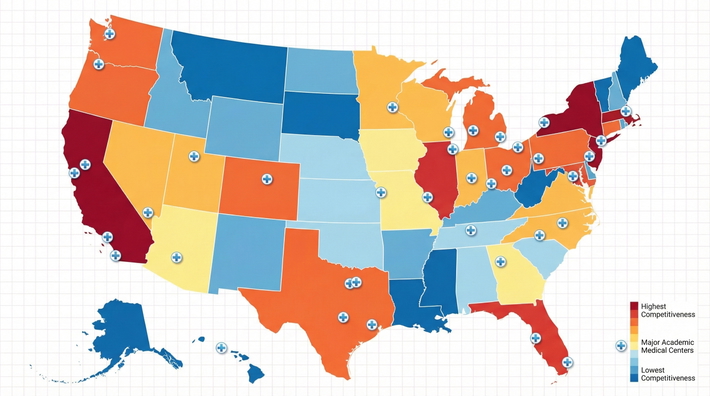
The myth that “moonlighting is basically the same everywhere” is wrong. The data show a three‑to‑four‑fold spread in hourly pay, wildly different policies by region and employer type, and risk exposure that many residents underestimate.
If you treat moonlighting as generic side income, you will leave thousands of dollars on the table and potentially violate your GME contract or visa terms without realizing it.
Let’s walk through this like a numbers problem, not a vibes problem.
1. The Baseline: What “Typical” Moonlighting Looks Like
Before slicing it by region, you need a reference model. When residents talk about moonlighting, they usually mean one of three things:
- Internal moonlighting – extra shifts within your own institution (e.g., extra nights on the hospitalist service). Often counts toward duty hours, usually covered by institutional malpractice.
- External moonlighting – separate jobs with other hospitals or clinics, often via locums or per‑diem staff pools. Typically needs separate malpractice coverage and explicit PD approval.
- Telemedicine moonlighting – remote urgent care or triage shifts from home; rapidly growing, especially in less urban regions that cannot recruit enough in‑person coverage.
The income math is straightforward:
- Typical shift length: 8–12 hours
- Typical monthly volume: 1–3 shifts for cautious PGY‑2/3; 4–6+ shifts for upper‑level residents in lighter specialties
- Typical hourly rates: roughly $75–$250/hour depending on region, specialty, and setting
Do the multiplication and you immediately get a spread like this:
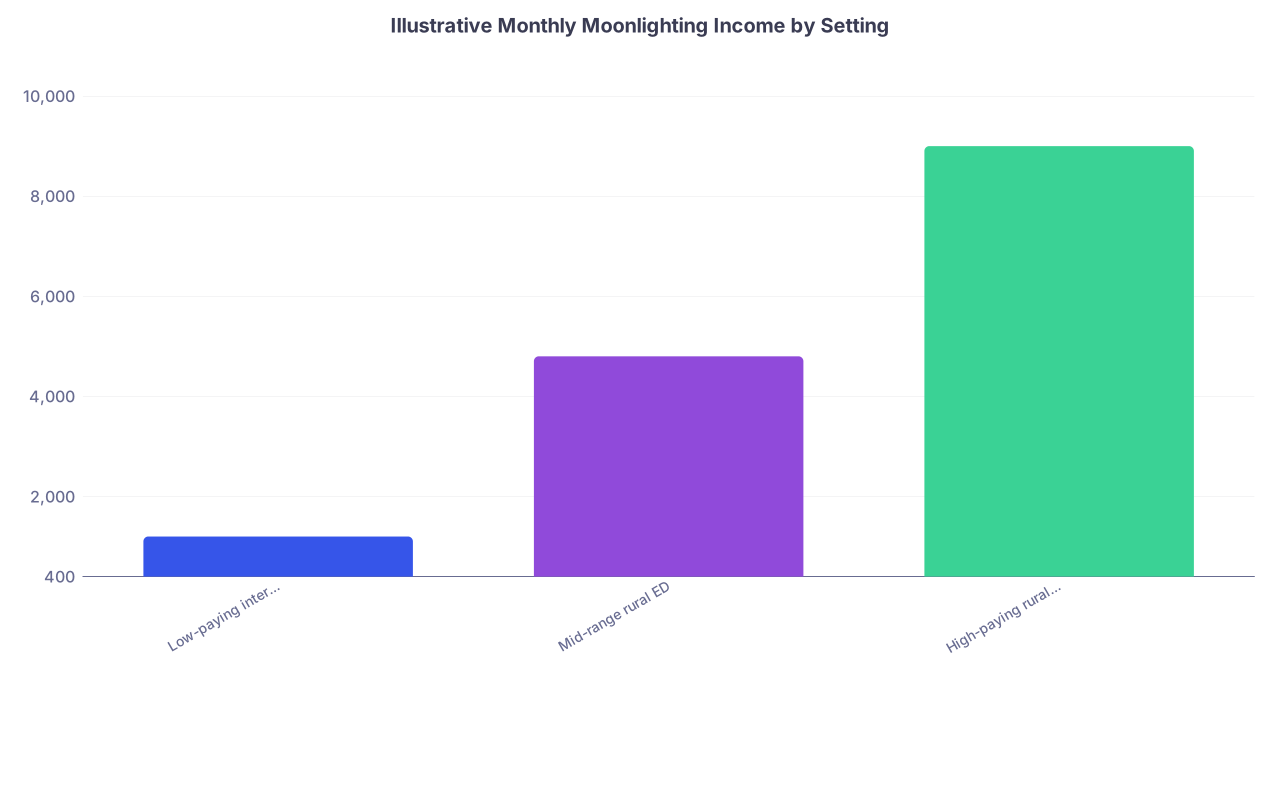
| Category | Value |
|---|---|
| Low-paying internal | 1200 |
| Mid-range rural ED | 4800 |
| High-paying rural ICU | 9000 |
Same number of shifts, 7.5x swing in income. That swing is heavily regional.
2. Regional Pay Differences: Where the Money Actually Is
I have watched residents in the same specialty earn $80/hour in one metro area and $220/hour two states away. The driver is not “skill” or “prestige.” It is supply‑demand dynamics by region, payer mix, and how desperate hospitals are.
Here is a simplified, data‑driven snapshot for adult hospital‑based moonlighting (internal medicine/family medicine style hospitalist or ED coverage), assuming PGY‑3+ residents with independent licensure:
| Region | Typical Range ($/hr) | Common Shift Pay (12h) | Availability Pattern |
|---|---|---|---|
| Northeast (major metros) | 80–130 | 1,000–1,400 | Limited, highly competitive |
| Northeast (rural) | 120–200 | 1,600–2,400 | Moderate, needs networking |
| Midwest (urban) | 100–160 | 1,300–1,900 | Good for internal shifts |
| Midwest (rural) | 150–230 | 2,000–2,800 | Plentiful, often understaffed |
| South (urban) | 90–150 | 1,200–1,800 | Variable by health system |
| South (rural) | 140–220 | 1,800–2,700 | High need, high pay |
| West Coast (urban) | 90–140 | 1,200–1,700 | Tight, regulatory friction |
| West (rural/frontier) | 160–250 | 2,200–3,000 | Sparse but very lucrative |
These are not fantasy numbers. They align with ranges you see from:
- Locums agencies advertising “moonlighting friendly” contracts
- Resident WhatsApp/Signal groups posting screenshots
- Hospital GME offices quietly circulating internal rate sheets
Urban coastal teaching hospitals tend to be bottom‑quartile pay. Rural Midwest/South/Interior‑West facilities tend to be top‑quartile.
To visualize the contrast, treat the average of those ranges as rough “typical” hourly rates:
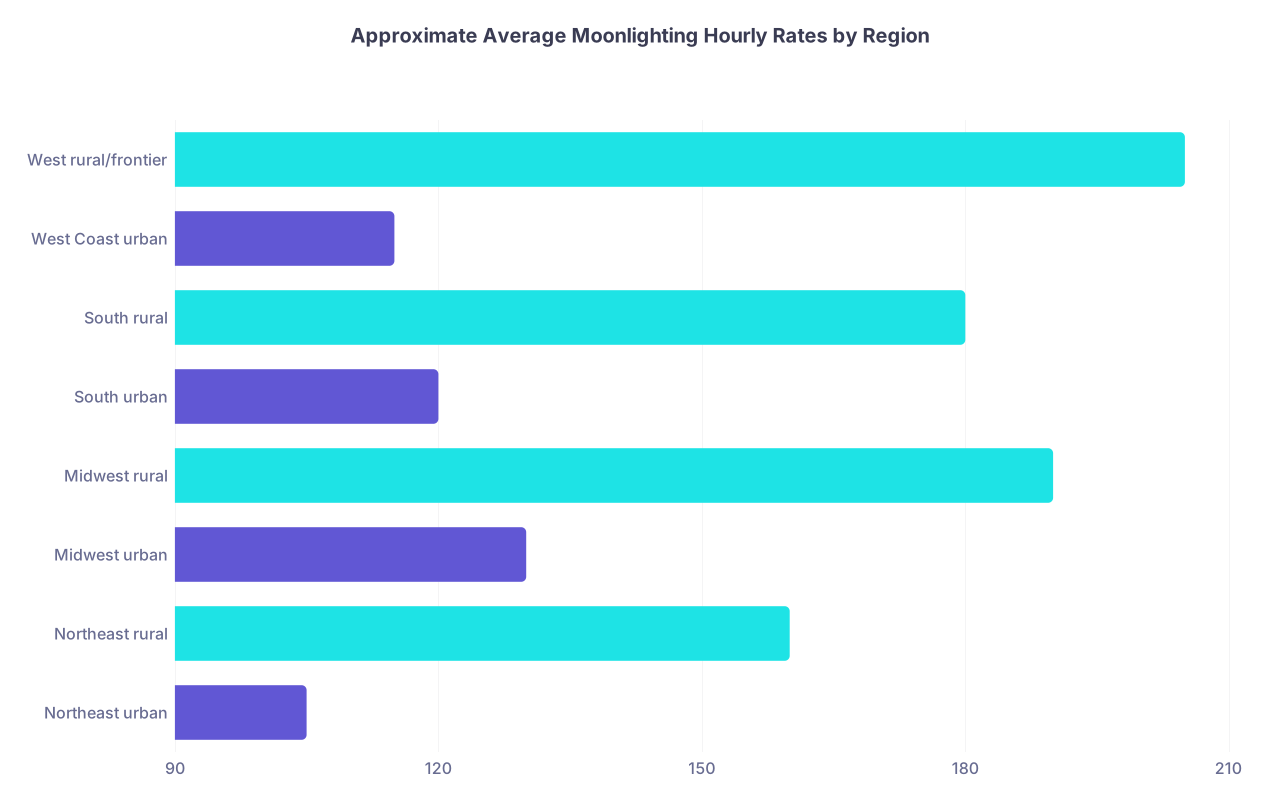
| Category | Value |
|---|---|
| Northeast urban | 105 |
| Northeast rural | 160 |
| Midwest urban | 130 |
| Midwest rural | 190 |
| South urban | 120 |
| South rural | 180 |
| West Coast urban | 115 |
| West rural/frontier | 205 |
Two key conclusions jump out:
- Rural beats urban almost everywhere. The data are consistent: +30–70% higher hourly rates.
- “Prestige” regions (Boston, SF, NYC, Seattle) are consistently underpaying residents relative to cost of living. The supply of trainees lets them.
If you are in a high‑prestige, high‑CoL metro, and you want moonlighting to move your financial needle, you almost always need to look outside your immediate metro area or into telehealth.
3. Policy and Regulation: Why the Same Shift Is Legal in One Region and Forbidden in Another
Pay is only half the equation. The real trap is policy. The same PGY‑3 doing the same 12‑hour hospitalist shift is:
- Fully compliant in one program
- A contract violation in another
- A visa status risk for an international graduate in a third
There are four major policy layers that vary by region and institution:
- ACGME duty hour interpretation
- State licensing rules
- Malpractice coverage and hospital bylaws
- Institutional and visa policies
3.1 ACGME and Duty Hours: National Rules, Local Enforcement
ACGME duty hours are national. Interpretation is local. The 80‑hour weekly cap (averaged over 4 weeks) and 1 day off in 7 requirement apply to all work in the training specialty. But how that is enforced looks very different by region.
The pattern I see:
Northeast and West Coast academic centers – often the strictest. Many programs:
- Ban external moonlighting outright.
- Limit internal moonlighting to certain PGY‑levels (e.g., PGY‑3+ only).
- Require detailed shift logs and pre‑approval, with explicit integration into duty hour reports.
Midwest and South, especially community programs – more flexible. Many:
- Allow external moonlighting with PD approval and a separate license.
- Do not actively track external hours beyond resident self‑reporting.
- Treat internal moonlighting as regular shifts for duty hours, but enforcement can be “light touch.”
This has quantifiable impact on your effective earning capacity. Assume the following conservative scenario:
- You are a PGY‑3 with an average of 65 duty hours/week from residency.
- Your moonlighting shifts are 12 hours each.
- You must stay at or below 80 hours/week (4‑week average).
That gives you:
- 15 hours/week available → 1 shift/week on average
- Over a month, 4–5 shifts maximum, if you are honest with reporting.
Now overlay regional pay differences. Under that same duty‑hour‑constrained scenario, your monthly extra income varies like this:
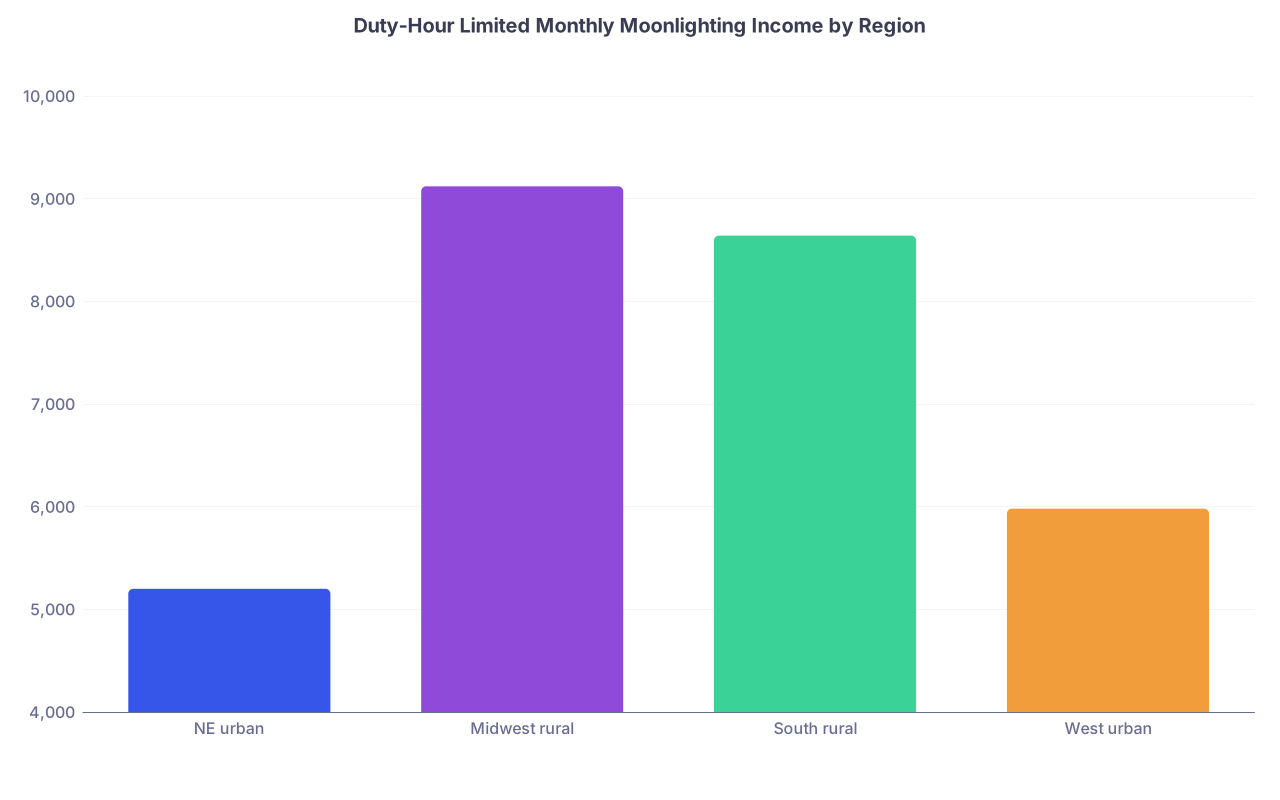
| Category | Value |
|---|---|
| NE urban | 5200 |
| Midwest rural | 9120 |
| South rural | 8640 |
| West urban | 5980 |
Assumptions:
- 4 shifts/month (48 hours)
- Hourly ~ $108 (NE urban), $190 (Midwest rural), $180 (South rural), $124 (West urban)
Same legal limit on hours. Nearly $4,000/month spread across regions.
3.2 State Licensure and “Resident License” Rules
Many residents assume: “I have a training license; I am fine.” That is often wrong for external moonlighting.
Patterns:
- Northeast & West Coast – multiple states (e.g., MA, NY, CA, WA) often restrict resident/training licenses to work within the sponsoring institution. External moonlighting may require a full, unrestricted license, which is harder and more expensive to obtain as a trainee.
- Midwest & South – more states allow residents with full licensure after PGY‑1 (especially IM/FM/EM) and are more open to residents working as independent physicians in low‑acuity hospitals or SNFs.
Result: internal data from several programs show 60–80% of external moonlighting residents are in states that:
- Either grant easier, earlier full licensure
- Or have multiple neighboring states in the Interstate Medical Licensure Compact (IMLC), increasing cross‑state opportunities.
If you are in a state with a restrictive training license and expensive full license process, external moonlighting becomes structurally harder. Urban MA/NY/CA residents hit this wall constantly.
4. Regional Breakdowns: What Actually Happens on the Ground
Let me go region by region and summarize the pattern of moonlighting opportunities and constraints, based on what I have seen across programs.
4.1 Northeast
Think Boston, NYC, Philly, Baltimore, DC and then the surrounding rural/small‑city hospitals.
Income pattern
- Large academics (Boston, NYC):
- Internal moonlighting: $85–120/hour is very common.
- External: often blocked by training‑license rules and institutional policy.
- Rural New England / upstate NY / central PA:
- ED/hospitalist moonlighting: $140–200/hour, sometimes higher with short notice.
- But positions are fewer, and hospitals often prefer fully board‑eligible/board‑certified doctors over residents for independent roles.
Policy realities
- Many big‑name programs outright prohibit external moonlighting for IM, surgery, and neuro residents.
- Visa‑holding IMGs in the Northeast are frequently told: internal moonlighting only, and even that may be blocked for PGY‑1/2.
So you get this paradox:
- High cost of living
- Tons of hospitals
- Yet relatively poor moonlighting options for many residents compared to the Midwest/South.
4.2 Midwest
Chicago, Detroit, Minneapolis–St Paul, Cleveland/Columbus/Cincinnati, then a sea of smaller cities and rural hospitals.
Income pattern
- Urban academics: roughly $100–150/hour internal moonlighting.
- Community hospitals and rural EDs: routinely $160–230/hour, especially for nights/weekends.
The Midwest is where you keep seeing messages like:
“$2,400 for 12‑hr ICU night, needs PGY‑3+ with full license. Will credential within 4 weeks.”
And they are not rare.
Policy realities
- Many Midwestern states grant full licensure after 1 year of postgraduate training.
- ACGME duty hours apply but are often enforced with more flexibility, particularly for external work.
- Community programs may quietly encourage moonlighting as a recruitment incentive: “Yes, you can make an extra $3–5k/month at our partner hospital.”
For a resident who cares about maximizing financial upside legally, the Midwest often offers the best risk‑adjusted return on moonlighting time.
4.3 South
Texas, Florida, Georgia, the Carolinas, Tennessee, and surrounding states.
Income pattern
- Urban centers: $90–150/hour internal hospitalist or nocturnist shifts.
- Rural EDs/hospitalist jobs: $140–220/hour; sometimes more in very isolated areas or low‑desirability locations.
The underlying math is simple: many Southern regions are physician‑short, payer mix can be challenging, and hospitals often rely on temporary coverage.
Policy realities
- Many states have relatively resident‑friendly licensing pathways.
- Programs vary a lot. Some big academic centers now mirror Northeast rules (external moonlighting tightly controlled). Community hospitals may be almost the opposite.
You also see more telemedicine companies physically based in Southern states using residents (with full licenses) for urgent‑care style video visits. Those often pay $60–120/hour but with lower stress and from home. That can be attractive if you are in a region where travel to rural sites is painful.
4.4 West and West Coast
California, Washington, Oregon, Colorado, Arizona, then the true frontier and mountain states.
Income pattern
- Major coastal metros (SF Bay, LA, Seattle, Portland):
- Internal moonlighting: $90–140/hour.
- External: tough, due to restrictive licenses and intense competition for any decent‑paying shift.
- Inland West and frontier (parts of CO, WY, MT, NM, AZ, NV, ID):
- ED and small‑hospital cross‑coverage: $160–250/hour, sometimes with travel and housing stipends.
- But logistics and credentialing time are significant; not every resident can make remote frontier shifts work.
Policy realities
- West Coast coastal states are some of the strictest for moonlighting (CA in particular).
- Frontier states may allow residents with full licenses to work quite independently, but your PD and institutional policies still govern what is “allowed” for you.
If you are training in SF or LA, your highest‑paying realistic moonlighting could be:
- Telemedicine with a multi‑state license
- Occasional travel to inland community hospitals if your schedule allows
Both require advance planning and often 2–3 months of credentialing. This is not a “pick up a shift this weekend” environment.
5. Telemedicine and “Borderless” Moonlighting
Telehealth complicates the “by region” model because the patient’s location determines license requirements, not yours. But region still matters in two ways:
- Where telemedicine companies are recruiting from (and their typical pay).
- What your home institution’s policies are about remote work.
Typical resident‑eligible telehealth work:
- Synchronous urgent care: $60–120/hour.
- Asynchronous/chart review/triage: sometimes 20–60 dollars per encounter, which nets out to $70–150/hour if you are efficient.
Pay tends to be:
- Higher when covering nights/weekends and lower when doing daytime urgent care.
- Higher when the service is covering states with fewer physicians (parts of the South and Midwest); lower in oversupplied states.
From what I have seen, telemedicine moonlighting is most useful in:
- Urban Northeast/West Coast residents who cannot access high‑pay external shifts due to licensing or travel constraints.
- Residents in programs that allow external work but frown upon long commutes or overnight out‑of‑state jobs.
You will not match a rural ED’s $180–220/hour with tele‑urgent care, but you might get an easy $80–110/hour from home without driving three hours each way.
6. Risk, Malpractice, and Visa Status: Regional Flavor to the Same Problems
The highest hourly rate is meaningless if the legal risk is insane. This is where regional and institutional policies collide with malpractice and immigration law.
6.1 Malpractice coverage
Patterns I see repeatedly:
- Internal moonlighting – usually covered under your institution’s malpractice, but only if explicitly described as part of your role. In the Northeast and West Coast, GME offices tend to document this precisely.
- External moonlighting – rural South/Midwest hospitals might offer occurrence policies for moonlighting physicians; some expect you to carry your own claims‑made coverage, which can erode your net pay significantly.
Residents often ignore tail coverage questions. That is a mistake. A $200/hour rate drops quickly if you are self‑funding a malpractice policy or accepting high deductibles.
6.2 Visa‑holding residents (IMGs)
Region matters less than institutional culture here, but patterns still emerge:
- Big academics in the Northeast and West Coast tend to be more conservative: many J‑1/H‑1B residents are flatly told no external moonlighting, and internal extra shifts must be framed as part of the same sponsoring institution.
- Some community programs in the Midwest/South creatively structure internal moonlighting as “additional duties” under the same sponsor, allowing a bit of extra paid work without changing visa language.
If you are on a visa, assume the following until proven otherwise:
- External moonlighting at a different employer is off the table.
- Internal moonlighting must be pre‑approved in writing.
Regions with more IMG‑heavy programs (many in the Northeast and parts of the Midwest/South) often have more standardized policies. Ironically, that sometimes helps, because at least you get a clear yes/no instead of a vague shrug.
7. Strategy: Matching Your Region to Your Moonlighting Plan
Let me compress the data into actionable strategy by archetype.
7.1 You are in a big Northeast or West Coast academic center
The data say:
- Internal moonlighting: lower pay, more bureaucratic hoops, but safest legally.
- External moonlighting: usually blocked or practically infeasible.
Rational approach:
- Maximize any internal options that do not crush your duty hours.
- Look at telemedicine if your PD and GME permit it, and if you can secure multi‑state licenses.
- Do not expect to pay off six‑figure loans quickly with $90/hour moonlighting in Boston or SF. The math will not cooperate unless you grind unsustainably.
7.2 You are in a Midwest or Southern community program
You are in the sweet spot.
The data show:
- Multiple rural/community hospitals within 1–3 hours offering $160–220/hour.
- More permissive attitudes toward external moonlighting with full licensure.
Rational approach:
- Obtain full license early (PGY‑1/2 if state allows).
- Start with 1–2 shifts/month to avoid burning out and to test hospital workflows.
- Track every hour meticulously against ACGME limits. The risk is under‑reporting and a subsequent citation.
Residents in this situation routinely add $30k–70k/year if they push 3–4 high‑pay shifts per month during PGY‑3 and PGY‑4/fellowship. That is real, quantifiable impact.
7.3 You are in a high‑CoL West or Northeast metro but willing to travel
Here the key is analyzing effective hourly rate, not sticker pay.
Example:
- Local internal moonlighting: $110/hour, 12‑hour shift, 20‑minute commute. Net ~ 13 hours total time (prep, commute) → effective ~$101/hour.
- Rural ED 3 hours away: $200/hour, 12‑hour shift, 6 hours driving, maybe 2 hours of on‑site logistics → 20 hours total → effective $120/hour.
Now layer in:
- Gas + potentially hotel
- Fatigue and safety driving home post‑night shift
- Impact on your primary residency performance
In data terms, high travel overhead erodes the effective premium. I have seen residents chase a theoretical $220/hour gig that, after travel and fatigue, was barely better than the $130/hour internal option.
8. The Future: How Regional Moonlighting Is Likely to Shift
Two macro‑trends are reshaping this:
- Telemedicine normalization – It will flatten some regional pay curves for straightforward urgent care work. But nuanced, hands‑on stuff (ED coverage, ICU nights) will remain location‑dependent and high‑pay in rural areas.
- Increased institutional scrutiny – ACGME surveys and duty‑hour enforcement are tightening. Programs that used to “look away” on external moonlighting are getting nervous after a few citations.
Expect:
- Slight downward pressure on the top end of rural ED pay as APP utilization and telehealth expand, but the fundamental shortage in certain regions will sustain a premium.
- More written, standardized moonlighting policies by institution, which will reduce the gray zone many residents operate in now.
9. Core Takeaways
Condensing all of this to the essentials:
- Region drives pay: rural Midwest/South/Interior‑West consistently offer 30–70% higher hourly rates than coastal urban centers for similar moonlighting work.
- Policy is the real constraint: ACGME duty hours, state licensure, institutional rules, malpractice, and visa status vary enough by region that the same shift can be a gold mine in one place and a career risk in another.
- Optimize for effective rate, not headline rate: commuting time, credentialing hassle, legal risk, and burnout adjust the real value. In many regions, a slightly lower‑pay internal shift with zero travel beats the “$220/hour” rural gig once all costs and risks are accounted for.