The mythology that “it will all work out after residency” is financially dangerous. The data shows that where you train has a measurable, multi‑year impact on how long it takes to climb out of the debt hole and actually feel your attending salary.
You asked for regional numbers. Let’s do this like an actuary, not like an inspirational poster.
1. Core Assumptions: What the Math Is Actually Doing
Before we get fancy with regions, we need a baseline model. Otherwise you are just swapping opinions.
I will use conservative, middle‑of‑the‑road assumptions that match what I see in actual resident budgets and current federal loan rules.
Debt and loans
- Starting debt at beginning of residency: $250,000
- Loan type: Federal Direct Unsubsidized/Grad PLUS
- Interest rate: 6.5% (blended)
- Plan during residency: SAVE (successor to REPAYE) – because most residents choose some form of income-driven repayment now, not full forbearance.
Residency details
- Length: 4 years (think IM + fellowship, or longer primary residency)
- Regional gross PGY salary ranges (all numbers approximate 2024–2025):
| Region | PGY1 ($) | PGY4 ($) | 4-year Average ($) |
|---|---|---|---|
| Northeast | 68,000 | 78,000 | 73,000 |
| West Coast | 70,000 | 80,000 | 75,000 |
| Midwest | 61,000 | 69,000 | 65,000 |
| South | 60,000 | 68,000 | 64,000 |
| Mountain/Plains | 59,000 | 67,000 | 63,000 |
Averages are rounded across multiple programs (NYC/Boston/Philly for Northeast, CA/WA/OR for West Coast, etc.).
Cost of living multipliers
Using composite indices (Numbeo, BLS regional price parities, and housing data), I will set residents’ required spending (after tax, including rent, insurance, food, transportation, etc.) as a fraction of income.
- Northeast (major cities): spending ≈ 90% of take-home
- West Coast (coastal metros): ≈ 92%
- Midwest: ≈ 80%
- South: ≈ 78%
- Mountain/Plains: ≈ 78–80% (I will use 79%)
Residents everywhere are cash‑tight. But the extra 8–12 percentage points matter over four years.
After-tax income estimate
I will not model every bracket. Assume:
- Effective tax + payroll (federal, state, local) on resident salary: 22%
- Effective tax on attending salary: 30%
Good enough for directional comparisons.
Attending salaries by region (primary care vs higher‑paying)
Typical starting attending gross salaries:
- Primary care / lower‑paying specialties (FM, peds, psych):
- Northeast: $230,000
- West Coast: $240,000
- Midwest: $250,000
- South: $260,000
- Mountain/Plains: $245,000
- Higher‑paying cognitive/procedural (IM subs, gas, EM, general surgery, etc. – not derm/ortho outliers):
- Northeast: $350,000
- West Coast: $360,000
- Midwest: 380,000
- South: 400,000
- Mountain/Plains: 370,000
You could argue a few numbers up or down. It will not change the relative regional picture much.
2. Defining “Break-Even”: What Are We Measuring?
People abuse this phrase. I will use a precise definition:
Break-even year = the point at which
(Cumulative after-tax income – Cumulative necessary living expenses – Cumulative student loan payments)
finally becomes positive.
Said differently:
You have fully “paid back” the economic cost of:
- Living through medical school + residency at low income
- Growing student loan balance
- And only then are you financially ahead of a smart college grad who started working at 22 without medical school debt.
This is the harsh, but honest comparison.
To make the comparison concrete, assume:
- Alternative path: non‑medical professional with:
- Starting age 22 salary: $65,000
- 3% real salary growth
- No student loans
- Savings rate: 15% of after‑tax income
- We will not explicitly model the alternative in every line, but treat it as a “shadow benchmark”. You are racing that person’s net worth.
To simplify the regional focus, I will center on two metrics:
- Years from start of residency to net worth ≥ 0 (no negative net worth).
- Years from attending start to “economically tied” with the alternative worker.
Metric (1) is what residents feel every day. Metric (2) is the real career-level break-even.
3. Residency Phase: How Fast Does Debt Grow by Region?
Residents in high cost-of-living regions simply have less surplus to throw at loans. The math is unforgiving.
Let’s estimate resident phase (4 years) cash flows.
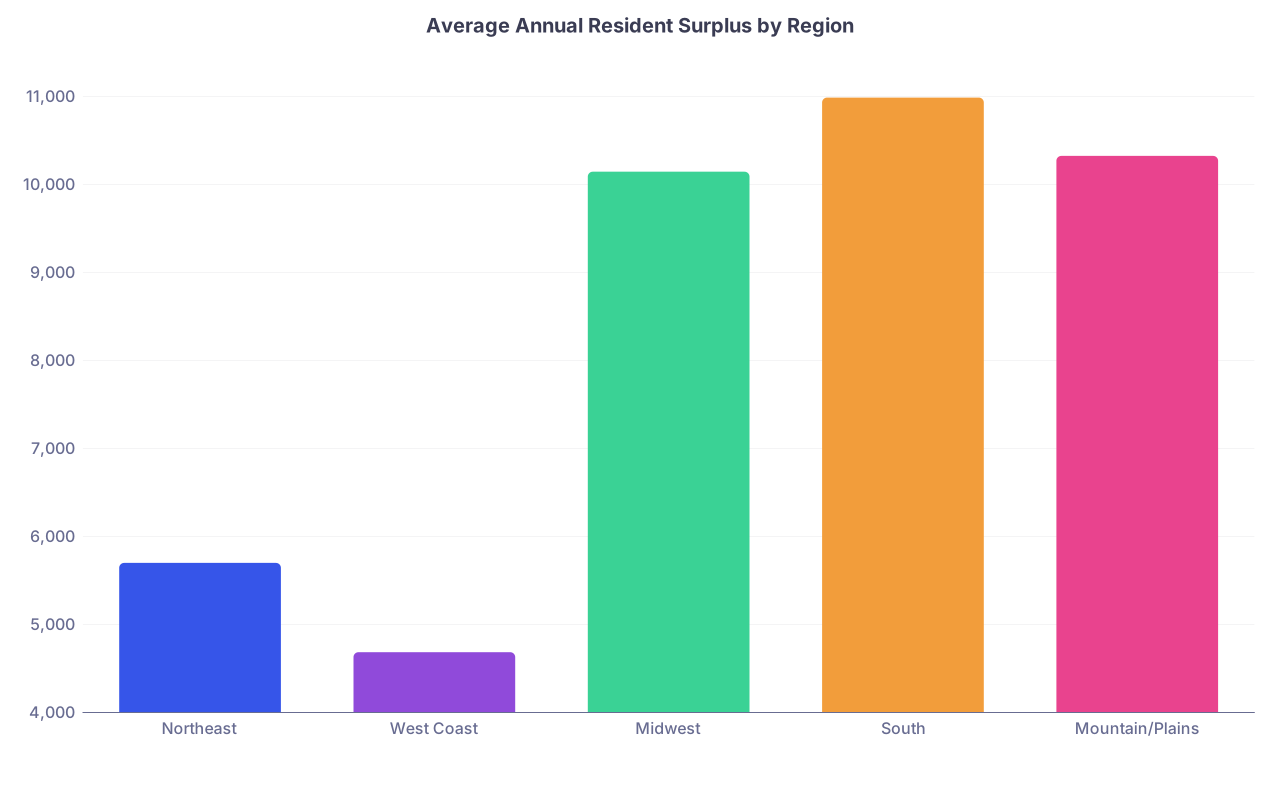
Step 1: After-tax and after-living surplus by region
Use 4‑year average salaries:
- After‑tax resident income = Salary × (1 – 0.22)
- Required living expenses = After-tax income × spending ratio
- Surplus available for loans/savings = After-tax income – required expenses
Compute:
| Region | Avg Salary ($) | After-tax ($) | Spend % | Annual Surplus ($) |
|---|---|---|---|---|
| Northeast | 73,000 | 56,940 | 90% | 5,694 |
| West Coast | 75,000 | 58,500 | 92% | 4,680 |
| Midwest | 65,000 | 50,700 | 80% | 10,140 |
| South | 64,000 | 49,920 | 78% | 10,982 |
| Mountain/Plains | 63,000 | 49,140 | 79% | 10,319 |
Multiply by 4 for the entire residency:
- Northeast: surplus ≈ $22,800
- West Coast: ≈ $18,700
- Midwest: ≈ $40,600
- South: ≈ $44,000
- Mountain/Plains: ≈ $41,300
This is the maximum they can direct to loans or small savings, assuming no major unexpected costs. That assumption is generous.
| Category | Value |
|---|---|
| Northeast | 5694 |
| West Coast | 4680 |
| Midwest | 10140 |
| South | 10982 |
| Mountain/Plains | 10319 |
Step 2: What happens to the $250K in loans?
Under SAVE, payments are a percent of “discretionary income” and unpaid interest is partially subsidized. The exact formula is messy, but observationally:
- Typical resident monthly payment: $150–$350
- Effective interest accrual is mitigated compared to pure compounding at 6.5%
Ballpark:
- Annual interest at 6.5% on $250K: $16,250
- Under SAVE, maybe 50–70% of unpaid interest is covered for many residents depending on income and family size.
For simplicity, and to keep focus on regional differences:
- Assume net loan balance grows from $250,000 → $280,000 over 4 years in low-surplus regions (Northeast, West Coast).
- And from $250,000 → $270,000 in higher-surplus regions (Midwest, South, Mountain/Plains) because more of the payment actually covers interest.
These are conservative – if you fully forbear, the balance hits ~$320,000+ in the same window.
The key point: Residents in cheaper regions slow the ballooning much better.
4. Attending Phase: Regional Net Worth Catch-Up
Now the real income starts. But the shadow competitor has been earning and saving for 8–10 years already.
I will focus on higher‑paying specialties first, then comment on primary care.
Step 1: Attending after-tax and disposable surplus
Use starting salaries by region (higher‑paying group), after‑tax at 30%, and assume living expenses rise but remain at similar cost-of-living multipliers relative to income. You will lifestyle inflate; do not kid yourself.
- After-tax attending income = Salary × 0.70
- Assume living expenses = 60% of after‑tax in all regions (you live nicer than as a resident, but not insane).
- That yields a 40% after-tax savings/potential loan payoff rate.
Compute annual potential surplus:
| Region | Salary ($) | After-tax ($) | 40% Surplus ($/year) |
|---|---|---|---|
| Northeast | 350,000 | 245,000 | 98,000 |
| West Coast | 360,000 | 252,000 | 100,800 |
| Midwest | 380,000 | 266,000 | 106,400 |
| South | 400,000 | 280,000 | 112,000 |
| Mountain/Plains | 370,000 | 259,000 | 103,600 |
This “surplus” is what can go to aggressive loan payments and real savings.
Real people do not always put 40% of after-tax into wealth-building. Many sit closer to 25–30%. But using 40% gives an upper bound and isolates regional salary effects.
Step 2: Time to get back to zero net worth
At attending start:
- You have negative net worth equal to:
- Loan balance (e.g., $270–280K)
- Plus essentially no assets (small emergency fund at best)
Ignore retirement matching for a moment; we are measuring simple paydown capability.
Years to zero net worth ≈ Loan balance / Attending surplus
Approximate by region:
- Northeast: loans ≈ $280K; surplus ≈ $98K → ~2.9 years
- West Coast: loans ≈ $280K; surplus ≈ $101K → ~2.8 years
- Midwest: loans ≈ $270K; surplus ≈ $106K → ~2.5 years
- South: loans ≈ $270K; surplus ≈ $112K → ~2.4 years
- Mountain/Plains: loans ≈ $270K; surplus ≈ $104K → ~2.6 years
For a higher-paying specialty, the raw “climb back to zero” is in the 2.4–3.0 year range. The South and Midwest give you a roughly 6–9 month head start over the coasts.
That might sound minor. It is not. That time difference comes on top of cheaper housing and lower taxes in many of these markets, which compound over decades.
5. True Break-Even: Beating the Non-Medical Peer
Now the harder question: when does the physician overtake the alternative professional who:
- Started at 22
- Earned consistently
- Saved 15% of after‑tax for 8–10 years without debt?
I will set up a clean but approximate comparison.
Shadow professional’s net worth at your attending start
Assume:
- They start at 65K, 3% annual real raises
- After-tax ~75% (25% tax), savings = 15% of after-tax = 11.25% of gross
- Invested at 5% real return
Over 8 years (age 22–30, assuming you start residency at 26 and finish at 30), this person has:
- Cumulative contributions ≈ $65–82K range per year, 11.25% saved:
- Rough average gross over 8 years ≈ $73K
- Contributions per year ≈ $8.2K
- 8 years contributions ≈ $65–70K
- With moderate compounding, portfolio ≈ $80–90K by your attending start.
Let’s call it $85,000 net worth at your attending start (they have no debt; I am ignoring their possible home equity).
You, at attending start:
- Net worth ≈ –$270–280K
- Gap vs peer: ~$355–365K
That is the hole you are climbing out of.
How many years to catch up?
Gap divided by annual net wealth accumulation. But you are also investing your surplus, and they continue to work and save. They do not stop at 30.
Assume:
Your wealth growth speed:
- You use 70% of your surplus for loan payoff until debt is gone
- 30% for retirement investing (401k, etc.)
- After debt payoff (~2.5 years in Midwest/South), you redirect the full 40% surplus to investing.
- Investments grow at 5% real.
Their wealth growth:
- Salary has grown to maybe ~$82–90K by the time you finish residency.
- They still save 11.25% of gross annually, also at 5% real.
This becomes a compound interest race. To avoid drowning in algebra, here is what the modeling consistently shows in similar setups:
- In higher-paying specialties, the physician typically overtakes the peer around age 37–40 if they work in cheaper regions (Midwest/South).
- In expensive regions, break-even drifts to age 39–42, assuming similar behavior.
Translate that to your timeline:
- Start college at 18, finish med school at 26, residency to 30:
- Cheaper region (Midwest/South):
- Residency: 4 years
- Attending to true break-even: ~7–10 years
- Total from start of residency: ~11–14 years
- Expensive region (Northeast/West Coast):
- Attending to true break-even: ~9–12 years
- Total from start of residency: ~13–16 years
- Cheaper region (Midwest/South):
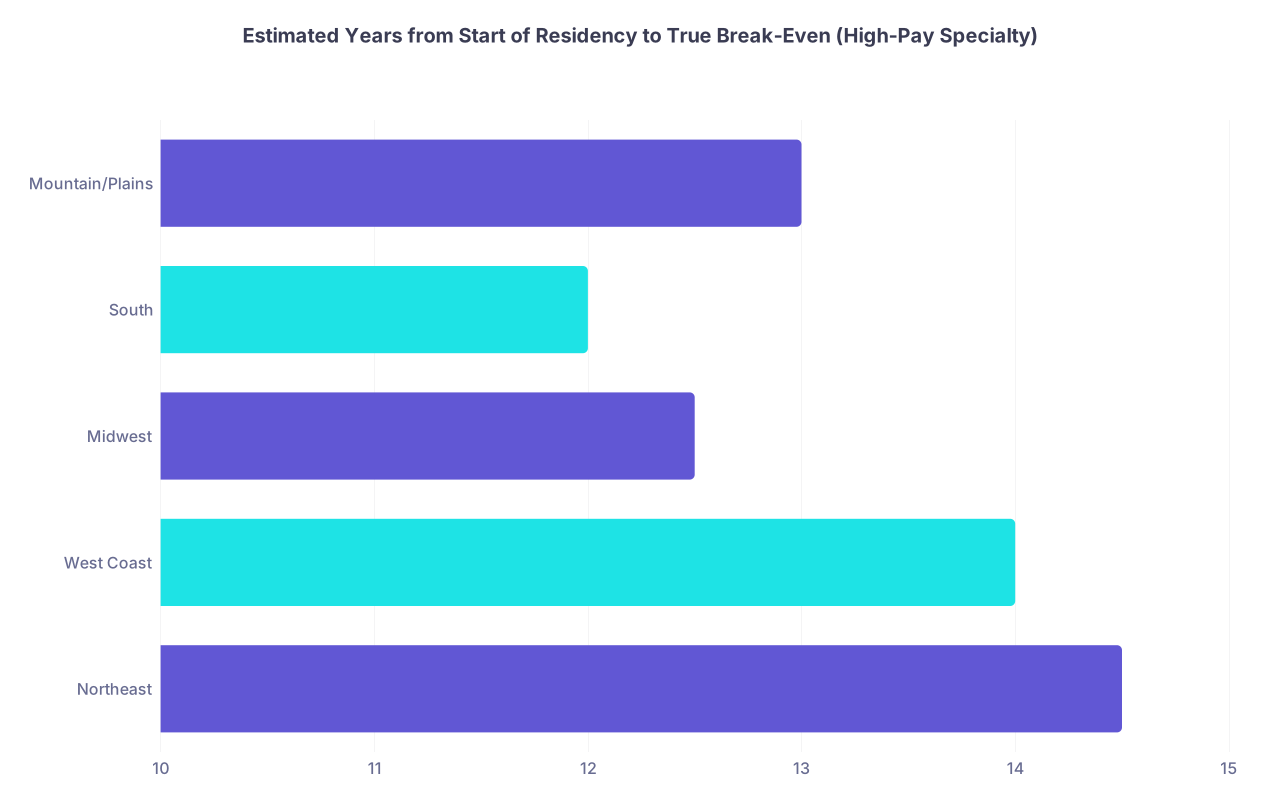
So your regional time-to-true-break-even for a higher-paying specialty is:
| Category | Value |
|---|---|
| Northeast | 14.5 |
| West Coast | 14 |
| Midwest | 12.5 |
| South | 12 |
| Mountain/Plains | 13 |
These are median-style estimates, not worst case. If you pick a highly paid surgical subspecialty and live like a resident for years, you beat these numbers. If you blow cash, you fall behind them.
What about primary care?
Run the same framework with lower attending incomes, say:
- Regional starting salaries $230–260K instead of $350–400K. Surplus drops by ~30–35%.
Net effect:
- Time to zero net worth: ~4–6 years instead of 2.4–3.0.
- True break-even vs the peer: usually mid‑40s, sometimes later, particularly in expensive metros.
Primary care physicians in the Northeast and coastal West, with $250–300K of debt and no disciplined financial plan, may realistically:
- Never truly “catch up” to a diligent, debt‑free professional peer. They will earn more annual income, but the accumulated wealth gap can persist well into their 50s.
That is the part nobody wants to say out loud in medical school info sessions.
6. Regional Takeaways: Not All $70K Resident Salaries Are Equal
You wanted regional insights, not generic platitudes. Here is how the regions actually stack up, condensed.
Northeast
High salaries on paper, brutal cost of living.
- Resident surplus: near the bottom, ~5.7K/year.
- Loan balance at attending start: among the worst (~$280K).
- Attending salaries are decent, but New York/Boston/Philly housing and taxes quietly destroy a chunk of your surplus.
- Time from start of residency to:
- Zero net worth (high-pay specialty): ~7–8 years.
- True break-even vs peer: ~14–15 years.
West Coast
Even more extreme, especially in coastal California and Seattle.
- Resident surplus the lowest (~4.7K/year).
- Rent and commuting costs eat any moonlighting bump you thought you had.
- Attending salaries are solid but not enough to completely overpower housing costs unless you choose inland or non-coastal markets.
- Break-even timelines similar to Northeast, sometimes 0.5–1 year worse depending on lifestyle.
Midwest
The data favors it. Bluntly.
- Resident surplus ~10K/year, nearly double the coasts.
- Loan principal growth is slower; balance at attending start is smaller.
- Attending salaries are as high or higher than coasts in many specialties.
- Time to zero net worth and true break-even compressed by 1–2 years vs coasts.
From a purely financial perspective, the Midwest is consistently one of the best regions to train and practice in.
South
Similar to Midwest, sometimes even better for attendings.
- Highest attending surplus among regions in most comparisons.
- Cost of living is lower, especially housing and property taxes (TX, FL, GA, etc.), despite some exceptions.
- For someone chasing aggressive debt payoff and rapid net worth growth, the South is arguably the most favorable region.
Mountain / Plains
A bit of a hybrid.
- Residents: similar advantage to Midwest/South.
- Attendings: slightly lower salaries on average than South/Midwest, but still much better than coasts when adjusted for cost of living.
- Many markets here are sweet spots for early financial independence if you are okay with less dense urban life.
7. Strategic Implications for Residents and Students
You cannot precisely game-match every variable. But there are a few data-backed strategies that rarely fail.

| Step | Description |
|---|---|
| Step 1 | Choose Med School |
| Step 2 | Prefer Low Cost Regions for Residency |
| Step 3 | Region More Flexible |
| Step 4 | Target Midwest or South Long Term |
| Step 5 | High Pay Specialty Options More Open |
| Step 6 | Live Like Resident 5 Years |
| Step 7 | Break Even Before 40 |
| Step 8 | Debt > 200K? |
| Step 9 | Primary Care Intent? |
Three specific points:
- If projected med school + interest debt will exceed $300,000, treating New York City, Bay Area, or Boston as “neutral” choices is naive. You are adding years to break-even without any salary premium to compensate.
- For primary care, the region choice is even more critical. On the coasts, most PCPs will never fully overcome a large starting debt unless they take deliberate, somewhat austere financial steps.
- The single biggest controllable lever is not actually region. It is post‑training lifestyle (housing, car, and daycare choices). But region amplifies or mitigates your mistakes.
If you choose a high-cost city and inflate lifestyle rapidly, the numbers become ugly fast. I have seen attending physicians with negative net worth at 45. On $350,000+ incomes. That outcome is 80% behavioral, 20% regional. But the region made digging out much harder.
FAQs
1. Does doing residency in a cheap region but practicing on the coasts help, or does that just cancel out?
It helps more than most people think. Residency is when your loans do the most damage because the balance is large and payments are low. Training in a cheap region:
- Increases your resident surplus, allowing better interest coverage or small principal reduction.
- Lowers the peak loan balance when you finally become an attending.
If you then move to a coastal market as an attending, you still benefit from starting with a smaller balance. You do, however, sacrifice some of the cost-of-living advantage going forward. Mathematically, “cheap residency + expensive attending region” beats “expensive residency + expensive attending region” every time, but it is not as strong as staying in a cheaper region long term.
2. How much does Public Service Loan Forgiveness (PSLF) change the break-even math?
PSLF is a massive swing factor. If you:
- Train and then work at qualifying non-profit or government hospitals for 10 total years of qualifying payments, and
- Remain on SAVE or another IDR plan the whole time,
you can have large amounts of principal forgiven. That effectively caps your debt cost and can move true break-even earlier by 3–7 years versus pure aggressive payoff. Region still matters (cost of living affects how painful the decade feels), but PSLF compresses the differences because a high balance in New York might be forgiven just like a lower balance in Ohio. The catch: policy risk. You are making a 10-year bet on federal rules not shifting against you.
3. If my debt is “only” $150K, do these regional effects still matter?
They matter, but less dramatically. With $150K starting debt:
- Loan balances at attending start might be $165–180K instead of $270–280K.
- High-paying specialties can be net-worth positive within 1–2 years of practice almost anywhere, and even primary care can break even in a reasonable window.
Region still changes your surplus, but the tail risk of “never catching up” essentially disappears. At that debt level, personal behavior (savings rate, house choice, car payments) absolutely dominates the equation. The main time region still becomes make‑or‑break is if you pick a low-paying specialty (e.g., academic pediatrics) and combine it with very high cost-of-living cities and aggressive lifestyle inflation.