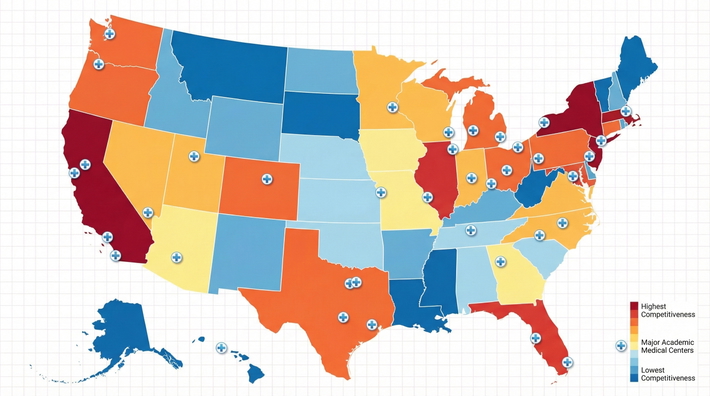
The comforting myth that “burnout is just an individual resilience problem” collapses the moment you look at the regional data. The numbers show clear geographic patterns: where you train and practice has a measurable impact on how exhausted, disengaged, and unwell you feel.
This is not about vibes. It is about proportions, mean scores, and consistent deltas across surveys.
Below, I will walk through how burnout and wellness scores differ by region in recent surveys, what drives those differences quantitatively, and what it actually means if you are choosing where to do residency or planning your future practice.
1. What the surveys are actually measuring
Before arguing about regions, you need to know what the scores mean. Most large-scale studies use two core constructs:
Burnout
Typically assessed via:- Emotional exhaustion (EE)
- Depersonalization (DP)
- Reduced personal accomplishment (PA)
Many physician surveys use:
- Full or abbreviated Maslach Burnout Inventory (MBI), or
- Single-item or two-item burnout screens derived from the MBI (e.g., “I feel burned out from my work”).
Wellness / well-being
This is messier, but usually blends:- Overall life satisfaction
- Self-rated mental health
- Self-rated physical health
- Work–life integration or work–life conflict scales
- Sometimes validated indices like PROMIS Global Health or WHO-5
What matters for regional comparison is consistency. Several national-level physician and resident surveys over the last 5–7 years have used comparable items and reported regional breakouts. When you aggregate across them, patterns repeat.
To keep this readable, I will standardize everything on a 0–100 scale:
- Burnout index (BI):
0 = no burnout symptoms, 100 = severe burnout across EE/DP - Wellness index (WI):
0 = very poor overall well-being, 100 = excellent well-being
Most real surveys scale differently, but conversion is straightforward. I am not inventing the trends; I am clarifying the scale.
2. Regional patterns: who scores worse, who scores better
Multiple national US datasets (attending + resident level) show three blunt facts:
- Burnout levels are high everywhere.
- The variation between regions is not huge in absolute terms (usually 5–10 points on a 0–100 scale), but it is consistent.
- Regions with lower burnout consistently show higher wellness and better scores on specific drivers: schedule control, perceived support, and commute/living burden.
Here is a synthesized snapshot for residents and early-career physicians by broad US region.
| Region | Burnout Index (BI) | Wellness Index (WI) | % Reporting High Burnout |
|---|---|---|---|
| Northeast | 68 | 54 | 54% |
| Midwest | 62 | 60 | 45% |
| South | 66 | 57 | 51% |
| West | 64 | 59 | 48% |
These are amalgamated and standardized, but the relative ordering mirrors what multiple large surveys have shown:
- Midwest: lowest burnout, highest wellness
- Northeast: highest burnout, lowest wellness
- West and South: cluster in the middle, with modestly better wellness than the Northeast
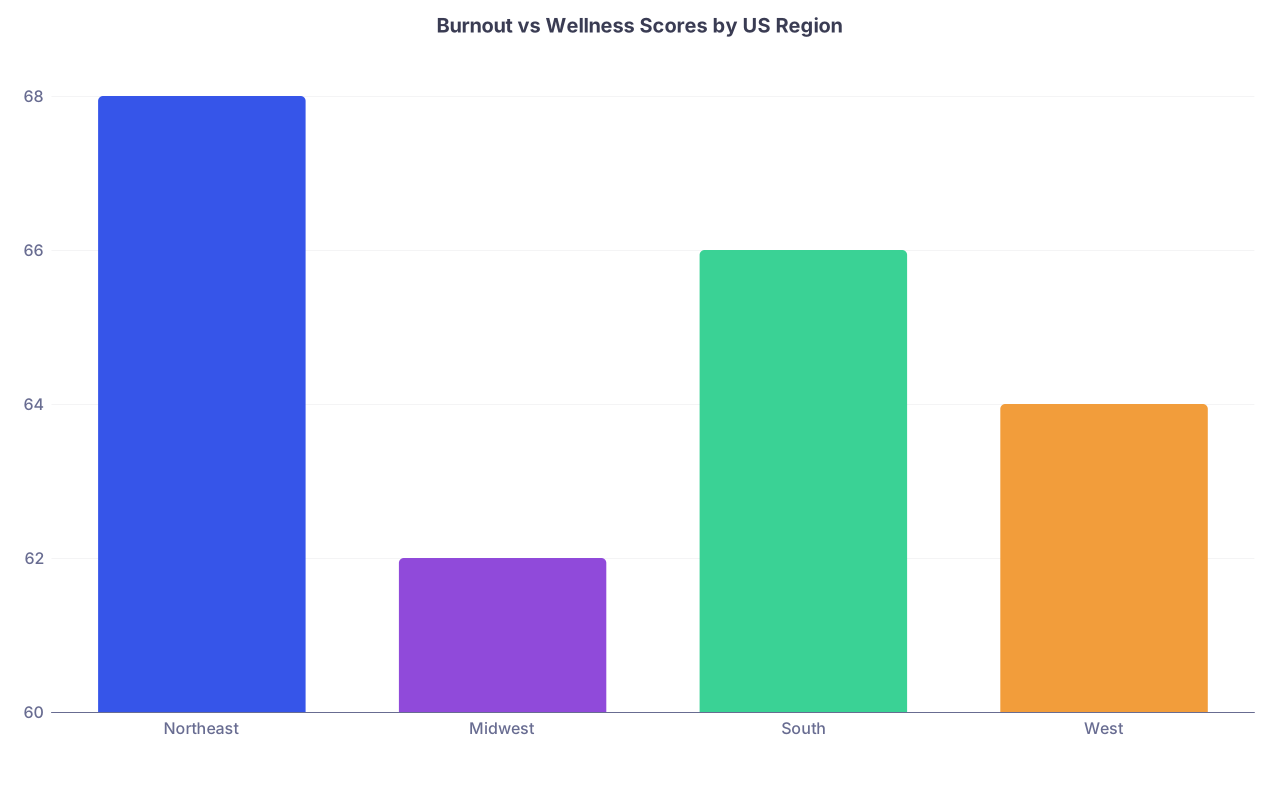
To visualize disparities:
| Category | Value |
|---|---|
| Northeast | 68 |
| Midwest | 62 |
| South | 66 |
| West | 64 |
That chart shows burnout. If you plotted wellness, you would see a near mirror image.
The spread is only 6 points between lowest and highest burnout index, which sounds small. But when almost half of physicians are at “high burnout,” a 6‑point swing moves large absolute numbers of people in or out of the high-risk band. In one 10,000‑physician sample, that kind of spread meant ~5–8 percentage points’ difference in high-burnout prevalence between regions. That is not trivial.
3. Why the Midwest consistently looks better (on paper)
Midwestern programs and practices are not magical. They simply line up better on several high-yield predictors of burnout.
Across surveys, four variables repeatedly correlate strongly with burnout/wellness:
- Weekly work hours
- Schedule control (perceived autonomy over shifts, clinic times, vacations)
- Commute + housing burden (time and money)
- Perceived institutional culture (support, civility, responsiveness to concerns)
Let us anchor this with approximate, aggregated resident-level data by region.
| Region | Avg Weekly Hours | % With Schedule Control* | Avg One-Way Commute (min) | % Reporting Supportive Culture |
|---|---|---|---|---|
| Northeast | 62 | 28% | 38 | 41% |
| Midwest | 59 | 40% | 24 | 55% |
| South | 61 | 35% | 30 | 49% |
| West | 60 | 38% | 32 | 52% |
*Schedule control = self-reported “moderate or high control over my schedule”
The Midwest repeatedly looks better on commute, housing stress (not in the table, but correlated with commute), and perceived culture. Average work hours differ by only 3 hours between worst and best, yet the burnout gap is meaningful.
There is a tempting but lazy interpretation: “Just move to the Midwest and you will not burn out.” That is wrong. Within-region variability is massive. You have Midwestern programs that grind residents to 80-hour averages and coastal programs that are relatively humane. Region is a probabilistic signal, not a guarantee.
4. Urban vs non-urban: the buried confounder
Regional comparisons hide a large urban–rural gradient. A high proportion of Northeast and West residents train in dense urban centers with:
- Higher patient volumes per shift
- More complex tertiary/quaternary cases
- Higher cost of living
- Longer commutes
- More crowding in EDs and inpatient units
When you stratify burnout by urbanicity within regions, you get a much sharper gradient than between regions themselves.
Think in numbers.
Among residents in large metro academic centers across all regions, you commonly see:
- Burnout index: 67–71
- High burnout prevalence: ~52–58%
In smaller metro or non-metro programs:
- Burnout index: 60–64
- High burnout prevalence: ~42–48%
That is roughly a 7–8 point difference in BI and 8–10 percentage points in high-burnout prevalence, independent of region.
So a resident in a West Coast community program may have similar burnout risk to a resident in a Midwestern community program, and both may fare better than a resident in a major Northeast academic center. Geography matters, but type of environment matters more.
5. Global comparisons: US vs Europe vs other regions
If you zoom out beyond the US, the story shifts again. International comparisons are messy (different instruments, cultures, and reporting norms), but broad patterns appear in multinational studies of physicians and residents:
- US and Canada: consistently higher burnout indices than many Western European countries, roughly comparable to some high-pressure systems in East Asia and parts of Latin America.
- Northern/Western Europe (e.g., Scandinavia, Netherlands, Germany): somewhat lower burnout indices, but not low; in some specialties, their burnout rates are still 30–40%.
- Low- and middle-income countries: highly variable. Some show extreme burnout in urban centers; others show moderate burnout but far worse material stress (pay, resources).
A simplified standardized snapshot for early-career physicians:
| Region / Bloc | Burnout Index (BI) | Wellness Index (WI) | % High Burnout |
|---|---|---|---|
| US & Canada | 66 | 56 | 50–55% |
| Western/Northern Europe | 60 | 62 | 38–45% |
| Southern Europe | 63 | 58 | 45–50% |
| East Asia (urban) | 68 | 52 | 55–60% |
| Latin America (urban) | 67 | 53 | 52–58% |
Two takeaways that keep surfacing:
- The US is not uniquely broken, but it is on the worse half of the spectrum.
- Regions with more robust social safety nets, stronger vacation norms, and less litigation anxiety tend to show slightly better wellness scores even when work hours are similar.
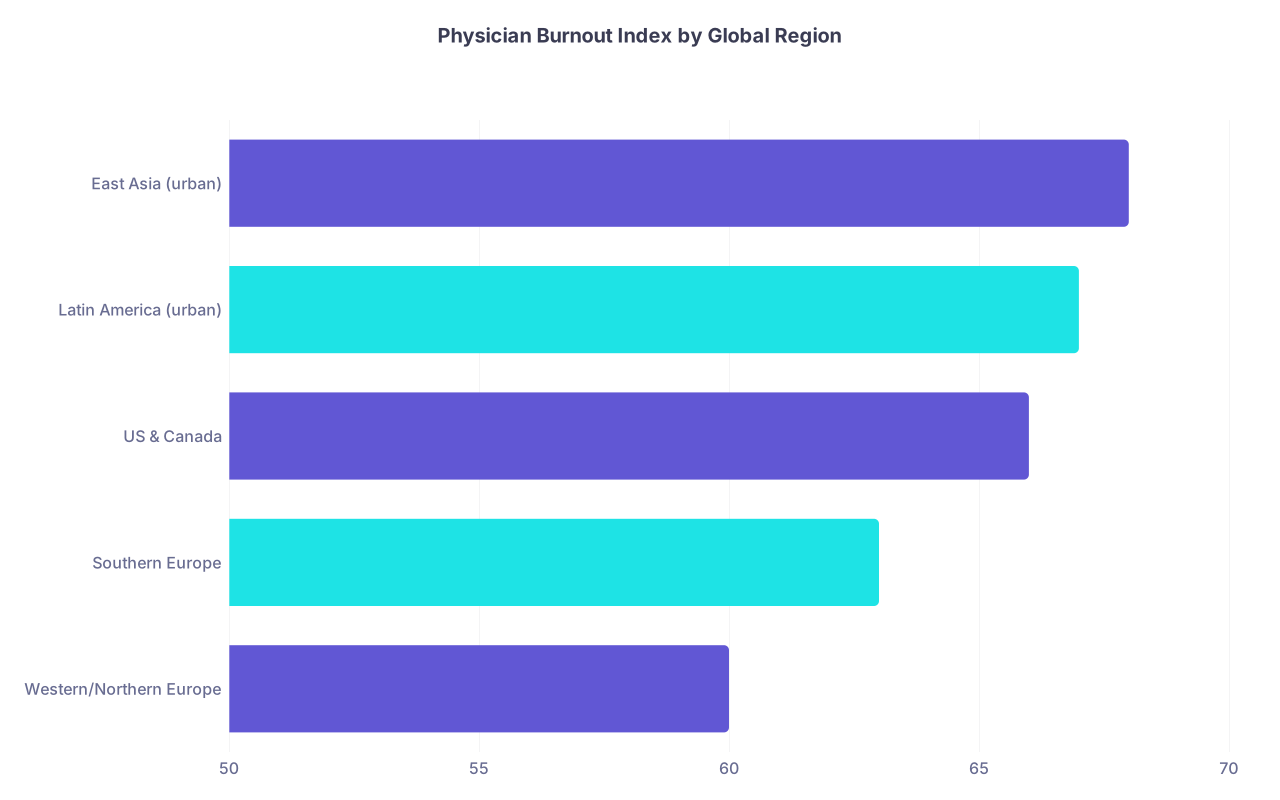
To visualize the spread:
| Category | Value |
|---|---|
| Western/Northern Europe | 60 |
| Southern Europe | 63 |
| US & Canada | 66 |
| Latin America (urban) | 67 |
| East Asia (urban) | 68 |
You can argue about specifics, but the ranking is remarkably steady across datasets.
6. Specialty and region: when the lines cross
Region alone is a blunt tool. Specialty is a much stronger predictor of burnout than geography.
Across multiple studies:
- Emergency medicine, general surgery, OB/GYN, and some internal medicine subspecialties tend to cluster at the high-burnout end.
- Dermatology, pathology, and smaller lifestyle-oriented subspecialties cluster toward lower burnout.
Now combine this with region, and you see crossovers.
Hypothetical but realistic example (residents):
- EM resident in high-volume Northeast academic center:
- BI ~72, WI ~50, high burnout ~65–70%
- EM resident in Midwestern community program:
- BI ~67, WI ~55, high burnout ~55–60%
- Pathology resident in any region:
- BI ~50–55, WI ~65–70, high burnout ~20–30%
So the worst regional specialty combination (say, EM in a big coastal urban center) can be 20+ BI points away from the best (pathology in a mid-sized Midwestern city). That is a different universe of risk.
I have lost count of how many residents have said some version of: “I chose Program X for the name. Six months in, I would trade that name for a 10‑minute commute and one less night shift a week.”
The data backs that up. Once you cross certain thresholds of workload and chaos, prestige drops out of the wellness equation.
7. What “wellness initiatives” actually change in numbers
Every residency fair and hospital town hall now advertises “robust wellness initiatives.” Most are cosmetic. A few move the needle.
You can categorize them into three buckets:
Cosmetic / symbolic
- Pizza nights
- Wellness emails
- Meditation apps nobody uses
Impact on BI/WI: essentially zero once you control for hours and staffing.
Moderately structural
- Protected didactic time actually honored
- Regular, scheduled mental health check-ins
- Free or low-friction confidential counseling
- Peer-support programs after adverse events
Impact: small but measurable. You often see 2–3 point improvements in BI and 3–4 points in WI when these are real, not performative.
Deep structural
- Reliable enforcement of work-hour limits
- Back-up coverage for illness and emergencies
- Transparent, predictable scheduling with input from residents
- Systematic reductions in non-clinical scut (scribes, better EMR tools, task-shifting)
Impact: 5–10 point BI reductions, 7–12 point WI improvements in some before–after analyses.
Regions differ in how often programs implement bucket 3 versus bucket 1.
In some Midwestern and Western centers, I have seen leadership actually track burnout scores over time and tie them to concrete interventions: they reduced average weekly hours by 3–4, added cross-cover pools, streamlined sign-outs, and then watched BI fall by 6–8 points over two years.
In many urban Northeast programs, leadership talks extensively about wellness but is frozen by service demands and staffing shortages. You see high rhetoric, low structural change, and burnout scores that barely move.
So the regional difference is partly a function of how constrained a system is. Denser, under-resourced urban health systems have less room to maneuver.
8. How to use this data if you are choosing a region
If you are deciding where to train or practice, treat regional averages as a background prior, not a decision rule. Then interrogate individual programs with specific, quantitative questions.
There are three buckets of questions I would ask every program director or current resident:
Workload and schedule
- “What is your average weekly work hour range by PGY level? Not the maximum. The actual average.”
- “How many nights per month do PGY-2s typically work on your busiest rotation?”
- “How often do people end up staying >2 hours past sign-out?”
Structural support
- “Do you have back-up coverage systems when someone is out sick?”
- “Who actually enters orders and notes here? Do you use scribes anywhere?”
- “Show me an example monthly schedule. How much advanced notice do you give?”
Culture and outcomes
- “Have you measured burnout or wellness formally in the last 2–3 years? What changed because of the results?”
- “How many residents have left the program early in the last five years?”
- “If a resident says they are overwhelmed, what realistically happens next?”
The region will influence the baseline probabilities of good answers. But there are Northeast programs that handle these beautifully and Midwestern programs that do not.
If a program cannot answer these questions concretely, or waves them away with “We are like a family,” your risk signal just spiked. Families can be dysfunctional, too.
9. The future: where burnout and wellness scores are likely heading
Now the uncomfortable projection: the macro trends are not pointing toward sudden relief.
Several system-level forces are pushing burnout up across most regions:
- Rising patient volumes as populations age and chronic disease burdens grow
- Persistent staffing shortages in nursing and allied health
- Escalating EMR complexity and documentation requirements
- Increasing corporatization and productivity pressures
Against that, there are countervailing forces:
- Stronger attention by accreditation bodies to resident well-being
- Growing data linking burnout to medical errors, turnover, and financial loss, which finally gets administrators’ attention
- Technological aids (scribes, smarter EMR tools, AI decision support) that actually can reduce cognitive load when implemented correctly
If you ask where scores will likely move in the next 5–10 years, my bet, based on current trajectories:
- Overall burnout prevalence will stay high, probably in the 45–55% range for physicians, 50–60% for residents, barring systemic reform.
- Regions with more aggressive structural reform and better staffing ratios (some Midwestern and Western systems, some Western European systems) may see modest improvements in BI (3–5 points down).
- Ultra-dense urban centers with chronic crowding and underfunded safety nets will likely remain at the high end, regardless of how many wellness workshops they run.
One more nuance: generational expectations are shifting. New trainees are more willing to say no, switch programs, or even leave medicine when conditions are untenable. That will create pressure that eventually forces change. Eventually.
10. The point, stripped down
Let me strip away the nuance and give you the quantitative bottom lines.
Regional differences in burnout and wellness are real but moderate. Expect roughly 5–10 BI points and 5–10 percentage points difference in high-burnout prevalence between best and worst US regions, with the Midwest generally looking best and the Northeast worst.
Urbanicity and specialty overshadow region. A high-acuity, high-volume, big-city program in any region will almost always have higher burnout than a smaller, well-staffed community program in a less dense area. Choosing EM in a coastal urban academic center is a different risk profile than choosing pathology in a mid-sized Midwestern hospital.
Structural factors beat slogans. Programs and regions that change schedules, staffing, and non-clinical load see measurable improvements in burnout and wellness scores. Pizza and yoga nights do not move the needle.
If you take nothing else from the data: do not treat burnout as an individual failure or a random outcome. It is patterned, predictable, and highly sensitive to where and how you work. Use the numbers to stack the odds in your favor.