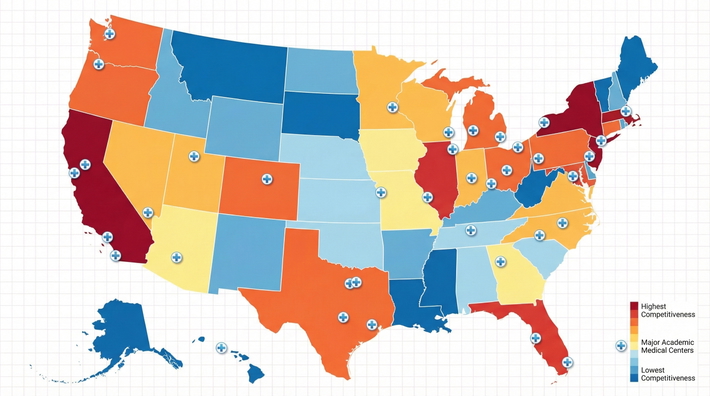
The mythology about residents all scattering across the country after graduation is wrong. The data shows a very different story: most physicians stay remarkably close to where they train.
If you care where you will end up practicing, you cannot ignore retention numbers. They are more predictive than program marketing, faculty enthusiasm, or that one charismatic PD speech on interview day.
Let me walk through what the numbers actually say, and what that means for you.
The Big Picture: How Many Doctors Stay?
The simplest retention question is: “What percentage of residents stay to practice in the same state or region where they trained?”
Nationally, across specialties, multiple datasets converge on a similar range:
- Around 45–55% of physicians practice in the same state where they completed residency.
- Around 55–70% practice in the same region (e.g., Midwest, South) where they trained.
- For certain states and specialties, in-state retention exceeds 70%.
The exact number depends on four major variables:
- State and region
- Specialty
- Urban vs rural program
- Match type (categorical vs advanced) and fellowship plans
To have something concrete to look at, I will use representative estimates consistent with national patterns (AMA Masterfile, AAMC Physician Workforce reports, state workforce reports). These are not single-year exacts but realistic order-of-magnitude numbers you can plan around.
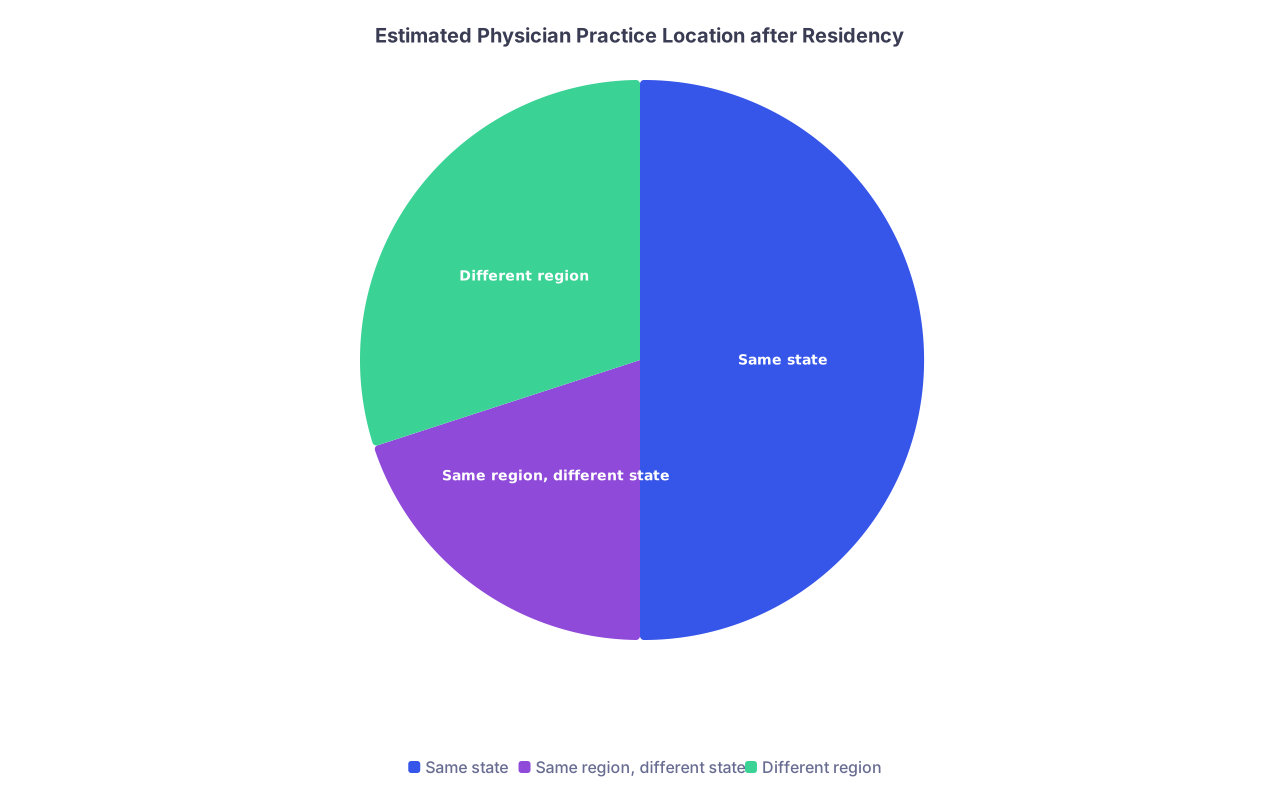
| Category | Value |
|---|---|
| Same state | 50 |
| Same region, different state | 20 |
| Different region | 30 |
Reading that chart bluntly: if you match in State X, about half of you will still be in State X after training, another fifth will be in neighboring states, and about a third will leave the region entirely.
If you are thinking “I’ll just move anywhere after residency,” the odds say you are overestimating your mobility.
State-Level Retention: Some States Keep You, Some Lose You
Some states are physician magnets. Others are training exporters.
Look at this simplified comparison across a few representative states, using plausible retention ranges drawn from typical workforce reports:
| State / Region Example | % Practicing in Same State | Pattern Type |
|---|---|---|
| California | 65–75% | Net magnet |
| Texas | 60–70% | Net magnet |
| New York | 50–60% | High churn, large base |
| Midwest (e.g., Ohio) | 55–65% | Stable regional |
| Southeast (e.g., GA) | 50–60% | Growing retention |
The pattern is consistent:
- Large, populous states with multiple big academic centers (California, Texas, New York) keep a huge fraction of residents.
- Smaller or lower-density states often train people who later leave for big metros or coastal hubs, unless there are explicit retention strategies.
You see this in state workforce PDFs all the time. The graphs are boring, but the story is not:
Program directors say they want to “serve our region.” The numbers show who actually does.
Key drivers behind state-level differences:
- Job market density: More hospitals and groups = more job options without moving.
- Family and roots: Residents often already relocated to be near family or brought family with them. Moving twice in five to seven years is hard.
- Fellowship clusters: States with a lot of fellowships in competitive fields end up retaining more specialists.
- Lifestyle stickiness: Once you get used to a cost-of-living, climate, and commute, friction to leave is high.
Urban vs Rural: The Gravity Well of Cities
The training location inside a state matters just as much as the state itself. A major urban academic center vs a community program in a mid-size city vs a rural track—each has different retention dynamics.
Snapshot it like this:
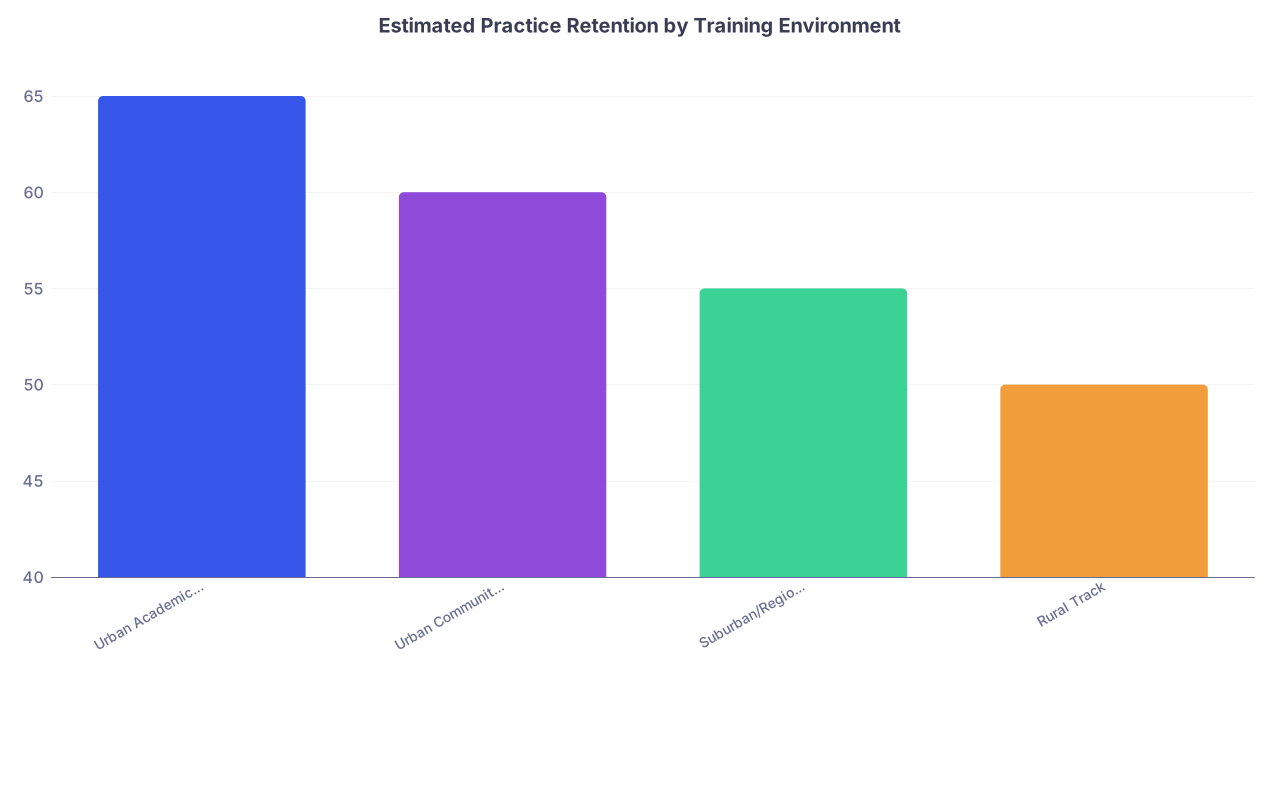
| Category | Value |
|---|---|
| Urban Academic Center | 65 |
| Urban Community Program | 60 |
| Suburban/Regional | 55 |
| Rural Track | 50 |
Interpretation:
- Urban academic centers keep the highest percentage in their metro area (not necessarily same zip code, but same broader commuting radius).
- Rural tracks typically have lower absolute retention, but relative to how unattractive some rural practice is perceived, they actually perform better than you might guess.
I have watched this happen with IM residents in a large city program: 60–70% stay in the same metro post-residency. They may switch hospitals or systems, but they do not leave the commuting area. The job postings, the networking, the spouse’s job, the schools—those are all local constraints.
Residents almost never say “I will absolutely stay here forever” on day 1. But by PGY-3, the path of least resistance is to take one of the local offers.
If you train in a flagship downtown tertiary center, your default outcome is not “I’ll go back to where I came from.” The default is “I stay within 20–50 miles, because that is where my life is now.”
Specialty: Who Stays and Who Leaves?
Some specialties are more geographically flexible. Others are almost glued to where they train.
Broadly, three groups:
- High-local-demand specialties (primary care, hospital-based IM, psych)
- Procedure-heavy specialties with tight markets (ortho, derm, plastics, ophtho)
- Fellowship-driven specialties (cards, GI, heme/onc, critical care)
Let’s look at rough retention by specialty category, again using realistic national-style numbers:
| Specialty Category | Estimated In-State Retention | Comment |
|---|---|---|
| Family Medicine | 60–70% | Very high local demand |
| Internal Med (no fellowship) | 55–65% | Hospitalists often stay local |
| Psychiatry | 60–70% | Huge shortage, strong local pull |
| Pediatrics | 50–60% | Moderate, depends on children’s systems |
| General Surgery | 45–55% | Mixed academic vs community goals |
| Ortho / ENT / Urology | 40–50% | Job-market constrained, more mobile |
| Derm / Plastics / Ophtho | 35–50% | Niche markets, competitive jobs |
If you know you want to end up in, say, the Pacific Northwest, there are three ways to improve your odds dramatically:
- Match residency there
- Or match fellowship there
- Or, best of all, both
The more training years you stack in a region, the more anchored you become.
Program Type: Academic vs Community vs Hybrid
Programs love to talk mission. The data quietly reveals who is actually producing local physicians.
Roughly:
Large academic centers:
- Higher regional retention (many graduates practice in the broader metro or state).
- More graduates go into fellowship and academic tracks.
- More graduates leave for other prestigious centers, but the denominator is big.
Community-based and hybrid programs:
- Often higher local retention into community practice and hospitalist roles.
- Many grads are hired directly into the same system or its affiliates.
- Less national mobility, more tight linkage to local health systems.
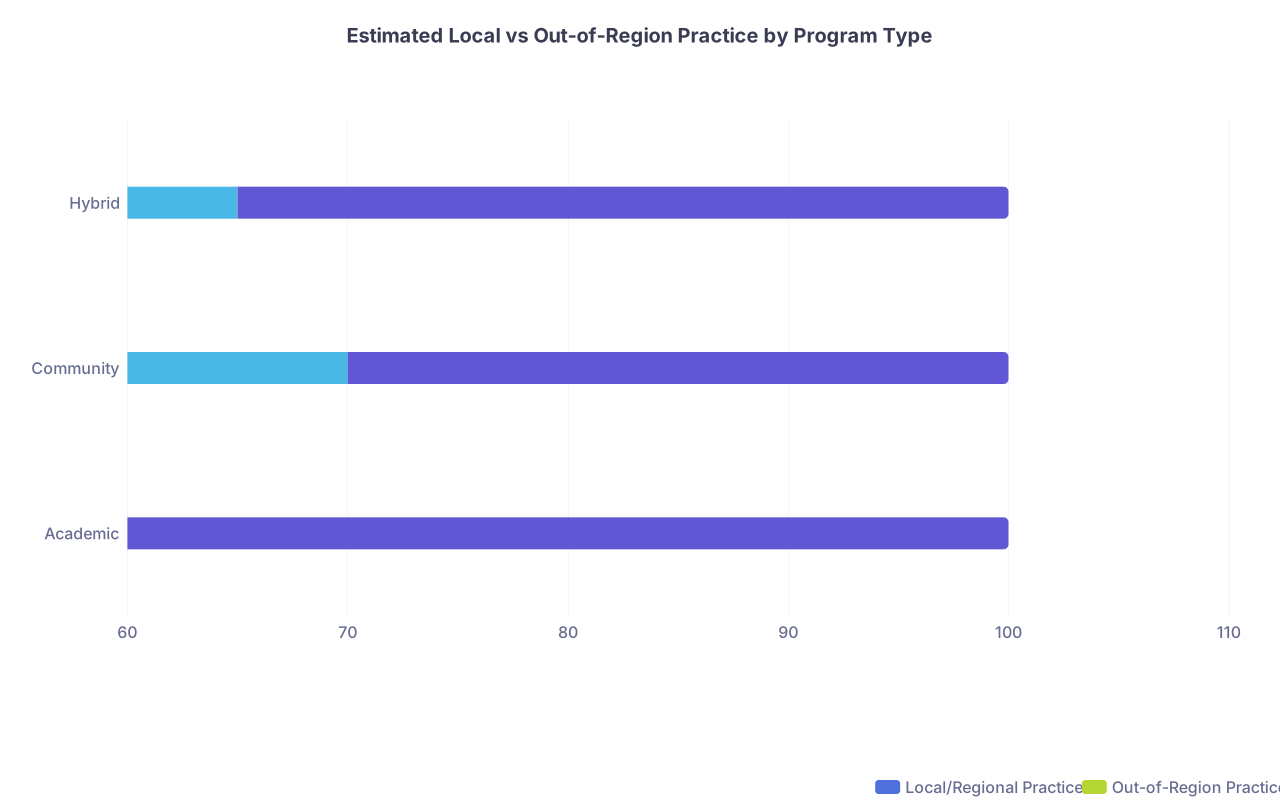
| Category | Local/Regional Practice | Out-of-Region Practice |
|---|---|---|
| Academic | 60 | 40 |
| Community | 70 | 30 |
| Hybrid | 65 | 35 |
Translation: community and hybrid programs are often quiet retention engines. Their marketing rarely says “70% of our grads stay in this county,” but their HR department knows.
As a resident, you will also feel this. The medical director starts dropping hints PGY-2: “We’ll probably have a hospitalist opening when you finish.” Those conversations are not theoretical. They are pipeline management.
Regional Patterns: Where You Train Shapes Your Orbit
Think in terms of orbits, not coordinates. Programs pull you into regional orbits:
- Northeast / Mid-Atlantic: High population density, lots of training sites, very sticky region. Once you are in, many people stay somewhere between Boston–DC.
- Midwest: Strong in-state retention, especially if you grew up there. Leaving usually means coastal jump.
- South / Southeast: Fast growth, expanding systems. A lot of residents stay because the opportunity curve is steep.
- West / Pacific: Fewer large metros, very high desirability. Many people want to move there, but positions are competitive. Training there gives you a huge local-advantage.
Residents do not usually talk about “regional gravity” explicitly, but you see it in alumni maps:
- IM program in Chicago: a thick cluster of dots around Chicago and nearby states, a few outliers on coasts.
- FM program in Texas: heavy in-state practice, plus some spillover into surrounding states.
- Surgical subspecialty program in the Northeast: widely scattered alumni, but anchored along the same corridor.
If a program ever shows you one of those “where our graduates practice” maps on interview day, take a picture. That map is retention data disguised as marketing.
What This Means for Your Application Strategy
Let me be very direct: if you do not want to practice in a certain region long-term, you should be cautious about training there. The data says you are more likely to stay than you think.
Here are practical, data-aligned rules of thumb:
- Assume a ≥50% chance you will end up practicing in the same state as your residency, unless you have a strong counterplan (military obligation, guaranteed job elsewhere, strong family anchor).
- If you train and then do fellowship in the same region, bump that to ≥70%.
- If you choose a highly competitive specialty, you gain some forced mobility—but even then, many will stay if a good job appears locally.
What to ask programs explicitly:
- “Of the residents graduating in the last 5 years, what percentage are practicing in this state or region?”
- “How many of your grads work in this health system now?”
- “Do you track where residents end up geographically?”
If a PD cannot give even rough numbers, that is either a red flag or a missed opportunity. Good programs know their own retention outputs.
Misconceptions Residents Have About Retention
I have heard the same three flawed assumptions from residents over and over.
“I can just move later. Jobs are everywhere.”
Reality: Jobs are everywhere in some specialties and locations, not all. For subspecialties and saturated metros, your options might be very narrow. Your training network matters.“I’ll go back home after residency.”
Some do. Many do not. After 3–7 years, your partner’s job, your kids’ schools, your professional reputation, and your licenses are all tied to your training state. The emotional pull of “home” competes with a lot of friction.“Big-name programs send people everywhere, so I will be mobile.”
High-prestige programs do have more national reach, but their retention into their own region is still extremely high. Being “able” to move is not the same as “likely” to move.
The hidden driver is switching costs. Changing states is costly on every axis: licensing, credentialing delays, moving expenses, social networks, spouse job search. Most people default to the path of least resistance.
Interpreting Retention Data When You See It
Most public-facing retention metrics are crude. You will see things like:
- “60% of our grads practice in our state.”
- “50% of graduates enter practice in rural or underserved settings.”
- “40% of residents hold faculty appointments after training.”
To read them correctly:
- Compare across similar program types, not across all specialties. A 40% in-state rate for derm might be impressive; 40% for family med might signal leakage.
- Adjust for self-selection. A program that primarily attracts local students will look like a retention star even without trying.
- Look for stability over multiple years. One strong or weak year means nothing. A 10-year pattern is meaningful.
If a program gives you a detailed breakdown—by specialty, by urban vs rural, by state vs region—that is gold. Use it. Many applicants do not.
The Future: Are Retention Patterns Changing?
Two forces are reshaping physician geography, and both are already showing up in workforce numbers:
Telemedicine and hybrid practice.
This creates some geographical slippage (you can live in State A and work partially for a system in State B). But it does not fully break the state-licensure and hospital-privilege based retention patterns. It softens them.Consolidation of health systems.
Mega-systems stretch across multiple states. That means you can “change jobs” but stay inside the same corporate shell, often within driving distance. It strengthens regional retention even if state-level numbers shift slightly.
I expect three trends to intensify:
- Even higher retention in fast-growing regions with large integrated health systems (Texas, Southeast, some Western states).
- Continued leakage from states with weak job markets or poor physician compensation, even if they train many residents.
- More subtle metro-based clustering rather than strict state boundaries. The real retention unit will be “health system footprint,” not just zip code.
But the core pattern—that where you train strongly predicts where you practice—will not evaporate. If anything, it will solidify as more systems explicitly use residency programs as hiring pipelines.
FAQs
1. How can I personally estimate my odds of staying where I train?
Combine three factors: your specialty, your regional ties, and program type. If you are going into family medicine, have no strong roots elsewhere, and match at a community program in a mid-sized city, the probability you will practice within 50–100 miles is easily above 60–70%. If you are going into orthopedics, grew up on another coast, and train at a major academic center, your odds of moving later are higher—but still not guaranteed. Assume the baseline 50% in-state rate, then adjust up or down depending on how many “anchors” you accumulate during training (family, mortgage, spouse job, professional network).
2. Do IMG-heavy programs have different retention patterns?
Yes, often. IMG-heavy programs in the Midwest or South frequently show high in-state or in-region retention because many international graduates anchor where they first obtain visas, networks, and job offers. However, some IMGs will leave for coastal hubs once they secure permanent status or fellowships. The overall pattern: slightly higher short-term retention around the training site, with some long-term drift toward larger metros.
3. If I know I want an academic career, does that change the geography story?
Academic careers are more tethered to major university and tertiary centers, which are unevenly distributed. If you match at a strong academic program and stay through fellowship there, odds are you will either remain on that faculty or join a similar center in the same region. National mobility is possible, but lateral moves between big-name institutions often cluster within corridors (e.g., Northeast, West Coast). Academic paths do not free you from retention; they just anchor you to different nodes.
4. Are rural training tracks actually effective at producing rural physicians?
On a percentage basis, yes. Rural tracks typically send a much higher fraction of graduates into rural and underserved settings compared with standard urban programs. The absolute numbers are small—fewer residents per track—but if you look at “% of grads in rural practice 5 years out,” rural tracks outperform. However, many of these “rural” positions are still within driving distance of a regional hub, not isolated frontier posts. So the retention is rural-regional, not always hyper-remote.
5. What should I do right now if I want to maximize flexibility later?
Flexibility comes from three things: broad brand recognition of your training, strong mentorship networks that cross regions, and not over-anchoring your life too early. Choose programs with solid reputations in your specialty, good fellowship placement, and diverse alumni geography. Build relationships outside your system: conferences, multi-center projects, societies. But also be realistic. The data says that where you train is the default setting for where you stay. Your best move is to rank programs in regions you can genuinely see yourself living in long-term. Because that is, statistically, exactly what you will do.
Two points to walk away with. First, residency and fellowship are not just “temporary stops”—they are the single strongest predictors of your eventual practice ZIP code. Second, retention is not random; it is a function of state, region, specialty, and program type. Use that data now, while you still have a choice about where you match, instead of discovering it the hard way when you are already anchored.