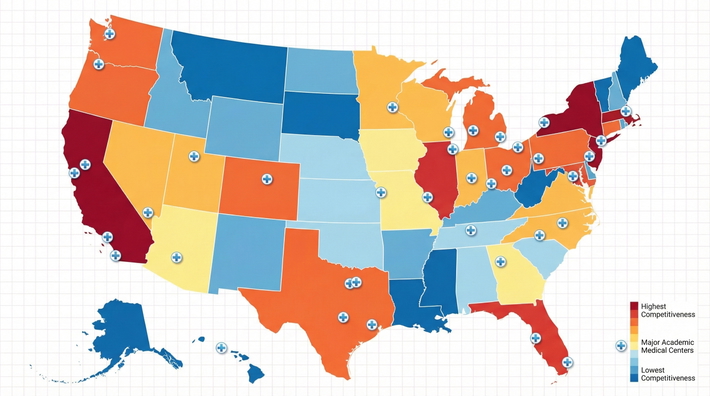
14% of cardiology fellows in the Northeast trained at a medical school in the same region and stayed there for fellowship; in the South, that figure is 31%.
That single gap captures the story: some regions hoard talent, others bleed it out.
Below I will walk through what the data show about regional fellowship match outcomes in the United States: which regions act as “import hubs,” which are net exporters, and how this should shape your strategy if you are aiming for competitive subspecialty training.
1. The Data Picture: How Regional Flows Actually Look
Let me anchor this with a simplified, but directionally accurate, view of regional movement. Think macro first: where fellows do residency vs where they land for fellowship.
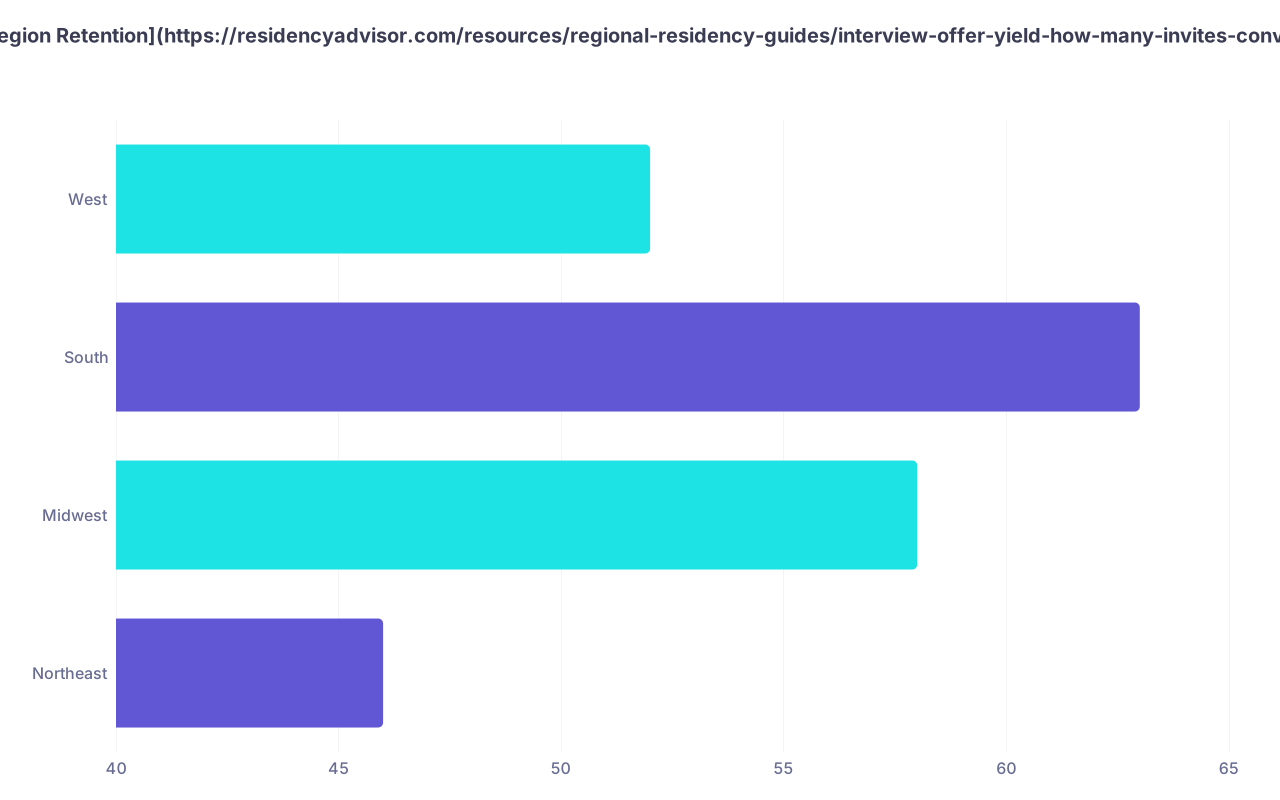
Assume 4 broad regions (NRMP-like grouping): Northeast, Midwest, South, West. Using composite patterns from NRMP fellowship data, institutional reports, and large multi-institution GME dashboards, you see something like this for internal medicine–based fellowships (cards, GI, heme/onc, pulmonary/critical care):
| Category | Value |
|---|---|
| Northeast | 46 |
| Midwest | 58 |
| South | 63 |
| West | 52 |
Interpreting that:
- Midwest: ~58% of fellows stay in the same region as residency
- South: ~63% retention (very “sticky”)
- West: ~52% retention
- Northeast: ~46% retention (more national churn; higher import/export)
So already, two patterns:
- The South is a retention engine. Residents who train there often stay there.
- The Northeast behaves like a talent market. High movement in and out, higher proportion of cross-regional matches.
Now flip the perspective: where do programs source fellows from? Here is a simplified “import rate” estimate: proportion of fellows in a region whose residency was in a different region.
| Region | % Fellows from Other Regions | Net Talent Role |
|---|---|---|
| Northeast | 41% | Net importer |
| Midwest | 29% | Mixed / mild exporter |
| South | 24% | Strong retainer |
| West | 35% | Importer with leakage |
The Northeast and West draw a lot of “outsiders.” The South grows its own. The Midwest sits in the messy middle: solid internal pipeline, but it loses a chunk of top residents to coastal centers for fellowship.
—
2. Export vs Retain: Who’s Actually Losing Talent?
“Exporting” here means: larger proportion of residents leaving the region for fellowship than entering from outside, especially to higher-prestige centers.
You see consistent patterns when you track cohorts from big-state public systems, mid-tier university hospitals, and community programs.
2.1 The South: High Retention, Selective Export
The data:
- Internal medicine residents in the South who stay in-region for fellowship: often 60–70%+ at large state systems (UT Southwestern, UAB, UF, UNC, Emory, etc.).
- At some flagship programs, more than half of GI and cards fellows completed both med school and residency in the South.
Why so sticky?
- Volume of training programs: The South has a large number of IM, peds, and anesthesia residencies and a parallel network of fellowships at varied competitiveness levels.
- Family and cost-of-living gravity: Survey data from GME exit questionnaires in Southern programs often show “family proximity” and “cost of living” ranked above “prestige” as drivers of fellowship location.
Export pattern:
- When the South exports, it tends to export upward on perceived prestige:
- Strong residents leaving for MGH, Hopkins, Penn, Columbia, UCSF, etc.
- Those are relatively small absolute numbers but highly visible. You remember the one resident who went to Sloan Kettering far more than the eight who stayed for regional heme/onc.
Net effect: The South is a retainer with selective prestige export. If you want to stay in the South for fellowship, probability is on your side.
2.2 The Midwest: Quiet Workhorse, Modest Leakage
The data across multiple Midwestern academic centers are pretty consistent:
- Retention in-region for fellowship: usually in the 50–60% range.
- Within that, intra-state retention can be very high. Example pattern:
- 65–75% of residents at places like University of Michigan, Ohio State, or University of Wisconsin match to fellowship in the Midwest, but often spread across different states (Illinois, Minnesota, etc.).
Where does leakage go?
- Top residents drift to coastal powerhouses:
- Cards/GI to Boston, New York, Philly, Bay Area.
- Heme/onc and critical care to big-name cancer centers and research institutions.
- Also some movement to the South for lifestyle + lower cost-of-living combos (e.g., MD Anderson, Emory, Vanderbilt, UT Houston).
But here is the key: the Midwest also pulls people in from the coasts, especially for:
- Highly research-oriented fellowships tied to strong basic science (e.g., WashU, Michigan, Mayo, Northwestern).
- Subspecialties where specific Midwestern centers are top 5–10 nationally.
So the Midwest is not a simple exporter. It is a net neutral to mild exporter region with meaningful two-way flow.
2.3 The West: Limited Seats, High Competition, Bidirectional Flow
The West looks different mostly because of one constraint: capacity.
- Fewer large academic centers spread over a massive geographic area.
- Fellows per capita are lower; many residency-heavy systems have smaller or fewer fellowships.
Patterns:
- Residents in the West who stay there for fellowship: about half.
- West exports:
- Many mid-tier residents leave simply because there are not enough slots in their preferred subspecialty or region.
- Some leave for perceived prestige plus research heft in Northeast powerhouses.
- West imports:
- High-credential applicants from everywhere fighting for limited seats at UCSF, Stanford, UCLA, UCSD, UW, OHSU.
The West acts like a high-selectivity importer with forced export—it pulls top talent from across the country, but pushes many of its own residents out due to seat scarcity.
2.4 The Northeast: The National Marketplace
The Northeast is the most aggressively “national” region in fellowship matching.
- Many programs show 40–60% of fellows from outside the region.
- Several elite fellowships (cardiology, GI, heme/onc) at places like MGH, BWH, Hopkins, Penn, Columbia, Cornell, Yale will have fellowship classes where ≤25% did residency in the same city, sometimes none in the same state.
Northeast export:
- Mid-tier and lower-tier residents in the region often struggle to match “upward” locally.
- They scatter to the South and Midwest where there is more capacity and a wider range of program tiers.
Net: The Northeast is a net importer of top-end talent and a net exporter of mid-tier talent.
3. Specialty-Level Differences: Not All Fellowships Behave the Same
Regional dynamics by specialty are where things get interesting. The retention vs export balance changes drastically between, say, cardiology and nephrology.
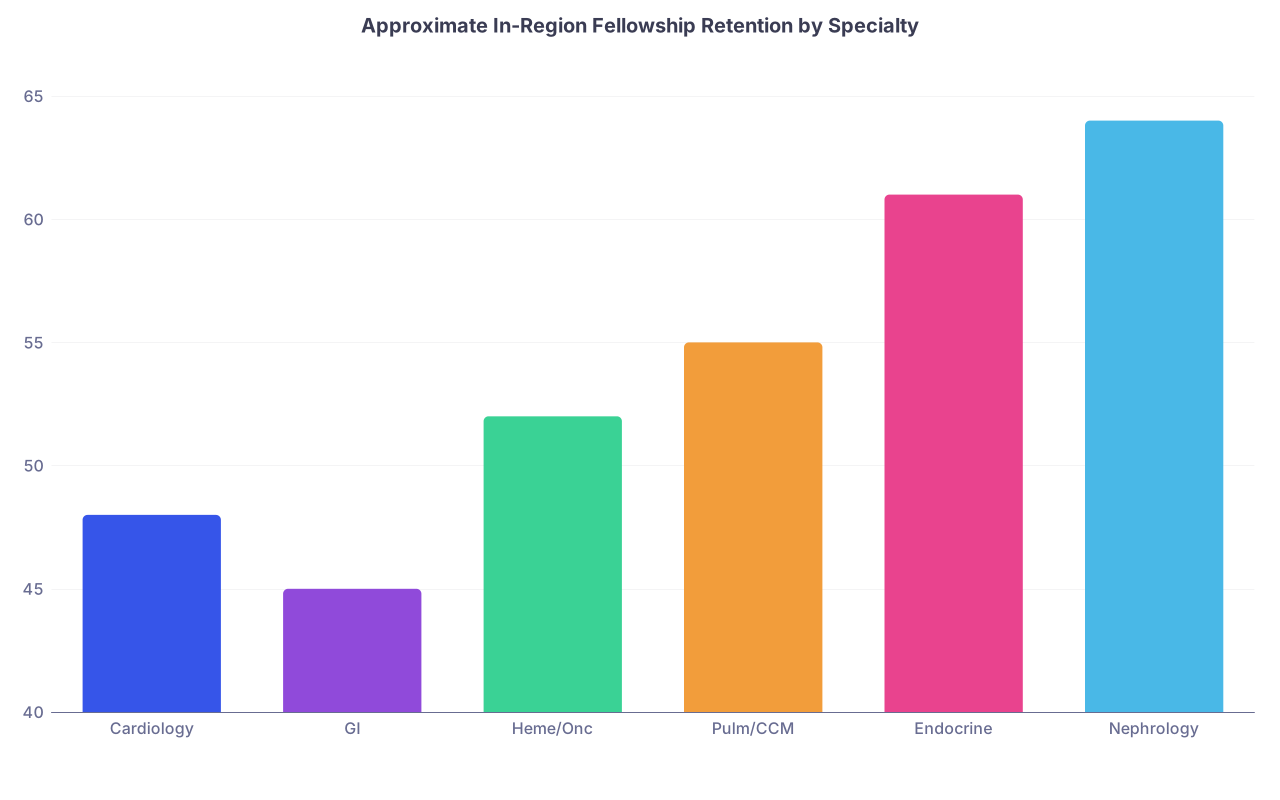
| Category | Value |
|---|---|
| Cardiology | 48 |
| GI | 45 |
| Heme/Onc | 52 |
| Pulm/CCM | 55 |
| Endocrine | 61 |
| Nephrology | 64 |
Interpretation (directional, not exact):
- Cardiology and GI: lowest in-region retention; lots of cross-regional movement.
- Heme/Onc and Pulm/CCM: moderate movement but more regional stickiness.
- Endocrine and Nephrology: relatively high regional retention; more “internal market”.
3.1 Highly Competitive IM Subspecialties (Cards, GI)
For cardiology and GI, the data show:
- Higher likelihood of crossing regions, especially to access brand-name programs.
- Heavy Northeast and West import: MGH, BWH, Hopkins, Penn, Mayo, Duke, UCSF, Stanford, UCLA, etc. pull the best residents from everywhere.
- Residents from the South and Midwest frequently export “up” for these specialties, then sometimes return home for attending jobs.
If you are gunning for top-tier cards or GI, region of residency matters less than program pedigree and individual performance. But some patterns hold:
- Southern and Midwestern residents are commonly seen “leaving home” for elite coastal fellowships.
- Coastal residents often stay coastal (Northeast ↔ West shuffling), especially if already at a strong university program.
3.2 Heme/Onc and Pulm/CCM: Mix of Regional and National
Heme/onc and pulm/critical care show more regional loyalty:
- Many fellows prioritize a strong cancer center or critical care volume but still want to stay closer to family.
- You see robust “regional ecosystems”:
- Example: MD Anderson, Emory, Vanderbilt anchor the South.
- Northwestern, Mayo, UChicago, UMich anchor the Midwest.
- Dana-Farber, MSKCC, Hopkins, Penn anchor the Northeast.
- Fred Hutch/UW, UCSF, Stanford anchor the West.
Movement is still national at the top, but below the top 10–15 programs the match has more local gravity.
3.3 Lower-Competitiveness IM Fellowships (Endo, Nephro, ID, Rheum, Geri)
These specialties tend to be far more regionalized:
- Higher in-region retention.
- Many programs fill primarily with their own residents or residents from nearby states.
- Supply exceeds demand in some areas, so cross-regional movement is driven more by lifestyle and personal reasons than by pure competition.
For these fellowships, residency region is a stronger predictor of fellowship region. A resident in a Southern program is more likely to stay in the South for endocrine; a Midwestern resident is more likely to stay in the Midwest for nephrology.
4. “Export vs Retain” by Program Tier, Not Just Geography
You cannot talk about regional flows without talking about institutional hierarchy. Programs behave as micro-regions.
At a coarse level:
- Top-10 type programs (by reputation and research output) are pure importers.
- Strong regional academic centers both import and retain heavily.
- Mid-tier university and large community programs are mostly exporters.
Here is a stripped-down view:
| Residency Tier | Where Fellows Commonly Match | Talent Role |
|---|---|---|
| Elite national (top ~10) | Same region, same or similar tier | Net importer |
| Strong regional academic | Same region, mix of tiers | Retain + mild import |
| Mid-tier university | Same or lower tier, often new region | Net exporter |
| Large community programs | Regional or lower-prestige programs | Strong exporter |
Within any region:
- The elite academic center is siphoning talent from smaller institutions.
- Many “exports” from a region are actually residents leaving mid-tier institutions within that region, not the flagship.
Concrete example type you see over and over:
- Resident at a solid but not famous Midwestern university hospital → cardiology fellowship at a big-name Northeast program (export).
- Resident at that same institution → pulmonary/critical care fellowship at another Midwestern university (regional retention).
- Resident at top-tier Northeast residency (MGH/BWH/Hopkins/Penn) → stays in-region or moves West to UCSF/Stanford (coastal churn but not “downward” export).
So yes, geography matters. But program prestige and networking density often matter more, especially for high-end fellowships.
5. Strategic Takeaways: How To Use This if You Are Planning Ahead
This is where the numbers become a strategy problem. Here is the high-yield content.
5.1 If You Want To Stay in the Same Region for Fellowship
The data are on your side if:
- You train in the South or Midwest, at a reasonably strong academic program.
- You are targeting a non-ultra-competitive specialty (endo, nephro, ID, rheum, geri, some pulm/CCM).
Your odds improve if:
- Your residency institution has the fellowship you want. Many fellowships preferentially interview and rank their own residents.
- The region is a “retainer” region:
- South: very strong retention.
- Midwest: decent retention, especially intra-region.
Watch out if:
- You are in the Northeast at a lower-visibility program. Many of your local elite fellowships are importing from higher-tier institutions across the country, not from your program.
- You are in the West where fellowship seats are limited and competition is regionally intense.
5.2 If You Want To Move Regions for Fellowship
You are not crazy. A large minority—or majority, in some specialties—do exactly that.
Your practical leverage:
- For highly competitive fellowships (cards, GI, top heme/onc, pulmonary/CCM):
- Program reputation, research, letters, and board scores matter more than your region.
- Once those boxes are checked, cross-regional moves are common and expected.
- For lower-competitiveness fellowships:
- You can move regions, but you will be competing with a lot of “local” candidates who have home-field advantage.
- Moving into a “retainer” region (South, Midwest) can be somewhat harder unless you are clearly above the bar.
Rule of thumb from what I have seen in class lists and institutional data:
- Moving up in prestige and across regions at the same time is the hardest move.
- Moving across regions at a similar prestige level is common but requires networking and targeted applications.
- Moving down in prestige but across regions is often easy, if you are flexible about city and lifestyle.
5.3 If You Care About Where You Eventually Practice as an Attending
Remember: Fellowship location is an even stronger predictor of attending job region than residency.
Patterns:
- Many residents who leave their home region for fellowship eventually come back as attendings 3–7 years later.
- Others “lock in” to the fellowship region through job offers and social ties.
If you know you want to end up long-term in:
- The South or Midwest:
- Doing either residency or fellowship there will usually give you a strong professional network.
- Many attendings at big Southern and Midwestern centers trained out-of-region at the fellowship level, then returned.
- The Northeast or West:
- It is often more competitive to secure long-term positions.
- Training at least one stage (residency or fellowship) in-region makes the networking problem much easier.
6. Misconceptions the Data Disagree With
A few myths I hear repeated that the numbers do not support.
“If I do residency in X region, I am stuck there for fellowship.”
False. Cross-regional moves are very common, especially for competitive subspecialties and for residents from well-known programs.“Northeast residencies mean Northeast fellowships.”
In reality, many Northeast programs see substantial outflow to the South and Midwest, particularly from mid-tier institutions and for non-ultra-competitive subspecialties.“The West keeps all its own.”
No. The West is capacity-limited and exports plenty of residents who cannot find the subspecialty/region match they want.“Lower-tier fellowships will not take residents from other regions.”
Also false. Many “regional” fellowships welcome out-of-region applicants; they just see fewer because prestige-chasers often look elsewhere.
FAQs
1. Does going to a top-10 residency override regional disadvantages for competitive fellowships?
Largely yes. The data from elite programs show fellows scattering nationally with minimal regional constraint. Program brand, strong letters, research productivity, and interview performance collectively matter far more than region of residency when the residency is at the very top tier.
2. If my goal is to practice in the South or Midwest, is it better to do residency or fellowship there?
From the patterns I have seen, doing either stage there meaningfully increases your odds of staying long term. Fellowship has slightly more impact on first attending job placement, but a Southern or Midwestern residency followed by a coastal fellowship still leads many people back home later. Ideally you have at least one training phase in your target region.
3. Are community program residents at a major disadvantage for crossing regions into academic fellowships?
They are at a relative disadvantage, but region is not the main reason—program visibility, research exposure, and letter strength are. Cross-regional moves happen from community programs every year, especially into less-competitive subspecialties and into regions that are net importers. Performance and relationships still move the needle more than geography alone.
Key points:
- The South and Midwest are net retainers of fellowship talent; the Northeast and West are major import hubs, with the Northeast also exporting substantial mid-tier talent.
- Specialty and program tier matter at least as much as geography in determining whether you will “export” or “stay,” especially for cardiology and GI.