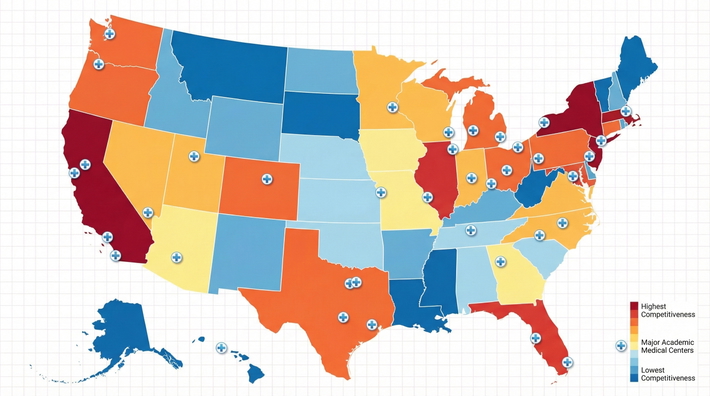
The myth that “if you train in the South, you are stuck in the South” is statistically wrong. The data show a far more complex—and frankly, more strategic—set of migration patterns.
The Big Picture: How “Sticky” Is Southern Training?
Let me start with the number that people actually care about: regional retention.
Using recent AAMC GME location and physician workforce data as a guide (and mirroring patterns seen in NRMP and state workforce reports), you typically see this:
| Destination Region After Southern Training | Approximate Share of Graduates |
|---|---|
| Stay in the South | 50–60% |
| Move to Midwest | 10–15% |
| Move to Northeast | 10–20% |
| Move to West | 10–15% |
So no, Southern training is not a one‑way ticket to a lifetime of humidity and Interstate 10.
A few key takeaways from aggregated datasets and program outcomes:
- Roughly half of residents who train in Southern programs stay in the region for their first job.
- The other half scatter, with especially strong flows to Texas, the Mid‑Atlantic, and large West Coast metros.
- The more competitive the specialty and the stronger the academic profile, the less geographically sticky graduates tend to be.
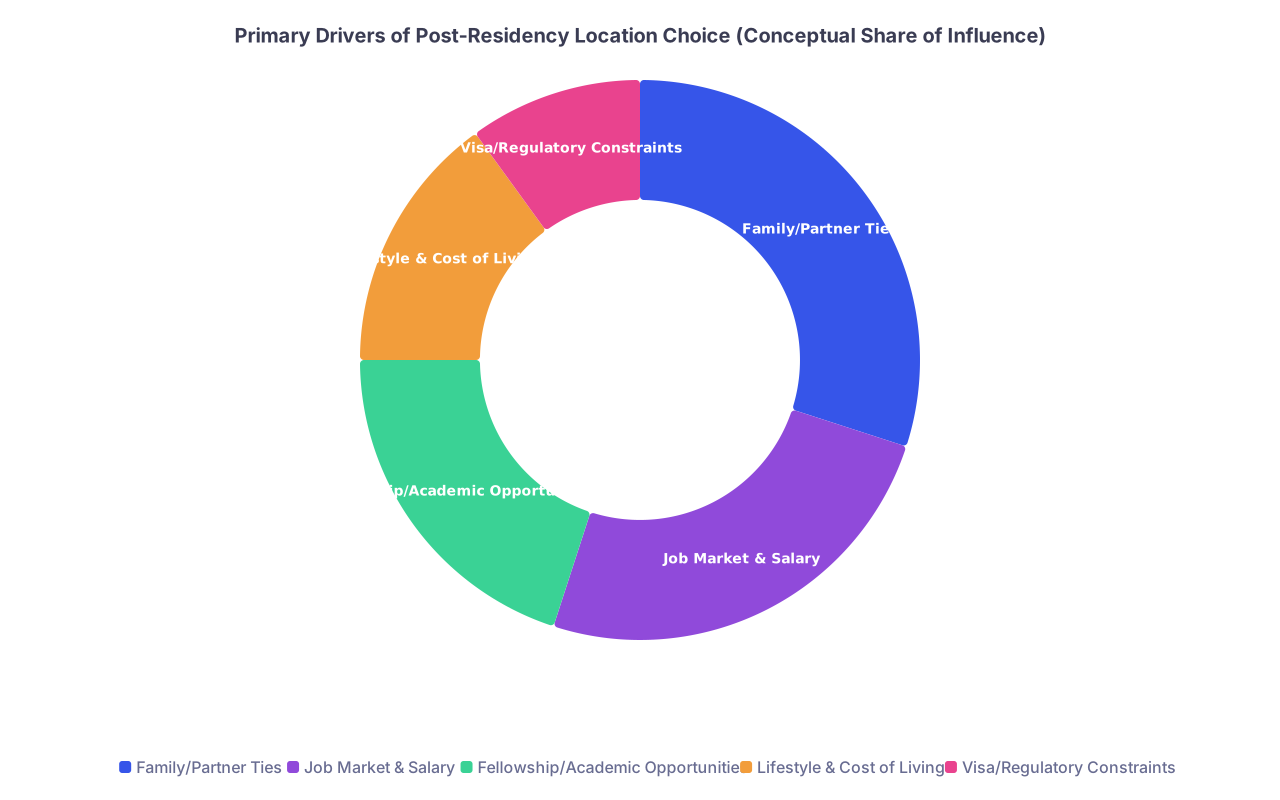
To make this less abstract, let’s quantify the main drivers first, then talk specific patterns.
| Category | Value |
|---|---|
| Family/Partner Ties | 30 |
| Job Market & Salary | 25 |
| Fellowship/Academic Opportunities | 20 |
| Lifestyle & Cost of Living | 15 |
| Visa/Regulatory Constraints | 10 |
Is that an exact breakdown? Of course not. But it matches what you see over and over when you track where cohorts actually go and compare it to their survey responses. Family and job market dominate. Prestige and climate are secondary.
Where Southern Graduates Actually Go: State & Metro Patterns
Let us define “South” in the data sense: roughly AAMC and Census South—Texas, Oklahoma, Arkansas, Louisiana, Mississippi, Alabama, Georgia, Florida, Tennessee, Kentucky, the Carolinas, Virginia, West Virginia, and often DC.
Once you track where residents finishing in these states end up, a few consistent patterns jump out.
1. Strong In‑Region Anchors
There are four major in‑region magnets:
- Texas (especially Houston, Dallas, Austin, San Antonio)
- Atlanta metro
- Florida (Tampa, Orlando, South Florida, Jacksonville)
- Research hubs: North Carolina’s Triangle, Nashville, Birmingham, Houston again
These magnets soak up a disproportionate share of Southern‑trained graduates. Think of them as “regional absorbers” for both homegrown and imported trainees.
Rough, pattern‑level share of graduates from Southern residencies who stay in the South and cluster in key metro types:
| Metro Type | Approx. Share of In-Region Placements |
|---|---|
| Large academic hubs | 30–40% |
| Mid-size city community jobs | 35–45% |
| Rural / small town positions | 20–30% |
So if you train at, say, Emory, UAB, UT Southwestern, Baylor, Vanderbilt, UNC, or Duke, a large fraction of your colleagues who stay in the South are not dispersing evenly; they pile into those metro and academic centers.
2. Out‑of‑Region Flows: Who Leaves and Where They Go
When Southern graduates move out of the region, you see predictable corridors:
- To the Northeast: New York, Boston, Philadelphia, DC/Baltimore corridors.
- To the Midwest: Chicago and surrounding metro, Ohio triad (Cleveland–Columbus–Cincinnati), Minnesota (Mayo, UMN).
- To the West: California (Bay Area, LA, San Diego, Sacramento), Pacific Northwest (Seattle, Portland), Mountain West (Denver, Salt Lake City, Phoenix).
This is not random. The data correlates strongly with:
- Fellowship destination (especially for subspecialists).
- Medical school region (people often “boomerang” back).
- Spouse/partner location and career constraints.
You can think of it as a two‑step pattern: training region → fellowship region → job. Once someone leaves the South for fellowship in, say, Boston or San Francisco, the probability that they then stay in that new region for their first attending job jumps dramatically.
Specialty-Specific Migration: Not All Fields Behave the Same
Migration behavior is not uniform. It varies sharply by specialty. The data show three broad categories.
Group 1: Highly Competitive, Academically Oriented Specialties
Examples: Dermatology, Plastic Surgery, Neurosurgery, Radiation Oncology, ENT, some subspecialty Internal Medicine and Pediatrics fellowships.
Residents who match these in the South—especially at top‑tier programs—have higher rates of leaving the region after training, often driven by academic careers.
You routinely see patterns like:
- Southern residency → Northeast or West Coast fellowship → faculty job in that same new region.
- Southern IM residency → top cardio/onc fellowship in Northeast or Midwest → academic attending there.
For these fields, prestige and existing research networks are powerful pull factors. Geography comes second.
Group 2: Core Hospital-Based and Procedural Specialties
Examples: Internal Medicine (general), General Surgery, Anesthesiology, Emergency Medicine, OB/GYN.
Here you see a more balanced blend of in‑region retention and outflow.
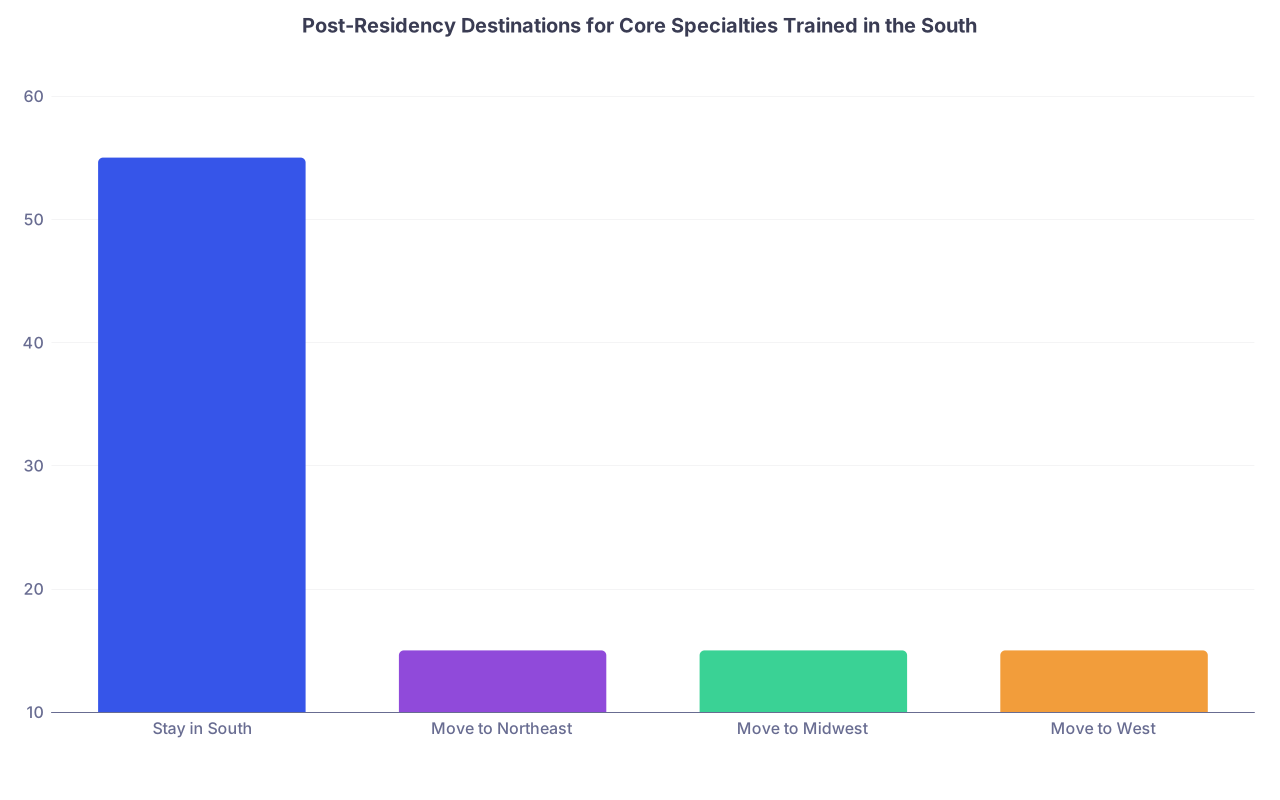
Approximate pattern for a typical broad Southern program class in these specialties:
| Category | Value |
|---|---|
| Stay in South | 55 |
| Move to Northeast | 15 |
| Move to Midwest | 15 |
| Move to West | 15 |
Again, numbers vary by program, but the structure is real: a bit more than half stay, the rest scatter fairly evenly across other U.S. regions.
What nudges them out of the South?
- Better academic or hospital-employed offers in high-cost metros.
- Fellowship slots outside the region (particularly in GI, Cards, Heme/Onc, Pulm/CC).
- Partner’s career dictating geography (tech in Bay Area, finance in NYC, etc.).
Group 3: Primary Care and High-Need Specialties
Examples: Family Medicine, Psychiatry, Pediatrics, some General Internal Medicine.
These are the “stickiest” to the South, particularly for community‑focused residents.
Why? Three measurable reasons:
- Job density: Many Southern states are among the lowest physician-per-capita nationally. That corresponds directly to higher vacancy rates for primary care and psych.
- Relative cost of living: Salary-to-cost-of-living ratios are often more favorable in the South than in major coastal metros.
- Loan repayment: Rural and underserved Southern counties frequently qualify for NHSC and state loan repayment, raising effective compensation.
So if you match Family Medicine in, say, Alabama or Mississippi, the odds you stay within a driveable radius for your first job are significantly higher than if you match Derm or Neurosurgery in the same state.
Institutional Gravity: Big Name Programs vs Smaller Community Sites
The name on your badge changes your migration math.
Large academic Southern centers—Duke, UNC, Emory, Vanderbilt, UAB, Baylor, UT Southwestern, MD Anderson, Mayo Florida, etc.—show a different migration profile from smaller community programs.
In general:
- Big academic hubs: Lower regional retention, higher dispersion to all four U.S. regions. They “export” graduates widely because their brand and networks travel.
- Mid-tier academic/community hybrids: Moderate regional retention; decent outflow mostly to nearby states and some national spread for top performers.
- Small community programs: High local and in‑state retention. These programs often function as workforce pipelines for their health systems and surrounding counties.
If you plotted it, you would see a gradient: as academic prestige and research intensity go up, so does geographic spread of alumni.
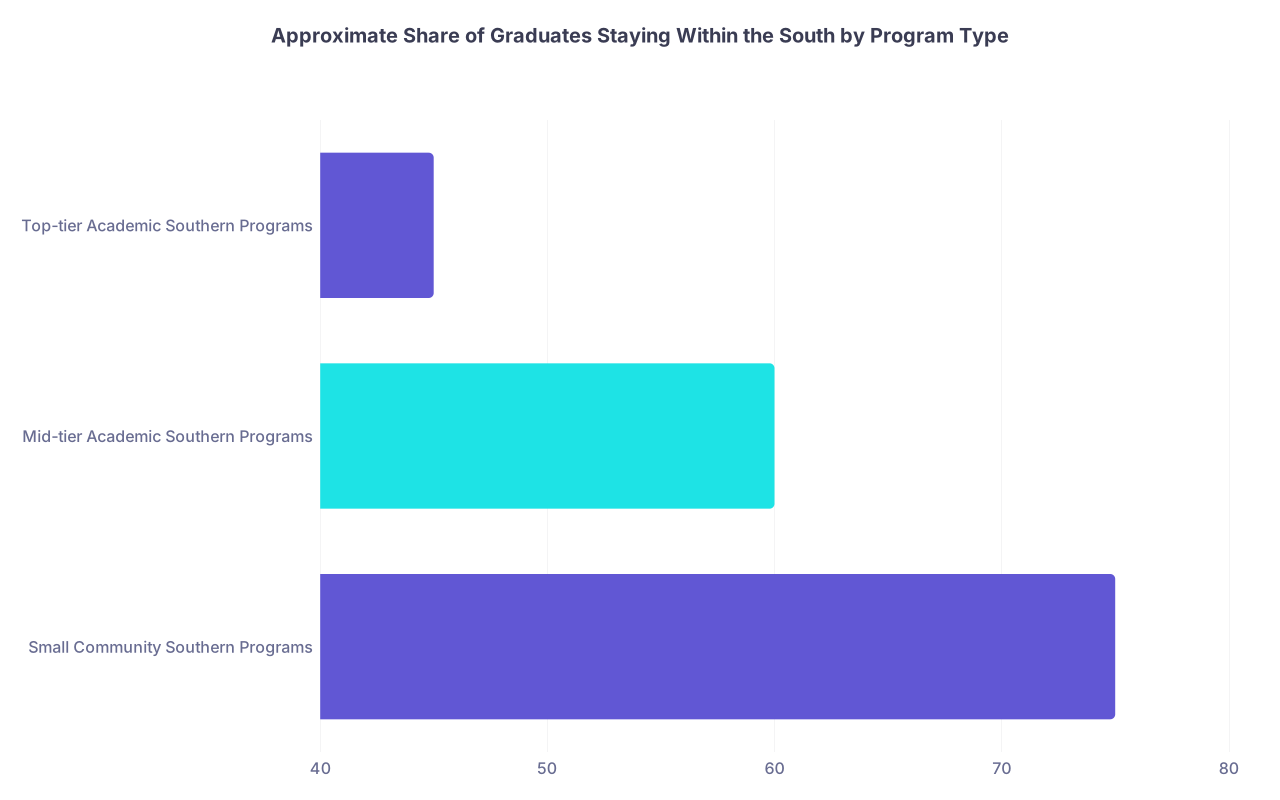
| Category | Value |
|---|---|
| Small Community Southern Programs | 75 |
| Mid-tier Academic Southern Programs | 60 |
| Top-tier Academic Southern Programs | 45 |
Again: conceptual illustration, but the directionality is right. The bigger and more established the name, the more mobility its graduates tend to have.
Push and Pull: Economic and Policy Forces Behind Migration
Physicians are not purely academic creatures. The job market, pay, and policy environment move them. A lot.
Compensation and Cost of Living
Look at MGMA or Doximity compensation maps and adjust for regional cost of living. The South looks very good on a numbers‑only basis for many specialties, especially:
- Primary care
- General surgery
- Anesthesiology
- EM
- Hospitalist roles
The effective income (salary divided by cost index) for a hospitalist in, say, North Carolina or Tennessee often beats a similar job in Boston or San Francisco by a wide margin.
This is one reason those rural and mid‑size Southern cities retain a substantial slice of graduates—especially those with heavy debt burdens.
Policy and Practice Environment
State policy environments matter more than students admit on interview day:
- Malpractice climate and tort reform: Several Southern states are relatively physician‑friendly.
- Scope-of-practice and autonomy: Many physicians feel they have more control over practice models in certain Southern markets.
- Taxes: Zero‑income‑tax states (e.g., Texas, Florida, Tennessee) are nontrivial draws at attending‑salary levels.
The flip side is also true: state laws around reproductive health, LGBTQ+ issues, or public health policies can push some residents out of the region. You see this particularly in OB/GYN, EM, and certain primary care fields where state legislation directly impacts daily practice. The numbers are harder to quantify cleanly, but surveys and exit interviews from some programs show a non‑negligible share of trainees explicitly citing policy climate as a reason to leave.
Fellowship as a Migration Engine
One of the cleanest predictors in the data: where you do fellowship.
General pattern:
- Residents who match fellowship in the South are highly likely to stay in the South for their first job.
- Residents who leave the South for fellowship are more likely to settle in that new region.
So, the “true” migration decision for many IM, Peds, and Surgery residents is not made at PGY‑3 or PGY‑5 graduation. It is made at the fellowship match list.
Southern vs Non‑Southern Graduates: Who Moves In?
Migration is not one‑way. Southern programs import a lot of talent from other regions, especially at the residency level.
Two common flows:
- Northeastern med students matching to Southern programs for lifestyle, “better hours,” and perceived culture.
- International medical graduates (IMGs) training in the South, especially in Internal Medicine, Family Medicine, and Psychiatry.
And then the question is: do they stay?
The data pattern:
- U.S. MDs from the Northeast or West who match in the South: split. A notable fraction train there and then move back North or West for family reasons or academic jobs.
- IMGs who match in Southern primary care/IM programs: higher in‑region retention than U.S. grads, especially if they secure H‑1B or J‑1 waiver positions in underserved Southern communities.
That J‑1 waiver piece matters. Many waiver jobs are in rural or semi‑rural Southern areas, which naturally increases regional retention among international graduates who trained in the region.
Misconceptions vs Data: What People Get Wrong
Let me be blunt about a few common claims I hear on interview days and from M4s:
“If I go to a Southern program, I will never get a job on the coasts.”
False. Top Southern programs place graduates into jobs and fellowships in every major coastal metro every single year. The limiting factor is usually your CV and letters, not your latitude.“Southern community programs trap you locally.”
Overstated. They bias you locally because local employers know you, and you have more interviews there. But strong residents from community programs do move to other regions—especially if they couple with fellowship training elsewhere.“Nobody from the South wants to work rural.”
Also false. The South still supplies a significant share of rural physicians nationally, often through regional state schools and community-centric residencies. Many of those graduates are locally born and intentionally stay.
How to Use This Data Strategically as an Applicant
The numbers are interesting, but you care about one thing: your odds.
Here is how to interpret migration patterns when building a rank list.
Look at each program’s actual alumni map.
Many academic programs publish where their graduates go (job and fellowship). If 70–80 percent of their last 5 classes took jobs within a few hours’ drive, assume you will be pushed in that direction unless you actively resist.Separate “brand mobility” from “geographic convenience.”
A high‑visibility Southern academic program gives you more national mobility than a lesser‑known program in a coastal city. The brand moves with you. Choose accordingly.If you want to end up outside the South, watch fellowship outcomes.
For medicine, peds, and surgery, your ultimate region is often more tied to fellowship location. Target Southern residencies that consistently send people to the regions you want for fellowship.If you want to stay in the South, follow the pipelines.
Many systems (HCA, large academic systems, integrated networks) explicitly recruit from their own residencies. Look at where their hospital network has facilities. That is your default job market.
The Future: How Migration Out of the South Is Likely to Evolve
This is the “Future of Medicine” piece you asked for, so let us project forward a bit, based on current data trends.
Trend 1: Growing Southern Population and Physician Demand
The South is gaining population faster than most other regions. Census and state demographic projections all point the same way. More people, aging residents, and high chronic disease burdens equal more physician demand.
That generally implies:
- Continued strong job markets in Southern metros and rural areas.
- Upward pressure on compensation, especially in high‑need specialties.
- Stable or increasing in‑region retention of Southern‑trained graduates.
Trend 2: Policy Divergence Between States
State-level policy divergence (abortion laws, public health, LGBTQ+ rights, etc.) is not going away. It is accelerating. For some graduates, this will be a dominant factor; for others, compensation and family will override it.
What I expect to see:
- Increased sorting of OB/GYN, EM, Family Medicine, and Pediatrics grads by state policy preference.
- Some Southern states losing physicians to more aligned states (sometimes in the same region, sometimes cross‑region).
- Systems in restrictive states increasing financial and structural incentives to offset policy deterrents.
Trend 3: Remote and Hybrid Work in Certain Subspecialties
Teleradiology, telepsychiatry, tele‑neurology, tele‑ICU, and virtual consults change the map. For certain subspecialties:
- You can live in a low‑cost Southern region and work for an employer based anywhere.
- Or the reverse: live near family outside the South and contract with Southern systems.
That will blur traditional migration metrics. The licensure and reimbursement data already show meaningful cross‑state practice footprints expanding.
Trend 4: Consolidation and System‑Level Pipelines
Large health systems—HCA, Ascension, CommonSpirit, major academic systems—are behaving more like national employers with regional hubs.
Result:
- Your “migration” may be intra‑system rather than purely geographic. Emory‑trained hospitalists working at affiliated sites across Georgia. HCA residents moving across the Southeast or to Texas within the same system.
- Residents gain some mobility while systems keep them in‑network, which does not show up cleanly in traditional regional migration stats.
So if you are thinking long‑term, pay attention not just to which state you train in, but which system you attach to.
The bottom line from the data: Southern training does not lock in Southern practice, but it does shape your probability distribution. Roughly half of graduates stay, half leave, and the deciding variables are not mysterious—they are measurable: specialty, program type, fellowship destination, family ties, and policy preferences.
Understand those levers, and you can make Southern programs work for almost any geographic outcome you want.
With that framework in place, your next step is to stop guessing: pull up the alumni outcome pages, talk to current residents about where their seniors went, and build your own short list of programs whose migration patterns actually match your goals. The match will come and go; your geography will follow you for years. Choose it on purpose.