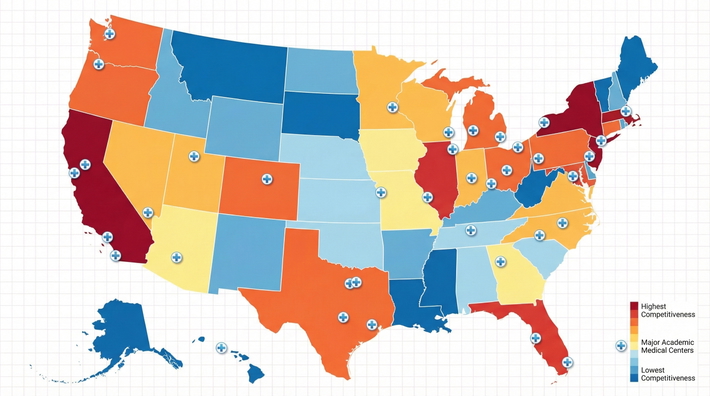
The myth that “Step scores are the same everywhere” is not just wrong—it is mathematically lazy. Regional patterns in Step performance and expectations are real, persistent, and they shape your residency options whether you notice them or not.
If you treat the national average as your only benchmark, you will misread the market. The data show that a 245 does not buy the same thing in Boston as it does in Birmingham. Same number, different clearing price.
Let’s walk through it like an analyst, region by region.
1. The National Baseline: What “Average” Actually Means
Before comparing regions, you need a baseline. Otherwise, all the “high” and “low” talk is just noise.
For Step 1 (back when it was scored) and Step 2 CK, the distributions have looked remarkably similar over recent years:
- Step 1 (pre-pass/fail era): mean roughly 230–233, SD about 19.
- Step 2 CK: mean around 245, SD about 15.
Programs know those numbers cold. They build internal cutoffs around them, often in half-standard-deviation chunks.
So, roughly:
- Step 2 CK 230–235 → about 0.7–1.0 SD below mean
- Step 2 CK 245 → near mean
- Step 2 CK 255–260 → about +0.7 to +1.0 SD above mean
Here’s a simple anchor:
A 250 on Step 2 CK is around the 70–75th percentile nationally.
Now, the problem: different regions compress or stretch that same percentile drastically in the residency market. A 250 in the Midwest might put you in the top tier for many solid university programs. The same 250 in parts of the Northeast just gets you into the “we will read your file” pile at the top-heavy academic centers.
To make this concrete, I will use estimated “average matched Step 2 CK” ranges by region and program type. These are not official numbers; they are pattern-based approximations from NRMP data, published program medians, and what PDs freely say when they think only students are listening.
2. Regional Step Score Patterns: The Big Picture
At a 30,000-foot view, this is how the regions stack up for Step 2 CK expectations at competitive academic programs:
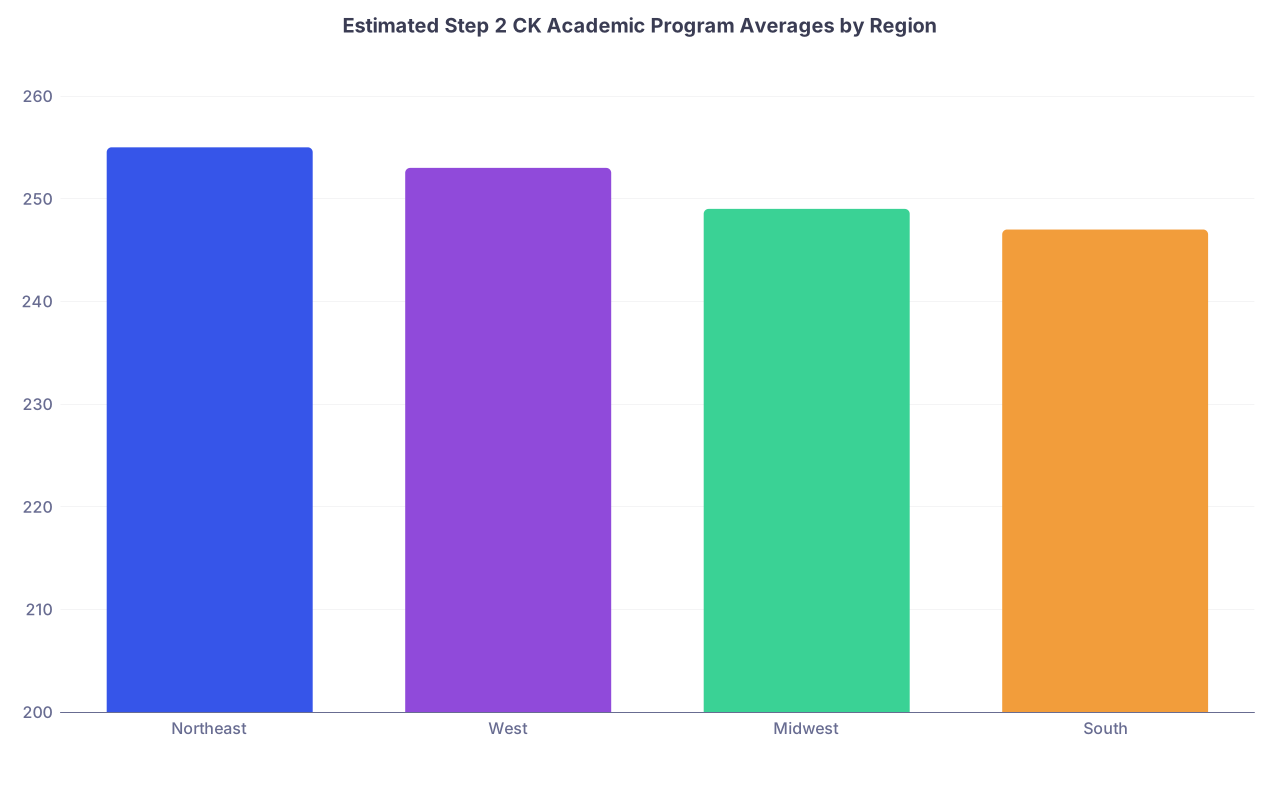
| Category | Value |
|---|---|
| Northeast | 255 |
| West | 253 |
| Midwest | 249 |
| South | 247 |
Interpretation:
- Northeast and West: higher average expectations, especially at large, research-heavy centers.
- Midwest: slightly lower numerical thresholds, but still serious for competitive specialties.
- South: more range—top programs still demand strong scores, but there is more depth for mid-range applicants.
You should read those bars as “center of gravity” for competitive academic programs, not for every community program in that region. There is plenty of variance inside each region.
3. Northeast: High Scores, High Density, High Competition
Think Boston, New York, Philadelphia, New Haven, Providence. A dense cluster of brand-name hospitals and academic centers. Many are top-20 or top-30 in NIH funding. They attract national and international applicants.
The predictable result: Step inflation.
For core specialties (IM, general surgery, anesthesia, EM), the data and match anecdotes suggest something like this at academically strong Northeast programs:
| Specialty | Typical Interviewing Range | Truly Competitive Range |
|---|---|---|
| Internal Med | 245–255 | 255–265+ |
| General Surgery | 248–260 | 255–268+ |
| Anesthesiology | 245–255 | 252–262+ |
| Emergency Med | 240–252 | 248–258+ |
You will find outliers on both sides, but the pattern holds:
- Scores below ~240 at a mid- or low-tier med school struggle to get traction at big-name Northeast academics unless something else is exceptional (AOA, strong home program support, real research, connections).
- A 250+ is frequently the “practical minimum” for an out-of-region applicant to be seriously considered at the more elite places in Boston or Manhattan, unless they bring heavy research currency.
I’ve seen this play out in real rank meetings in the Northeast. The conversation sounds like:
“Good applicant, 244 Step 2, decent research…”
“Where are they from?”
“Midwest state school.”
“Any connection to the region?”
“Not really.”
“We have 30 others with 255+ and publications who actually want to be here.”
Harsh. But that is the market in score-dense regions.
Another factor: many Northeast schools themselves are high-output. Their own students are pushing 250+ Step 2 averages in some cases, so the local competition pool is already skewed high. Programs can be picky because they know they will fill.
Who benefits and who gets squeezed
Benefited:
- Applicants from top-20 med schools with 250+ and strong research.
- Students who already have geography leverage: grew up in NY/MA/PA, did research in Boston, etc.
Squeezed:
- Strong but not exceptional students (235–245) from mid-tier schools with no regional ties.
- IMGs without 250+ scores. In the Northeast, most IMG matches you see at big academics tend to carry Step 2 scores in the 250–260+ range plus heavy research.
If your Step 2 CK is in the 230s and you want a university IM spot, the Northeast is, statistically, your least efficient target region.
4. South: Wide Distribution, More Headroom for Mid-Range Scores
The “South” here means Texas, the Deep South, and the Southeast: Texas, Florida, Georgia, Alabama, the Carolinas, etc. It is not monolithic—UTSW is not the same as a small community program—but the distribution of scores among matched residents is usually wider than in the Northeast.
At many academic programs in the South, approximate ranges look more like:
| Specialty | Typical Interviewing Range | Truly Competitive Range |
|---|---|---|
| Internal Med | 235–248 | 248–258+ |
| General Surgery | 238–252 | 250–260+ |
| Anesthesiology | 238–250 | 248–258+ |
| Emergency Med | 235–248 | 245–255+ |
The center of gravity is a few points lower than the Northeast, but the key difference is in how they treat the middle.
Programs in the South more often weigh:
- Regional ties (“family in Georgia”, “grew up in Texas”),
- Fit and personality,
- Willingness to stay and practice locally,
alongside scores. You still need to clear a basic bar—Step 2 in the low 230s and below becomes a real problem anywhere—but a 238–245 applicant has a noticeably easier time landing interviews at solid university programs in the South than at equivalent-name ones in the Northeast.
That is not speculation; it shows up in match lists. Take a typical state school in the South. You will routinely see residents at their major academic IM programs with Step 2 scores that, if transplanted to Boston, would probably map more to mid-tier community or university-affiliated programs.
There is also the IMG factor. Many Southern programs are traditionally more open to IMGs, especially in IM and FM. In practice that means:
- US-IMGs with Step 2 CK around 235–245 plus good clinical performance have a realistic shot at multiple Southern programs.
- In the Northeast, that same profile often hits a wall unless the applicant carries distinctive extras (US grad, prior degree, citizen, or strong connections).
The top of the South is still cutthroat
Do not mistake “wider distribution” for “easy.” At places like UTSW, Emory, Baylor, UF, UNC, Duke, etc., you will see the same behavior as in the Northeast for the upper tiers: interview lists dominated by 250+ for competitive specialties.
The difference is depth. Once you move away from the half-dozen most competitive academic centers in each Southern state, the score slope softens more quickly.
5. Midwest: Underrated Region, Slightly Softer on Scores
The Midwest (Illinois, Michigan, Ohio, Minnesota, Wisconsin, Indiana, etc.) is the most underrated region from a Step economics perspective.
You have major academic powerhouses there—Michigan, Mayo, Northwestern, UChicago, WashU (if you include Missouri), Cleveland Clinic, Ohio State. Their high-end expectations resemble the Northeast and West. But once you step one or two notches down from those giants, the numbers become friendlier than many applicants realize.
For many Midwest university programs, real-world Step 2 CK ranges look something like:
| Specialty | Typical Interviewing Range | Truly Competitive Range |
|---|---|---|
| Internal Med | 238–250 | 248–260+ |
| General Surgery | 240–252 | 252–262+ |
| Anesthesiology | 240–252 | 250–260+ |
| Emergency Med | 238–250 | 246–256+ |
Notice how similar that looks to the South, but with a bit more clustering around the mid-240s at university programs.
The Midwest has two structural features that benefit applicants:
Supply-demand mismatch. There are a lot of training spots relative to the number of students desperate to live in, say, Toledo or Peoria compared with Manhattan or San Diego. That slightly reduces the score inflation.
Retention mindset. Many Midwestern state programs prioritize candidates likely to stay and practice in the region. If you are from the Midwest, your 238–245 means more there than it does on either coast.
I have seen multiple cycles where students with Step 2 in the 240s striking out at mid-tier East Coast programs land strong university IM or anesthesia spots in the Midwest. Same profile, different regional market.
IMGs also see a somewhat more forgiving environment in parts of the Midwest, especially in IM and FM, though the very top programs remain extremely competitive and research-heavy.
6. West: Small, Competitive, and Heavily Skewed Upward
The West is different not because the scores themselves are inherently higher, but because of scarcity. There are fewer residency slots relative to applicant interest in places like California, Colorado, and the Pacific Northwest. Lifestyle plus brand-name cities drive intense demand.
When supply is low and demand high, what happens? Scores become a blunter instrument of filtering.
Approximate Step 2 CK patterns at West Coast and Western academic programs:
| Specialty | Typical Interviewing Range | Truly Competitive Range |
|---|---|---|
| Internal Med | 245–255 | 255–265+ |
| General Surgery | 248–260 | 258–268+ |
| Anesthesiology | 245–255 | 255–265+ |
| Emergency Med | 242–252 | 250–260+ |
California in particular behaves like a compressed, smaller version of the Northeast:
- UCLA, UCSF, Stanford, UCSD, etc. overwhelmingly interview 250+ Step 2 CK for competitive specialties, with a strong bias toward 255–260+ for out-of-region candidates.
- Even mid-tier California university programs can run “hotter” than their peers elsewhere because hundreds of applicants throw in applications “just to see.”
You can see the effect in the data: California programs are some of the most over-applied per position in ERAS. That surplus of applicants with strong profiles propels the numerical thresholds upward.
For a mid-240s applicant without strong ties, the West is possibly the least efficient region to chase if you are aiming specifically for university positions in major metros. Your expected value of interviews per application dollar is often worse there than in the Midwest or South.
7. Side-by-Side: Regional Step “Temperature” by Program Tier
Summarizing all of that into one comparative view:
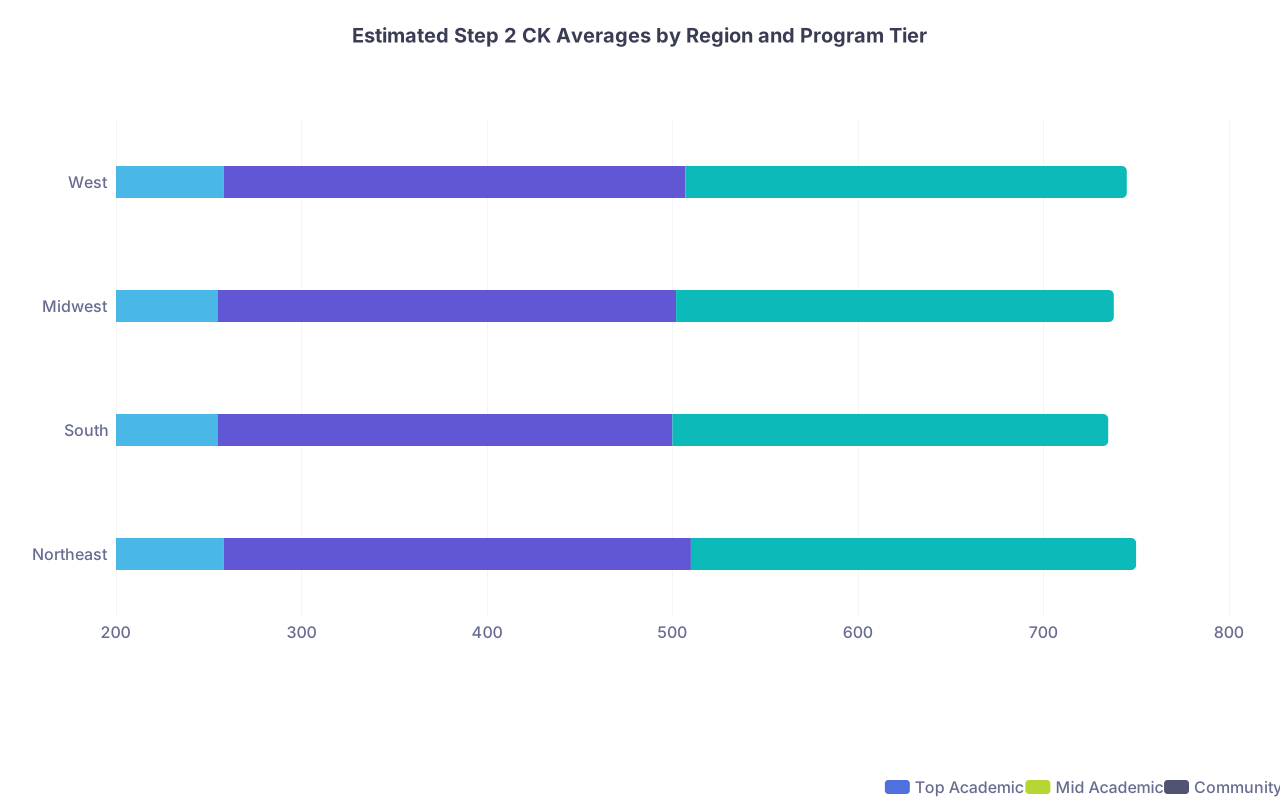
| Category | Top Academic | Mid Academic | Community |
|---|---|---|---|
| Northeast | 258 | 252 | 240 |
| South | 255 | 245 | 235 |
| Midwest | 255 | 247 | 236 |
| West | 258 | 249 | 238 |
Interpret this with some nuance:
- “Top Academic” = large university or quaternary programs with national reputations.
- “Mid Academic” = strong state university or affiliate programs without top-10 branding.
- “Community” = mostly non-university programs, some with academic affiliations.
Key patterns:
- The spread between “Top Academic” and “Mid Academic” is bigger in the Northeast and West. The climb from mid-tier to top-tier is steeper there.
- The South and Midwest compress those tiers a bit more. A 248–252 might keep you in the game for some high-quality programs.
This is why two applicants with the same Step 2 CK can have wildly different match outcomes depending on how heavily they weight each region.
8. What This Means for Your Strategy
You cannot change your Step score after the exam. You can change where you deploy it.
With a Step 2 CK of 260:
- Nationally: you are in an elite band (roughly +1 SD).
- Regionally: you can competitively aim anywhere—Northeast, West, Midwest, South—for most specialties, assuming the rest of your application is aligned.
With a Step 2 CK of 250:
- Northeast/West: strong candidate, but for the very top programs in ultra-desired cities you are not automatically “safe.” They see many 255–265+.
- Midwest/South: you are very competitive at most academic programs and a strong contender even at the top-tier ones depending on research and school pedigree.
With a Step 2 CK of 240:
- Northeast/West: you now need a realistic plan—more focus on mid-tier university and high-quality community/university-affiliated programs, plus strong regional ties or unique strengths.
- Midwest/South: you are absolutely still viable for many university programs in IM, anesthesia, EM, and some surgical prelims. The data and match lists back this up consistently.
With a Step 2 CK of 230–235:
- Northeast/West: academic programs become significantly harder unless you have exceptional compensating factors (top-10 med school, major research, strong advocacy from known faculty).
- South/Midwest: many categorical IM, FM, and some other core specialties remain realistic, especially at programs with a history of taking a broader range of scores.
Align region with score, not ego
The mistake I see repeatedly: applicants with mid-230s or low-240s who carpet bomb the Northeast and California because “I really want to live there,” then are shocked when the interview count is bleak.
They essentially ignore the regional score data. They treat a 242 as if it has equal purchasing power everywhere. It does not.
The data-driven move:
- Use your Step score to identify the regions where you are statistically above the local bar, not just near it.
- Overweight those regions with more applications.
- Still include a few reach programs where you want to live, but do not build your entire list around the most score-inflated geographies.
9. The Future: Step 1 Pass/Fail and More Weight on Step 2 by Region
Step 1 shifting to pass/fail pushes even more pressure onto Step 2 CK. Regionally, the effect is uneven:
- Northeast and West: Programs are already leaning harder into Step 2 as the primary numeric screen. Expect the bar to drift slightly upward as more students treat Step 2 as the “make or break” exam and prep accordingly.
- Midwest and South: Many programs will still use Step 2 scores, but they are more likely to consider holistic factors and local ties because their recruitment risk is different. Some already de-emphasize scores once basic competency is met.
We are already seeing a slow score creep in Step 2 CK medians in the more competitive regions, particularly in IM and surgery at major academic centers. There is no reason to expect that trend to reverse soon.
10. Practical Takeaways
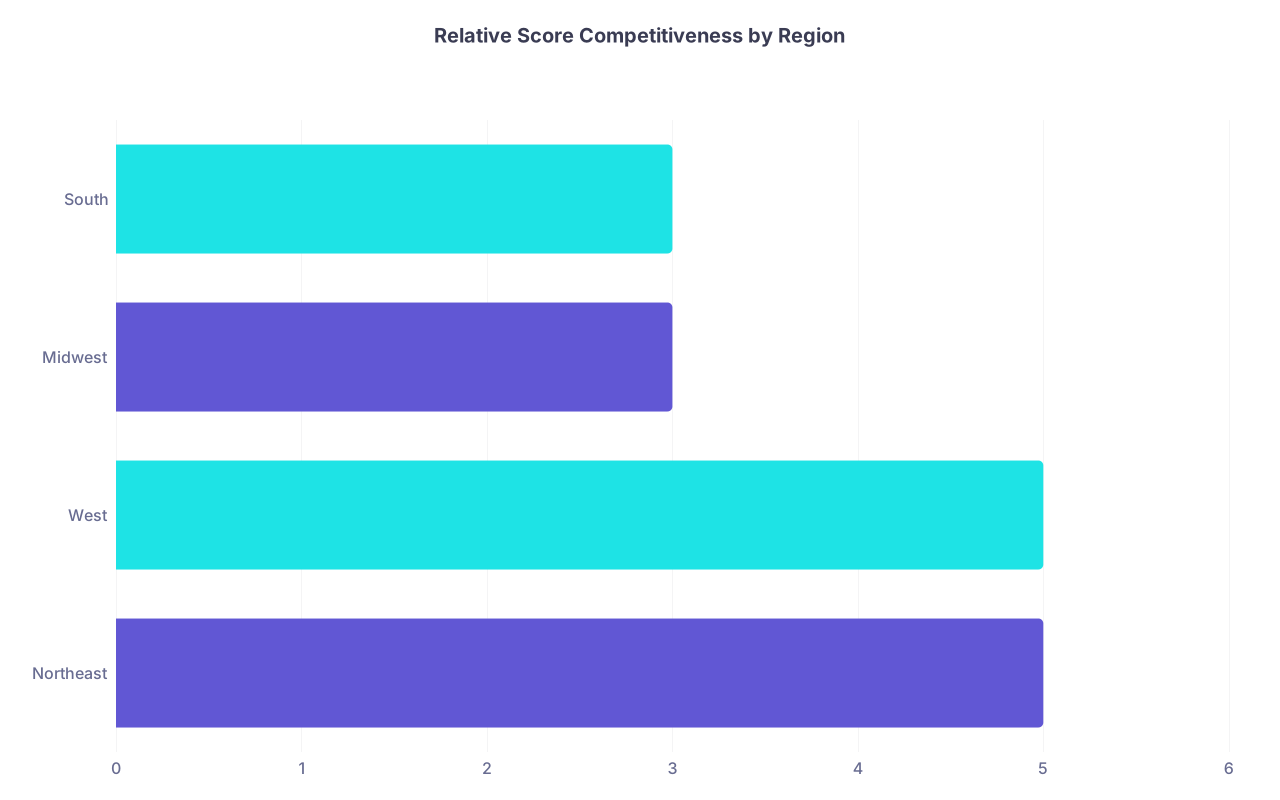
| Category | Value |
|---|---|
| Northeast | 5 |
| West | 5 |
| Midwest | 3 |
| South | 3 |
(Scale 1–5: higher = tougher score environment at academic centers.)
Three points to leave you with:
The same Step score buys different things in different regions. Northeast and West run hotter; South and Midwest give more room to mid-range scores, especially at good state and university-affiliated programs.
If your score is at or below the national mean, tilting your application strategy toward the Midwest and South usually increases your interview yield and match probability. Data and match lists confirm this year after year.
Regional ties, school pedigree, and research can bend the curve, but they rarely eliminate it. You can outplay your score, but you cannot ignore the regional score distributions and expect the market to bend around you.