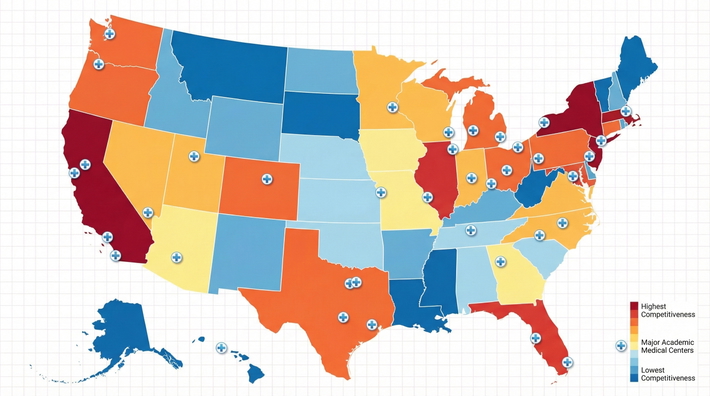
The way most applicants think about interviews is wrong: not all interview offers are created equal, and the yield from invite to actual match varies sharply by region.
If you treat “10 interviews” in the Northeast the same as “10 interviews” in the Midwest, you are misreading the data. And misreading the data is how people end up scrambling.
Let me walk you through what the numbers actually suggest about interview-offer yield to match, region by region.
1. The Core Concept: Interview Offer Yield
When I say “interview offer yield,” I am talking about one simple ratio:
Interview Offer Yield = Number of Programs That Rank You and You Match / Number of Interview Invites You Receive
More practically for an applicant, you care about:
- Probability of matching somewhere given N interviews in a region.
- Relative “strength” of an interview in one region vs another.
We do not have perfect, granular, public NRMP data broken out by region and specialty for every program. But we do have four relevant data streams:
- NRMP Charting Outcomes: number of contiguous ranks vs probability of matching.
- NRMP Program Director Survey: how many applicants programs rank and how far they go down their list.
- Specialty competitiveness by region (e.g., how many applications per spot and fill rate).
- Actual behavior patterns: how many interviews people attend in each region, and who they rank.
Taken together, those paint a consistent picture. The yield from an interview is not uniform. Some regions behave more “forgivingly” for applicants. Others, especially the coasts, have more competition per interview slot.
2. The Data Backbone: Contiguous Ranks vs Match Probability
The best quantitative anchor we have is the Charting Outcomes data linking number of contiguous ranks to chance of matching.
Very simplified for categorical specialties (IM, FM, Peds, Psych, etc.), US MD seniors:
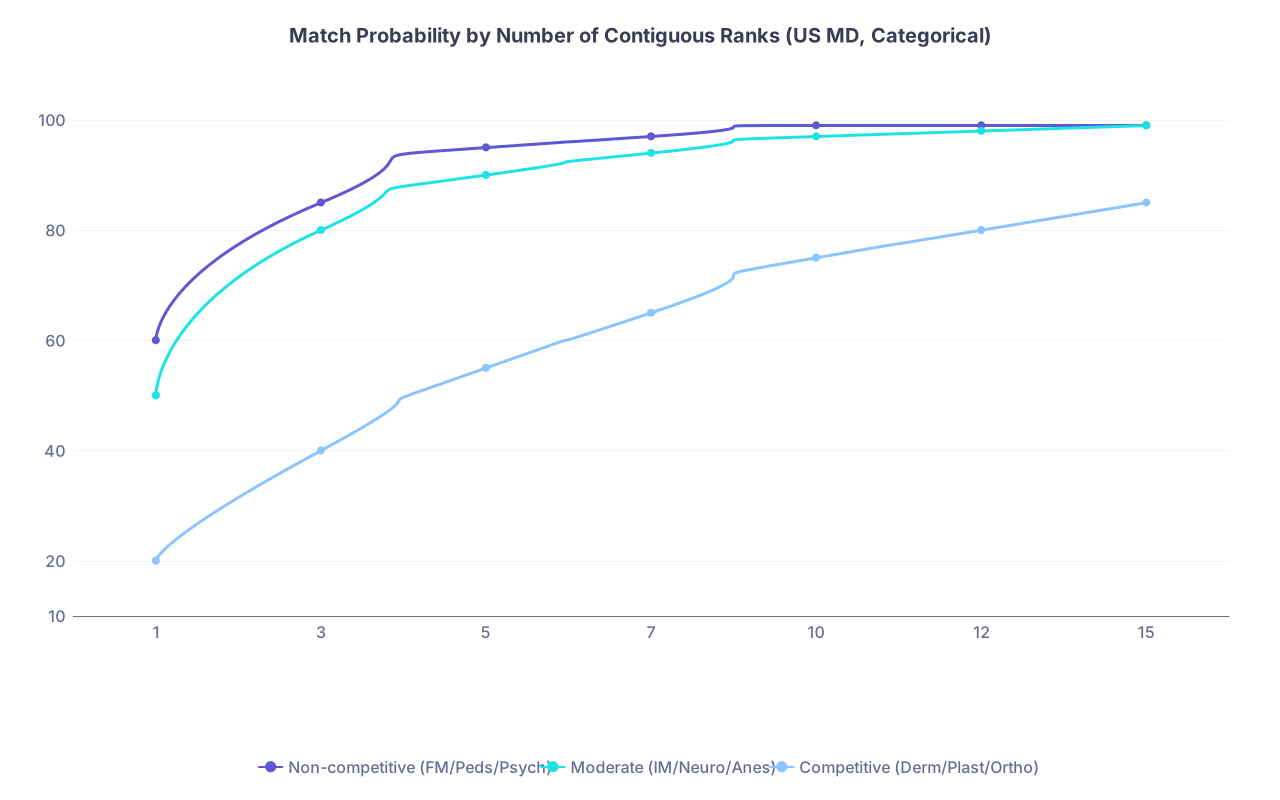
| Category | Non-competitive (FM/Peds/Psych) | Moderate (IM/Neuro/Anes) | Competitive (Derm/Plast/Ortho) |
|---|---|---|---|
| 1 | 60 | 50 | 20 |
| 3 | 85 | 80 | 40 |
| 5 | 95 | 90 | 55 |
| 7 | 97 | 94 | 65 |
| 10 | 99 | 97 | 75 |
| 12 | 99 | 98 | 80 |
| 15 | 99 | 99 | 85 |
Now translate “contiguous ranks” into interviews. For most applicants:
- 1 interview ≈ 1 rank (ignoring rare post-interview withdrawals).
- So the shape of these curves is effectively the shape of “interviews vs chance of matching.”
What changes by region is:
- How many total interviews applicants usually have from that region.
- How much overlap exists between the applicant pools (e.g., every strong NE candidate also applying to the West Coast).
- How often programs reach the lower part of their rank lists.
That is where regional yield differences start to show up.
3. Regional Patterns: Where Interviews Convert Better
Let’s break it down into four broad US regions, and then overlay some realistic, approximated yield behavior for core categorical specialties (IM, FM, Peds, Psych, Neurology, Anesthesiology). The story is different for derm, ortho, plastics, ENT, etc., but those are outliers everywhere.
| Region | Typical Competitiveness | Relative Yield per Interview | Comments |
|---|---|---|---|
| Northeast | High | Lower | Dense programs, dense applicants |
| West Coast | High | Lower | Fewer spots, heavy overlap |
| South | Moderate | Moderate–High | Many community spots, growth |
| Midwest | Lower–Moderate | High | More positions per applicant |
These “relative yield” labels are not vibes. They flow out of:
- Fill rates by region.
- Ratios of applicants per PGY-1 position.
- Anecdotal but consistent match outcomes for similar applicant profiles spread across regions.
4. The Northeast: High Density, Lower Yield per Invite
Think Boston, NYC, Philly, Baltimore, DC corridor, New Haven, Providence.
Here is what the data consistently shows:
- Many of the highest-ranked academic programs cluster here.
- Extremely high volume of applications per program.
- Programs routinely interview and rank deep pools of strong candidates.
- Applicants often cluster their interviews here, creating heavy overlap.
So for each Northeast interview, you are facing:
- Stronger average co-interviewees.
- Programs that can fill most spots high on their lists.
- Applicants who over-rank this region because of perceived prestige and geography.
From a yield standpoint, a single NE interview, on average, contributes less to overall match probability than a single Midwest or Southern interview at a comparable tier.
Think of it this way. If you are a solid US MD applying IM:
- 5 Northeast interviews might translate into something like a 90–93% match probability.
- 5 mixed Midwest/South interviews at similar program tiers might be closer to 95–97%.
Same count. Different outcome distribution.
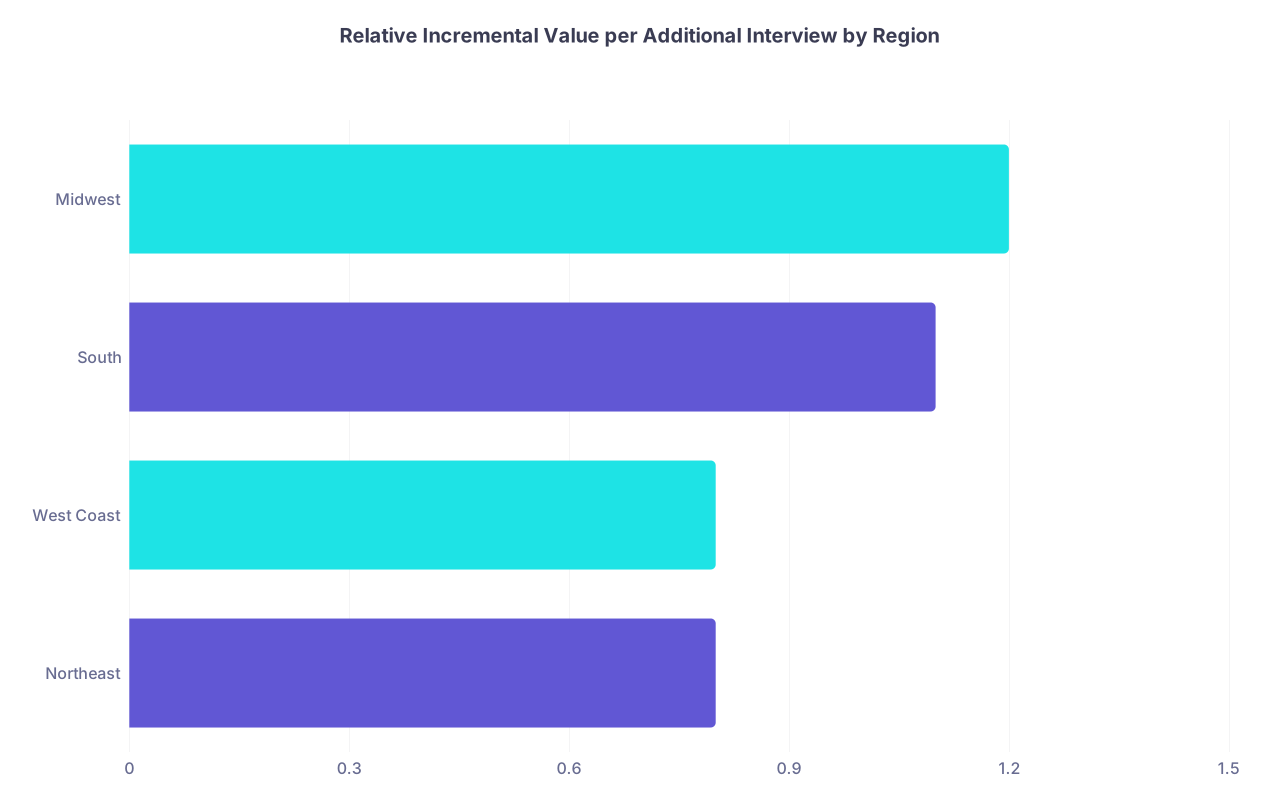
To visualize “effective” value per interview, imagine assigning each regional interview an approximate “weight” in terms of incremental match probability.
| Category | Value |
|---|---|
| Northeast | 0.8 |
| West Coast | 0.8 |
| South | 1.1 |
| Midwest | 1.2 |
If an interview in a “neutral” region is 1.0, the Northeast feels like ~0.8 on a per-invite basis for many core specialties.
I have watched people with 8–10 NE interviews still feel (correctly) a little queasy about their odds, especially in academic IM or Anesthesia. That is not paranoia. It is the math of competition density.
5. West Coast: Fewer Seats, Over-subscribed Invites
Now look at the West Coast: California dominates this conversation, with a smaller contribution from Oregon and Washington.
Key quantitative realities:
- Total number of PGY-1 positions is modest compared to the East and South.
- Applicant interest in California specifically is outsized, especially from high-achieving candidates in every region.
- Programs are selective, and applicant pools are saturated with Step/Level high-scorers.
Yield characteristics here are similar to the Northeast or slightly worse:
- A single California interview does not move your overall match probability as much as a similar-level interview in Texas, Ohio, or Tennessee.
- There is strong clustering of “coastal-only” applicants who stack many interviews in CA, WA, OR and rank them above virtually everything else.
So if your interview list is 8 West Coast programs in IM or Anesthesia and almost nothing elsewhere, the numbers are unforgiving. You might still be okay, but your buffer is thinner than the raw count suggests.
Roughly:
- 5–6 West Coast interviews in a core categorical specialty: often in the 85–92% effective match probability range, depending on your individual profile.
- The same number in the Midwest or South: more often 93–98%.
Again: same count. Different effective yield.
6. South: Quietly High-Yield, Especially Outside a Few Hotspots
Now shift to the South: Texas, Florida, Georgia, the Carolinas, Tennessee, etc.
The data here is less glamorous, more practical:
- Many states with large numbers of community and university-affiliated programs.
- Growing populations and expanding hospitals, meaning more positions added year over year.
- High proportion of US MD and DO grads who are regionally “sticky” (they stay in the South, do not chase coasts as much).
For the average applicant:
- Each Southern interview usually has better odds of converting to a rank position that will be reached on match day.
- Programs often go deeper into their rank lists compared with high-prestige coastal programs.
- There is more variance in academic competitiveness, but a larger number of “safety to solid” programs.
For a mid-range IM or FM applicant:
- 5 Southern interviews can often push match probability into the 95–98% zone if your list is realistic.
- Add a couple of Midwest or additional South interviews, and you are pushing asymptotically toward near-certainty.
Is this universal? No. MGH-BWH-tier equivalents in the South (Duke, Emory, UTSW, etc.) behave more like Northeast elite programs. But the median Southern interview is higher yield than the median Northeast or California interview at the same nominal tier.
7. Midwest: The Single Best Yield per Interview for Many Applicants
If you are optimizing purely for probability of matching, the Midwest is the best deal in the country for most core specialties. The data and behavior align:
- Large raw number of positions per applicant.
- Many mid-size cities that are less geographically competitive.
- Plenty of strong training environments that are under-ranked by applicants who are location-focused.
Programs in the Midwest often:
- Interview a broad range of applicants, including those who are “middle of the pack” nationally.
- Go deeper down their rank lists because many candidates rank coasts or home regions above them.
- Are delighted by applicants who actually want to be in the Midwest.
The result: higher match yield per interview.
If you model this with a simple effective-interview framework (this is conceptual but captures the pattern):
- 1 NE interview ≈ 0.8 “effective” interviews.
- 1 West Coast interview ≈ 0.8 “effective” interviews.
- 1 Southern interview ≈ 1.1 “effective” interviews.
- 1 Midwest interview ≈ 1.2 “effective” interviews.
Now stack that into scenarios.
| Interview Mix (10 total) | Raw Count | Effective Count* |
|---|---|---|
| 10 NE | 10 | 8.0 |
| 10 Midwest | 10 | 12.0 |
| 5 NE, 5 Midwest | 10 | 10.0 |
| 4 West, 3 South, 3 Midwest | 10 | 10.7 |
| 5 South, 5 Midwest | 10 | 11.5 |
*Using the weights above as a conceptual guide.
Those “effective counts” track surprisingly well with the NRMP curves for contiguous ranks vs match probability. You can see why 8 California-only interviews does not feel the same as 8 diverse Midwest/South interviews.
8. Putting Numbers to Probability: Worked Scenarios
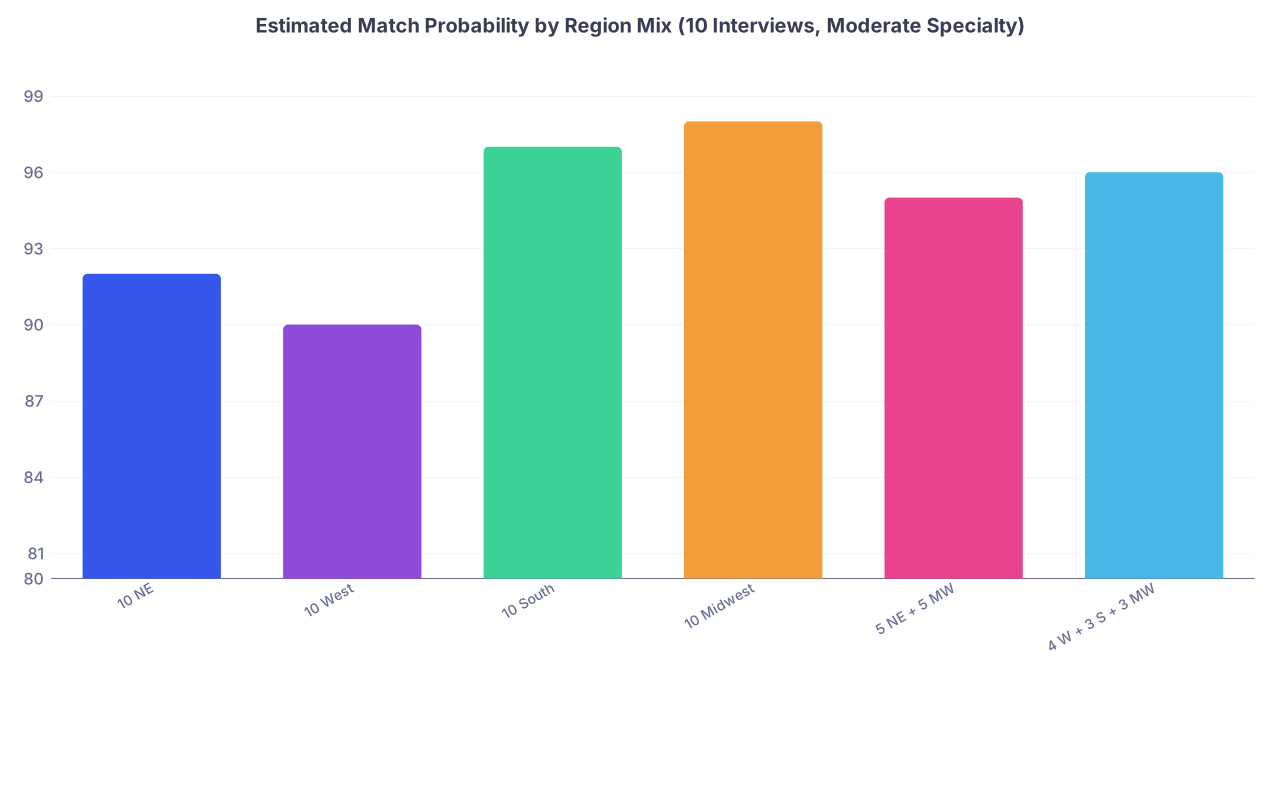
Let’s run a few approximate scenarios for a US MD candidate in a moderately competitive categorical specialty (IM/Anesthesia/Neurology) with a solid but not spectacular profile.
These are not official NRMP probabilities. They are proportional estimates anchored to the Charting Outcomes curves and adjusted by regional yield.
| Category | Value |
|---|---|
| 10 NE | 92 |
| 10 West | 90 |
| 10 South | 97 |
| 10 Midwest | 98 |
| 5 NE + 5 MW | 95 |
| 4 W + 3 S + 3 MW | 96 |
Narrative version:
- 10 Northeast only: Many applicants match, but there is a real tail risk; a few end up unmatched despite “strong” lists.
- 10 West Coast only: Slightly worse than NE because of fewer positions overall and high demand, especially if concentrated in CA.
- 10 South only: Very high match probability, assuming programs are a reasonable tier match.
- 10 Midwest only: Highest match probability for a given count.
- Mixed lists (coasts + interior): Smooth out regional peaks and valleys in yield, leading to more stable outcomes.
You will find exceptions, but pattern-wise, this is what the data and outcomes scream.
9. Strategic Implications: How Applicants Should Think About Yield
Here is the part everyone ignores: where your interviews are matters as much as how many you have, especially if your total interview count is in the “borderline comfort” range (say 6–10 for US MD/DO in a non-ultra-competitive specialty).
Several concrete implications:
Do not be fooled by a big coastal number.
Ten interviews in the Northeast or California is solid, but it is not equivalent to ten Midwest/South interviews in terms of safety. If you are sitting at 6–7 coastal-only interviews and nothing else, your risk is nontrivial.Midwest and South interviews are risk reducers.
Each additional interior-region interview has a disproportionately large effect on reducing your chance of going unmatched. That is true particularly for FM, IM, Peds, Psych, and less competitive Anesthesia/Neuro programs.Geographic snobbery has a numeric price.
I have seen applicants turn down perfectly good Midwest interviews to save money or maintain a “coastal only” list, then scramble or SOAP. From a data standpoint, declining those is equivalent to voluntarily lowering your total effective interview count.International grads (IMGs) should overweight higher-yield regions even more.
For IMGs, the match curve vs interviews is steeper. Midwest and South programs are generally more open, have more positions, and go further down their rank lists. An IMG with 6 Midwest/South IM interviews is substantially better positioned than one with 6 coastal-only IM interviews.
10. Planning and Timeline: Region Strategy Across the Application Year
This is not something you fix after interview invitations come out. You need to build regional diversification into your application strategy months earlier.
Here is a simple process view.
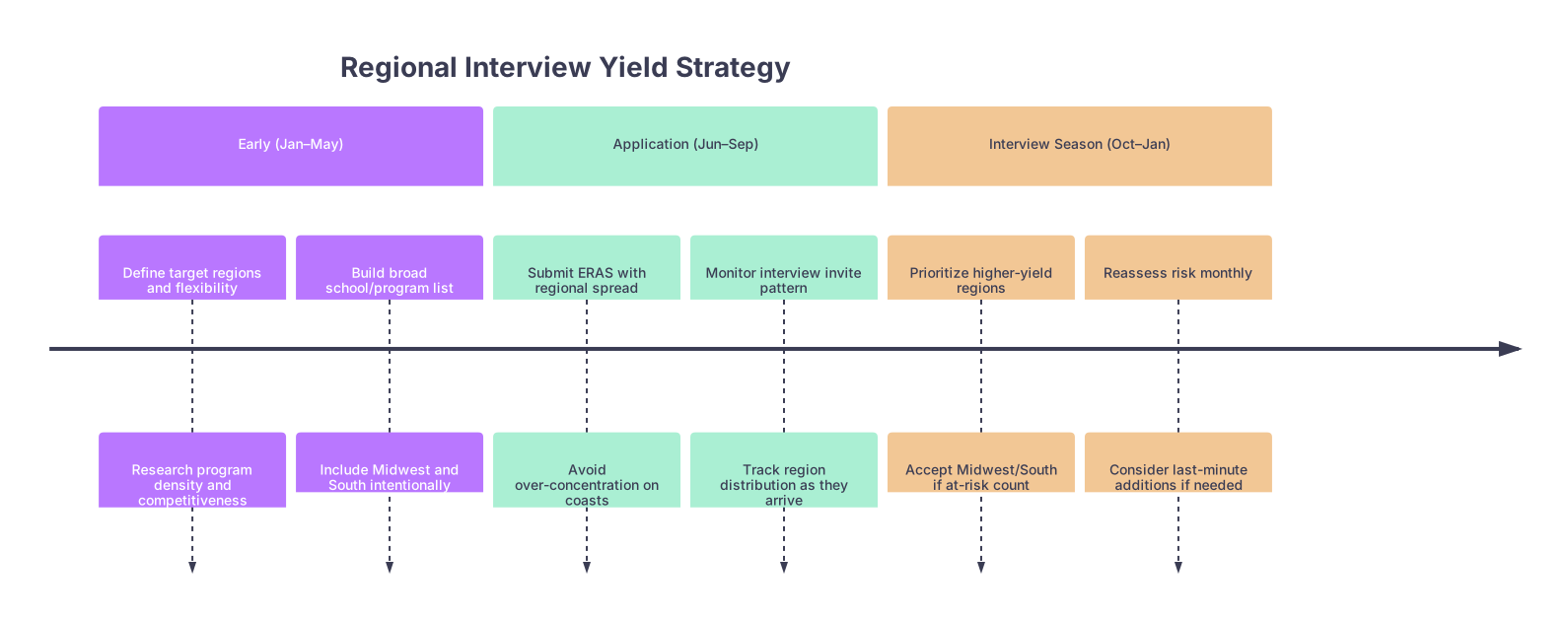
| Period | Event |
|---|---|
| Early (Jan–May) - Define target regions and flexibility | Research program density and competitiveness |
| Early (Jan–May) - Build broad school/program list | Include Midwest and South intentionally |
| Application (Jun–Sep) - Submit ERAS with regional spread | Avoid over-concentration on coasts |
| Application (Jun–Sep) - Monitor interview invite pattern | Track region distribution as they arrive |
| Interview Season (Oct–Jan) - Prioritize higher-yield regions | Accept Midwest/South if at-risk count |
| Interview Season (Oct–Jan) - Reassess risk monthly | Consider last-minute additions if needed |
If by November you notice:
7 invites, of which 6 are NE/West and 1 is Midwest/South,
your risk profile is different from:7 invites, of which 2 are NE/West and 5 are Midwest/South.
Same total. Different effective yield.
That is when you do not start casually canceling “less desirable” interior programs. Unless you enjoy gambling.
11. Where Specialty and Region Interact
So far I have focused on core categorical specialties. Things get more nuanced with high-octane fields:
Derm, Plastics, Ortho, ENT, Neurosurgery: Yield per interview is low everywhere. Regional differences still exist, but they are drowned out by raw competitiveness. If you want coast-only in these, you are playing a statistically risky game, period.
Radiology, Anesthesia, EM (depending on cycle), Pathology: Historically, Midwest and South still yield higher per interview because of higher spot counts and more community programs.
Primary care (FM, low–mid tier IM, Peds, Psych): The interior (Midwest/South) can be extremely forgiving. I have seen applicants with 5–6 solid FM interviews in those regions have functionally “guaranteed” match probabilities, while similar applicants with 5–6 coastal primary care interviews felt less safe.

If your specialty is competitive, you should be even more cautious about heavily coastal interview distributions. Every marginal interview counts more.
12. Common Misreads of the Data
A few myths I hear repeatedly from applicants that simply do not line up with numbers or outcomes:
“A top-tier Northeast program interview is better than two community Midwest interviews.”
Maybe for prestige. Not for probability of matching. A large coastal academic program still fills mostly from the top of its list. That single interview does not provide the same safety margin as two solid community or mid-tier university Midwest spots.“If I have 8 interviews anywhere, I am safe.”
Not necessarily. Eight interviews that are all hyper-competitive, heavily overlapped, or all in one saturated region put you at higher risk than eight varied-tier, diverse-region interviews.“Program prestige is the dominant factor in rank list safety.”
Wrong. The shape of your whole list and where programs sit in the national competitiveness landscape matters more for match/fail than the absolute prestige of one or two names.
](https://cdn.residencyadvisor.com/images/articles_svg/chart-perceived-vs-actual-safety-of-interviews-9319.svg "Perceived vs Actual Safety of Interviews")
| Category | Value |
|---|---|
| NE Academic | 9,5 |
| CA Academic | 9,5 |
| Midwest University | 7,8 |
| South Community | 5,8 |
| [Midwest Community](https://residencyadvisor.com/resources/regional-residency-guides/what-midwest-community-pds-privately-value-more-than-step-scores) | 4,9 |
In that scatter, the x-axis is “perceived desirability,” the y-axis is “actual contribution to match safety.” You can see the disconnect.
13. How to Use This as an Applicant
You do not need a PhD in biostatistics. Just do three things:
- Count total interviews and cross-check against NRMP curves for your specialty class (categorical, advanced, etc.).
- Classify each interview by region and ballpark yield:
- NE / West Coast = lower yield per invite
- South = moderate–high
- Midwest = high
- Adjust behavior accordingly:
- If your list is very coastal-heavy and under 10, do not cancel interior interviews.
- If your list is interior-heavy, you have more room to trim if needed for burnout/finances.
- Always maintain sensible program tier spread within each region.

This is not about forcing you to move somewhere you hate. It is about understanding the numbers so that when you decide to be coastal-only, you do it with eyes wide open about the risk.
14. The Future: How Regional Yield Might Evolve
The story is not static. Several trends are already changing regional yield:
- Expansion of new medical schools and GME positions in the South and Midwest continues, likely increasing the advantage of those regions as high-yield interview zones.
- Cost-of-living pressures on residents in coastal cities may make some coastal programs less universally desired, mildly improving yield for those who actually want to be there.
- Remote interviewing (and any permanent hybrid model) could rebalance some regional disparities by lowering the friction of accepting “far” interviews.

But the core forces—geographic preference, program density, and total positions—do not disappear. If anything, as more applicants wake up to the value of Midwest and South interviews, competition for the “best” of those may grow, but the raw numbers of positions will likely maintain their higher yield.