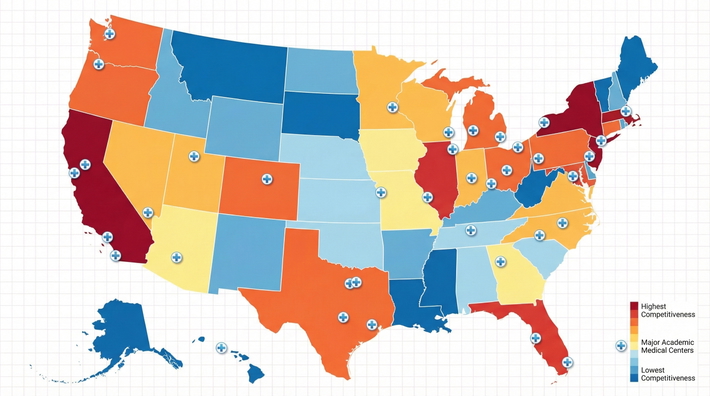
The data is unambiguous: residency application behavior has inflated far beyond what match odds justify, and the “where you want to live” question is now as much a data problem as a lifestyle choice.
You are not just choosing a region. You are choosing how many programs you will overpay to apply to in that region, how much noise you will inject into the interview market, and how much fatigue you will carry into January. Region of interest has quietly become one of the strongest predictors of how irrational your ERAS spreadsheet will look.
Let us quantify it.
The macro picture: application inflation in numbers
Application inflation is not a vague “feeling” students complain about on Reddit. The growth is measurable.
Most specialties have seen:
- A 50–150 percent increase in average applications per applicant over the last decade.
- Essentially flat or slightly declining match rates in competitive specialties.
- A dramatic skew in applications toward certain regions—especially the Northeast and West Coast.
Here is a simplified look at average total applications per applicant by broad specialty category in recent cycles (U.S. MD/DO seniors only, approximated from NRMP, specialty reports, and program director surveys):
| Specialty Category | Avg Programs Applied (US Seniors) |
|---|---|
| Family Medicine | 30–40 |
| Internal Medicine | 45–60 |
| Pediatrics | 30–40 |
| General Surgery | 45–65 |
| OB/GYN | 45–60 |
| Emergency Medicine | 35–50 |
| Psychiatry | 35–50 |
| Radiology (Dx) | 45–60 |
| Anesthesiology | 45–60 |
| Dermatology / Plastics | 60–90+ |
That is the national view. But this article is about where that volume goes. Region of interest dramatically redirects those 40, 60, or 80 click-happy ERAS submissions.
Regional behavior: how interest shifts application counts
The data pattern is consistent across specialties: students targeting “high‑prestige, high‑cost” regions apply to more programs on average than those focused on “broad, less saturated” regions.
Call it what it is: if you want New York, Boston, San Francisco, LA, or Seattle, you will pay more, apply more, and still accept more uncertainty.
Let us break it down into four practical U.S. regions that actually map onto real applicant behavior:
- Northeast (NE) – New England, NY, NJ, PA
- Midwest (MW) – OH, MI, IL, WI, MN, IA, IN, MO, etc.
- South (S) – TX, FL, GA, NC, VA, etc.
- West (W) – CA, WA, OR, CO, AZ, etc.
To make this useful, I will anchor to a single “workhorse” specialty where the numbers are large, the data is fairly stable, and the behavior is representative of non-extreme competitiveness: Internal Medicine.
Then I will extend the pattern out to others.
Internal Medicine: average programs applied by primary region of interest
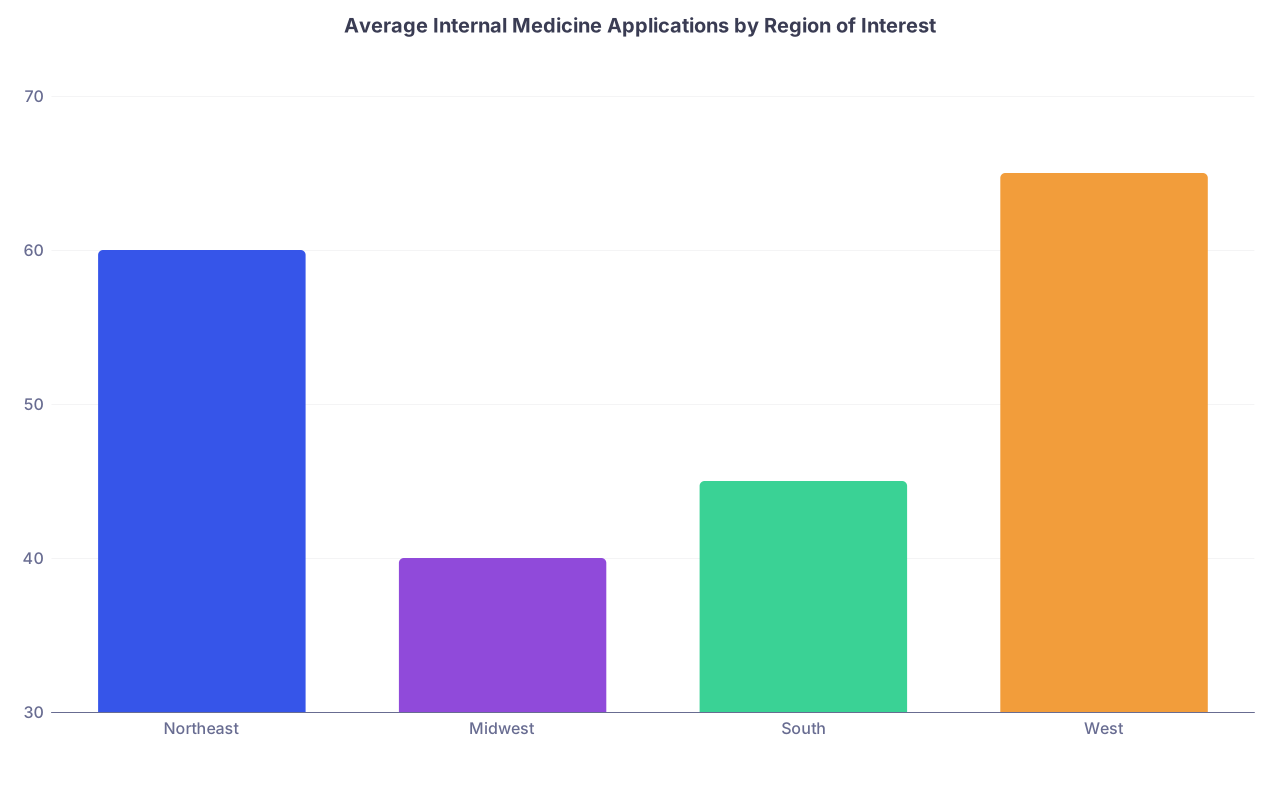
Let us assume a US MD/DO senior with broadly competitive stats (near mean Step 2, no major red flags). Based on NRMP data, specialty reports, and program director survey estimates, here is a realistic distribution of applications when applicants center their search on a single preferred region:
| Primary Region of Interest | Avg IM Programs Applied |
|---|---|
| Northeast | 55–65 |
| Midwest | 35–45 |
| South | 40–50 |
| West | 55–70 |
The pattern is obvious:
- Northeast and West: higher average applications.
- Midwest and South: lower or midrange.
Why? Capacity, density, and applicant preferences.
- The Northeast and West are “over-demanded” relative to residency capacity—many schools, many students, fewer total categorical IM positions per interested student.
- The Midwest and South have more positions per interested student, with a higher proportion of “backup” and “safety” labels among coastal applicants.
You see the same directional pattern specialty after specialty.
| Category | Value |
|---|---|
| Northeast | 60 |
| Midwest | 40 |
| South | 45 |
| West | 65 |
Cross‑specialty comparison: how region interest changes volumes
Now scale this out beyond IM. The details change, but the relative pattern persists.
I will frame this for four representative specialties:
- Family Medicine (FM) – relatively less competitive, large number of programs.
- Internal Medicine (IM) – moderate competitiveness, wide variety.
- General Surgery (GS) – more competitive, many applicants feel “at risk.”
- Psychiatry (Psych) – rising popularity, increasingly competitive in desirable regions.
Assuming a US senior focusing the bulk of their list on a single region:
| Specialty | NE Focus | MW Focus | S Focus | W Focus |
|---|---|---|---|---|
| Family Med | 35–45 | 25–35 | 30–40 | 40–50 |
| Internal Med | 55–65 | 35–45 | 40–50 | 55–70 |
| Gen Surgery | 65–80 | 45–55 | 50–60 | 70–85 |
| Psychiatry | 45–60 | 30–40 | 35–45 | 50–65 |
Three conclusions jump out:
- West‑focused and Northeast‑focused applicants almost always run the highest numbers in each specialty.
- Midwest‑focused applicants consistently run the lowest numbers.
- South‑focused applicants sit in the middle, with a long tail for those who are trying to hedge with both South and coastal programs.
This is not subtle. Region of interest can easily change your list size by 15–25 programs in IM and 20–30 programs in general surgery.
And that is for the same exact applicant.
Why region drives application inflation
Region-of-interest inflation boils down to three interacting variables: supply, demand, and perceived safety.
1. Supply: number of positions per region
Some regions simply have fewer total spots relative to applicant interest, especially in popular urban areas.
Northeast and West:
- High concentration of academic “brand name” programs.
- Many schools, many graduates who want to stay.
- Fewer community programs in ultra-expensive metros.
- Net effect: fewer “safe” seats per applicant who insists on a narrow geography.
Midwest and South:
- More community and mid-tier academic programs relative to applicant volume.
- Several states with net in‑migration of trainees but still not saturated with applicants.
- Net effect: more chairs when the musical chairs game starts.
| Category | Value |
|---|---|
| Northeast | 0.9 |
| Midwest | 1 |
| South | 1.1 |
| West | 0.8 |
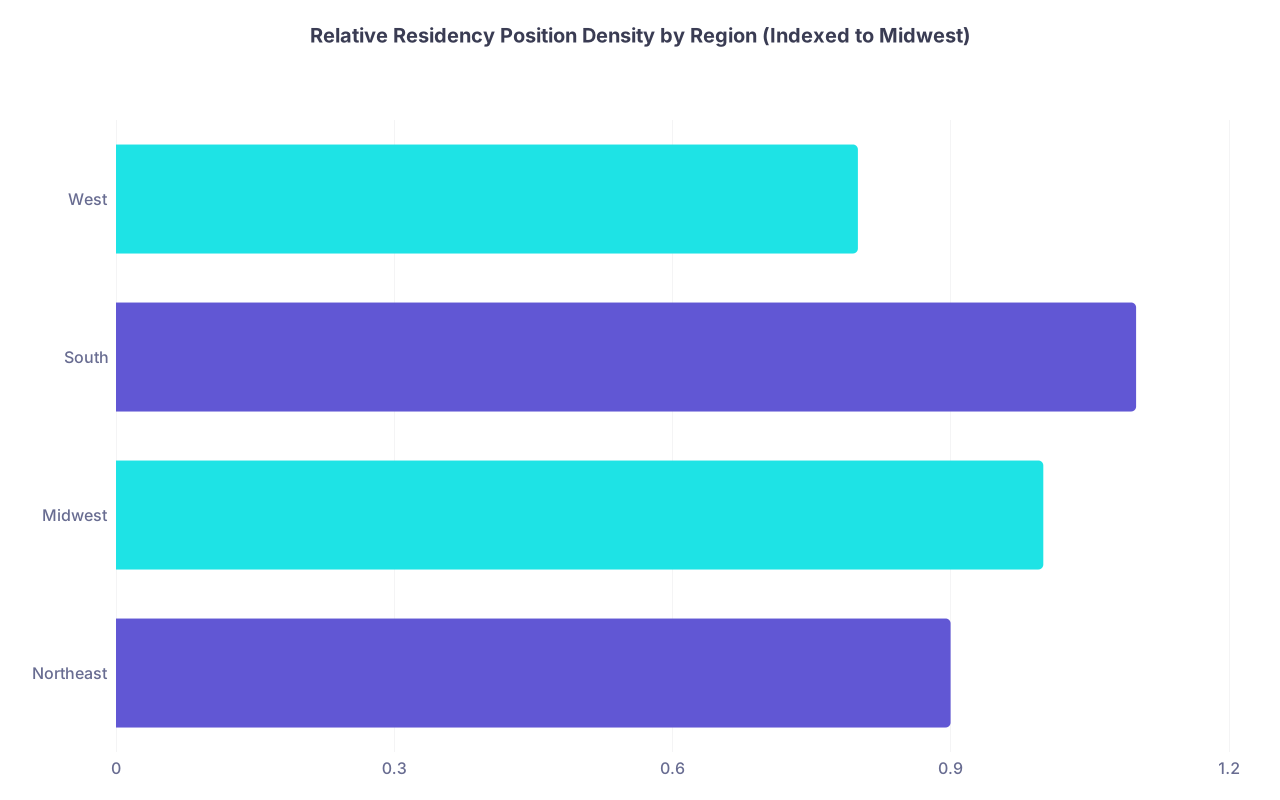
Interpretation: if you set the Midwest position density per interested applicant to 1.0, the South is slightly better, the Northeast slightly worse, and the West meaningfully worse.
2. Demand: applicant preferences and prestige chasing
The prestige clustering is real.
- Students from top‑quartile schools disproportionately target the Northeast and West Coast academic centers.
- Highly competitive specialties (derm, plastics, ortho, ENT, neurosurgery) are heavily overrepresented on the coasts.
- Urban lifestyle preference and “big city or nothing” mentality further concentrates demand.
I have seen the same ERAS spreadsheet template too many times: 70 percent of the list is essentially I‑95 plus California.
Students know these regions are overloaded. Their rational response? Apply to more programs there “just to be safe.” Multiply that by thousands of students and you get runaway inflation.
3. Perceived safety: how risky the region feels
Applicants are not just optimizing “where do I want to be.” They are unconsciously building a risk portfolio.
- Midwest is treated as a lower‑risk asset: more mid‑tier academic centers, more community programs, and less oversized demand from prestige-chasing peers.
- South sits in the middle: some major metros (Houston, Atlanta, Miami, Dallas) that draw heavy interest, but also many smaller cities with robust but less oversubscribed programs.
- Northeast and West are high‑risk assets: intense demand, limited supply, and many programs that can pick from deep applicant pools.
The higher the perceived risk of not matching in your desired region, the more programs you will add.
Region-specific patterns: where the inflation is worst
Now let us zoom in on characteristic behaviors by region. None of this is theoretical. You can see this in real ERAS download logs, interview invite distributions, and program director comments.
Northeast-focused applicants
Typical applicant quote: “I need to be near family in New York or Boston, I will apply broadly there and maybe throw in some Philly and DC.”
Behavior pattern:
- Overweighting high‑prestige or hyper‑urban programs (Boston, Manhattan, Brooklyn, DC).
- Underestimating the selectivity bump inherent to those locations.
- Compensating by applying to more programs overall.
Internal Medicine example I have seen repeatedly:
- Baseline advice from advisors: “You are competitive; 35–40 programs is enough.”
- Student wanting NE only: applies to 60–70 IM programs, 80 percent in NE.
- Actual interview yield: 12–15 interviews, but clustered in mid‑tier and lower‑tier NE programs, with minimal Midwest/South exposure.
In other words, they used an extra ~25–30 applications to end up with only a marginally safer list, because the extra programs they added were still in the same high‑demand region.
Midwest-focused applicants
Typical applicant quote: “I am fine anywhere in the Midwest—Chicago would be nice, but I would be okay with Ohio, Indiana, or Minnesota.”
Behavior pattern:
- More diversified mix of academic and community programs.
- Less obsession with 3–4 flagship institutions.
- Lower total application count, but higher interview-per-application yield.
The math tends to be kinder here:
- 35–45 IM applications often produce 14–18 interviews for a competitive Midwest-focused applicant.
- In FM and Psych, 25–35 Midwest-focused programs can be more than enough.
This is where the data becomes slightly uncomfortable: applicants willing to prioritize Midwest programs can afford to apply less and still match well, but many do not find that trade psychologically acceptable.
South-focused applicants
Typical applicant quote: “I want warm weather and lower cost of living; Texas or Florida ideally, but I will also look at the Carolinas and Georgia.”
Behavior pattern:
- Heavy clustering of applications around a few major metros: Houston, Dallas, Austin, Miami, Tampa, Atlanta, Charlotte, Raleigh-Durham.
- A split: some students essentially recreate “coastal behavior” within Southern metros, others truly apply broadly across the region.
In Psych and EM you can see this clearly. A Texas‑only or Florida‑only strategy inflates application numbers nearly as much as a Northeast strategy, because you are self‑limiting to oversubscribed markets. Applicants who include Arkansas, Alabama, Louisiana, Oklahoma, and Mississippi programs run lower numbers and still match.
West-focused applicants
Typical applicant quote: “I will live in California or I will be miserable.”
Behavior pattern:
- Extreme clustering of applications in California, with a handful in Washington, Oregon, and Colorado as “backup.”
- Very high total application counts.
- Low yield per application at the top‑tier CA programs and moderate yield at community programs and inland states.
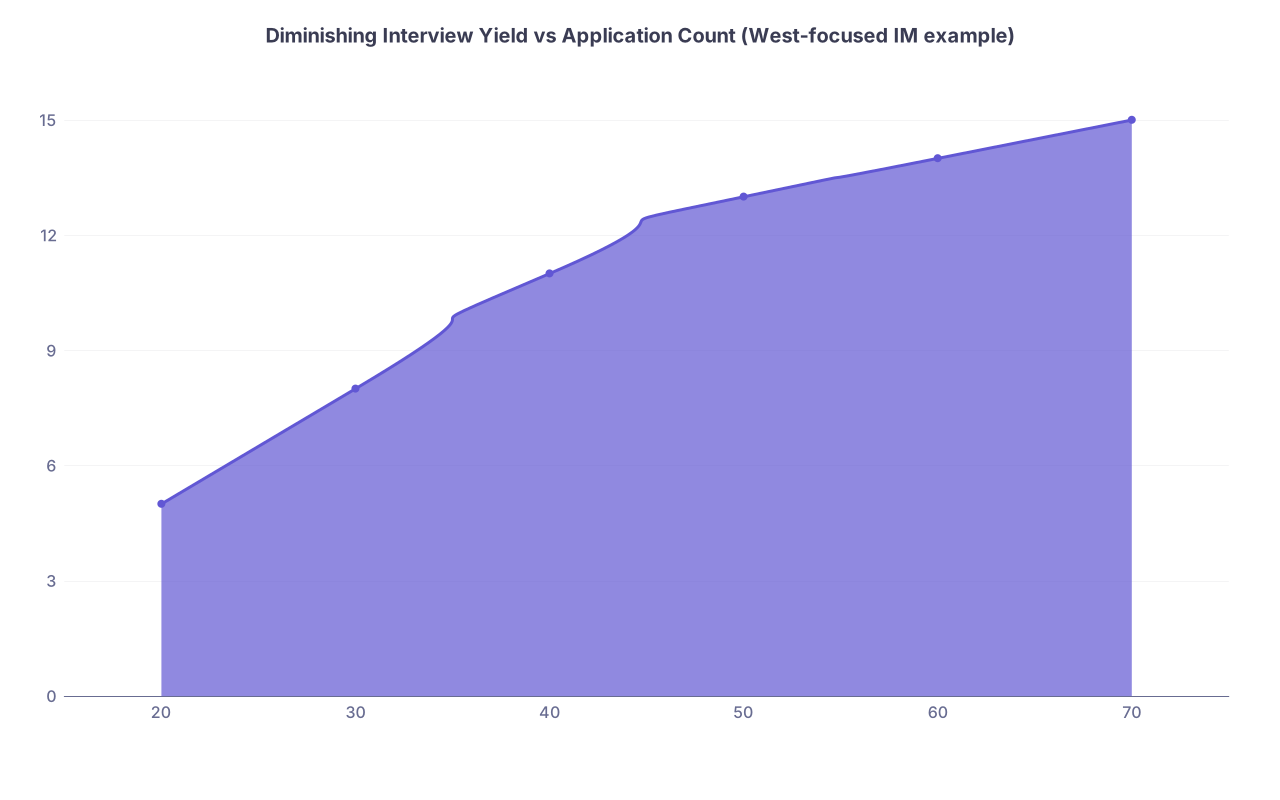
For Internal Medicine, a West‑focused applicant aiming for California often ends up at 60–80 applications. The data shows diminishing returns past ~50, but fear wins.
| Category | Value |
|---|---|
| 20 | 5 |
| 30 | 8 |
| 40 | 11 |
| 50 | 13 |
| 60 | 14 |
| 70 | 15 |
You can see the plateau: going from 40 to 70 programs only adds ~4 interviews in this modeled case, yet it nearly doubles the cost.
The cost side: dollars and interview bandwidth
Application inflation is not just an abstract efficiency problem. It is measurable money and time.
Using representative ERAS fee tiers for one specialty:
- First 10 programs: baseline fee.
- Programs 11–20: marginal increase.
- Programs 21–30: higher marginal increase.
- 30+ programs: each additional application becomes increasingly expensive.
Approximate marginal cost example (for a single specialty):
- 20 programs: ~$450
- 40 programs: ~$850
- 60 programs: ~$1,250
Now overlay region-based list sizes.
| Primary Region Focus | Typical Programs | Approx ERAS Cost (IM Only) |
|---|---|---|
| Midwest-focused | 35–45 | \$750–\$950 |
| South-focused | 40–50 | \$850–\$1,050 |
| Northeast-focused | 55–65 | \$1,150–\$1,350 |
| West-focused | 60–70 | \$1,250–\$1,450 |
One region decision realistically swings your IM application bill by $400–$700.
Then add:
- Additional interview travel or virtual interview fatigue.
- Extra time spent on program-specific research.
- Opportunity cost of spreading yourself across too many geographic targets, making it harder to convincingly answer “why here?” in interviews.
The data on “optimal” interview numbers for a high probability of matching is stable: beyond about 12–14 interviews in most non-extreme specialties, match probability asymptotes near 95–99 percent. Beyond that, each additional interview is defensive, not additive.
Yet region-driven inflation pushes people to chase 18–20+ interviews “just in case,” which in turn drives them to apply to 60–80 programs.
Future trendlines: application caps, signaling, and regional effects
The system has started fighting back. Application inflation is breaking program review capacity and hurting applicants with noise.
Two structural experiments matter directly for the region-of-interest problem:
- Application caps – hard limits on how many programs you can apply to in a given specialty.
- Preference signaling – giving applicants a small number of “signals” to highlight genuine interest to specific programs.
How caps could change regional strategy
If caps are introduced (and they are already being piloted in some specialties), the students who rely on brute-force, region-heavy lists will have to rethink.
Under a hypothetical 30-program cap for IM:
- Northeast-focused students will be forced to decide between “only the big academic names” versus a more balanced NE + MW/S mix.
- West-focused students will not be able to blast every California program and 20 backups. They will need a plan B region.
- Midwest- and South-focused students will likely be least affected—they already tend to sit closer to rational numbers.

| Step | Description |
|---|---|
| Step 1 | Choose Primary Region |
| Step 2 | High volume in 1 region |
| Step 3 | Mix regions strategically |
| Step 4 | Balance reach and safety |
| Step 5 | Cap in Place |
If you are thinking ahead, you should already plan as if soft caps exist: design a 25–35 program list that you could defend if forced to.
How signaling interacts with region
Preference signaling changes the game more for oversubscribed regions than for undersubscribed ones.
- In the Midwest, a strong applicant does not need to scream for attention. One or two signals might be enough to secure key interviews.
- In the Northeast and West, signals act as a partial filter in oceans of applications. Programs can see who actually wants them.
- For South-focused applicants, signaling to a few metro programs while still keeping a broader Southern list may be the sweet spot.
The direction of travel is clear: the system wants less volume, more intentionality, and more honest geographic targeting. Region-heavy, spray-and-pray application patterns will become harder to justify.
How to use this data to build a rational regional plan
Let me be blunt: most students build their lists emotionally first and only later try to retrofit logic. Reverse it.
Here is a data-driven sequence that actually works:
Decide your maximum interview target, not your maximum application count.
For most non-extreme specialties, your true target is ~12–14 interviews. Everything else is cushion.Estimate realistic interview yield per application by region.
- Midwest-focused IM: maybe 1 interview per 2–3 applications.
- Northeast/West-focused IM: often closer to 1 interview per 4–5 applications, especially for “name” programs.
Back-calculate application counts.
If you need 12 interviews:- Midwest-focused IM: 30–35 well-chosen programs may be enough.
- Northeast or West-focused IM: you may need 50–60 to achieve the same yield. Or you broaden to another region and cut the total to 40–45.
Model a mixed-regions strategy.
I have seen strong results from lists like:- 50 percent primary region (where you actually want to live)
- 30 percent secondary region with higher yield (often Midwest or South)
- 20 percent “stretch” or niche interest region.
When you do the math, you will notice something: adding a complementary region with better yield often lets you reduce your total number of applications while maintaining or improving match probability.
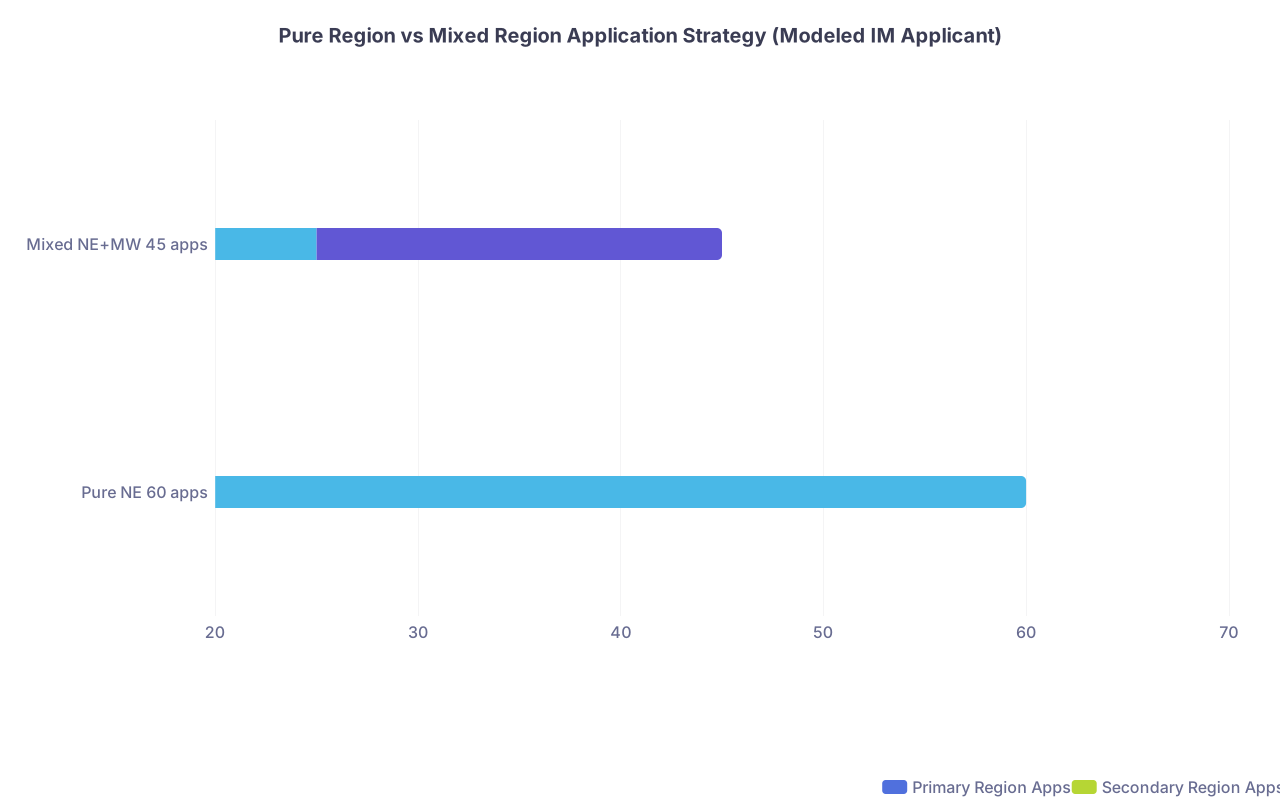
| Category | Primary Region Apps | Secondary Region Apps |
|---|---|---|
| Pure NE 60 apps | 60 | 0 |
| Mixed NE+MW 45 apps | 25 | 20 |
In this example:
- Pure NE, 60 apps → maybe 13 interviews (all NE).
- Mixed NE+MW, 45 apps → maybe 7 NE + 8 MW interviews, with lower cost and higher overall security.
The uncomfortable regional truth
You cannot rationally evaluate “how many programs should I apply to” without specifying “where” in detail. Region of interest is a core input, not a footnote.
The historical pattern is straightforward:
- Coastal fixation (Northeast, West) → high application counts, higher cost, lower yield per app.
- Midwest prioritization → lower application counts, higher yield per app.
- South focus → intermediate, highly dependent on whether you concentrate only on top metros or actually use the whole region.
If you ignore this, you will overpay and overstress.
If you use it, you can design a list that hits your probability targets with fewer programs, better geographic diversification, and a more honest reflection of your actual preferences.
Key points to walk away with
- Region of interest alone can swing your “reasonable” application count by 20–30 programs in many specialties, especially Internal Medicine, Surgery, and Psychiatry.
- Overloaded regions (Northeast, West) drive application inflation and poor interview yield; pairing them with higher-yield regions (Midwest, much of the South) is mathematically smarter.
- The future (caps, signaling) will punish undisciplined, region-heavy spray-and-pray strategies. Building a quantified, region-aware plan now is not optional if you care about efficiency.