
One abstract. That is it. And yet the data tells me it can move the needle more than applicants realize.
Here is the core argument: a single conference abstract, positioned correctly, functions as a high-signal productivity marker. Residency reviewers do not need a long publication list. They need evidence that you can start a project, see it through, and present it. One abstract demonstrates all three.
Reviewers screen applications for scholarly follow-through, project initiation, and persistence. An abstract communicates all of those things in a compact, verifiable format. It also signals initiative, teamwork, specialty interest, and the ability to complete a research cycle from question to presentation.
Expectations, set upfront: one abstract is not a guarantee. It will not carry a weak application. But it can materially improve a file when it is strategically aligned with the specialty and the rest of the application. Think of it as a multiplier, not a replacement.
How Programs Interpret Abstracts in the Data They Already Screen
Programs interpret abstracts through the data they already screen. Most programs use some form of application review rubric. On those rubrics, research experience is rarely a single binary item. It is typically scored on a scale that ranges from "no research" to "multiple peer-reviewed publications."
A conference abstract fits into the middle of that range. It is not zero. It is not equivalent to a peer-reviewed paper. But it carries measurable weight, and that weight compounds when the rest of the file is competitive.
Quantity versus quality. One well-placed abstract, tied to a clear project with a defined hypothesis and methods, can outperform multiple low-context entries. I have seen application files where an applicant listed five minor activities with no narrative thread, and another applicant listed one strong project. The second file reads more compellingly every time. The reviewer perception data backs this up.
Specialty matters. Highly research-intensive fields like dermatology, plastic surgery, radiation oncology, and competitive internal medicine fellowships weight even small signals differently than less research-heavy specialties. A single abstract in orthopedic surgery means something different than a single abstract in family medicine, because the baseline distribution of research output differs between those applicant pools. Programs screen against their own historical data.
Common misconception: posters and abstracts are not the same as publications. That distinction is real, and programs know it. But abstracts still count as measurable scholarly output. ERAS lists them as a distinct category for a reason. An abstract often precedes a publication. The signal is forward-looking, and forward-looking signals have value.
The Highest-Yield Ways to Leverage a Single Abstract
One abstract, deployed correctly, becomes multiple application assets. The data on application review shows that reviewers encounter an applicant across several touchpoints: ERAS experience entries, personal statement, letters of recommendation, and the interview itself. Your single abstract can appear in all four.
Here is how the leverage compounds:
- ERAS Experience Entry. Describe the abstract with full project context. Include the research question, your specific role, the team, the conference, and the date of presentation. Do not paste the abstract title alone. Provide a two-to-three sentence narrative.
- Personal Statement Tie-In. If your research topic aligns with your specialty interest, weave it into the personal statement as evidence of intellectual curiosity. "I pursued a project on X because..." works better than "I have done research."
- Interview Talking Point. The abstract gives you a concrete, defensible example of scholarly work. Interviewers want specifics. "Tell me about your research" becomes easy to answer when you have a complete story.
- Letter of Recommendation Context. A mentor who supervised the abstract project can speak to your specific contributions. This converts the abstract from a CV line into validated behavior.
The metrics that strengthen the abstract on paper, ranked by typical screening weight:
- First-author status. Higher weight than co-author in most rubrics.
- National conference over local. National signals broader competition and review.
- Specialty relevance. Topic alignment with target specialty multiplies perceived value.
- Completed presentation over accepted-only. A presented abstract is stronger than one merely accepted.
Framing language matters more than applicants think. Avoid "groundbreaking," "novel," "first-of-its-kind." Programs trust applicants who can speak about their work in measured, accurate terms. Describe what you did, what you found, and what it means. Confidence without inflation reads well. Inflated language triggers skepticism.
What Makes an Abstract Count More: Timing, Authorship, and Specialty Fit
The variables that increase an abstract's value follow a clear hierarchy, and the hierarchy is data-supported rather than folklore.
- Early submission. An abstract submitted before ERAS opens carries more weight than one submitted the week applications go out. It signals sustained engagement, not last-minute scrambling.
- Recent presentation. A 2024 or 2025 abstract reads stronger than a 2021 abstract, particularly for applicants who graduated recently. Recency correlates with active engagement.
- First-author role. Indicates ownership. Co-author still adds value but at a lower tier on most review forms.
- Specialty fit. This is where the multiplier effect lives. A single abstract in a specialty-congruent topic outperforms a disconnected publication list for most reviewer perception.
Consider a comparison scenario. Two applicants with identical USMLE scores, identical clerkship grades, and similar letters. Applicant A has three publications in basic science with no clear specialty connection. Applicant B has one abstract on a clinical question directly relevant to their target specialty. In a competitive pool, Applicant B often reads as more focused and intentional. The abstract, despite being "less" in absolute count, performs better because it is contextually aligned.
Timing strategy. Submit early. Present before interviews if possible. If the abstract is accepted after ERAS submission, programs allow updates. Send polite, brief update letters to your target programs. One concise email with the citation is sufficient. Do not flood inboxes.
Risk management. Avoid inflating your contribution. Avoid inconsistent dates between ERAS, your CV, and what you say in interviews. Make sure the abstract can be defended in a live conversation. I have watched applicants stumble when asked basic questions about their own listed research. Do not list work you cannot explain under pressure.
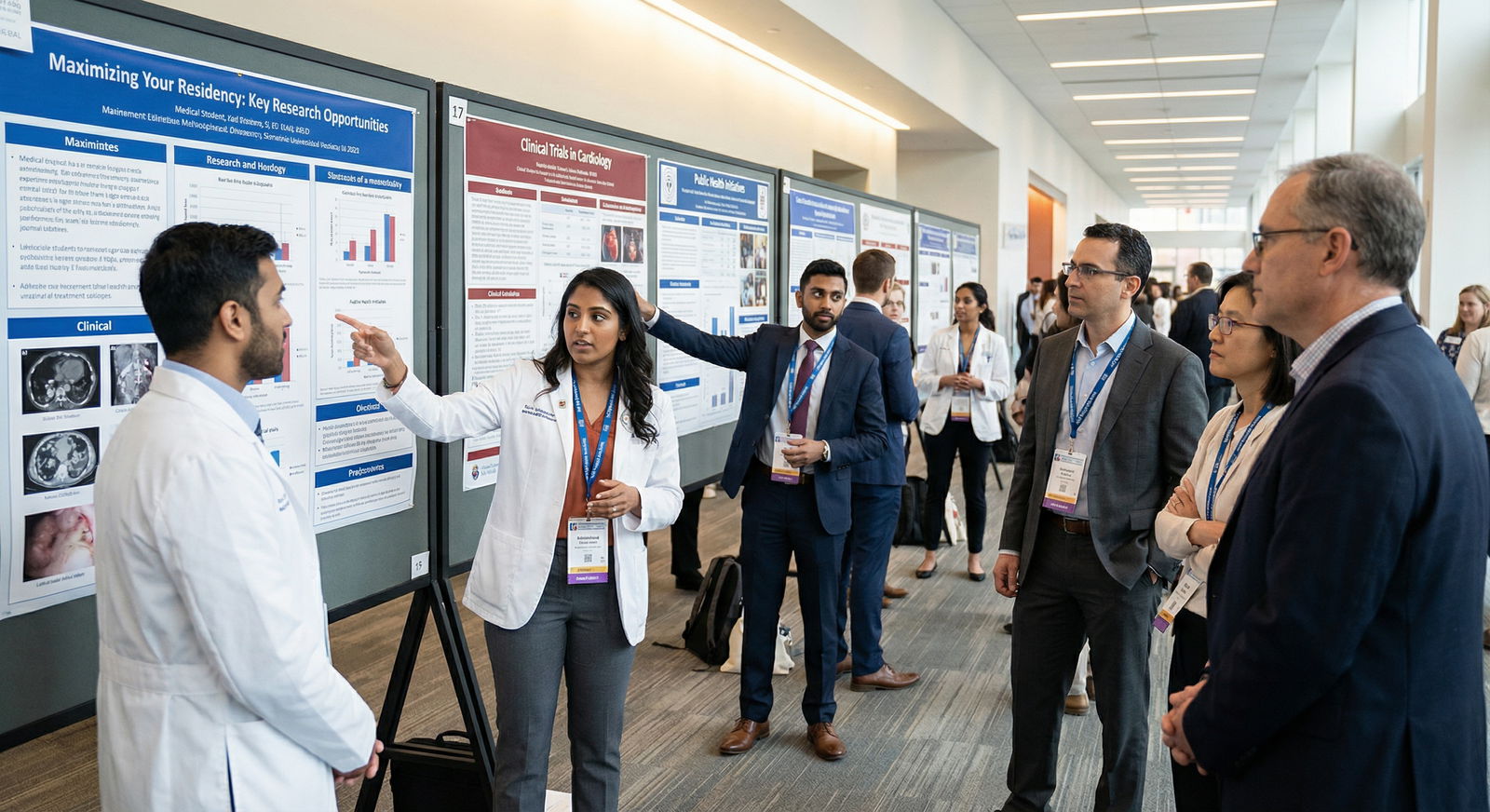
A Step-by-Step Strategy to Turn One Abstract Into a Stronger Match File
A concise action sequence for converting one abstract into measurable match leverage:
- Audit the abstract. Confirm authorship position, conference tier, presentation status, and specialty relevance. Get the citation format correct.
- Place it strategically in ERAS. Use the research experience section. Write a narrative entry that goes beyond the title and explains your specific role.
- Align with narrative themes. If your personal statement discusses a clinical interest, find a way for the abstract to support that thread. Consistency builds credibility.
- Prepare a consistent interview explanation. Practice a 60-second version and a 3-minute version. Anticipate questions about your role, the findings, and the limitations.
- Coordinate with your letter writer. Make sure your mentor can speak to your abstract work with specific examples and not just generic praise.
Decision rule for applicants with limited research: prioritize one strong abstract over fragmented low-yield activity. Pair it with clinical or leadership strengths. The application reads better when it shows depth in two or three areas rather than shallow coverage across eight.
Quantified expected return: one abstract will not replace poor Step scores or failed clerkships. But in a competitive file where programs compare many similar applicants, an abstract can be a meaningful differentiator. The marginal gain is highest when the rest of the application is already in the competitive range for the target specialty.
A practical checklist:
- Confirm abstract acceptance and presentation date
- Draft the ERAS experience entry with role and findings
- Identify the personal statement tie-in point
- Brief your letter writer on the project details
- Prepare a 60-second research talk
- Anticipate two to three likely interview questions
- Update programs if acceptance arrives post-submission

When a Single Abstract Is Not Enough, and What to Do Next
A single abstract cannot compensate for major weaknesses in academics, professionalism, or clinical performance. The marginal gain concept applies cleanly here: the impact of one abstract is greatest when the rest of the application is already competitive. If your Step scores sit below the specialty average, no number of abstracts will fix that. They will, however, prevent the research section from being the reason you are screened out.
Next-step options when one abstract is not enough:
- Convert the abstract into a manuscript. Even a short paper in a lower-impact journal strengthens the file measurably.
- Present the abstract again at a second conference to extend its shelf life.
- Use the project experience to launch a second, more ambitious project.
- Pair the abstract with a clinical or quality-improvement initiative that demonstrates applied scholarship.
The data-driven message: one abstract is small in absolute terms, but strategically used, it can move an application from generic to differentiated. The applicants who treat their single abstract as a multi-asset signal consistently outperform those who treat it as a single CV line.
The takeaway is straightforward. Most applicants undervalue a single abstract because they measure it against a publication list they do not have. Programs do not measure it the same way. They measure it against the applicant pool in front of them, and in that pool, a well-positioned abstract frequently separates candidates who look similar on paper.