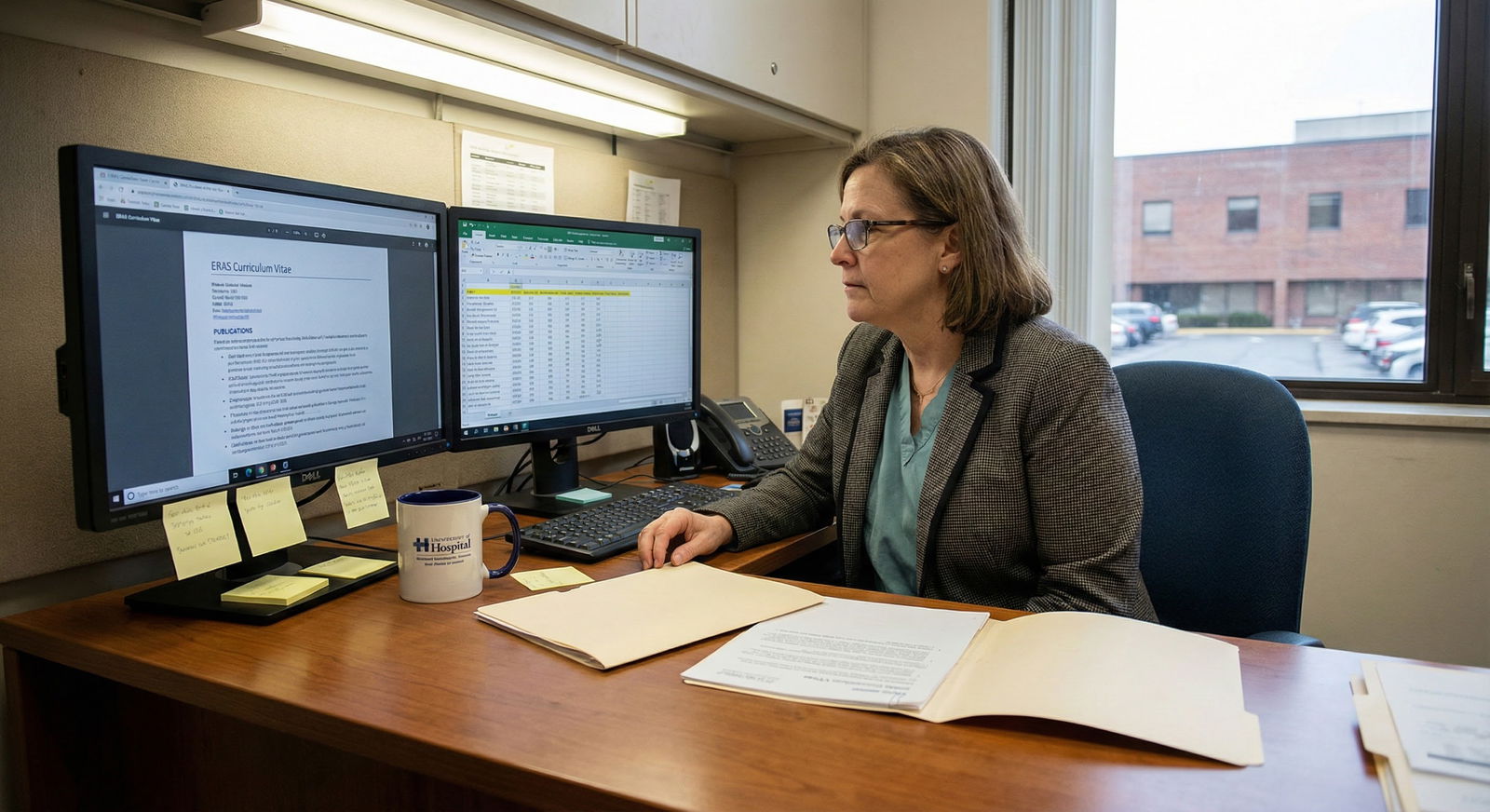
Most residency applicants destroy their own research story by telling three different versions of it.
ERAS says one thing.
The personal statement says another.
The interview answers? Completely different narrative.
Programs notice. They may not call it out, but they feel the disconnect. And “inconsistent story” is one of the quiet reasons people get ranked lower than their stats and CV deserve.
Let me fix that for you.
This is a step‑by‑step system to align your research story across:
- ERAS application
- Personal statement
- Interview answers
So you sound like one coherent, deliberate person instead of three slightly confused versions of yourself.
Step 1: Build a One‑Page Research Story Blueprint
Before touching ERAS, PS, or interview prep, you need a single source of truth.
Take 30–45 minutes and draft a one‑page research story blueprint. This is the backbone you will reuse everywhere.
A. List your research experiences (all of them)
On a blank page (or doc), write every research experience:
- Lab or clinical projects
- Quality improvement (QI)
- Chart reviews, database work
- Case reports, conference abstracts, posters, presentations
- Summer research programs, research years
For each, jot:
- Title / topic (informal is fine)
- Dates
- PI / mentor
- Your role (1–2 words: “data collection,” “study design,” “stat analysis,” etc.)
- Output (poster / abstract / manuscript / nothing yet)
No editing. Get it all down.
B. Extract 3–4 core research themes
Now you are going to find the through‑line. Not the random list.
Ask yourself:
- What types of questions did I keep coming back to?
- What patient population or problem shows up again and again?
- What skills did I actually learn and use repeatedly?
- What changed in how I think about medicine because of this work?
From that, pull out 3–4 themes. Examples:
- “Improving care transitions for high‑risk patients”
- “Emergency stabilization and acute decision‑making”
- “Health disparities and access to care”
- “Applied data science in clinical decision‑making”
- “Medical education and how trainees learn procedures”
Write them clearly. No buzzword soup. Think: “If I said this in an interview, would a normal attending know what I mean?”
C. Write your 3‑sentence research narrative
Now condense your entire research identity into three sentences:
Sentence 1 – Origin:
Why you got into research in the first place.“I started research because I wanted to understand why some of my patients on the medicine wards kept bouncing back to the hospital, even when we thought we did everything right.”
Sentence 2 – Evolution:
How your projects connect around a few themes.“Over time, that interest led me to projects on care transitions, readmission risk, and later a QI project focused on improving discharge education.”
Sentence 3 – Direction:
How this links to your future in that specialty.“Going into internal medicine, I want to keep doing pragmatic, frontline research that directly improves how we manage high‑risk patients after discharge.”
This three‑sentence block is the spine. You will adapt it slightly for:
- ERAS experiences “overview”
- Personal statement intro / body
- Interview questions like “Tell me about your research” and “Where do you see your career going?”
D. Define your research “brand” in one line
This is blunt, but it works. Finish this:
“If a PD remembers one thing about my research, I want it to be that I am the applicant who works on [X] using [Y] skills.”
Examples:
- “…works on acute stroke systems of care using clinical outcomes and database analysis.”
- “…works on surgical quality and complications using QI methods and multi‑center data.”
- “…works on childhood asthma and health equity using community‑based research and QI.”
This one line should govern what you emphasize everywhere.
Step 2: Make ERAS Work For Your Story (Not Against It)
Most people treat ERAS like a dumping ground. That is how you get a fragmented story.
You will use ERAS to visually reinforce your story blueprint.
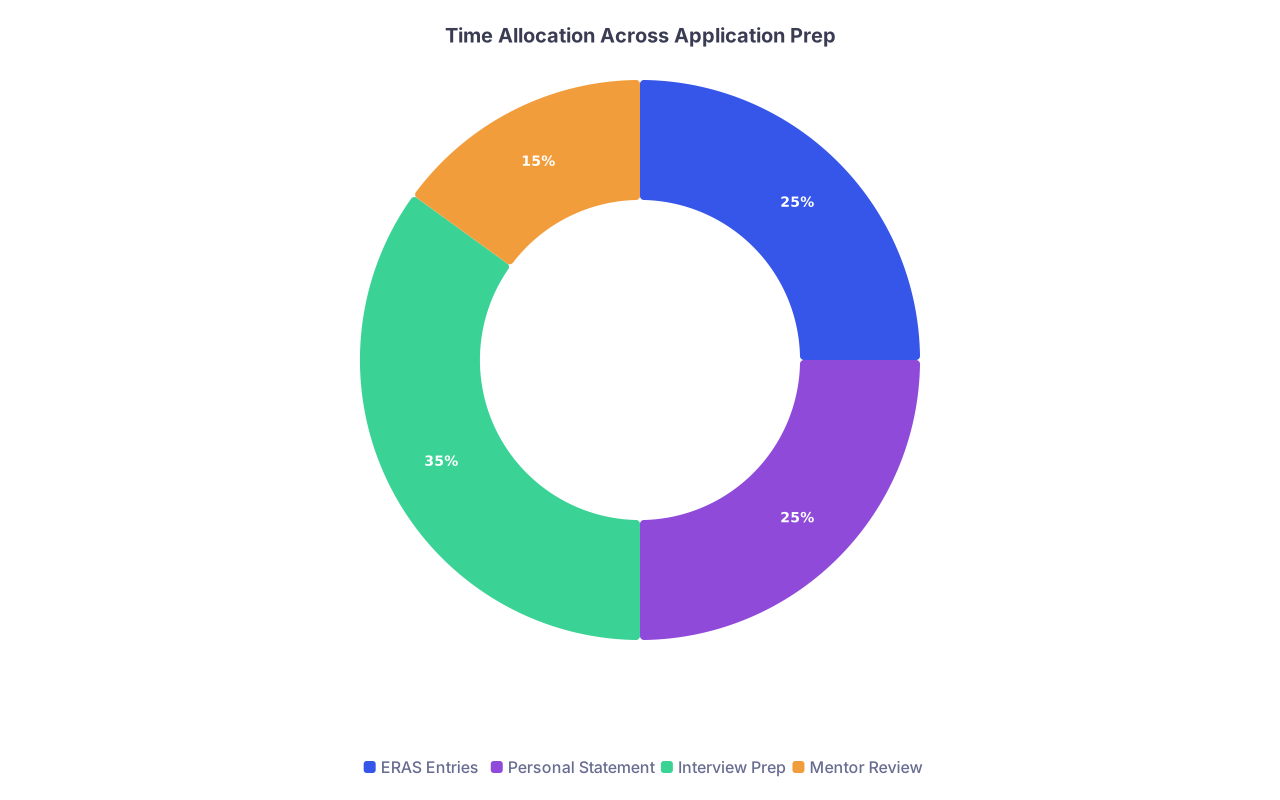
| Category | Value |
|---|---|
| ERAS Entries | 25 |
| Personal Statement | 25 |
| Interview Prep | 35 |
| Mentor Review | 15 |
A. Choose which projects get spotlight vs background
Not every project deserves equal airtime.
Use this simple rule:
Spotlight (detailed entries):
- Aligned with your 3–4 themes
- Show increasing responsibility or skills
- Have meaningful output (poster, manuscript, major QI change)
Background (short / combined or omitted if trivial):
- One‑off case reports unrelated to your main focus
- Short shadow‑type roles where you did almost nothing
- Projects where you cannot discuss methods or findings coherently
Better to have 3–5 clearly described projects that hang together than 11 disjointed things you barely recall.
B. Write ERAS research entries that tell a mini‑story
For each main research entry, you need three parts:
- Context (1 sentence) – What was the question or problem?
- Your role (2–3 concrete actions) – What you actually did.
- Outcome / skill gained (1–2 points) – What came out of it and what you learned.
Example (bad vs good):
Bad:
“Retrospective study of COPD readmissions. Helped with data collection and analysis. Submitted abstract to ATS.”
Good:
“Retrospective study examining factors associated with 30‑day COPD readmissions in a safety‑net hospital. I designed the data collection sheet, extracted chart data for 250 patients, and performed multivariable logistic regression under supervision. This project strengthened my skills in R, helped our team identify modifiable discharge factors, and led to an abstract accepted at ATS.”
The good version:
- Fits your blueprint (“care transitions / readmissions” theme)
- Shows real responsibility
- Sets you up for interview questions later
C. Standardize titles, dates, and roles
Programs hate guessing.
Use consistent project titles across ERAS, PS, and interviews.
- Do not call it “COPD transitions project” in one place and “Readmission initiative” in another. Pick one.
Keep dates aligned with reality.
- If IRB approval dragged, fine. But do not have one project ending in 2023 in ERAS and call it “current” in your PS.
Be honest but clear about your role:
- “Co‑first author” only if that is actually the case.
- “Contributed to study design and data analysis” is sufficient; you do not need to sound like the PI.
| Type | Vague Description | Clear Description |
|---|---|---|
| Data Work | Helped with data | Extracted 300 charts, built REDCap database |
| Analysis | Assisted with statistics | Performed logistic regression in R under mentor |
| Writing | Helped write paper | Drafted introduction and methods sections |
| QI Project | Worked on discharge project | Designed checklist and tracked 60 discharges |
Use the “clear description” style every time.
D. Connect publications and presentations back to projects
Do not let your CV look like a random storm of titles.
When you list:
- Publications
- Abstracts
- Posters
- Oral presentations
Use the same short project name somewhere in the description or parentheses.
Example:
- ERAS experience: “COPD readmissions quality improvement project”
- Poster: “Factors associated with 30‑day COPD readmissions in a safety‑net hospital (COPD readmissions QI project).”
That way, when a PD skims, they see: “Oh, that project led to real output.” Your story tightens.
Step 3: Rewrite Your Personal Statement Around One Research Spine
Most research‑heavy applicants misuse the personal statement. They either:
- Write a generic “why I love [specialty]” essay and cram in one awkward paragraph of research, or
- Turn it into a grant application background section.
Both are weak.
You are going to build the PS around your research spine, while still sounding like a future clinician, not a PhD candidate.

A. Choose one anchor project and 1–2 supporting ones
The personal statement is not a catalog. It is a story with a main thread.
Pick:
1 anchor project – the one that:
- Best represents your themes
- You can talk about easily and confidently
- Has at least some outcome or interesting learning
1–2 supporting projects – to show progression, breadth, or a shift in focus.
That is it. Everything else stays in ERAS and interviews.
B. Use a simple 4‑part PS structure
Hook (1–2 paragraphs):
- A moment, patient, or research‑related experience that illustrates why you care about your research topic.
- Avoid cliché patient‑death narratives unless they are truly central and you can handle the nuance.
Research journey (2–3 paragraphs):
- Walk the reader through your anchor project.
- What was the question? What did you actually do? What surprised you?
- Then add 1–2 supporting projects that show growth or refinement of your interests.
Clinical link (1–2 paragraphs):
- Connect how your research changed how you think at the bedside.
- “Because of this project, I now pay attention to X when admitting Y,” or “It made me more systematic about Z.”
Future direction (1 paragraph):
- Tie your themes to what you want in residency:
- “I hope to continue working on QI around…”
- “I am interested in residency programs that support resident‑led research in…”
- Tie your themes to what you want in residency:
C. Maintain tight consistency with ERAS
Cross‑check:
- Are project names and timelines consistent with ERAS?
- Are your roles described at the same level (not exaggerated)?
- Are your themes clearly recognizable from your blueprint?
If in your blueprint your themes are “health disparities and QI in ED flow,” but in the PS you ramble mostly about neuroscience lab work from M1 that you barely remember, you just broke your story.
Fix it. Align.
D. Avoid these 4 research PS mistakes
Dumping statistics instead of insight
- Weak: “We studied 300 patients and found a 20 percent relative risk reduction…”
- Strong: “What mattered to me was watching how a small checklist change led to fewer missed follow‑up appointments.”
Sounding like you dislike clinical work
- If all your passion is in the lab and you barely mention patients, PDs worry. Explicitly link research to better patient care.
Over‑selling your role
- Your interview will expose this immediately. If you say you “designed the trial” and then cannot explain sample size or primary endpoint, they will not forget.
Listing every paper and poster
- That is what your CV is for. In the PS, depth beats breadth.
Step 4: Prepare Research Interview Answers That Match the Written Story
If ERAS and PS are the script, the interview is the live performance. This is where misalignment kills you.
You need rehearsed, flexible answers that map directly to your blueprint.

| Step | Description |
|---|---|
| Step 1 | Research Story Blueprint |
| Step 2 | ERAS Entries |
| Step 3 | Personal Statement |
| Step 4 | Interview Answers |
| Step 5 | Consistent Project Names |
A. Core questions you must master
At minimum, you should have tight answers for:
- “Tell me about your research.”
- “What was your role on your main project?”
- “What did you learn from doing research?”
- “How do you see research fitting into your career?”
- “Tell me about a challenge or failure in research.”
- “Explain this project / poster / paper” (they may point directly to your ERAS).
B. Build your “Tell me about your research” answer
Use your three‑sentence narrative from Step 1, then add 2–3 specifics.
Example structure:
Start with the 3‑sentence overview:
- Origin → evolution → direction.
Highlight 1–2 projects that represent your themes:
- 20–40 seconds each.
- Focus on question, your role, and what you found or learned.
End with a forward‑looking line:
- How this fits with their program / your future.
Total time: 2–3 minutes. Not a TED Talk. Not 20 seconds.
C. Answer “What was your role?” with clarity and humility
Programs are testing whether the person on paper is the person in front of them.
Use this formula:
Start with where you joined in the project lifecycle.
- “I joined after the initial idea was developed, when the team was planning data collection.”
Name 3–4 concrete tasks you owned.
- “I built the REDCap database, extracted data for ~200 charts, cleaned the dataset, and ran the primary regression under supervision.”
Mention 1 thing you did not do to signal honesty.
- “I did not design the original protocol or write the IRB, but I reviewed those documents with my mentor so I understood the rationale.”
That mix of competence + honesty builds trust immediately.
D. Translate methods into plain language
You will lose faculty if you bury them in jargon.
Practice explaining:
- Study design
- Primary outcome
- Main methods
In plain English first, then in technical terms if asked.
Example:
- Plain: “We looked back at charts to see which factors were associated with patients coming back to the hospital within 30 days after discharge for COPD.”
- Technical: “It was a retrospective cohort study with 300 patients, and we used multivariable logistic regression to identify predictors of 30‑day readmission.”
Be fluent in both.
E. Handle gaps, null results, and messy stories
Every project has something awkward:
- The paper never got published
- The results were negative
- You left before completion
- The mentor disappeared
Do not dodge. Clean it up like this:
Acknowledge reality:
- “That project did not make it to publication.”
Add what did happen:
- “We did present it as a poster at our regional conference.”
Extract a learning or skill:
- “Even though the results were null, it taught me a lot about careful data cleaning and how hard it is to change readmission rates with a single intervention.”
Programs care more about your maturity than your hit rate.
Step 5: Stress‑Test Your Consistency
Now you have:
- A research story blueprint
- ERAS aligned to that story
- PS structured around one spine
- Interview answers mapped to the same themes
You are not done until you stress‑test for alignment.
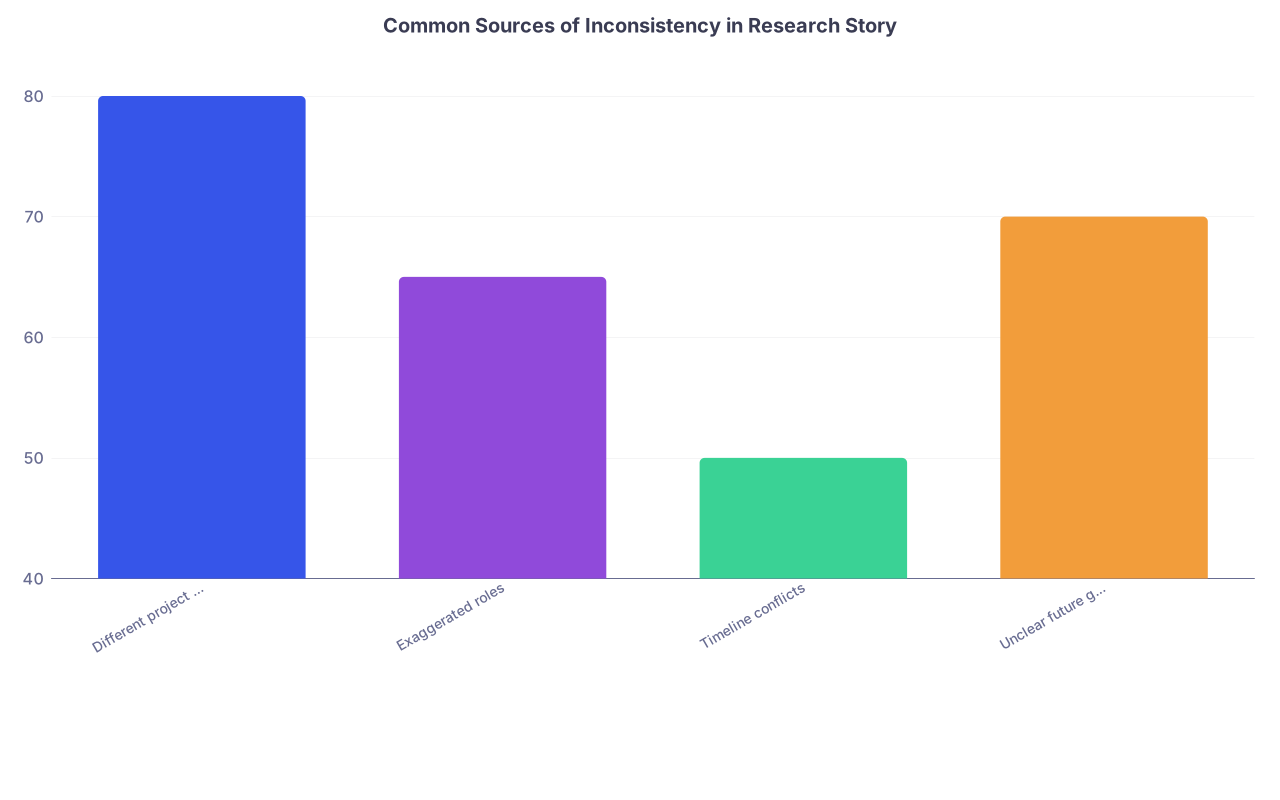
| Category | Value |
|---|---|
| Different project names | 80 |
| Exaggerated roles | 65 |
| Timeline conflicts | 50 |
| Unclear future goals | 70 |
A. Do a vertical read by project
Pick your main project. For that single project, read:
- ERAS entry
- Any pubs / posters listed
- PS mention
- Your prepared interview answer notes
Ask:
- Are the titles consistent?
- Are the dates consistent?
- Is your role described the same way (or reasonably close)?
- Are the main takeaways the same?
If not, fix the written parts now and rewrite your interview notes.
Repeat for your second‑most important project.
B. Do a horizontal read by theme
Now skim everything for your 3–4 themes:
- Do they actually show up, in some form, in each domain (ERAS, PS, interview prep notes)?
- Are you over‑emphasizing a side project in your PS that barely appears in ERAS?
- Does your “future direction” line in the PS match what you say when asked “Where do you see yourself in 5–10 years?”
If you say in your PS:
“I am deeply committed to a career as a physician‑scientist with significant protected research time.”
But in the interview, when asked about the future, you say:
“I am not entirely sure; I might want a community job, maybe teaching,”
you just confused your audience. Pick a range that makes sense and stay within it.
You can express uncertainty without sounding unmoored:
“I know I want research to remain part of my career. Right now I am open to whether that is as a clinician‑educator who does QI and outcomes projects, or in a more traditional physician‑scientist role if I find the right mentorship.”
Aligned. Honest. Not rigid.
C. Get one knowledgeable person to cross‑check
Send three things to a mentor or trusted senior resident:
- Your ERAS experiences section
- Your personal statement
- A bullet outline of your research interview answers
Ask them explicitly:
- “Does this feel like one coherent story?”
- “Where do I sound inconsistent or unclear about what I actually did?”
- “If you were a PD, what single research theme would you remember about me?”
If their answer to #3 does not match what you wrote in your one‑line “brand,” revise until it does.
Step 6: Practical Implementation Timeline
You are likely juggling rotations, Step 2, and 20 other things. So here is a bare‑bones, realistic order of operations.
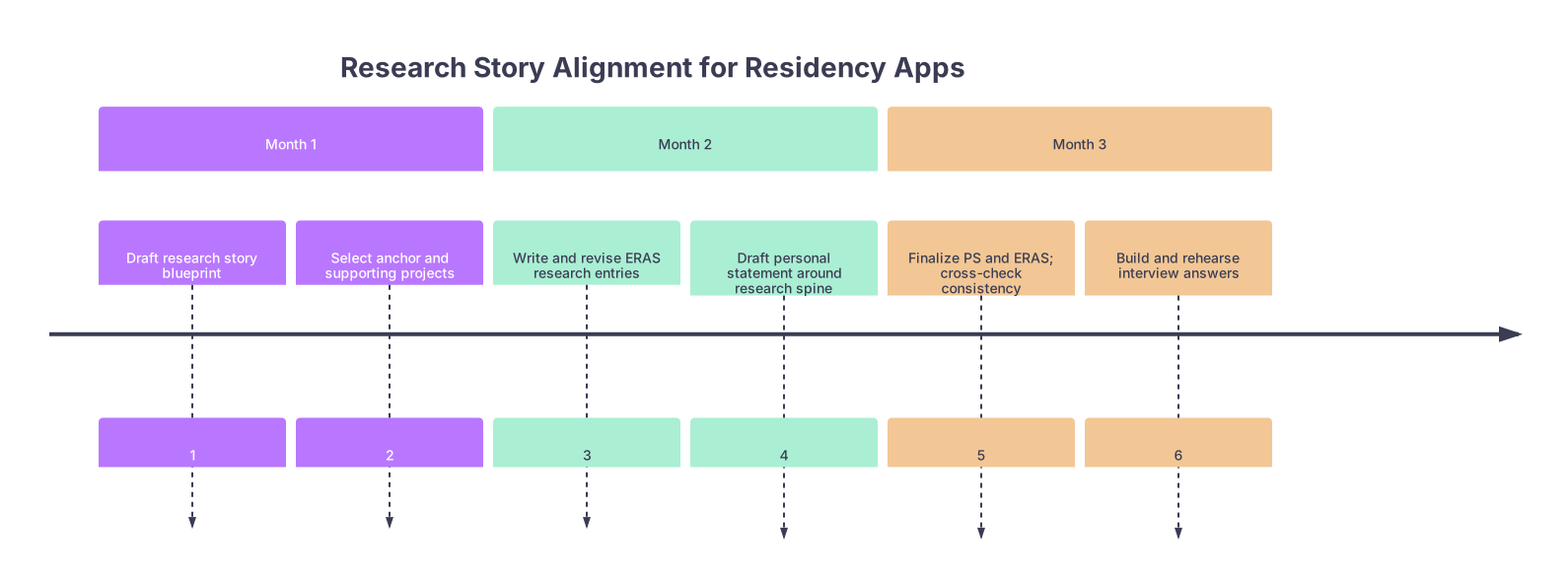
| Period | Event |
|---|---|
| Month 1 - Draft research story blueprint | 1 |
| Month 1 - Select anchor and supporting projects | 2 |
| Month 2 - Write and revise ERAS research entries | 3 |
| Month 2 - Draft personal statement around research spine | 4 |
| Month 3 - Finalize PS and ERAS; cross-check consistency | 5 |
| Month 3 - Build and rehearse interview answers | 6 |
Week 1–2
- Draft your one‑page research blueprint.
- List all projects and choose 3–5 core ones.
- Write your three‑sentence research narrative + one‑line brand.
Week 3–4
- Rewrite ERAS research entries for those core projects using the mini‑story format.
- Standardize titles, dates, and roles.
- Connect outputs (abstracts, posters) back to these projects.
Week 5–6
- Draft your PS using the 4‑part structure and anchor project.
- Make sure themes match the blueprint.
- Get feedback from 1–2 people who understand your specialty’s culture.
Week 7–8
Build interview answer bullet points for:
- “Tell me about your research”
- “What was your role?” for 2–3 key projects
- “What did you learn?” and “How does research fit into your future?”
Practice out loud with a friend, resident, or mirror. Multiple times.
Week 9+ (interview season)
- Before each interview day, review:
- Program’s research strengths and niche
- How your themes intersect with their work
- Slightly tailor your “future direction” answer to highlight the overlap (without sounding like you just discovered their website yesterday).
Final Checkpoints Before You Submit
Run through these yes/no checks:
- Can I describe my research in three clear sentences that match what is on ERAS and in my PS?
- If an interviewer points to any project on ERAS and says, “Tell me what you did here,” can I talk for 60–90 seconds without bluffing?
- Are my project names, dates, and roles consistent across ERAS, PS, and how I plan to speak?
- Would a PD be able to summarize my research focus in one sentence after skimming my file?
If you can say “yes” to those, your research story is in the top tier. Not because you have the most publications. But because your narrative is coherent, believable, and aligned.
Programs rank that higher than you think.