
The mentor who promised everything and then vanished right before submission season is not unlucky. It is predictable. And you need to treat it like a systems problem, not a personal failure.
You are not the first applicant whose PI / research mentor / PD-adjacent “sponsor” went silent when you needed edits, a letter, or a final sign-off. I have seen this exact scenario every single year: residents in July–September panicking in workrooms, refreshing their email, whispering, “He still hasn’t answered” while ERAS deadlines creep closer.
Here is how you fix it, step by step, without blowing up the relationship or your application.
1. First: Diagnose Exactly What You Need From This Mentor
Do not just think, “They went silent.” You need to know on what and how critical it is.
List, very concretely, what you were expecting from this mentor:
- Letter of recommendation (LOR)
- ERAS experiences/activities description edits
- Personal statement feedback or co-writing
- Sign-off on a manuscript or abstract you plan to list
- Confirmation of role/title (e.g., “research fellow,” “sub-I,” “lab manager”)
- Advocacy phone calls or emails to program directors
- Completion of an institutional form (like departmental letter or chair letter input)
Now categorize each item by criticality:
| Item | Criticality | Deadline Type |
|---|---|---|
| LOR for ERAS | High | Hard |
| Personal statement edits | Medium | Soft |
| Manuscript sign-off | Medium | Soft |
| Title confirmation | Low | Soft |
| Advocacy emails | Medium | Soft |
High-criticality + hard deadline items (especially LORs) are your priority. These are the ones you manage aggressively. The rest you handle in parallel but without the same level of panic.
Reality check:
If the only thing you “need” is perfect wordsmithing of your personal statement, your application is not doomed. If you are depending on them for a LOR and the deadline is in 2 weeks, you are in a risk zone and must act like it.
2. Stop Sending Vague “Just Checking In” Emails
Most applicants send weak, non-actionable emails like:
“Hi Dr. X, just checking in to see if you had any feedback on my personal statement. No rush, I know you’re busy!”
This is how you get ignored.
You are not being rude by being specific and deadline-oriented. You are being professional. Busy faculty respond to:
- Clear asks
- Clear deadlines
- Minimal friction to completion
Here is the structure you should use today.
A. The “Urgent but Polite” Email Template (for Letters & Time-Sensitive Items)
Subject: ERAS Letter – Final Deadline and Materials
Body:
Dear Dr. [Last Name],
I hope you are doing well. I wanted to follow up regarding the letter of recommendation for my residency application. ERAS programs begin downloading applications on [date], and ideally the letter would be submitted by [date – usually 3–5 days earlier] to be included.
To make this easy, I have re-attached the following:
– Updated CV
– Draft of my personal statement
– Brief bullet list of the projects and clinical work I have done with youIf you are no longer able to write a strong letter within this timeline, I completely understand. Please let me know as soon as possible so I can arrange an alternative.
Thank you again for your support and mentorship,
[Your Name]
[Your Position – e.g., PGY-1 Internal Medicine]
Key details:
- You explicitly mention the deadline.
- You reduce friction by attaching everything they need.
- You give them a graceful exit (“if you are no longer able to write a strong letter…”). That line is critical. It lets a non-responsive or reluctant mentor bow out without ghosting you.
B. The “Non-Urgent, Contained Ask” Email Template (for Edits / Feedback)
Subject: Requesting Final Review – Personal Statement (One Brief Pass)
Dear Dr. [Last Name],
I have incorporated your prior feedback into my personal statement and am planning to upload the final version to ERAS on [date]. If you have time for one last brief review before then, I would be grateful. If not, no worries at all – I will proceed with the current version.
I have attached:
– Final draft (1 page)
– 3–4 bullet points of what I am trying to highlight for [specialty]Thank you again for your guidance,
[Your Name]
This signals: “I’m not helpless. I will move on without you if needed.”
3. Use a Structured Follow-Up Schedule (Not Desperate Daily Emails)
You need a protocol, not random chasing.
If you are within 3–4 weeks of a key deadline:
T – 21 days: Send the first clear, deadline-oriented email (like above).
T – 14 days: One concise follow-up:
“I wanted to gently follow up on the letter below as programs will begin downloading applications on [date]. Please let me know if you are still able to submit this letter, or if I should arrange another writer.”T – 7–10 days: If still no response, escalate (see next section).
T – 3–5 days: Hard pivot to backup plan if nothing concrete is scheduled or submitted.
Include specific language in your follow-ups that makes it easy for them to say “no”:
“If your schedule has changed and you are no longer able to complete this, I completely understand – please let me know so I can plan accordingly.”
That line is powerful. Genuine mentors will respond to avoid sabotaging your timeline. The others were never going to come through anyway.
4. Escalate Strategically Without Starting a War
Silence after 2–3 targeted emails on a high-stakes item (like a LOR) means you must escalate. Not emotionally. Tactically.
A. Low-Level Escalation: Use an Alternate Channel
Try one of the following:
A brief in-person ask after conference/rounds:
“Dr. X, I sent an email about the residency letter with the ERAS deadline – just wanted to confirm if you are still able to write it. If not, that’s totally fine, I just need to line up an alternate letter writer.”A short message via institutional messaging (Teams, Slack, paging system) only if that is normal in your environment:
“Hi Dr. X – wanted to quickly confirm whether you’re still able to submit my ERAS letter. Programs start downloading on [date]. If not, no problem – I’ll arrange another letter.”
You are not cornering them. You are asking a binary question.
B. Higher-Level Escalation: Involve an Administrative Ally
If the mentor is a PI or senior faculty with an admin:
“Hi [Admin Name],
I hope you are well. I am following up regarding a residency letter of recommendation that Dr. [Last Name] kindly agreed to write for my ERAS application (programs download applications on [date]). I worry my previous emails may have gotten lost.Would you mind confirming whether Dr. [Last Name] is still able to complete this, or if I should arrange another letter writer?
Thank you for your help,
[Your Name]”
Administrative staff often know exactly what is going on. They also do not want incomplete tasks hanging over their faculty.
C. When to Stop Pushing This Mentor
If after all of this:
- No reply
- No in-person clarification
- No admin help
Then you stop chasing. You mark this mentor as unreliable for high-stakes tasks and execute Plan B.
Do not send a guilt-trip email. Do not rant. Just quietly move on and fix your application.
5. Activate Backup Recommendations Fast
You cannot wait for a ghost mentor if that risks having <3 strong letters in ERAS. You need backups.
Who Makes a Viable Backup Recommender?
Rank like this:
- Clinical faculty who directly supervised you, even if not a “big name”
- Research mentors who respond quickly, even if the project was smaller
- Program leadership who know your work ethic
- Senior residents/fellows cannot write official LORs alone, but they can draft strong letters for an attending to co-sign
Look for:
- They know you personally
- They have seen you work (clinic, wards, OR, research meetings)
- They can comment on reliability, teamwork, clinical thinking, or scholarly output
Email Template for a Last-Minute Backup Letter
Subject: Residency LOR Request – Short Timeline
Dear Dr. [Last Name],
I hope you are doing well. I am applying to [specialty] this cycle and wanted to ask if you would be willing to write a strong letter of recommendation for my ERAS application.
I realize this is a tight timeline. Programs begin downloading applications on [date], so it would need to be submitted by [date – usually 5–7 days earlier]. I understand completely if your schedule does not allow this.
To make this as easy as possible, I can provide:
– Updated CV
– Draft personal statement
– ERAS letter request link
– Brief bullet summary of our work together and specific examples that might be helpful to includeThank you for considering this,
[Your Name]
You may be surprised who says yes. Plenty of attendings are happy to help if you reduce their cognitive load and communicate clearly.
6. Salvaging Manuscripts and Research Sign-Offs
Different problem, similar solution.
If your mentor is sitting on:
- A paper you want to list as “submitted” or “in progress”
- An abstract needed for a conference relevant to your application
- A final approval of your role / authorship
Here is the key: Do not lie in ERAS. But you can accurately represent works-in-progress without the final green light, if you are precise.
How to Categorize a Stalled Project on ERAS
Use honest statuses:
- “Data collection ongoing; manuscript in preparation”
- “Draft manuscript in internal review with senior author”
- “Abstract drafted; submission planned for [Conference, Year]”
Do not:
- List a paper as “submitted” if it has not actually been submitted.
- Invent acceptance or presentation statuses.
Tactical Email for Manuscript Sign-Off
Dear Dr. [Last Name],
I am finalizing my ERAS application and wanted to accurately list our project, “[Title or Short Description].” The current status is [e.g., “manuscript drafted; awaiting your feedback before journal submission”].
If you are comfortable with this description, I will list it as:
– Role: [e.g., primary author, data analysis, etc.]
– Status: “[exact status]”I would still very much appreciate your feedback on the manuscript whenever your schedule allows, and I will not submit to a journal without your approval.
Thank you again,
[Your Name]
You are:
- Being transparent
- Protecting your integrity
- Signaling you are not trying to bypass them
If they never respond, your description is still truthful.
7. Shielding Your Personal Statement and Experiences From Mentor Dependence
Too many applicants hand their personal statement and experiences over to a mentor to “completely rewrite” and then get stuck when the mentor disappears.
Here is how to avoid that trap and how to recover if you are already in it.
A. Build a Version That Is Fully Yours
Today, produce:
- A complete, 1-page personal statement that you would submit even if nobody else touches it
- Fully written ERAS experiences with clear impact and reflection
This is your “no one saves me” version. It may not be perfect. It will be good enough.
Then, any mentor input is a bonus, not a dependency.
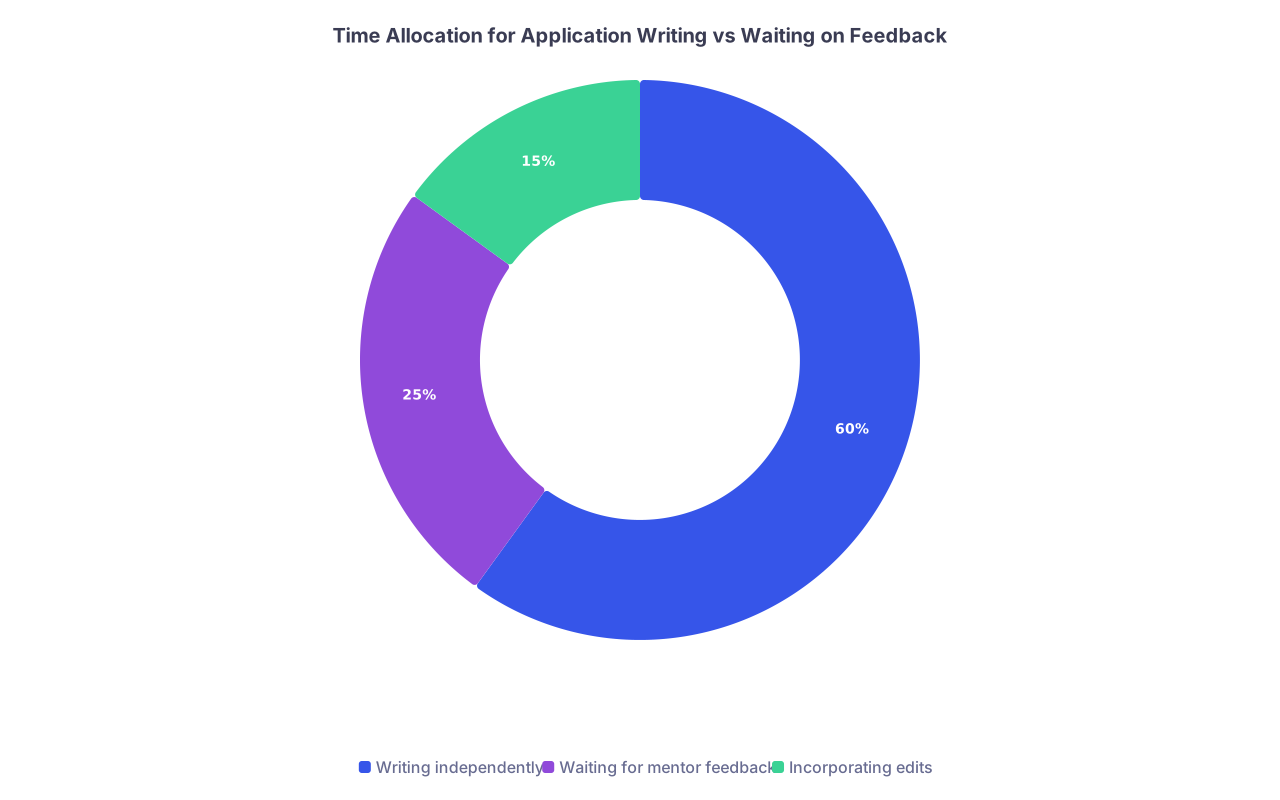
| Category | Value |
|---|---|
| Writing independently | 60 |
| Waiting for mentor feedback | 25 |
| Incorporating edits | 15 |
Aim for your time looking like the above. More writing, less waiting.
B. Use Peers and Reliable Faculty for Last-Minute Edits
If your main research mentor vanishes:
Ask a trusted resident/fellow in your chosen specialty to do a quick read for:
- Clarity
- Specialty fit
- Red flags or cliches
Ask one non-medical reader (someone literate and blunt) to flag awkward sentences.
You do not need another “famous” mentor to polish your statement. You need one or two smart readers who answer emails.
8. Protecting the Relationship (If It Is Worth Protecting)
Not every silent mentor is malicious. Some are:
- Overwhelmed
- Burned out
- Distracted by grants, family issues, service overload
You can still protect the relationship while protecting your application.
Basic rules:
- Do not vent about them widely in your department.
- Do not put anything accusatory in writing.
- Do not call them out in group settings.
Later, when your application chaos is over, you can calibrate.
If they finally email you in November with, “Sorry, things got crazy, did the letter situation work out?”, you can respond:
“Thank you for getting back to me. Because of the tight timeline and uncertainty, I arranged alternate letters to ensure my application was complete by September. I remain very grateful for your mentorship on [project X] and hope we can continue working together on [project or follow-up].”
You have:
- Protected yourself
- Been honest
- Left the door open if they are still valuable
If they are chronically unreliable and the power dynamic allows it, you quietly minimize future dependence. You do not choose them as your main sponsor when you apply for fellowships or jobs.
9. Preemptive Systems So This Never Hurts You Again
Let me be blunt. The biggest mistake is not that your mentor went dark. The mistake is relying on a single person for a critical piece of your future.
Going forward, you want redundancy everywhere.
A. Always Plan for One More Letter Than You Need
If your specialty wants 3 letters:
- Aim to secure 4–5 early
- Expect 1 to be late or worthless
| Specialty | Letters Required | Letters to Secure |
|---|---|---|
| Internal Medicine | 3 | 4–5 |
| General Surgery | 3–4 | 5 |
| Pediatrics | 3 | 4–5 |
| EM (SLOEs) | 2 SLOEs + 1 LOR | 3 SLOEs/LORs |
You want redundancy, especially if one of your writers is a classic “academic celebrity” with 200 unread emails.
B. Establish Expectations in Writing Early
When a mentor agrees to write a letter or review something, say:
“Thank you so much. I will send you my materials by [date], and ERAS opens on [date], with programs starting to download applications on [date]. Would aiming for submission by [date] work for you?”
That way, silence later is a deviation from a shared timeline, not some vague misunderstanding.
C. Track Your Application Logistics Like a Project Manager
I have watched too many strong residents fall apart because every task lived only in their head.
Use a simple tracker (spreadsheet, Notion, whatever) for:
- Each letter writer
- Date requested
- Date you sent materials
- Confirmed or tentative submission date
- Follow-up emails sent
For example:
| Writer | Role | Date Asked | Status | Last Follow-Up |
|---|---|---|---|---|
| Dr. A (Research) | Primary PI | 7/10 | No response | 8/1 |
| Dr. B (Clinical) | Wards Attg | 7/15 | Submitted | — |
| Dr. C (Chair) | Department | 7/20 | In progress | 7/28 |
The moment someone looks unstable (no reply, vague promises), you activate backup options. No drama. Just procedure.
10. Mental Game: Stop Interpreting Silence as a Judgment on You
You are exhausted, your self-esteem is hanging on ERAS, and a mentor vanishing feels personal. In almost every case I have seen, it is not.
Common reality:
- They are underwater.
- They forgot.
- They overcommitted because saying “no” felt awkward.
- They misread their calendar and thought your deadline was later.
None of those explain away the behavior, but they do change how you should internalize it.
Do:
- Reframe this as a logistics problem.
- Protect yourself with contingency plans.
- Learn to build a mentorship portfolio instead of a single-point-of-failure mentor.
Do not:
- Decide you are unworthy because one busy PI did not answer.
- Delay your entire application waiting for them.
- Start revising your entire specialty choice in a panic.
Your job is to submit a complete, honest, strong application on time. Their job is to help if they can. If they do not, you still execute.
FAQ (Exactly 4 Questions)
1. Should I still list a mentor as a “reference” or talk about them in interviews if they ghosted me?
If they did not write a letter and have become unreliable, do not voluntarily highlight them as your key mentor in interviews. You can still mention the project or experience, but avoid framing them as your primary sponsor. Interviewers sometimes know or contact people you name; you do not want your credibility hung on someone who may be non-responsive or lukewarm about you.
2. What if a mentor submitted a generic or weak letter because they were rushed—can I have it removed?
You generally cannot remove or see letters once submitted in ERAS. The real prevention is upfront: only ask people who can write a “strong” letter and explicitly use that word. If you suspect a letter will be weak or late, quietly deprioritize that writer and recruit additional, more reliable attendings. A mediocre letter among several strong ones rarely kills an application, but do not let a borderline person be one of your only letters.
3. Is it better to wait for a famous PI’s letter or go with a less-known but responsive attending?
For residency applications, a detailed, specific letter from an attending who actually knows you beats a generic two-paragraph note from a big-name PI. If you can get both, great. If you must choose, reliability and depth of knowledge about your abilities matter more than the name. I have seen applicants matched at top programs with zero “famous” names in their letters, but with excellent, concrete narratives about their performance.
4. How late is “too late” for a letter to still help my application?
Ideal: all core letters in by the time programs first download applications (usually late September). Still helpful: letters that arrive within the first 2–3 weeks of application season. After that, impact decreases, especially for highly competitive specialties that screen early. That is why you treat any unresponsive mentor as a risk and secure backups by early–mid September at the latest.
Open your LOR tracking sheet, or start one if it does not exist, and mark every mentor as green (confirmed and reliable), yellow (uncertain), or red (non-responsive). For every yellow or red today, draft the exact email you will send in the next 24 hours to either secure their commitment or free yourself to move on.