
The manuscript is not “in progress.” It is either moving toward submission or it is quietly dying. You are too close to Match season to let it die.
You want this paper submitted before programs look at your application. Not “almost done.” Not “draft with coauthors.” Submitted.
Here is exactly how to get a stalled manuscript from whatever mess it is in right now to “submitted” in 14–21 days while you are still juggling rotations, Step 2, and everything else.
Step 1: Get Brutally Clear on the Deadline and the Goal
First, define success correctly.
Your goal is submission before programs seriously review your file, not eventual publication.
For most residency applications:
- ERAS opens: early September
- Programs start reviewing: mid–late September
- Interview invites: October–December
Your manuscript timeline goal:
- Best case: Submitted before ERAS certification.
- Still useful: Submitted before most interview invites go out.
- Bare minimum: Submitted before January (for update emails and interview talking points).
So you are not trying to:
- Perfect every sentence.
- Completely re-run every analysis for fun.
- Get into NEJM from a small retrospective chart review.
You are trying to:
- Produce a clean, honest, clearly written manuscript.
- Submit to a realistic journal that is likely to review it promptly.
- Be able to say on your application and in interviews:
“Manuscript submitted to [Journal], under review.”
That sentence alone can change your research section from “unfinished project” to “completed scholarly product.”
Step 2: Diagnose Why You Are Stuck (Pick One Primary Block)
Most “stalled” manuscripts are stuck for boring, fixable reasons. Name your main block. No more vague “I’ve been busy.”
Common culprits:
Structural paralysis
- The draft is messy.
- You keep changing the intro and methods.
- You have no clear outline.
Analysis anxiety
- Stats are half done.
- You are not sure which tests are appropriate.
- Reviewer or mentor comments scared you off.
Writing avoidance
- Results exist, but you dread writing.
- You stare at a blank screen and open email instead.
- You “edit” the intro for the 20th time, but nothing new gets written.
-
- Coauthors are not responding.
- Your PI is slow or controlling.
- You are waiting for someone to “approve” before moving on.
Journal perfectionism
- You are hunting for the “perfect” journal.
- You are aiming 3 tiers too high for the quality/size of the project.
- You keep changing format aiming for multiple targets at once.
Pick your main one. Circle it if you printed this. That is the bottleneck you will attack first.
Step 3: Pick a Realistic Journal — This Week
A stalled manuscript without a target journal is just a hobby. You need constraints.
How to pick fast and rationally
Use this 30-minute protocol:
Match scope and study type
- Is it case series, QI project, small retrospective, educational intervention, survey, basic science?
- Search PubMed for similar studies. Look where they were published. Those are your top targets.
-
- If your study is:
- Single-center
- Retrospective
- No novel mechanism
Then JAMA is fantasy. Stop pretending.
- If your study is:
Favor quicker, realistic journals
- Specialty journals
- Society journals
- Educational or QI-focused journals (for education/QI projects)
- Journals that clearly state timelines or have frequent issues
Check basic requirements
- Word limit (especially for original investigations)
- Reference limit
- Figure/table limits
- Specific reporting guidelines (CONSORT, STROBE, PRISMA, etc.)
Now pick:
- 1 primary journal you are formatting for now.
- 1 backup journal in case of rejection (slightly lower tier, similar scope).
Write them down. That is your lane.
| Project Type | Primary Journal Tier | Backup Tier Option |
|---|---|---|
| Small single-center retrospective | Mid-tier specialty journal | Lower-tier specialty / regional |
| QI project on inpatient flow | QI or hospital medicine journal | Institutional / educational journal |
| Curriculum innovation | Medical education journal | Specialty education journal |
| Case series (3–5 patients) | Case report journal | Specialty case report outlet |
| Survey of residents | Specialty or education journal | Regional / national society supplement |
Once you lock this in, you build everything around that journal’s instructions. Not a generic manuscript. Their manuscript.
Step 4: Build a 14-Day Submission Plan (Tight and Aggressive)
You will not “find time.” You will allocate time.
First, figure your realistic weekly writing capacity
Look at the next 2 weeks:
- On heavy call / ICU: Maybe 30–45 minutes per day, 5 days.
- On lighter elective: Maybe 60–90 minutes per day, 6 days.
- Days off: One 2–3 hour block once or twice.
Total that time. That is your writing budget.
Now assign that time to specific tasks.
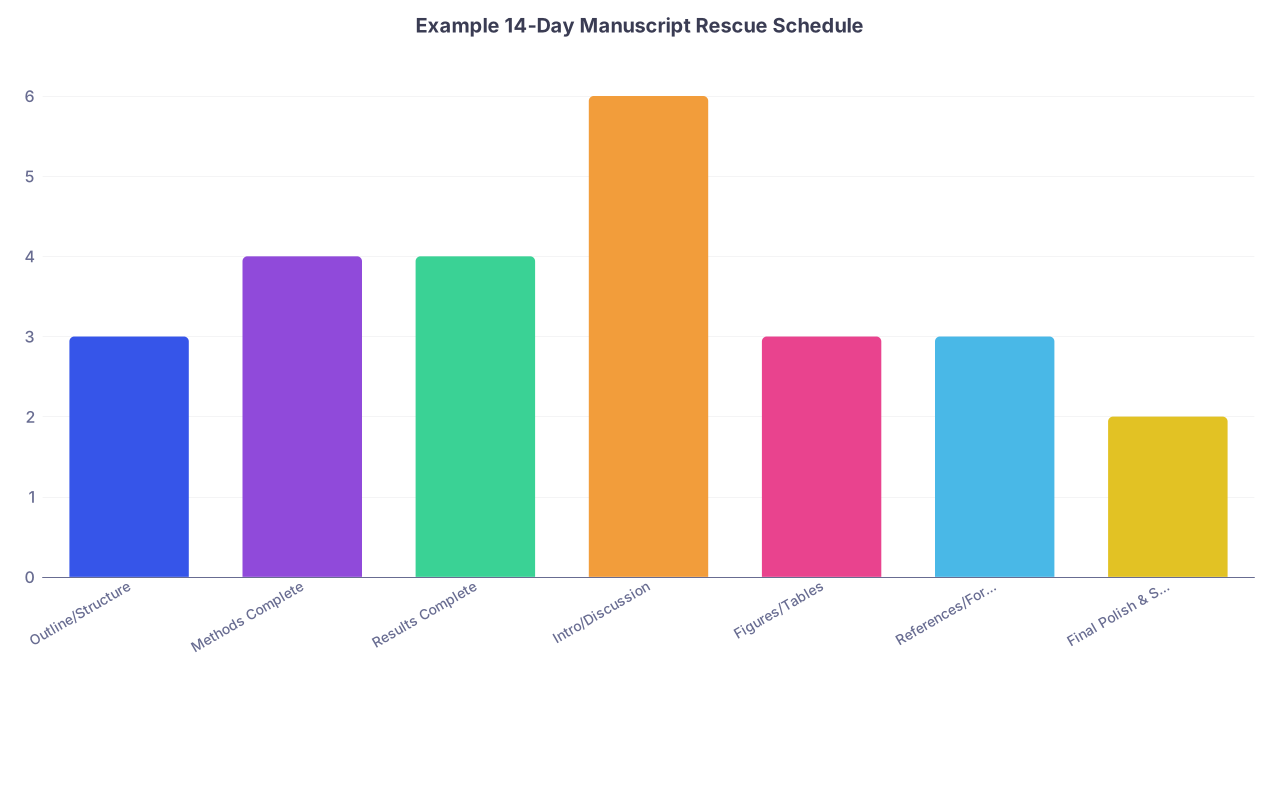
| Category | Value |
|---|---|
| Outline/Structure | 3 |
| Methods Complete | 4 |
| Results Complete | 4 |
| Intro/Discussion | 6 |
| Figures/Tables | 3 |
| References/Formatting | 3 |
| Final Polish & Submit | 2 |
(Values are “hours” — adjust to your reality.)
A simple 14-day template
Days 1–2
- Choose journal and backup.
- Download author guidelines and 3 recent similar articles.
- Build or clean up the outline:
- Title
- Abstract
- Intro (3–4 paragraphs)
- Methods (structured)
- Results (subheadings that mirror methods)
- Discussion (4-part structure)
- Conclusion.
Days 3–5
- Lock methods section.
- Finalize which outcomes, which variables, and which statistical tests you will report.
- Coordinate with statistician if needed (short, focused questions).
Days 6–8
- Write the Results to match your chosen outcomes and tables.
- Build tables and figures in final format.
- Do not obsess over wordsmithing yet.
Days 9–11
- Rewrite Introduction and Discussion in one cohesive pass.
- Make sure each result is clearly interpreted once (not five times).
Days 12–13
- Reference cleanup.
- Check against journal checklist.
- Internal “peer review” by one trusted coauthor who responds quickly.
Day 14
- Incorporate essential coauthor edits.
- Submit.
Aggressive? Yes. Possible? Absolutely. I have watched residents rescue a year-stalled project in under two weeks by following a plan like this.
Step 5: Fix the Structure Once, Then Stop Tinkering
Most stalled manuscripts die from constant structural surgery. You keep reopening old wounds.
You are going to stabilize the skeleton, then refuse to re-break bones.
Use a boring, proven structure
Introduction (3–4 paragraphs)
- Broad problem (1 paragraph)
- What is known + key gaps (1–2 paragraphs)
- What your study does and your main objective/hypothesis (last paragraph)
Methods
- Design (retrospective cohort, cross-sectional, etc.)
- Setting and participants
- Variables and outcomes
- Data collection
- Statistical analysis
- IRB / ethics
Results
- Participant flow and baseline characteristics
- Primary outcome
- Key secondary outcomes
- Any sensitivity / subgroup analyses
Discussion (4-part skeleton)
- Opening: One concise paragraph: what you did, what you found.
- Interpretation: What the results mean, how they fit with or differ from prior work.
- Strengths and limitations: Concrete, not generic.
- Implications and future directions: How this affects practice/research.
One-pass structural cleanup
Spend one dedicated 60–90 minute block to:
- Create clear headings and subheadings.
- Reorder sections to match a standard flow.
- Move stray sentences to their rightful home (methods stuff out of discussion, etc.).
- Delete duplicated sentences.
Then make a rule: No more structural surgery. From now on you only:
- Fill gaps.
- Tighten language.
- Clarify confusing spots.
Step 6: Lock the Methods and Analysis Early
Manuscripts stall when analysis never feels “final enough.” You keep people-pleasing ghosts of hypothetical reviewers instead of getting the job done.
You need a final analysis plan for this submission round.
30-minute stats triage
If you have no statistician:
- Identify:
- Primary outcome
- 1–3 key secondary outcomes
- Main predictor(s)
- Choose appropriate tests:
- Two groups, continuous outcome: t-test or Mann–Whitney.
- Categorical outcome with two levels: chi-square or Fisher.
- Multiple predictors: basic linear or logistic regression if justified.
If you do have a statistician:
- Send a targeted email:
- 1–2 paragraphs summarizing study.
- Specific questions:
- “Is X test appropriate for Y?”
- “Can you help confirm this model is reasonable?”
Do not write, “Any thoughts?” That is how you get a 3-week delay.
Methods checklist
Lock in:
- Study design and dates.
- Inclusion / exclusion criteria.
- Primary and secondary outcomes (no more changing after you see results).
- Handling of missing data.
- Software and version.
Write the Methods in full now, not at the end. This forces you to face your analytic choices instead of dodging them.
Step 7: Get the Results Written and Tabled Quickly
The Results should be the cleanest, least emotional section. It also often feels like the heaviest lift.
Here is how you cut through it.
Start with tables and figures
Open Excel, R, SPSS, or whatever you used, and:
Create:
- Table 1: Baseline characteristics.
- Table 2: Primary outcomes.
- Table 3: Key secondary outcomes / exploratory findings (if needed).
Align your subheadings with tables:
- “Participant characteristics”
- “Primary outcome: [X]”
- “Secondary outcomes”
Keep figures minimal:
- 1–2 key graphs if they add clarity (Kaplan-Meier plot, bar graph, etc.).
- Do not art-direct this. Simple is fine.

Then write result paragraphs that mirror the tables
For each section:
- 1–2 sentences describing what the table shows.
- Highlight the key numerical findings with approximate values.
- Avoid interpretation, hedging, or mechanistic speculation.
Example:
- “Among 212 patients, 58% were male and the median age was 64 years (IQR 55–72).”
- “The primary outcome, 30-day readmission, occurred in 18% of the intervention group and 27% of the control group (p = 0.04).”
You are just reporting the facts. Save the meaning for the Discussion.
Step 8: Write an Introduction and Discussion That Do Not Suck Time
You can spend 10 hours on these sections or 2. You do not have that kind of time to waste.
Fast-track Introduction
Follow this script. Fill in the blanks.
- Paragraph 1 – Why this matters
- 2–3 sentences: frame the clinical or educational problem.
- Paragraph 2–3 – What is known
- Summarize 3–6 key studies.
- Use 1 sentence per citation cluster: “Prior work has shown…”
- Paragraph 4 – Gap and objective
- 2–3 sentences:
- “However, [gap].”
- “We aimed to [primary objective].”
- Optional: “We hypothesized that [simple, testable hypothesis].”
- 2–3 sentences:
Stop. No literature review thesis. This is not your PhD.
Fast-track Discussion
Use this 4-paragraph skeleton:
- What you did and what you found
- 3–4 sentences: “In this single-center retrospective study of X, we found that…”
- Compare with prior work
- 1–2 paragraphs:
- Where you agree.
- Where you differ.
- One or two plausible reasons.
- 1–2 paragraphs:
- Strengths and limitations
- Bullet in your head, then write:
- Strengths: sample size, setting, prospective design, etc.
- Limitations: single center, missing data, confounding, generalizability.
- Be honest but not self-destructive.
- Bullet in your head, then write:
- Implications and future work
- 1 paragraph:
- What clinicians/educators might do with this.
- What studies should come next.
- 1 paragraph:
If you find yourself writing a fifth paragraph, ask if it is actually adding anything. If not, cut.
Step 9: Manage Coauthors Without Letting Them Stall You
Coauthors can be your biggest asset or your biggest delay. You do not have time for free-form chaos.
You are going to lead this like an attending leads rounds.
Send a clear, time-boxed email
Subject:
“[Manuscript title] – Final draft for submission to [Journal] – feedback by [date]”
Body:
- 2–3 sentences:
- “Attached is a near-final draft.”
- “Target journal: [X]. Deadline to submit: [date].”
- Then:
- “Please send any essential edits by [DATE – 5–7 days from now].”
- “If I do not hear from you, I will assume you approve submission as is.”
Attach:
- Manuscript as Word doc.
- Target journal author guidelines link.
This email does two things:
- Makes your timeline explicit.
- Shifts the default from “wait until every single person responds” to “moving forward unless blocked.”
Handle the slow PI
The PI sometimes needs a different approach.
- Ask directly for a 15-minute meeting (Zoom or in-person).
- Bring:
- Clean draft.
- Proposed journal.
- Submission checklist.
Say something like:
- “I would like to get this submitted before Match season. Here is the draft and target journal. Can we go through any critical changes you want so I can submit by [specific date]?”
Most decent PIs respect concrete timelines. Vague “whenever” invites endless delay.
Step 10: Format Once, Use Checklists, Stop Polishing
Journal formatting can be a soul-sucking black hole if you let it. You should give it one focused pass, not 12 scattered half-passes.
Build a simple journal checklist
From the author instructions, create a list like:
- Word count below X
- Abstract structured, X words
- Max Y figures, Z tables
- References in X style
- Cover letter included
- Ethics/IRB statement present
- Trial registration (if applicable)
- Funding/conflict of interest statements
- Author contribution statement
Then, in one 60–90 minute block, go through line by line until every box is checked.

| Step | Description |
|---|---|
| Step 1 | Draft nearly complete |
| Step 2 | Select target journal |
| Step 3 | Review author guidelines |
| Step 4 | Create journal checklist |
| Step 5 | One-pass formatting |
| Step 6 | Coauthor review with deadline |
| Step 7 | Final edits |
| Step 8 | Online submission portal |
| Step 9 | Confirm submission email |
Cover letter: do not overthink it
Three short paragraphs:
- “We are submitting [Title] to [Journal] as an [article type].”
- One paragraph summarizing why this is important and what you found.
- Conflict of interest / prior presentation statement.
Done.
Step 11: Use This as Application Leverage, Even If It Is Not Accepted Yet
You are doing this in the context of residency applications. The point is not just academic virtue. It is to strengthen your file and your interview narrative.
Here is how to capitalize on a “submitted” manuscript:
On ERAS / CV
You can list under “Publications” as:
- “Smith J, Lee A, YOUR NAME, et al. Title. Submitted to [Journal], 2024.”
If space requires accepted-only, then put it under “Research”:
- “Prepared first-author manuscript on [topic]; submitted to [Journal] (under review).”
In your personal statement or supplemental essays
Briefly mention:
- “I led a project examining [X] that has been submitted for publication.”
- Do not indulge in a two-paragraph methods dump. State the impact or what you learned.
In interviews
This is where it really matters.
When asked about research:
- “I recently submitted a manuscript on [topic] as first author. It is currently under review at [Journal]. My role included [design/analysis/writing], and through that project I learned [specific skills/insights].”
Programs care far more about:
- Your ownership.
- Your follow-through.
- Your understanding of the project.
Than whether it is accepted yet.
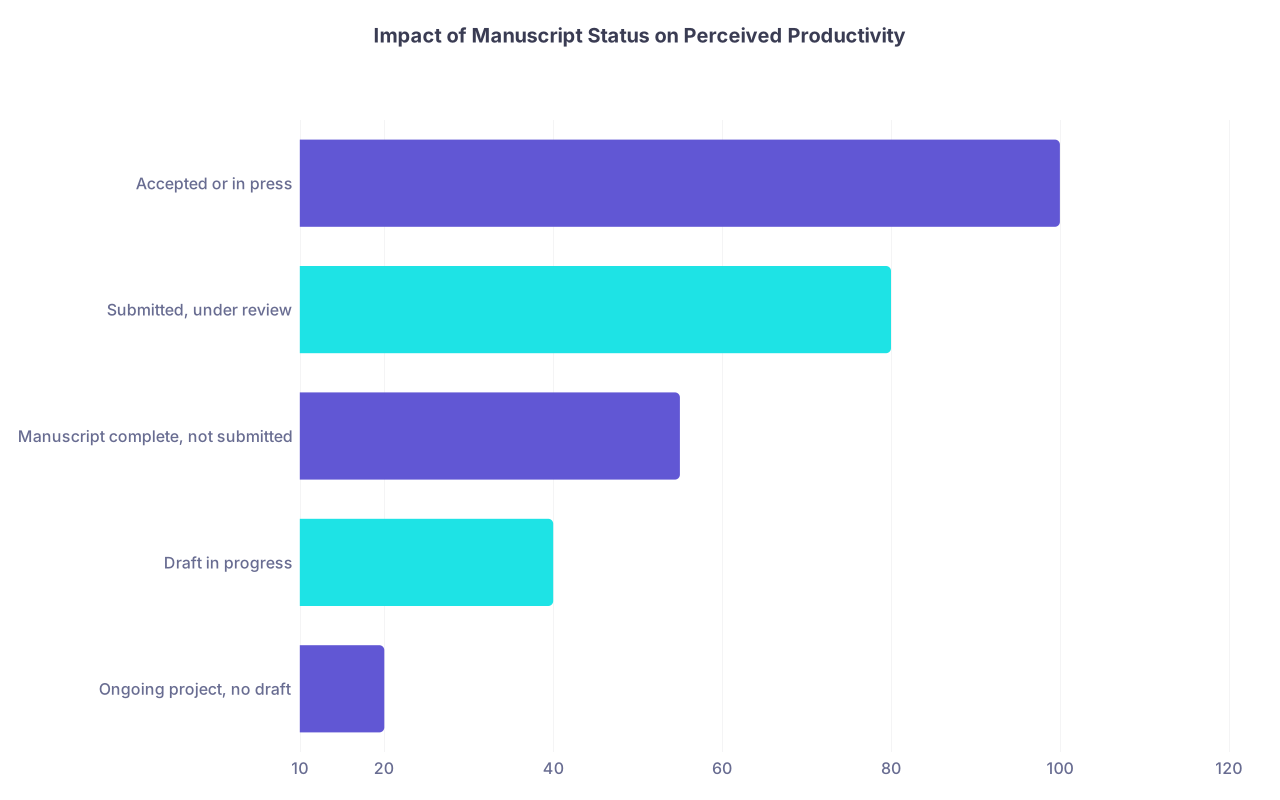
| Category | Value |
|---|---|
| Ongoing project, no draft | 20 |
| Draft in progress | 40 |
| Manuscript complete, not submitted | 55 |
| Submitted, under review | 80 |
| Accepted or in press | 100 |
That chart is what I have seen on selection committees—subjectively. “Submitted” sits much closer to “accepted” than to “draft in progress.”
Step 12: If (When) It Gets Rejected, Re-Submit in 7 Days
Rejection is not failure. Letting the paper die after rejection is failure.
You already picked a backup journal. You are going to use it.
When the rejection comes:
- Download reviewer comments.
- Skim once. Walk away for 24 hours.
- Ask: Are there fixable, reasonable points?
- Minor: clarify methods, adjust tables, tone down claims.
- Moderate: add sensitivity analysis, reorganize discussion.
Implement **only the changes that:
- Improve clarity or integrity; and
- You can complete within 3–5 hours.**
Then:
- Reformat for Journal #2 using the same checklist workflow.
- Submit within 7 days of receiving the rejection.
You can absolutely say “submitted” on your application if you reasonably expect to do this within a week. Just actually do it.
Your 24-Hour Action Plan (Do This Today)
You are not going to “think about this.” You are going to move the manuscript forward within 24 hours.
Here is your immediate plan:
- Open the latest manuscript file.
- Spend 10 minutes skimming it without editing.
- Name your main block (from Step 2).
- Choose:
- Target journal.
- Backup journal.
- Draft a 14-day schedule in your calendar with specific:
- 30–90 minute blocks labeled “Manuscript – [section].”
- Send one email today:
- Either to your PI (“Can we meet 15 min to finalize and submit?”)
- Or to your statistician (“I need to lock these 2–3 analytic choices.”)
- Or to yourself: a calendar invite titled “Submit manuscript to [Journal]” on a specific date.
Do not close your laptop until one concrete, irreversible step is done:
Journal chosen, calendar blocked, or coauthor contacted.
FAQ (Exactly 4 Questions)
1. Does “submitted” actually help my residency application, or do programs only care about accepted papers?
Programs care about patterns of behavior: Do you start things and finish them. A submitted manuscript, especially if you are first or second author, shows you can carry a project through data, writing, framing, and dealing with coauthors. On committees, I have seen “submitted” treated far more favorably than “ongoing project.” It gives you a clean, concrete story to tell in interviews and usually counts as a meaningful scholarly product.
2. My PI is not responding, and I am worried about submitting without full approval. What should I do?
First, give your PI a clear choice: send a concise email with the near-final draft, target journal, and a hard deadline: “If I do not hear from you by [date], I plan to submit as is to meet residency timelines.” If you still get no response and you are genuinely first author who did the majority of the work, loop in a trusted senior coauthor or division chief for advice. Most institutions have policies about author approval; follow those. The key is to stop waiting silently. Make your timeline explicit and documented.
3. I am worried the paper is “too small” or “not good enough.” Should I still push to submit before Match?
Yes. The perfect is killing the good here. Most resident projects are not paradigm-shifting. That is fine. A well-executed, honest, modest retrospective or QI project is still legitimate scholarship. Submitting now does three things: it shows follow-through, it frees mental bandwidth, and it gives you something concrete to discuss. You can always aim higher on your next project. This one’s job is to be finished.
4. I have multiple half-finished projects. Should I try to submit all of them before Match or focus on one?
Pick one primary manuscript and make that your submission target. If you have bandwidth for a second, great, but do not let “I should do everything” lead to doing nothing. Commit to the project where: (a) the data are already collected, (b) you are first or second author, and (c) the PI is at least somewhat responsive. Get that one submitted. Then, if time remains, apply the same process to the next.
Now, open your stalled manuscript file and write down a target journal and a submission date in your calendar—today.