
The fastest way to kill a research career is to stay quiet about authorship until the paper is done. Then get angry. Then send a long email. Do not do that.
If you are applying for residency, you need publications and real credit. You also need mentors who will still answer your emails in five years. You can get both—if you handle authorship like an adult, not like a desperate applicant.
Here is how.
1. Understand the Rules Before You Start Arguing
You cannot argue for something you do not understand. Most conflicts I have seen come from people using the word “authorship” to mean three different things at once.
Know what authorship actually means
Most academic medicine uses ICMJE criteria. In plain language, a true author typically must:
- Contribute significantly to:
- conception/design, or
- data collection, or
- analysis/interpretation
- Help draft or critically revise the manuscript
- Approve the final version
- Agree to be accountable for their part
If you did all of these, you are not “asking for authorship.” You are asking for appropriate credit.
If you did one or none, you are asking for a favor.
Those are very different conversations.
Credit ≠ Authorship
You have three different “buckets” of recognition:
- Authorship order
- Acknowledgements
- Letters and phone calls (program directors, future jobs, etc.)
A smart resident does not try to cram everything into authorship. That is where people get defensive. Sometimes the best move is: accept middle authorship but secure a powerful letter that explicitly explains your role.
How residency programs actually read this
For most non-competitive specialties, the key signal is:
- Do you have any peer-reviewed work?
- Is your name on more than one project?
- Does your record tell a coherent story?
For highly competitive fields (derm, ortho, plastics, radiation oncology, neurosurgery), programs care more about:
- First-author or co-first on at least 1–2 papers
- Continuity with a known mentor or lab
- Evidence you saw a project through, not just “helped a bit”
So no, you do not need to be first author on everything. But you do need to avoid being invisible.
2. Set the Stage Early: Get Authorship on the Table Up Front
If you are already months deep with no clarity, skip to the next section. But if you are about to join a project, this is where you prevent 80% of problems.
Your goal: a brief, written understanding of role and expectations. Not a 10-page contract. Two clear sentences in an email.
The script you use at the beginning
Say this in your first real research meeting (or over email after):
“I am really excited to help with this project. To make sure I am aligning my effort with expectations, can we clarify how authorship typically works on your papers, and what I would need to contribute to be a co-author or first author?”
You are not demanding anything. You are asking about the lab’s operating system.
If the mentor is reasonable, you will hear something like:
- “If you take the lead on data collection and first draft, you will be first author.”
- “Residents who help with data extraction and analysis are usually middle authors.”
- “If you are just helping with charts or minor edits, that is usually an acknowledgement.”
Then you lock it in:
“That makes sense. So if I take responsibility for X, Y, and Z, would that qualify me for [co-author / first author] on this paper?”
When they say yes, you follow with an email summary:
“Thanks again for meeting. To confirm, I will [roles]. If I complete those responsibilities, we discussed that I would be [first/middle] author on the manuscript. Looking forward to getting started.”
That email is your insurance policy. If things drift, you pull it out later.
3. You Are Deep in the Project and Authorship Is Vague. Fix It Now.
Scenario I see constantly: You have done data extraction, organizing references, maybe half the draft, and months later there is still no title page, no author list, nothing.
You are already behind. But this is fixable if you move now.
Step 1: Diagnose your position honestly
Ask yourself:
- Have I done sustained work over weeks or months?
- Have I done intellectually meaningful work (design, analysis, writing), not just clerical tasks?
- If I walked away tomorrow, would the project noticeably slow down or fall apart?
If yes to at least two of those, you probably deserve authorship. The question is which position.
Step 2: Have a live conversation (not a long email)
Do not start with a 6-paragraph email listing your contributions. That feels like an indictment. Mentors get defensive and delay.
Schedule a short meeting or Zoom. Your script:
“I wanted to check in about the paper and clarify roles and authorship so I can plan my time for the next few months. I have really enjoyed working on this and want to make sure expectations are clear on both sides.”
Then:
- Briefly list your contributions (use concrete examples).
- Ask, directly, how they see authorship.
Example:
“So far I have:
– Extracted data for 120 patients and cleaned the dataset
– Helped refine the inclusion/exclusion criteria
– Drafted the Methods and Results sectionsGiven that work, I wanted to ask how you are thinking about authorship order, and where you see my role.”
Then stop talking. Let them answer.
Step 3: If the answer is vague or sidestepped
Typical dodges you might hear:
- “We will see later once we finish more.”
- “Authorship is complicated. Let us get the paper accepted first.”
- “Everyone is contributing a lot.”
Your response should be calm and specific:
“I completely understand it is not final yet. It would still help me to have a working expectation so I know how much more time I can commit to this project versus others. Based on my current role and continued involvement, I was hoping to be [first/co-first/middle] author. Do you see that as realistic, or would that not align with your plan?”
You are gently forcing them to state an actual position.
Step 4: Put the outcome in writing
Whatever they say, you send a short confirmation email that day:
“Thanks for discussing authorship earlier. To recap, we agreed that if I continue to [specific roles] through submission, I will be [first / co-first / middle] author on the paper. I will focus next on [next steps].”
If they push back on that email, you have your answer: this is a mentor who will probably under-credit you. Adjust your investment of time accordingly.
4. Asking for First Authorship Without Sounding Entitled
You cannot walk in saying, “I deserve first author.” That is how you get labeled as “difficult,” especially as a med student or prelim resident.
But you also cannot just hope they will notice how much you did. You need to make the case.
When first authorship is a fair ask
Reasonable grounds to push for first author:
- You initiated the project (idea, protocol, IRB).
- You did the majority of data collection and analysis.
- You drafted the bulk of the manuscript and responded to reviewer comments.
- The project literally would not exist without you.
If those are true, you are not asking for a favor. You are asking for their integrity.
How to frame the request
Use this structure:
- Acknowledge their role and seniority
- List your concrete contributions
- State your desired authorship clearly
- Connect it to your career needs (residency applications)
- Offer to do more if they feel the bar is not met
Example:
“I really appreciate your guidance on this project and the opportunity to work with your group. At this point I have [initiative: developed the idea and protocol], [work: collected and cleaned the dataset], and [writing: drafted most of the manuscript and coordinated revisions].
Since I am applying to dermatology this cycle, a first-author paper would significantly strengthen my application. I wanted to ask if you would consider listing me as first author, given my role so far.
If there are additional responsibilities you would want me to take on to justify that position, I am very willing to do them.”
This is direct but not aggressive. You are making it easy for them to say yes. Or to at least offer a path to yes.
5. When You Are Being Treated Unfairly: How Hard To Push
Sometimes mentors are just using you. They like free labor, and they assume students will not push back. You have three levers:
- Time – how much more effort you put in
- Credit – authorship vs acknowledgement vs nothing
- Future relationship – whether you keep or burn the bridge
You almost never want to pull all three at once.
Case 1: You are getting some authorship, just lower than you want
Example: You thought you would be first author. They offer second or third.
Ask these questions out loud:
“Can you help me understand how you decided on this order?”
“What would have been needed for me to be first author on this project?”
Then decide:
- If their answers are reasonable (e.g., “Another resident started the project a year before you, designed the protocol, and collected half the data before you joined”), accept the middle authorship, get a great letter, and move on.
- If their answers are nonsense (“The fellow always gets first author” when the fellow contributed almost nothing), you have a different problem: a mentor without integrity.
In that second case, do this:
- Take the authorship anyway. It still helps your CV.
- Quietly redirect your main efforts to another mentor or lab.
- Do not rely on that person for a critical letter.
You do not have to blow things up to protect yourself.
Case 2: You are being denied authorship entirely despite major work
This is rare but it happens. If you have genuine contributions and earlier emails confirming your role, you have more leverage than you think.
Escalation protocol:
One clear, final conversation with the PI
“I want to be transparent that I am very concerned about not being listed as an author given my contributions: [list specific work]. We had previously discussed that if I completed [X tasks], I would be a co-author. Can we revisit this decision?”
If they dig in, decide whether escalation is worth it
You can:
- Accept a mention in acknowledgements and walk away (if the paper is minor or the PI is powerful and petty).
- Seek advice from a trusted faculty member outside the project before doing anything formal.
- In extreme cases, involve the research office or department chair. That is a nuclear option. Use only if there is clear bad behavior and real harm to you.
If you escalate formally, do it factually, not emotionally. You present emails, drafts with your tracked changes, data work you did. Let others judge.
Sometimes, quietly documenting everything and then backing away is the smarter long game. The academic world is small.
6. Protect Yourself With Documentation and Visibility
You cannot control other people’s ethics, but you can make it much harder for them to erase you.
Always leave a paper trail
At minimum:
- Save emails where your role is discussed.
- Send brief recap emails after key meetings.
- Use track changes with your name on manuscript drafts.
- Keep a local copy of datasets you cleaned or scripts you wrote (within IRB rules).
This is not paranoia. It is professionalism.
Make your contributions visible to more than one person
Do not let your entire fate rest on a single senior author who might disappear.
Smart moves:
- CC the fellow or co-PI when you send major work.
- Present your work at a lab meeting or department conference.
- Ask if you can give a brief presentation of your methods or results.
Now multiple people associate you with the project. That makes it socially harder for someone to cut you out.
7. Multiple Projects, Limited Time: Prioritize Strategically
You do not have infinite bandwidth. You have clinical duties, Step 2, your application, maybe a life. You cannot fight for every authorship tooth and nail.
You need a triage system.
, Chart review, Prospective study, Basic science](https://cdn.residencyadvisor.com/images/articles_svg/chart-typical-time-investment-by-project-type-8095.svg "Typical Time Investment by Project Type")
| Category | Value |
|---|---|
| [Case report](https://residencyadvisor.com/resources/research-residency-applications/using-case-reports-wisely-a-targeted-plan-for-fast-but-meaningful-output) | 20 |
| Chart review | 80 |
| Prospective study | 200 |
| Basic science | 300 |
Rule of thumb for residency applications:
If you are pre-application season (1–2 years out):
Invest in 1–2 higher-yield projects where first or co-first is realistic, plus a few low-lift middle author jobs for volume.If you are in the application year:
Prioritize:- Projects that can realistically be submitted before ERAS opens.
- Projects where authorship is already clearly established.
- Mentors who respond quickly and actually move things forward.
If a PI is vague about authorship, slow on emails, and constantly “revising the aims,” ask yourself: Is this worth it right now? Or will this paper come out after I match?
You do not need every project to be perfect. You need enough visible, completed work.
8. How to Handle Shared First Authorship and Group Politics
Shared first authorship can be useful and messy. Programs vary in how much they care. Most committees will count “co-first” almost the same as first, especially if your name is listed first and the footnote clearly states “These authors contributed equally.”
| Authorship Type | Competitiveness Signal (Rough) |
|---|---|
| Solo First Author | Very Strong |
| Co-First (you listed 1st) | Strong |
| Co-First (you listed 2nd) | Moderate–Strong |
| Early Middle (2nd–3rd) | Moderate |
| Late Middle / Last | Mild |
When co-first is a win
Take co-first when:
- Another trainee truly did similar work.
- The PI is trying to keep lab peace.
- Your name is still near the front, and you can explain your role in your personal statement and ERAS experiences.
Phrase it like this on your CV:
Doe J*, You A*. Title. Journal. Year. (*Co-first authors)
No program director is going to split hairs about whose asterisk is more first.
When co-first is actually a demotion
Watch for this scenario: You did 80% of the work. A senior resident or fellow did 20%, late in the game, and the PI wants to call it “co-first” to satisfy hierarchy.
You can push back:
“I am open to co-first if that is best for the team, but I want to be transparent that I have led the project from idea through data collection and drafting. Could we list my name first among the co-first authors, given that role?”
Reasonable mentors will agree. If they do not, file that away and recalibrate how much you trust them for future work.
9. How to Talk About These Situations in Interviews
Residency interviewers can smell drama. You want to sound assertive and mature, not like a victim still angry about your PGY-0 research year.
If asked about research challenges or difficult mentors, your framework is:
- Brief context
- What you did to clarify expectations
- How you adjusted
- What you learned
Example:
“On one project we had initially not clarified authorship roles up front. As the work progressed, it became clear that expectations were misaligned. I scheduled a meeting with the PI, laid out my contributions, and asked directly how they saw authorship. We did not completely agree, but we came to a compromise where I received middle authorship and I shifted my main efforts to a different project where my leadership role was clearer. That experience taught me to discuss roles and authorship early and document expectations in writing.”
That answer says: I am not passive, but I am not reckless. Programs like that.
10. Email Templates You Can Use Tomorrow
You are busy. Here are actual email skeletons you can copy, tweak, and send.
A. Before starting a project
Subject: Clarifying roles and expectations for [Project Name]
Dear Dr. [Name],
Thank you again for the opportunity to work on the [topic] project. I am very interested in contributing.
To help me plan my time and meet expectations, could we clarify:
– The main tasks you would like me to take on
– How authorship is typically determined for projects in your groupI want to make sure I am aligning my efforts with what is needed for potential co-authorship.
Best,
[Your Name]
B. Mid-project, trying to clarify authorship
Subject: Quick check-in on authorship for [Project Name]
Dear Dr. [Name],
I have really appreciated working on the [topic] project and wanted to touch base about roles and authorship as we move toward a manuscript.
So far I have [brief bullet list of what you have done].
Since I am applying for [specialty] this coming cycle, it would help me to understand how you are thinking about authorship order and where you see my role, so I can plan my time and contributions appropriately.
Would you be available for a brief meeting to discuss this?
Best regards,
[Your Name]
C. After an authorship discussion, confirming agreement
Subject: Follow-up on authorship for [Project Name]
Dear Dr. [Name],
Thank you for taking the time to discuss the project today. To summarize our conversation:
– I will [your responsibilities]
– If I complete these tasks through manuscript submission, I will be listed as [first/co-first/middle] authorI appreciate your guidance and will focus next on [immediate next step].
Best,
[Your Name]
D. Diplomatic push for higher authorship
Subject: Question about authorship order for [Project Name]
Dear Dr. [Name],
I wanted to follow up regarding the tentative author list for the [topic] manuscript. At this point I have [list key contributions].
Given this role and my upcoming [residency/fellowship] applications, I was hoping to be considered for [first/co-first] authorship. If there are additional responsibilities you would like me to take on to support that, I am very willing to do so.
I appreciate your consideration and your mentorship on this project.
Best regards,
[Your Name]

11. Special Situations: Multi-Site Studies, Big Labs, and Industry Projects
These are the places where authorship gets truly chaotic. Expectations vary wildly and politics are heavier.
Multi-site collaborations
You might be “the person” at your site but still end up as author #14 out of 28. That can still be useful—multicenter papers in big journals look good even if you are buried in the list.
To maximize your visibility:
- Ask to be site PI or “site lead” if possible.
- Make sure your name is associated with your institution’s part of the work.
- Ask if there will be secondary analyses or spin-off papers where you can take a leading role.
Big labs with many trainees
Hierarchy is brutal in some large research groups. Postdocs, fellows, residents, med students all want first author.
Strategy:
- Aim for smaller, contained sub-projects where you can truly own the process.
- Accept that on the giant “flagship” projects you may get only middle authorship, and that is fine.
- Pick one mentor inside that lab who actually answers your emails and focus your energy there.
Industry collaborations
Industry-affiliated projects often have predetermined authorship structures, with medical writers and in-house statisticians.
Always ask early:
“For industry-supported projects like this, how is authorship typically determined for trainees?”
If the answer is “trainees are rarely authors,” decide whether the experience is worth your time for reasons other than publications (skills, networking, exposure). Do not assume you will be the exception.

| Step | Description |
|---|---|
| Step 1 | Offered New Project |
| Step 2 | Clarify expectations in writing |
| Step 3 | Accept for experience/network |
| Step 4 | Decline or limit involvement |
| Step 5 | Invest time |
| Step 6 | Limit time, seek other projects |
| Step 7 | Clear path to authorship? |
| Step 8 | High-impact / unique opportunity? |
12. Align Your Research Story With Your Residency Application
All of this fighting over authorship is pointless if your research story does not make sense on paper and in conversation.
You want:
- A coherent theme (e.g., “quality improvement in ICU,” “outcomes in spine surgery,” “health disparities in oncology”).
- Clear roles where you actually drove something forward.
- Mentors willing to speak specifically about what you did.
When you write your ERAS descriptions:
- Do not just write “Co-author on manuscript about X.”
- Spell out your active verbs: “Designed protocol,” “Performed data analysis,” “Drafted manuscript,” “Responded to reviewer comments.”
That tells the reader that authorship was earned, not gifted.
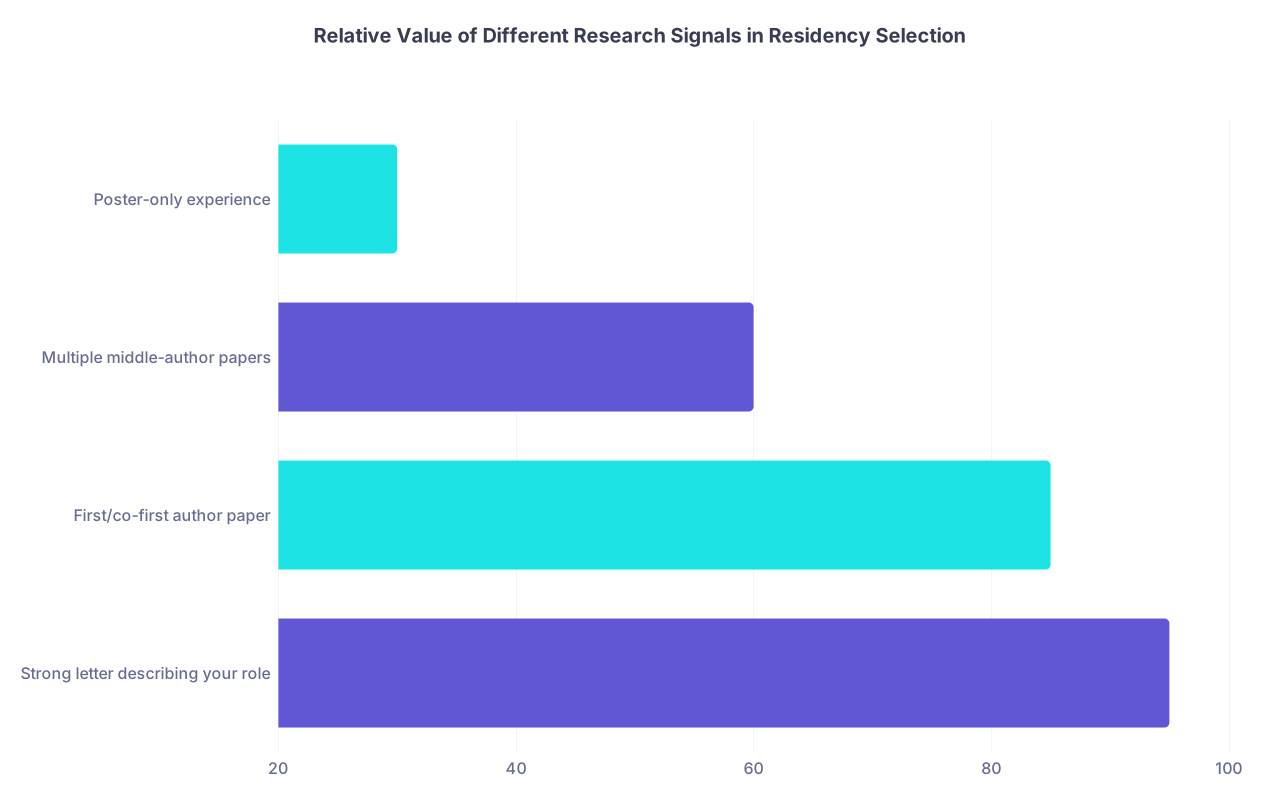
| Category | Value |
|---|---|
| Strong letter describing your role | 95 |
| First/co-first author paper | 85 |
| Multiple middle-author papers | 60 |
| Poster-only experience | 30 |
Programs care more about what you actually did than the exact position of your name once you clear a certain bar.

The Bottom Line
You can ask for authorship and credit without burning bridges if you:
- Talk early and clearly about roles, expectations, and authorship—then confirm it in writing.
- Make a concrete, specific case for your contribution when pushing for better authorship, instead of vague complaints.
- Protect your long-term career by documenting your work, choosing your battles, and redirecting effort toward mentors and projects that actually recognize your value.