
The way most students use QI and audit projects on residency applications is weak – but that is not the fault of QI. It is the fault of sloppy framing and poor execution.
You can turn a basic audit or QI project into a research-strength asset on your ERAS application. You just have to stop treating it like a box to check and start treating it like a study you will be judged on.
Below is a practical playbook: how to design, upgrade, and present QI/audit work so program directors read it as real, rigorous “research” – not filler.
1. Understand What Programs Actually Want From “Research”
Let me start with the reality: most residency programs do not care whether your project was randomized, NIH-funded, or done in a world-famous lab.
They care about three things:
Can you:
- Ask a clear question
- Use data to answer it
- Change behavior or systems based on what you find
Will you:
- Finish what you start
- Push something to completion (poster, presentation, manuscript)
Do you:
- Understand basic concepts of study design, bias, measurement, and outcomes
A solid QI or audit project can hit all three. Often better than some “research” students brag about that never made it past a half-finished spreadsheet.
Where QI/audits go wrong on ERAS:
- Listed as: “Chart review of XYZ” with no outcomes, no dissemination, no impact
- Described vaguely: “Worked on QI project to improve hand hygiene”
- Zero structure: no clear aim, no defined measures, no cycle of change
Your job is to fix that. The underlying work may be fine. The presentation and organization are usually the problem.
2. Choose the Right QI/Audit Project to “Upgrade”
Not every QI or audit project deserves to be elevated into a showpiece. You need to be selective and strategic.
Here is how I quickly sort projects into three tiers:
| Tier | Description | Application Value |
|---|---|---|
| A | Clear aim, data collected, intervention tested, outcome measured, some dissemination | High |
| B | Data collected or in progress, descriptive results, limited intervention or follow-up | Medium |
| C | Idea-only, no real data, one-off task (e.g., simple chart check) | Low |
You want at least one Tier A project by the time you submit ERAS. Two is great. Three is overkill unless you are going for very research-heavy specialties.
If all your projects are Tier B or C right now, that is not fatal. But it means you have work to do in the next 3–9 months to:
- Tighten your project question
- Add or complete data collection
- Run at least one change cycle
- Generate something presentable (poster, abstract, talk)
If you are early (MS2/MS3 or early intern), pick projects with:
- Access to data that you can actually obtain (EHR reports, clinic logs, etc.)
- An engaged faculty mentor who answers emails
- A problem with a guideline or benchmark you can measure against (e.g., SCIP measures, AHA guidelines, USPSTF, institutional targets)
If you are late (MS4 in your application year), prioritize:
- Projects where data are already collected or collection is nearly done
- Analysis and write-up over starting something totally new
- Turning an “almost done” QI/audit into a finished, presentable product
3. Design Your QI/Audit Like a Research Study
This is where many students lose credibility. They treat QI as a fuzzy process project with no rigor.
You are going to treat it like research with a QI framework.
Step 1: Write a One-Sentence Aim That Reads Like a Research Question
Bad:
“Improve documentation of VTE prophylaxis.”
Better:
“To increase the percentage of medicine inpatients with appropriately documented VTE prophylaxis orders from 60% to 90% over 6 months through standardized admission order sets.”
That sounds like a hypothesis. Programs like that.
Your aim should usually specify:
- Population
- Outcome measure
- Baseline performance
- Target performance
- Time frame
Step 2: Define Your Measures Up Front
You need three types whenever possible:
- Outcome measure – the thing that matters (e.g., rate of VTE events, appropriate prophylaxis rate, door-to-needle time).
- Process measure – what you change (e.g., percentage using new order set, completion of checklist).
- Balancing measure – what you ensure does not get worse (e.g., bleeding events, ED length of stay).
Write them out explicitly. That is exactly how you will phrase them in abstracts and your ERAS description.
Step 3: Use a Simple, Recognizable Framework
Do not get cute. Use something common that program leadership has seen:
- PDSA (Plan–Do–Study–Act) cycles
- Model for Improvement
- Pre–post observational study
- Before–after with historical control
You can even state it directly:
“Using a series of three PDSA cycles, we implemented and refined a standardized VTE prophylaxis order set and evaluated changes in prophylaxis appropriateness and VTE events.”
Now your “QI” reads like a planned, iterative study rather than a random bundle of tasks.
4. Upgrade an Existing Project: Practical Retrofit Steps
Let me walk you through how to rescue a typical underpowered QI/audit project.
Scenario I see constantly:
You did a chart audit on diabetic foot exam documentation in a primary care clinic. You pulled 200 charts, found that only 40% had proper documentation, told your preceptor, and… that was it.
Right now, that is Tier B at best.
Here is how you turn it into a Tier A, “research-like” QI project.
Step A: Tighten the Question and Define Standards
- Benchmark against guidelines (e.g., ADA recommendation for annual foot exams).
- Define “compliant documentation” explicitly (what has to be in the note).
- Decide your target improvement (e.g., 40% → 80%).
Step B: Turn Retrospective Audit Into Baseline Data
Frame the existing data as:
- Time frame (e.g., January–March 2024)
- Sample (e.g., adult patients with diabetes seen for routine visit)
- Baseline outcome (e.g., 40% had guideline-concordant foot exam documentation)
Step C: Design and Implement at Least One Intervention
Examples:
- EMR smart phrase / dot phrase for foot exam documentation
- Brief provider education + laminated card in exam rooms
- Pre-visit planning checklist for MAs to cue physicians
Pick something you can realistically implement and re-measure within 2–3 months.
Step D: Collect Post-Intervention Data
Use the same method as baseline:
- Similar sample size
- Same inclusion criteria
- Same outcome definitions
Now you have a pre–post comparison – which is exactly what most observational research is.
Step E: Analyze Simply but Clearly
You do not need fancy statistics. But you need something:
- Absolute improvement (40% → 78%)
- Relative improvement (95% increase)
- If you can, a simple chi-square or Fisher’s exact test for pre–post proportions is enough to sound serious.
Write down:
- n for baseline
- n for post-intervention
- p-value if appropriate
Step F: Package It Like a Research Project
At this point you can:
- Submit an abstract to:
- Your school’s research day
- Local ACP/AAFP/ACOG/ACS chapter meeting (depending on project)
- A QI-specific meeting (IHI, institutional QI day, etc.)
- Create a one-page poster or e-poster
- Ask your mentor to help target a low-bar publication outlet:
- Institutional QI journal
- Specialty-specific “practice improvement” section
- Case-study style QI reports
This is no longer “I helped with a chart audit.”
It is: “Primary author on QI project improving diabetic foot exam documentation, presented at [X], under review for publication.”
That is a real research-esque bullet.
5. Document and Describe It Like Research on ERAS
You can do brilliant work and then ruin it with lazy descriptions in the Activities section.
You need to write QI/audit experiences using the same structure you would for clinical research:
- Context / problem
- Methods / design
- Role
- Results
- Dissemination / impact
Here is what that looks like.
Before vs After ERAS Entry
Weak ERAS entry:
- Title: “QI project – VTE prophylaxis”
- Description: “Helped with data collection and improving VTE prophylaxis on the inpatient medicine service.”
Strong ERAS entry:
Title: “Quality improvement: Increasing appropriate VTE prophylaxis in hospitalized medical patients”
Description (concise but rigorous):
- “Designed and led a pre–post quality improvement study on a 36-bed medicine unit to increase guideline-concordant VTE prophylaxis. Defined baseline rates (62% appropriate prophylaxis among 220 patients over 3 months), developed a standardized admission order set, and implemented two PDSA cycles with resident education. Post-intervention, appropriate prophylaxis increased to 89% (n=210, p<0.001) with no increase in bleeding events. First author on abstract accepted for presentation at [Regional Meeting].”
Notice the language:
- “Pre–post quality improvement study”
- “Defined baseline rates”
- “Implemented two PDSA cycles”
- “p<0.001”
- “First author on abstract”
Program directors read that and mentally file it under “research-capable, data-oriented, completes projects.”
6. Use QI to Signal Specialty Fit Strategically
Here is the blunt truth: programs like applicants whose projects clearly align with their specialty.
You want your top 1–3 QI/audit experiences to “make sense” for the field you are applying into.
Examples:
- Internal Medicine: readmission reduction, Hgb A1c control, heart failure pathway optimization, VTE prophylaxis, sepsis bundles.
- Emergency Medicine: door-to-CT times for stroke, sepsis recognition, ED throughput, triage acuity accuracy.
- Surgery: SSI reduction, ERAS protocols, DVT prophylaxis in post-op patients, time to OR for fractures.
- Pediatrics: vaccination rates, asthma action plans, growth chart documentation, antibiotic stewardship in URIs.
- OB/Gyn: postpartum hemorrhage bundles, gestational diabetes screening, prenatal visit adherence.
You do not need dozens. One or two strong, specialty-relevant QI projects is plenty.
If your existing project is off-specialty (e.g., you are applying EM and your only QI is on inpatient geriatrics), you still list it. But consider adding a smaller, tightly executed, EM-aligned QI project before application season.
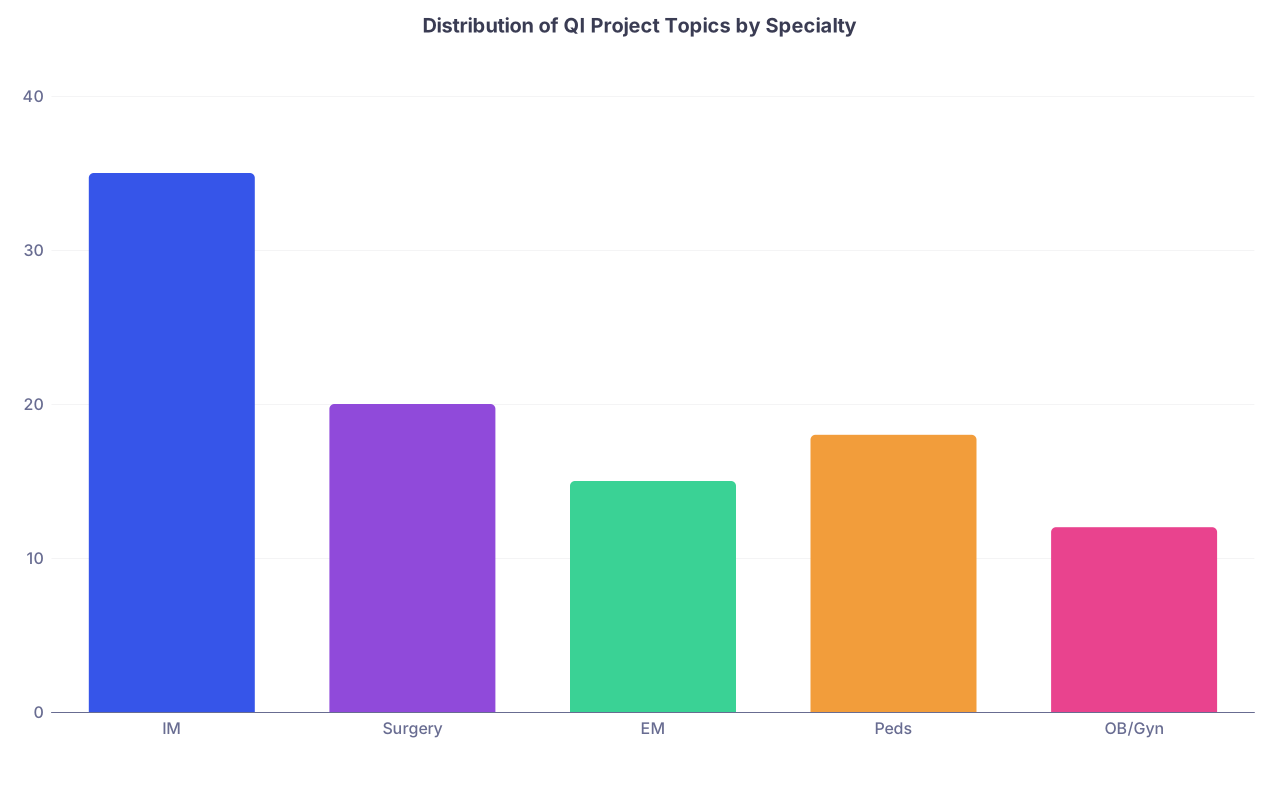
| Category | Value |
|---|---|
| IM | 35 |
| Surgery | 20 |
| EM | 15 |
| Peds | 18 |
| OB/Gyn | 12 |
7. Turn Routine Clinical Work Into QI-Grade “Research”
Many students are already sitting on QI opportunities and do not recognize them. Here is how you systematically mine your rotations.
Step 1: Listen for Complaints and Repeated Frustrations
You will hear phrases like:
- “Our discharge summaries are always delayed.”
- “We keep missing these vaccinations.”
- “Our no-show rate is killing this clinic.”
These are not just annoyances. They are QI questions.
Step 2: Convert Complaints Into Measurable Aims
Example:
- Complaint: “Our discharge summaries are always delayed.”
- Aim: “Increase proportion of discharge summaries completed within 24 hours of discharge from 40% to 80% over 4 months.”
Step 3: Ask Three Direct Questions
To a faculty or chief resident:
- “Is anyone already working on this?”
- “Is there existing data I can access?”
- “If I take the lead on this, would you be willing to be my faculty mentor?”
If the answer to #3 is “yes,” you have a potentially strong QI project.
8. Common Mistakes That Make QI Look Weak (And How to Fix Each)
Mistake 1: No Baseline Data
Statement: “We implemented a new sepsis screening tool.”
Program’s reaction: “So what?”
Fix:
- Go back and collect pre-implementation data, even if retrospectively.
- Define 2–3 clear metrics and show before/after numbers.
Mistake 2: No Defined Role
Statement: “I participated in a hospital-wide hand hygiene initiative.”
Program’s reaction: “Did you send one email or run the entire project?”
Fix:
Spell out concrete contributions:
- “Developed data collection tool;
- abstracted 150 charts;
- performed primary data analysis in Excel;
- co-authored poster.”
Mistake 3: No Dissemination
Statement: “We did a QI project on opioid prescribing.”
Program’s reaction: “Why should we believe it mattered?”
Fix:
- At minimum, present at:
- Departmental grand rounds
- Student research day
- Resident conference
- Better:
- Submit to regional/national specialty meeting
- Write a one-page “QI brief” for a small journal or institutional repository
Mistake 4: Over-selling Flimsy Work
Statement: “‘Prospective interventional trial’ of pre-round note templates.”
Program’s reaction: They smell exaggeration.
Fix:
- Be accurate but confident:
- “Pre–post quality improvement project using PDSA cycles.”
- Not “clinical trial.”
You want to sound serious, not delusional.
9. Build a Mini “Research Track” Out of QI Over 1–2 Years
If you still have time before your application, you can intentionally stack QI projects into a cohesive research narrative.
Here is a simple 18-month plan:
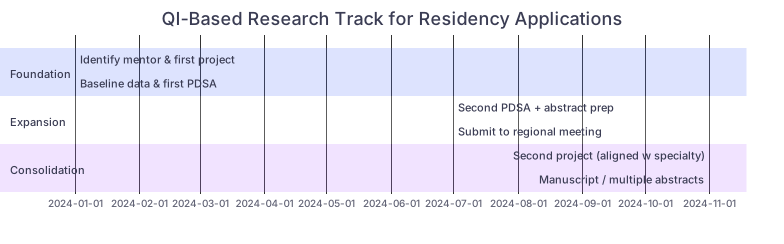
| Task | Details |
|---|---|
| Foundation: Identify mentor & first project | a1, 2024-01, 2m |
| Foundation: Baseline data & first PDSA | a2, after a1, 4m |
| Expansion: Second PDSA + abstract prep | b1, 2024-07, 4m |
| Expansion: Submit to regional meeting | b2, after b1, 2m |
| Consolidation: Second project (aligned w specialty) | c1, 2024-11, 6m |
| Consolidation: Manuscript / multiple abstracts | c2, after c1, 4m |
By ERAS submission:
- You have 1–2 completed QI projects.
- At least 1–2 posters or oral presentations.
- Possibly a short publication.
- A coherent narrative: “I am someone who uses data to improve care.”
This is exactly what residency PDs want when they say “we value research.”
10. How to Talk About QI as Research in Interviews
If you upgrade the project but freeze when asked, you lose half the benefit. You need a tight, 60–90 second script for each major QI project.
Structure it like this:
Opening line (1 sentence)
“One of my main projects was a quality improvement study on reducing unnecessary telemetry on our general medicine floor.”Why it mattered (1–2 sentences)
“We had chronic overuse of telemetry, which tied up beds, increased alarms, and did not improve outcomes for most patients. We wanted to see if we could safely reduce telemetry use by aligning practice with AHA guidelines.”What you did (2–3 sentences)
“We did a baseline audit of 300 admissions and found that 55% of telemetry orders did not meet guideline indications. I worked with a hospitalist mentor to design a guideline-based order set and ran two PDSA cycles with resident education. I handled the data collection and analysis, comparing appropriate use and rapid response events pre and post.”Results (1–2 sentences)
“Appropriate telemetry use improved from 45% to 82%, with no increase in rapid response or code events. We presented this at our institutional QI day and are preparing a brief report for publication.”What you learned (1–2 sentences)
“It taught me how to move from frustration about an issue to a structured, data-driven intervention, and it showed me how systems-level changes can impact hundreds of patients at once.”
That is research language. QI content. Perfectly acceptable as “research experience” for almost any program.
FAQ (Exactly 3 Questions)
1. Do competitive specialties (like dermatology, ortho, plastics) actually respect QI/audit projects as research?
Yes, if they are executed and presented well. Hyper-competitive fields still lean toward traditional clinical or basic science research, especially multi-center or high-impact work. However, a rigorous QI project with clear methodology, measurable improvement, and national-level presentation absolutely counts as research experience. If you are applying to these specialties, you should ideally have: (1) at least one traditional research project, and (2) one or more strong QI projects that demonstrate initiative and impact. The QI work alone will not rescue a weak application, but it can significantly strengthen a good one.
2. My QI project never got “better outcomes,” only better documentation. Is that still worth highlighting?
Yes, as long as you are honest and precise about what improved. Documentation, process reliability, and adherence to guidelines are legitimate outcomes in quality improvement. The key is not to claim “reduced mortality” if what you showed was “increased accurate medication reconciliation.” You frame it as: “We improved documented compliance with [guideline] from X% to Y%, which is an important process measure linked to better outcomes in the literature.” Programs understand that stepwise improvement often starts with documentation and process metrics.
3. I joined a QI group late and only helped with data collection. Should I list that as a research experience?
You can list it, but you should not oversell your role. It is better to frame it as a supporting research/QI experience rather than your flagship project. Briefly describe the study aim, methods, and outcomes, then clearly state: “I contributed by cleaning and abstracting data from 150 charts and assisted with figure creation for the poster.” If you have time, ask the team whether there is a small sub-analysis, secondary outcome, or spin-off project you can lead. That is often the fastest path to moving from “data helper” to “co-author” on at least one tangible product.
Open your ERAS activities list right now and look at every QI/audit item. For each one, draft a one-sentence aim, a clear design (pre–post, PDSA, audit), and at least one concrete result. If you cannot do that yet, you have just identified your next 2–3 months of focused work.