
Your research data is not the problem. Your workflow is.
Most medical students doing research for residency applications are drowning in half-finished projects and messy spreadsheets, not because they lack intelligence or effort, but because they have no ruthless, repeatable system. They ping-pong between the lab, the wards, and “I’ll write that abstract this weekend” until ERAS opens and panic hits.
Let me fix that for you.
What you need is not generic advice like “start early” or “be organized.” You need a concrete, step-by-step workflow that starts where you are right now—scattered data, limited time—and ends with a polished, submission-ready abstract that actually helps your residency application.
I am going to give you exactly that. A simple pipeline:
Data chaos → Clean dataset → Core results → Draft abstract → Final submission
You can run this workflow on any project: retrospective chart review, QI project, survey, basic science. It will not make your stats perfect. It will make your output real and on time.
Step 1: Stop the Bleeding – Contain the Chaos
Before you touch the stats, you need to control the mess. That starts with a single “research hub” for each project.
1. Create a Single Project Folder
On your computer or cloud (OneDrive, Google Drive, Dropbox – pick one and stop hopping):
- Make a folder:
LastName_ProjectShortName_Specialty_Year
Example:Nguyen_AFibReadmissions_Cardiology_2026
Inside that folder, create four subfolders:
01_Protocol_IRB02_Data03_Analysis04_Manuscripts_Abstracts
Then, one master note file:
Project_Log.mdorProject_Log.docx
This log is where you track:
- Key dates (IRB approval, first patient included, analysis finished)
- Team roles and decisions
- To-do list for the next work session
No more decisions lost in email threads. No more “Wait, which version did we use?”
2. Lock Down Roles and Expectations
Your residency application does not care that you “helped with a project.” It cares that you can point to a specific role and tangible product.
Clarify with the PI or resident today:
- Who is responsible for:
- Data collection
- Data cleaning
- Analysis
- Abstract writing
- Submission logistics
- Who is first author on:
- Conference abstract
- Manuscript (if planned)
- Target:
- Conference(s) and their deadlines
- Journal (if already decided)
If you do not nail this down early, you will end up as “middle author on a maybe-paper in three years.” For competitive specialties (Derm, Ortho, ENT, Plastics, Rad Onc), that is a bad trade.
Step 2: Turn Messy Data into a Clean, Usable Dataset
You cannot write a good abstract from garbage data. But you also cannot spend three months “perfecting” the dataset while clerkships are eating you alive. You need good enough data cleaning.
1. Standardize Your Variable List
Open your data file (usually Excel, REDCap export, CSV). Create a separate “Codebook” sheet or document:
For each variable, define:
- Variable name (short, no spaces):
age,sex,bmi,los_days - Definition:
length of stay in days from admission to discharge - Type:
- Continuous (e.g., age, BMI)
- Categorical (e.g., sex, smoker yes/no)
- Ordinal (e.g., NYHA class I–IV)
- Coding:
sex: 0 = female, 1 = malesmoking_status: 0 = never, 1 = former, 2 = current
- Missing values:
- Use a single code: blank,
NA, or.(but be consistent)
- Use a single code: blank,
If your current sheet has random text (“Unknown”, “?” , “N/A”), fix that now. This is what destroys fast analysis later.
2. Fix the Three Most Common Data Nightmares
You do not have time to fully sanitize everything. Focus on what will absolutely break your analysis:
Inconsistent categories
- Problem: “M”, “Male”, “MALE”, “m” all in the same column.
- Fix: Convert them all to a single, defined code (0/1 or Male/Female – pick one and stick with it).
Obviously impossible values
- Age 306. BMI 2. Systolic BP 900. Length of stay -3.
- Fix:
- Correct if clearly a typo and you can confirm (e.g., 306 → 36).
- Otherwise set to missing and document in your log.
Date chaos
- Mixed formats, missing years, text like “Summer 2020.”
- Fix:
- Convert to a standard format (
YYYY-MM-DD) where possible. - If you just need lengths or time intervals, compute them once (e.g.,
discharge_date – admit_date = los_days) and then ignore the raw dates for analysis.
- Convert to a standard format (
Do not chase every minor quirk. Fix the stuff that will derail your stats.
Step 3: Decide the Story Before You Run Every Test Imaginable
Most student projects die in “analysis limbo” because there is no clear research question. Without it, you run 30 tests, get a random p < 0.05, and end up with a messy, incoherent abstract.
You need one primary question. Maybe one or two secondaries. That is it.
1. Lock in the Core Question
Open your project log and answer these in one or two sentences:
- Population: Who are you studying? (e.g., adults ≥18 admitted with sepsis)
- Exposure / Intervention: What is different between groups? (e.g., early vs delayed antibiotics)
- Outcome: What is the main thing you care about? (e.g., in-hospital mortality, 30-day readmission)
- Time frame: When? (e.g., 2018–2022 at a single academic hospital)
Example:
Among adults admitted with sepsis (population) at our tertiary care center between 2019–2022 (time), is early antibiotic administration within 3 hours of triage (exposure) associated with lower in-hospital mortality (outcome)?
Write that at the top of your log and, frankly, at the top of your analysis file. It is your anchor.
2. Choose a Simple Analysis Plan You Can Actually Execute
Most med students do not need regression with 9 covariates and interaction terms. You need simple, robust analysis that you understand.
For a basic retrospective clinical project, start with:
- Descriptive stats
- Continuous variables: mean ± SD (or median [IQR] if skewed)
- Categorical variables: counts and percentages
- Group comparisons
- Categorical vs categorical: Chi-square or Fisher’s exact
- Continuous vs two groups: t-test or Mann–Whitney U
- Continuous vs multiple groups: ANOVA or Kruskal–Wallis
If your PI wants multivariable regression, fine. But get the descriptive and simple comparisons done first. They are what residencies will actually see in your abstract.
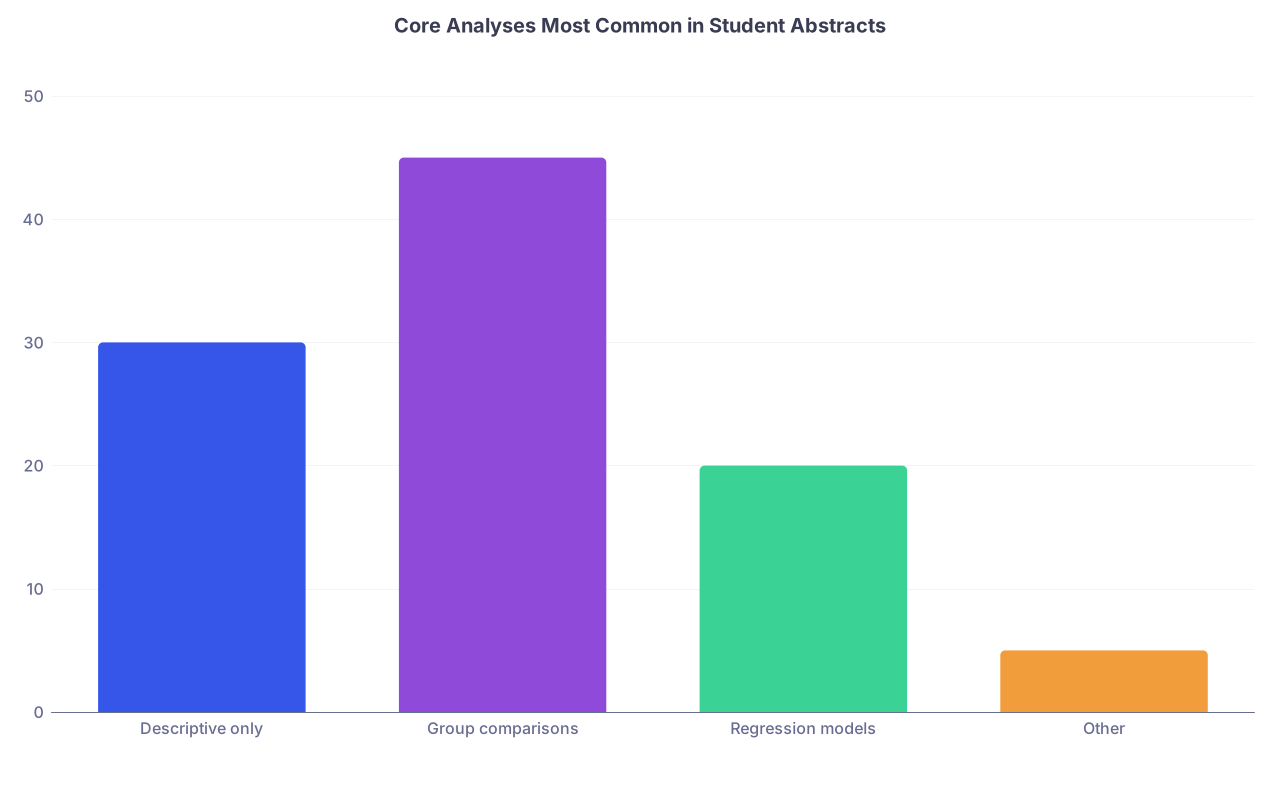
| Category | Value |
|---|---|
| Descriptive only | 30 |
| Group comparisons | 45 |
| Regression models | 20 |
| Other | 5 |
Use software you can learn quickly: SPSS, Stata, R, Python, or even advanced Excel for very simple projects. The best tool is the one you can actually run without waiting three weeks for the biostatistician.
Step 4: Run a Focused, Fast Analysis Session
You are on rotations. You do not have six-hour blocks. You have 45–90 minute windows between call shifts, lectures, and life.
So you plan a “results sprint.”
1. Before the Sprint: Prepare a Mini-Analysis Checklist
Directly in your project log, write a one-page checklist:
- Confirm analysis dataset
N(after excluding ineligible/missing key data) - Table 1: Baseline characteristics
- Primary outcome rate (overall)
- Outcome by exposure/group
- Secondary outcomes (if applicable)
- Sensitivity checks (if preplanned)
During your sprint, you touch only these items. Not side hypotheses. Not pretty graphs. Just what you need to fill in an abstract.
2. Actually Run It – One Table at a Time
Open your stats software:
Define your final analytic dataset
- Drop obviously ineligible patients (e.g., under 18 if adults only).
- Exclude cases missing the primary outcome. Document how many and why.
Generate Table 1
Typically includes:
- Age, sex, BMI
- Key comorbidities
- Relevant clinical variables (e.g., initial lactate, APACHE score)
For each variable:
- Overall
- By group (e.g., early vs delayed antibiotics)
Compute your primary outcome
Example: In-hospital mortality:
- Overall mortality rate (%)
- Mortality by group (early vs delayed)
- p-value for difference
Save outputs properly
- Export tables as
.csvor copy cleanly into aResults_Tables.docxfile. - Name outputs with versioning:
Table1_v1_2026-01-06.docx
- Export tables as
Do not leave results stuck inside SPSS output windows or a random R console session.
Step 5: Draft the Abstract in a Single Sitting
Now you have:
- A cleaned, defined dataset
- Descriptive stats
- Primary outcome comparisons
You are ready to write. Not perfect. Not final. But enough for a draft that your mentor can actually work with.
Most medical conferences follow a similar structure:
- Background
- Objective
- Methods
- Results
- Conclusions
You can draft this in 60–90 minutes if you have the data in front of you.
1. Use a Ruthless Word Budget
Aim for:
- Background: 2–3 sentences (40–60 words)
- Objective: 1 sentence
- Methods: 3–5 sentences
- Results: 4–6 sentences
- Conclusions: 2–3 sentences
That is it. No literature review. No hand-waving.
2. Plug Your Data into Concrete Sentences
Use this skeleton and modify as needed.
Background
One or two precise facts + the gap.
Sepsis is a leading cause of in-hospital mortality, and timely antibiotic administration is a key component of early management. However, real-world data on the association between antibiotic timing and outcomes in community hospitals remain limited.
Objective
Direct and narrow.
We aimed to evaluate the association between antibiotic administration within 3 hours of triage and in-hospital mortality among adults admitted with sepsis.
Methods
Include design, setting, population, exposure, outcome, and analysis.
We performed a retrospective cohort study of adults ≥18 years admitted with sepsis to a single community teaching hospital from January 2019 to December 2022. Sepsis was defined using Sepsis-3 criteria. The exposure was receipt of intravenous antibiotics within 3 hours of emergency department triage. The primary outcome was in-hospital mortality. We compared baseline characteristics and outcomes between early and delayed antibiotic groups using chi-square and t-tests.
Results
Lead with N, then core numbers. No vague language.
Among 732 eligible patients, 418 (57.1%) received antibiotics within 3 hours of triage. Mean age was 64.3 ± 15.2 years, and 52.6% were male. Overall in-hospital mortality was 18.7%. Mortality was lower in the early antibiotic group compared with the delayed group (15.3% vs 23.4%, p = 0.01). The early group also had a shorter median length of stay (6 [IQR 4–9] vs 8 [IQR 5–12] days, p < 0.001).
Conclusions
One key takeaway + implication. No grandiose claims.
In this single-center cohort, antibiotic administration within 3 hours of triage was associated with lower in-hospital mortality and shorter length of stay among adults with sepsis. These findings support ongoing efforts to prioritize timely antibiotic delivery in emergency department sepsis protocols.
That is a residency-ready abstract. It shows you can define a question, analyze data, and say something coherent.
Step 6: Align the Abstract with Residency Application Strategy
You are not just doing research for fun. You are doing it because your ERAS application and interviews will be judged on it. The same abstract can look impressive or forgettable depending on how you present and prioritize it.
1. Map Each Project to Your Target Specialty
Look at your current and planned projects. Ask one question:
Does this help my narrative for my intended specialty?
If you are applying to:
Internal Medicine / Cards / Pulm / Heme-Onc
Sepsis, heart failure, AFib, ICU outcomes, risk prediction models – all high-yield.Surgery / Ortho / Neurosurgery
Perioperative outcomes, complication rates, surgical techniques, QI projects in the OR.Derm / Ophtho / ENT / Plastics
Specialty-specific projects are almost mandatory. General QI is not enough.Psych / Neuro
Outcomes work, treatment response, neuroimaging, or solid QI around readmissions, restraint use, etc.
Be ruthless. If a project does not support your target field and you are short on time, it goes to the back of the line. Not deleted. Just deprioritized.
| Specialty Target | High-Priority Project Type | Low-Priority Project Type |
|---|---|---|
| Internal Med | Clinical outcomes, QI in wards | Basic science unrelated to IM |
| Surgery | Peri-op outcomes, techniques | Generic med education surveys |
| Dermatology | Derm clinical/bench studies | ICU sepsis if no derm tie-in |
| Psychiatry | Psych outcomes, service use | Orthopedic QI with no psych link |
| Radiology | Imaging-based projects | Purely clinic workflow QI |
2. Extract ERAS-Friendly Talking Points
From each abstract, you want 3–4 quick bullets you can talk about in an interview:
- Your specific role (“I did the chart abstraction and primary analysis.”)
- The core result (“Early antibiotics were associated with about 8% absolute lower mortality.”)
- What you learned (“How to build a dataset that a statistician would not hate.”)
- The impact (“It led to a change in our sepsis order set.” – if true)
Write these into a separate file:Residency_TalkingPoints_Research.docx
You will thank yourself in six months on a Zoom interview when someone says, “Tell me about this project.”
Step 7: Build a Repeatable “Abstract Machine”
One project is fine. Two or three is better. For competitive residencies, you want a pipeline of abstracts that can turn into posters and, ideally, a publication or two.
That means turning this workflow into a reusable system.
1. Create a Reusable Template Set
In your main research folder, create a Templates directory with:
Template_Project_Log.docxTemplate_Codebook.xlsxTemplate_Abstract.docxTemplate_Analysis_Checklist.docx
Each new project:
- Copy the folder
- Rename it
- Modify the templates minimally
You should never again start a project from a blank document.
2. Implement a Simple Timeline for Each Project
You are busy. You cannot babysit a project forever. So you set a default timeline from “data complete” to “abstract submitted.”
Use this as a baseline:
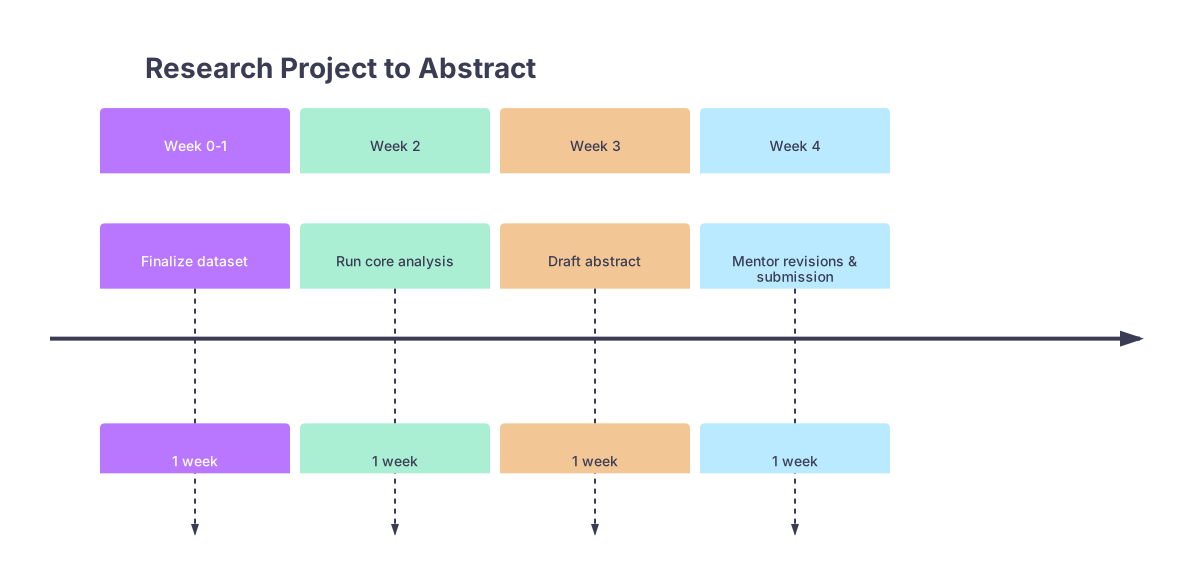
| Period | Event |
|---|---|
| Week 0-1 - Finalize dataset | 1 week |
| Week 2 - Run core analysis | 1 week |
| Week 3 - Draft abstract | 1 week |
| Week 4 - Mentor revisions & submission | 1 week |
Four weeks. That is the target. Some will stretch, but this gives you something to push against. If a project sits with “data basically done” for more than a month, that is a red flag.
3. Track Conference Deadlines Like Exams
You would not miss a Step 2 registration window. Stop missing abstract deadlines.
Build a small deadline tracker (spreadsheet or calendar):
Columns:
- Conference name
- Specialty
- Abstract deadline
- Word limit
- Status (idea, data collected, analysis done, abstract drafted, submitted)
- Project name
Example entries:
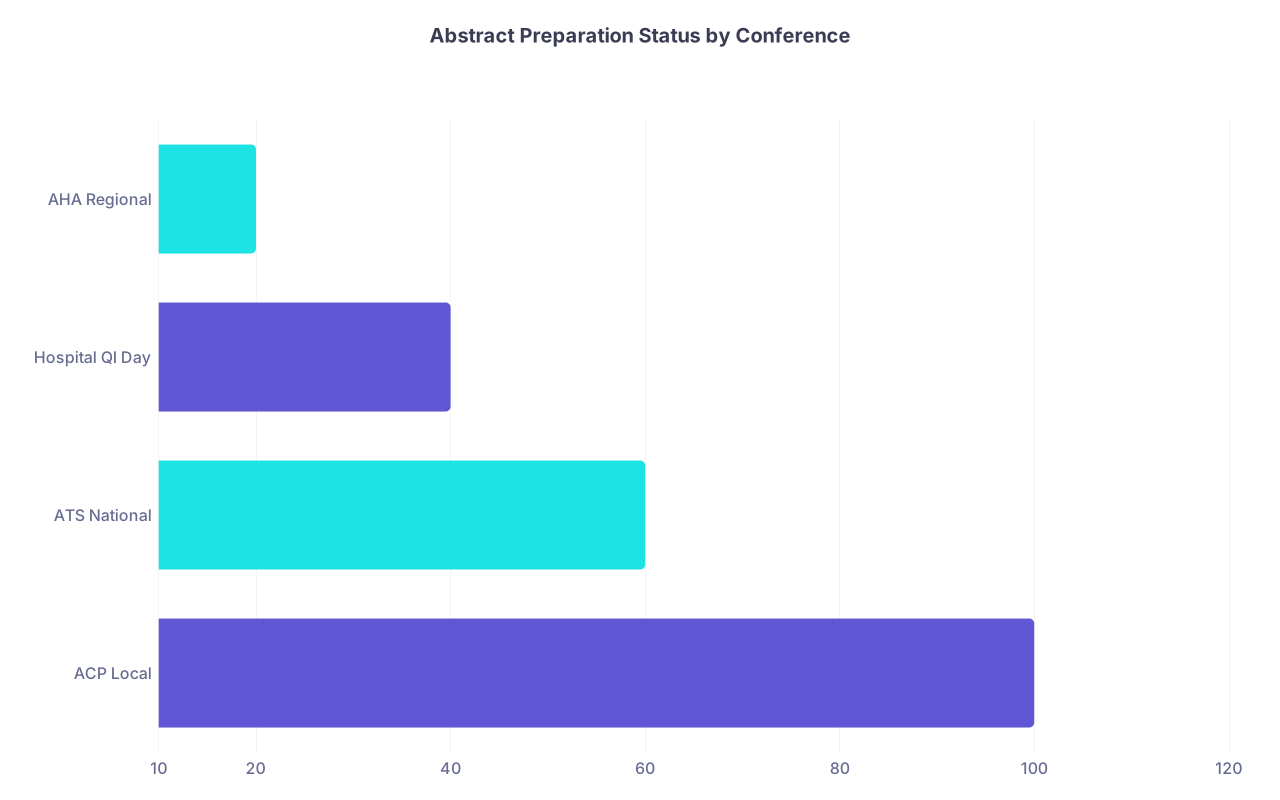
| Category | Value |
|---|---|
| ACP Local | 100 |
| ATS National | 60 |
| Hospital QI Day | 40 |
| AHA Regional | 20 |
(Values represent % completion toward submission.)
Review this every two weeks. Decide which deadlines you will actually hit. Then work backward.
Step 8: Fit This Into a Real Med Student Schedule
Everything above is worthless if it does not fit around shelf exams, call nights, and your sanity.
You need a minimum viable research schedule.
1. Use the “3 × 45-Minute” Rule
For an active project aiming at an abstract in 4–6 weeks:
- 3 blocks per week
- 45 minutes each
- Hard start, hard stop
Example weekly breakdown:
- Block 1: Data cleaning / codebook updates
- Block 2: Running or revising analysis
- Block 3: Writing / editing abstract
You can do this early morning, post-call afternoon, or between lectures. But you commit. It is easier to keep momentum with 3 × 45 than 1 × 3-hour heroic session you cancel every week.
2. Protect One “Deep Work” Session Before Major Deadlines
Two weeks before an abstract deadline, schedule:
- One 2–3 hour uninterrupted block
- Goal:
- Finalize abstract text
- Format per conference rules
- Get last mentor feedback
- Submit
Put it on your calendar like an exam. Let your co-authors know: “I am planning to finalize the abstract on [date], so please send edits by [earlier date].”

Step 9: Avoid the Common Failure Modes That Kill Med Student Projects
I have watched dozens of student projects die the same stupid deaths. Avoid these, and you are already ahead of half your peers.
1. “We’ll Figure Out Authorship Later”
No. You will not. Figure it out now, get it in writing (even if that is just an email), and protect your time investment.
- If you are doing the bulk of the work on analysis and writing, you should be first author on at least the abstract.
- If your role is minor (data entry only), be realistic. But do not sink major effort into a project that will not credit you visibly.
2. Endless Perfection in Analysis
Do not get stuck in:
- “We should add 5 more variables to the model.”
- “Let’s test 4 different definitions of sepsis.”
- “Maybe we should learn machine learning for this.”
For an abstract tied to residency season, done < perfect. Get a clean, defensible analysis, then iterate later if the project lives on as a manuscript.
3. Absent PI Syndrome
Some mentors are fantastic. Some vanish.
If your PI repeatedly:
- Takes 4+ weeks to respond to drafts
- Has not looked at the data after you have cleaned it
- Misses multiple abstract deadlines without urgency
You need to quietly throttle your effort and move some of your energy to a more responsive project. One well-supported project that produces a podium or first-author poster is worth more than three dead-end “maybe papers.”
Step 10: Turn Today’s Data Chaos into a Submission in 30 Days
Let me pull this together into a concrete, 30-day rescue plan for you.
You have:
- A partially collected dataset
- No abstract
- ERAS season approaching or conference deadlines looming
Here is how you fix it.
Week 1 (Days 1–7)
- Create a clean project folder and log.
- Build your codebook and standardize variables.
- Define:
- Primary question
- Primary outcome
- Main exposure/group
- Fix the three worst data issues (categories, impossible values, missing key outcomes).
Week 2 (Days 8–14)
- Finalize your analysis dataset (N, inclusion/exclusion).
- Generate:
- Table 1
- Primary outcome numbers overall and by group
- Meet (or email) your PI with:
- One-paragraph summary of question
- One-page results table
- Proposed abstract outline
Week 3 (Days 15–21)
- Draft full abstract using the skeleton above.
- Get targeted feedback:
- Ask your PI: “Are the conclusions too strong / too weak?”
- Ask a resident/fellow: “Is this clear and boring, or clear and interesting?”
- Revise once. Do not rewrite endlessly.
Week 4 (Days 22–30)
- Format abstract for a real conference (word count, headings, structure).
- Confirm:
- All authors approve
- Affiliations and funding statements are correct
- Submit. Put the confirmation email in your project folder.
That is how you go from data chaos to abstract in a month without blowing up your rotation performance.

Your Next Step: Do One Ruthless Hour Today
Do not “plan to start” this weekend. Do this instead:
- Pick one active or stalled project.
- Create the project folder and the
Project_Logfile. - Write at the top of that log:
- One-sentence research question
- Target conference and its abstract deadline
- Block a 45-minute session on your calendar in the next 48 hours labeled:
“[Project Name] – Data Cleaning Sprint #1.”
Then, in that 45 minutes, touch only that project. No email. No side-reading. Just cleaning and defining the dataset.
You will feel the difference immediately. You will go from “I kind of have a project” to “I am pushing a real abstract toward submission.”
Open your calendar right now and schedule that 45-minute sprint. That is where your residency-level research actually starts.