How to Talk About Minimal Research on Interviews Without Sounding Weak
You do not need a first‑author NEJM paper to sound strong in an interview.
You do need a story, a frame, and discipline in how you talk about your research gap.
I have watched applicants with almost no research experience outperform PhDs on interview day. I have also watched good candidates torpedo themselves in 30 seconds by apologizing for their CV. Same “objective profile.” Completely different outcome.
Let’s fix that.
You are not going to magically create years of research before interview season. The only lever you have now is how you present what you have. That is more powerful than you think—if you do it deliberately.
Step 1: Get Ruthlessly Clear on Where You Actually Stand
Before you decide what to say, you need to know your situation in “program language,” not applicant wishful thinking.
Ask yourself four blunt questions:
What is my actual research volume?
- 0 projects ever
- 1 small project / QC / case report, not published
- A few posters / abstracts
- One or more manuscripts (submitted/accepted/published)
How research‑heavy is my target specialty?
Dermatology and radiation oncology care much more about research than family medicine. You know this already, but quantify it.Am I applying to high‑research institutions?
Think university hospitals with big NIH portfolios and T32 grants versus community programs with little formal research infrastructure.Do I have any ongoing scholarly or QI work right now?
Even an in‑progress chart review, QI project, or educational initiative matters if you frame it correctly.
Quick comparison so you see how programs may look at you:
| Specialty Type | Typical Research Expectation | How Harshly 'Minimal Research' Is Judged |
|---|---|---|
| Derm, Rad Onc, Plastics | High | Very high |
| Academic IM, Neuro | Moderate–High | Moderate–High |
| EM, OB/GYN, Anesthesia | Moderate | Moderate |
| Community IM, Peds | Low–Moderate | Low–Moderate |
| FM, Psych, Neuro Peds | Low | Low |
If you are applying to a research‑heavy specialty with almost no research, you cannot pretend it does not matter. You have to confront it directly and intelligently. Everyone else should still prepare, because at some point you will be asked about “your scholarly work.”
Step 2: Stop Making the Two Most Common (And Fatal) Mistakes
I hear the same self‑sabotage patterns over and over.
Mistake 1: Leading With an Apology
“I know my research is kind of lacking.”
“I did not really get the chance to do much research.”
“I am not really a research person.”
This sounds defensive, insecure, and passive. Interviewers hear:
- “I did not prioritize this.”
- “I cannot own my choices.”
- “I will probably avoid hard, non‑required work as a resident.”
You think you are “being honest.” You are actually telling them not to rank you.
Mistake 2: Overcompensating With Fluff
“I collaborated heavily on a major project” (you collected five surveys).
“I led a multi‑center trial” (you emailed another site twice).
“We are about to submit” (nothing actually written).
Programs smell this a mile away. When they probe, the story falls apart. Better to have small, honest experiences that you present clearly than exaggerated nonsense that crumbles under one follow‑up question.
Rule:
No apologizing.
No inflating.
Just clear, confident ownership of what you have done and what you are doing next.
Step 3: Build a Controlled Narrative Before You Walk In
You need a script. Not to recite word‑for‑word, but to anchor how you talk about this.
There are three parts:
- A concise summary of your actual research involvement
- A clear reason it is limited (if they push)
- A forward‑looking statement that shows growth and alignment with the specialty
Let’s build each.
1. Concise Summary (Own What You Have)
Goal: Describe your research in 1–2 sentences that sound intentional and grounded.
Examples:
For very minimal research:
“My formal research has been limited to a chart‑review quality improvement project in our internal medicine clinic, focused on optimizing follow‑up for uncontrolled diabetes. I helped with data collection and analysis, and we presented the results at our local hospital research day.”For a couple of small projects:
“I have been involved in two main projects. One was a retrospective chart review on readmission predictors in heart failure, where I worked on data abstraction and drafting the methods section. The second was a case report on a rare vasculitis presentation that we presented as a poster at the state ACP meeting.”
Notice what I am not doing:
- No “unfortunately”
- No “I wish I had more”
- No apology.
You say what you did. Clean. Simple. Then move on.
2. Clear Reason (If They Ask “Why So Little?”)
You do not volunteer excuses. But if they ask, you must have a tight, non‑whiny explanation plus what you learned from it.
Keep this under 20–25 seconds.
Better examples:
Schedule and access reality (not laziness):
“During my pre‑clinical years, our school did not have a strong centralized research structure, and I frankly did not know how to access research mentors early on. By the time I figured out where the opportunities were, most long‑term projects were already well underway.”Competing early commitments, then a pivot:
“I spent my first year deeply involved in a longitudinal free clinic commitment that met weekly, and I chose to put my extra time there instead of the lab. In third year, after realizing I wanted a more academic internal medicine path, I actively sought out a mentor and joined the outcomes project I mentioned earlier.”
What interviewers are listening for:
- Did you make a conscious choice?
- Did you recognize the gap?
- Did you do something about it later?
3. Forward‑Looking Statement (Turn a Weakness Into a Trajectory)
This is where you stop the bleeding and actually gain points.
You pivot from “limited research” to “growing interest and realistic research goals in your field.”
Examples tailored to specialty:
Internal medicine, moderate research:
“As I have gotten more exposure to internal medicine, I have realized I am particularly interested in outcomes and quality improvement work. I am not aiming to be a basic scientist, but I do want to be the kind of attending who can ask a good clinical question and work with a team to answer it. That is why I have prioritized QI‑oriented projects and plan to build on that during residency.”Emergency medicine, limited research culture:
“My main focus has been clinical EM and systems‑level improvement rather than traditional bench research. Going forward, I am most interested in operations‑focused projects—things like throughput, boarding, and high‑utilizer pathways—where I can contribute meaningfully even without a heavy basic science background.”Even for research‑heavy specialties, you still align with what is realistic:
“I recognize I am starting with less research than many applicants. My primary interest lies in clinical research and patient‑reported outcomes in dermatology, particularly around chronic inflammatory diseases. I have already connected with a mentor to continue the project I started, and I am looking for a residency that will help me build those skills methodically.”
Step 4: Translate Non‑Traditional Work Into “Research‑Adjacent Strength”
Many applicants actually have more “research‑adjacent” experience than they realize. They just do not know how to talk about it.
Think:
- Quality improvement projects
- Clinical audits
- Database building for a service
- Curriculum development with pre‑ and post‑surveys
- Free clinic tracking outcomes
- Leadership in projects that used data
These do not magically become “NIH‑level research,” but they absolutely count if framed correctly.
How to Frame Non‑Traditional Work
Use three elements:
- Question – What were you trying to figure out or change?
- Method – How did you systematically measure or test it?
- Impact – What changed (or what did you learn)?
Example: Free clinic project with no “official” label
Instead of:
“I just volunteered at the student‑run clinic. No research really.”
Say this:
“In our student‑run clinic, I helped track no‑show rates and reasons for missed visits over a six‑month period. We started with the question of whether reminder calls made a measurable difference. We collected baseline data, implemented a reminder system, and then compared no‑show rates before and after. The rates dropped from roughly 30% to 18%, and we used that data to argue for institutional support to maintain the reminder system.”
One is “I just volunteered.”
The other is structured, analytical, and sounds like someone who can contribute to QI or clinical research.
Step 5: Script Your Answers to the Three Predictable Questions
Most of your interview anxiety can be eliminated by pre‑writing and practicing answers to the predictable hits.
Question 1: “Tell me about your research.”
Do not panic. You are not being quizzed on methods like a PhD defense. They just want to know:
- Have you ever engaged with scholarly work?
- Can you explain it clearly without rambling?
- Did you learn anything?
Structure:
- 1–2 sentences: Context and your role
- 1–2 sentences: What the project asked / found
- 1–2 sentences: What you learned / how it shaped you
Example for minimal research:
“I worked on a small QI project in our internal medicine clinic focused on patients with uncontrolled diabetes. My role was to extract data from the EHR on A1c levels, visit frequency, and no‑shows before and after we implemented a structured follow‑up protocol. We found that consistent scheduled follow‑up with nursing phone reminders modestly improved A1c control in a subset of patients. The main takeaway for me was seeing how even small, structured changes, if measured properly, can improve care, and it made me more interested in participating in future QI efforts during residency.”
Key: short, specific, and you sound like an adult who understands what you did.
Question 2: “Why do you not have more research?”
(Or the softer version: “How do you see research fitting into your career?”)
Use the three‑step formula:
- Brief reason (no whining).
- Ownership and what you did once you recognized the gap.
- Forward‑looking plan that fits the program.
Example:
“Earlier in medical school, I did not prioritize research. I was heavily involved in longitudinal clinical volunteering and some family responsibilities at home, and I thought I would aim for a purely community‑based career. During third‑year rotations, especially inpatient internal medicine, I realized I enjoyed asking the ‘why’ and ‘what if’ questions that lend themselves to more academic work. That is when I joined the outcomes project I mentioned. Going forward, I see myself as a clinically focused internist who participates in outcomes‑oriented projects and QI, especially in a residency that supports structured scholarly time.”
Notice there is no “my school is bad” or “COVID ruined everything” excuse. Those explanations have been overused to death. Programs are tired of hearing them as the only reason.
Question 3: “What kind of research or scholarly work would you want to do here?”
This is where most low‑research applicants start hand‑waving. You cannot afford that.
Be specific but realistic. Tie your answer to:
- A broad area (outcomes, QI, medical education, health disparities)
- A patient population or disease you have actually seen
- The program’s known strengths (from their website, residents, etc.)
Example tailored answer:
“At your institution, I would be most interested in participating in clinical outcomes or QI work in heart failure. During my medicine clerkship, I was struck by how many admissions were preventable with better outpatient follow‑up and medication reconciliation. I know your department has active projects on readmissions and transitional care. I might not have a strong research background now, but I can bring consistent effort and follow‑through on data collection and protocol implementation, and I want to grow those skills under structured mentorship.”
That sounds like someone they can plug into a project tomorrow. Which is exactly what you want.
Step 6: Leverage the Rest of Your Application to Offset Minimal Research
Programs do not evaluate research in isolation. They look at the whole profile.
If you are light on research, you must double down on:
- Clinical strength – strong clerkship comments, sub‑I performance, LORs saying “reads around cases,” “takes ownership,” “functions at an intern level.”
- Work ethic and reliability – concrete examples of sustained commitments (years in free clinic, leadership with deliverables).
- Teaching / communication – tutoring, peer teaching, curriculum creation, anything that shows you can explain complex concepts clearly.
Your interview behavior itself becomes part of this compensation strategy.
- If you speak clearly and concisely about your limited research → you look analytical and self‑aware.
- If you ramble, apologize, or seem defensive → you reinforce the “not academic” stereotype.
You can also connect your strengths to how you will contribute to the program’s scholarly output even without a heavy research background:
- Strong writers can help with case reports, chart review manuscripts.
- Organized, reliable residents become the ones PIs trust with data integrity.
- Good communicators are ideal for educational projects and OSCE design.
Make that explicit.
“I know I am coming in with relatively limited formal research, but I have always been the person in group projects who writes the first draft and makes sure deadlines are met. My hope is to use that same reliability to support the team’s ongoing clinical projects here.”
Interviewers remember that kind of statement.
Step 7: Use Mock Reps To Eliminate Weak Phrasing
You cannot think your way into sounding confident. You have to say the words out loud till they are boring.
Here is a simple three‑day protocol:
Day 1 – Write and Record
Write down your:
- 60‑second answer to “Tell me about your research.”
- 30‑second answer to “Why not more research?”
- 45‑second answer to “What would you want to do here?”
Record yourself on your phone answering those three questions.
Play it back and circle:
- Any apologies (“sorry,” “unfortunately,” “I wish…”)
- Any filler (“like,” “you know,” “um,” “kind of,” “sort of”)
- Any vague phrases (“do more research,” “get involved,” “help out”)
Rewrite the answers cutting that garbage. Replace with:
- Specifics.
- Measurable actions.
- Concrete domains (outcomes, QI, med ed, etc.).
Day 2 – Mock Interview With a Human
Grab a friend, resident, or advisor and say:
“Ask me these three questions exactly like an interviewer would, and do not go easy on me.”
Questions:
- “Can you walk me through your research experience?”
- “Given that this is an academic program, how do you think about your limited research?”
- “If you matched here, how do you see yourself engaging in scholarly work?”
Ask your mock interviewer to rate you on:
| Category | 1 (Weak) | 5 (Strong) |
|---|---|---|
| Clarity | Rambling / vague | Concise / specific |
| Confidence | Apologetic / defensive | Calm / matter-of-fact |
| Ownership | Blames externals | Owns choices |
| Forward-Looking | No clear plan | Concrete next steps |
Fix the lowest‑scoring category in your script.
Day 3 – Pressure Test
Do the same three questions again, but this time:
- Stand up.
- Wear what you would wear on interview day.
- Look into the camera as if it is an interviewer on Zoom.
This sounds silly. It is not. Your brain associates the scenario with the script. On the real day, your body “recognizes” the situation and runs the practiced answer rather than the panicked one.
Step 8: Do Something Now So You Are Not Completely Static
You may not be able to add a publication before interviews. You can still change the story from “I have not done research” to “I am currently engaged in X and plan to continue it.”
Programs like movement.
Examples of fast, realistic actions you can take even late:
- Join a small case report with a resident or attending.
- Attach yourself to a chart review that is already ongoing.
- Start a very tight, simple QI project (e.g., discharge summary quality checklist on one service).
- Help a faculty member with data cleaning or literature review.
Then you can honestly say:
“Recently, I started working on a case report about X with Dr. Y, and we are in the drafting phase now. It has been a good entry point for me to learn the writing and submission process.”
Compare that to:
“I have not really done much research.”
Same CV line. Different energy entirely.
Here is how the psychological difference looks:
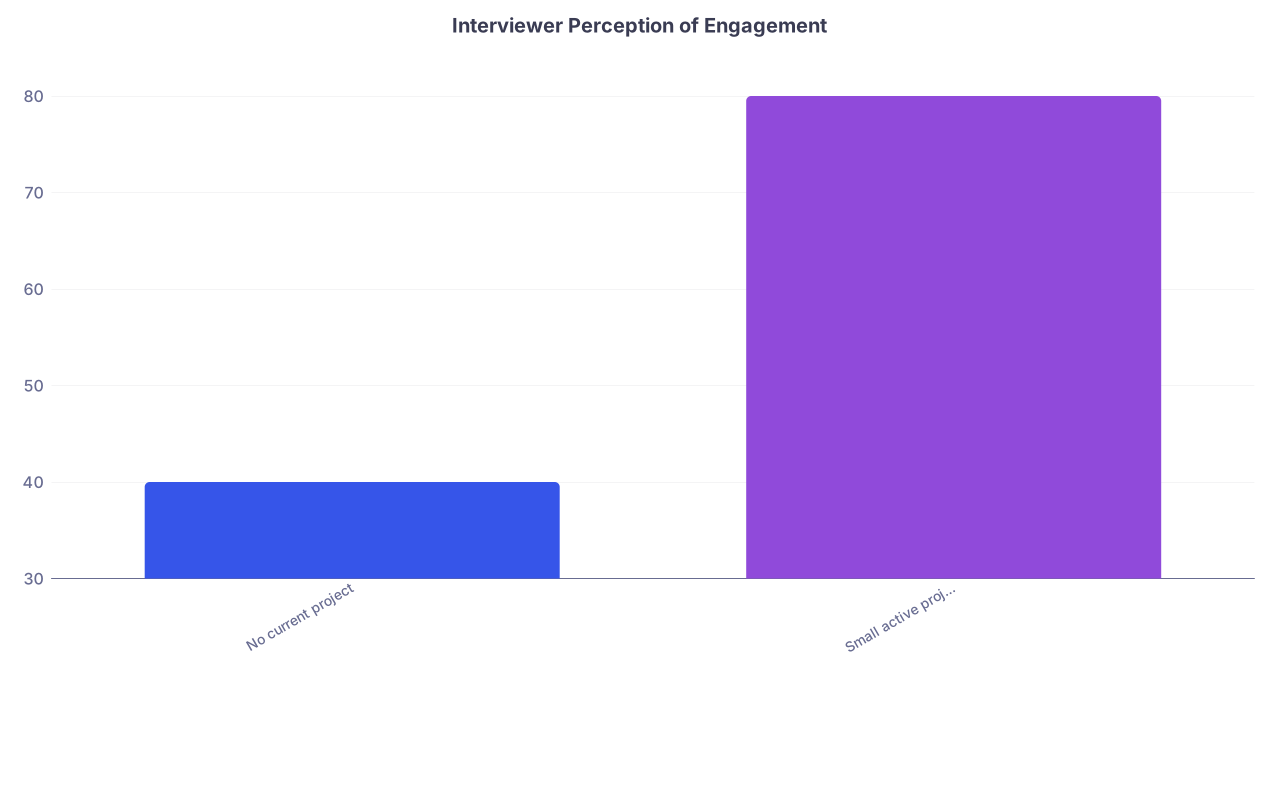
| Category | Value |
|---|---|
| No current project | 40 |
| Small active project | 80 |
The numbers are illustrative, but the effect is real. A small active project almost doubles the perceived engagement.
Step 9: Match Your Research Story to the Program Type
You should not give the same answer at a community FM program and an Ivy League academic IM department.
For Community‑Oriented, Less Research‑Intense Programs
Emphasize:
- QI
- Clinical excellence
- Teaching
Example pivot:
“My research background is limited, and that aligns with my long‑term goal of being a clinically focused physician in a community setting. That said, I care about systems and am particularly interested in QI projects that improve transitions of care and reduce readmissions, which I know are priorities here.”
For Academic, Research‑Heavy Programs
Acknowledge the gap, then emphasize:
- Your interest in learning
- Your realistic role on teams
- Your commitment to show up consistently
Example:
“I recognize I am coming from a background with less formal research than many of your applicants. That is exactly why I am looking for a program where I can be pushed in that area. In the short term, I see myself contributing as a reliable member of existing teams—doing high‑quality data collection and manuscript drafting—while I build the skills to eventually design my own smaller projects by the end of residency.”
Academic programs understand that not everyone starts in the lab. What they cannot stand is someone who pretends not to care or who is clearly not capable of sustained effort.
Step 10: What To Avoid Saying, Word for Word
Here are phrases that will make you sound weak instantly. Cut them.
- “I did not really get a chance to do research.”
- “Our school does not have much research, so…”
- “I am just not a research person.”
- “I know my application is not very competitive….”
- “I wish I had done more, but…” (and then a long story)
Replace with:
- “My formal research experience is limited to X and Y.”
- “Earlier in medical school I prioritized A and B, and later I realized I wanted more academic engagement, so I joined C.”
- “I am interested in growing in this area, particularly in D and E, and have started by working on F.”
See the difference? Strong applicants describe their trajectory. Weak ones describe their regrets.
Key Takeaways
- Stop apologizing and inflating. State your research experience clearly, own your choices, and do not lead with excuses.
- Control the story. Prepare scripted, practiced answers that (a) summarize what you have done, (b) briefly explain why it is limited if asked, and (c) pivot to clear, realistic future goals.
- Show movement, not perfection. Even a small active project plus confident, specific framing will make “minimal research” sound like the start of a serious, upward trajectory—not a permanent liability.