
The way most residents use case reports is lazy and wasteful. You can do far better, in far less time, with a targeted plan.
You are not going to win a Nobel Prize with a case report. But you can turn a handful of real patients into:
- Concrete CV lines that matter for residency programs
- Specific talking points for interviews
- Credible proof that you understand your specialty and can finish projects
The trick is to stop treating case reports as random “interesting cases” and start treating them as small, fast, research projects with a clear career purpose.
Here is a step‑by‑step system I have seen work repeatedly for students and residents who needed quick but meaningful output before applications.
1. Get Your Head Straight: What Case Reports Can and Cannot Do
First, clear up the fantasy.
Case reports can:
- Add legitimate scholarly activity to your ERAS
- Show early interest in a specialty (especially if your school has weak research)
- Give you something specific to discuss in personal statements and interviews
- Demonstrate follow‑through: idea → draft → submission → revision → publication
- Help you build relationships with faculty who write letters
Case reports cannot:
- Substitute for substantial research if you are targeting the absolute top programs in highly competitive specialties (derm, plastics, ortho, ENT, etc.)
- Fix a truly weak application (low scores, red flags) all by themselves
- Prove that you are a serious scientist
So use them correctly:
- As fast, strategic add‑ons, not your entire research portfolio
- As evidence of engagement with the field you say you care about
2. Start From the End: What Do Programs Actually Want To See?
Before you chase any “interesting” patient, decide what success looks like on your CV by the time you apply.
For most residency applicants, a smart, realistic target is something like:
| Applicant Type | Realistic Target by Application Time | Comment |
|---|---|---|
| Low research background, community school | 1–2 case reports (submitted or accepted), 1 poster | Very achievable in 6–12 months |
| Average applicant, mid-tier academic | 2–4 case reports, 1–2 posters, maybe 1 small review | Good evidence of engagement |
| Research-lean specialty (FM, psych, peds) | A few case reports + some QI is usually enough | Volume less critical than follow-through |
| Competitive specialty (derm, ortho, ENT, plastics) | Case reports as *supplements* to more substantive work | Do them, but do not stop there |
Focus on:
- Submitted or accepted status by ERAS submission. “In preparation” impresses almost nobody.
- Alignment with your specialty. A cardiology case report matters more for IM cards than a random endocrine oddity, unless you can clearly tie it.
- Diverse formats: a mix of written case reports, posters, maybe a short letter.
If you are 6–9 months from ERAS:
- Your goal is fast, realistic output: cases and small case series with a sane chance of acceptance somewhere.
- Any project that cannot be drafted in 4–6 weeks from chart pull to submission should be considered “bonus” work, not your core plan.
3. Build Your Case-Report Machine: A Simple Workflow
You will fail if you treat every case like a one‑off heroic effort. You need a repeatable pipeline.
Here is a simple flow that actually works:

| Step | Description |
|---|---|
| Step 1 | Spot Case |
| Step 2 | Quick Triage |
| Step 3 | Find Faculty Mentor |
| Step 4 | Drop Fast |
| Step 5 | IRB / Case Report Policy Check |
| Step 6 | Chart Review & Data Extraction |
| Step 7 | Draft Outline |
| Step 8 | Write Full Draft |
| Step 9 | Faculty Revision |
| Step 10 | Target Journal Selection |
| Step 11 | Submission |
| Step 12 | Revise & Resubmit if Needed |
Let us break this down into actions you can repeat.
Step 1: Triage Cases Ruthlessly (10–15 minutes)
Most “interesting” cases are not publication‑worthy. Or they are, but not in your timeframe.
You want cases that:
- Are rare, new, or unusually instructive
- Have a clear take‑home message (diagnostic pitfall, management twist, novel association)
- Can be clearly supported with the chart (labs, imaging, objective data)
Quick triage checklist:
- Has this been reported many times already? (5‑minute PubMed check)
- Is there a clear angle: first, rare, or educational?
- Do I have enough data in the chart to tell the story coherently?
- Is there a faculty member in my target specialty who will care?
If you cannot answer “yes” to at least two of those fast, drop it and move on.
Step 2: Attach Yourself to the Right Faculty
The game changes dramatically once you find 1–2 attendings who:
- Like teaching
- Have some history of publications (PubMed them)
- Are known to be fair and responsive
Approach script (in email or in person) can be straightforward:
“Dr. Smith, I saw an unusual case of X on our service that might make a good case report or brief communication. I did a quick PubMed search and found only a few similar reports. I am interested in [your specialty] and would like to take the lead on drafting this if you think it has merit. Would you be open to supervising and being senior author?”
Key points:
- Show you already did some homework
- Offer to do the work (chart abstraction, first draft, revisions)
- Make clear you want to move quickly (helps filter out slow mentors)
If they say no or seem unenthusiastic, do not push. Move to the next attending.
Step 3: Understand the Local Rules (IRB, Privacy, Templates)
You do not need full IRB review for most case reports, but you do need to:
- Know your institution’s policy on case reports vs research
- Ensure HIPAA compliance and de‑identification
- Sometimes get an IRB “not human subjects” letter or similar determination
Ask one simple question to your mentor or research office:
- “What is the institutional process for publishing single‑patient case reports and small case series?”
Then:
- Get any required forms or templates
- Save them in a dedicated folder. You will use them repeatedly.
4. Speed Without Sloppiness: A 2–3 Week Case-Report Sprint
You can get a solid draft done in 2–3 weeks while on rotation if you stay disciplined.
Here is a tight but realistic 3‑week sprint:
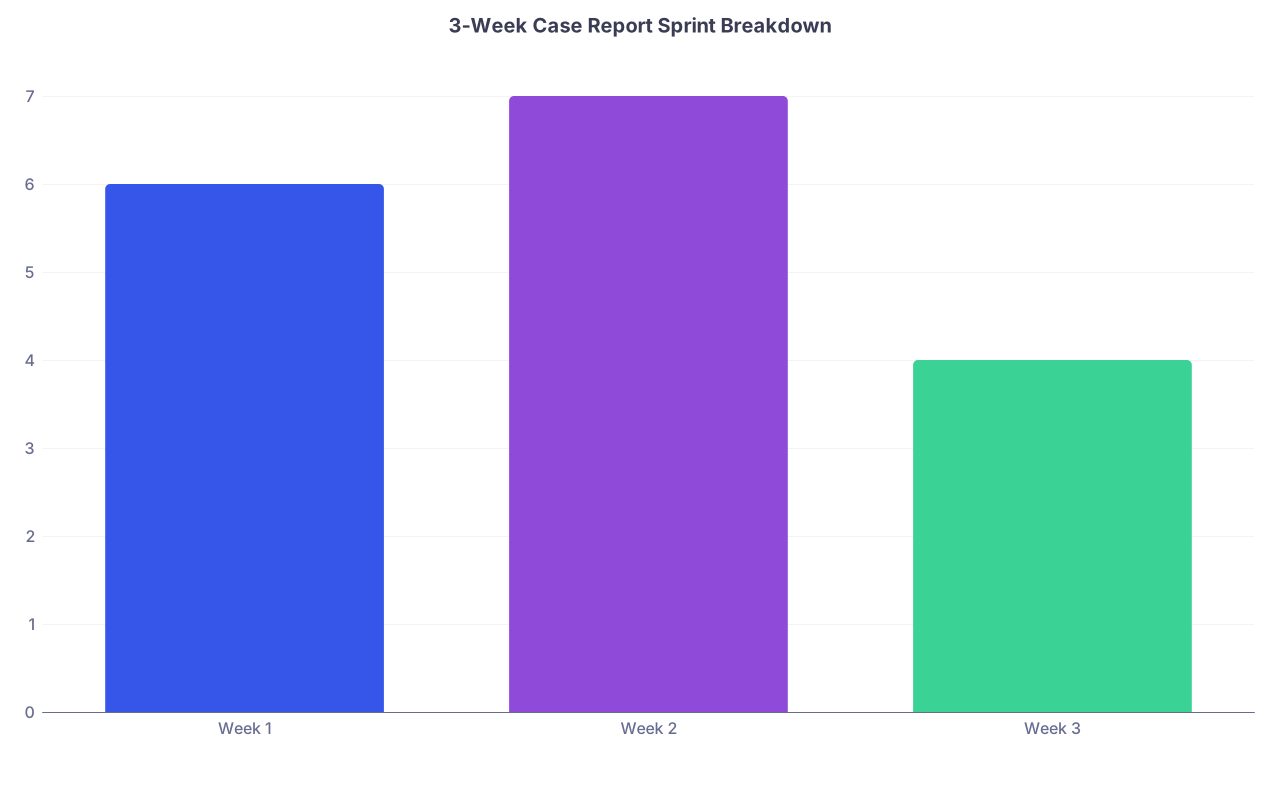
| Category | Value |
|---|---|
| Week 1 | 6 |
| Week 2 | 7 |
| Week 3 | 4 |
(Values = approximate focused hours needed each week.)
Week 1: Data and Structure (5–7 hours)
Day 1–2 (1–2 hours):
- Pull the chart, imaging, labs
- Make a simple timeline: symptom onset → presentation → key interventions → outcome
- List key data points: vitals, key labs, imaging findings, treatments
Day 3 (1–2 hours):
- Spend 30–60 minutes on PubMed
- Search “[diagnosis] case report”, “[complication] rare”, “[drug] adverse effect”
- Identify: what has been reported, what is missing
- Write a one‑paragraph “angle”:
- Example: “This is the first reported case of drug‑induced X in a patient with Y, highlighting the risk of Z.”
Day 4–5 (2–3 hours):
- Create a detailed outline:
- Introduction: 2–3 short paragraphs (background + gap + objective)
- Case Presentation: structured by timeline, not chaos
- Discussion: 3–5 subsections (epidemiology, prior reports, pathophysiology, management, takeaway)
- Conclusion: 2–3 sentences, no fluff
Stop. Send outline + key references to your mentor asking: “Is this the right direction?”
This saves you from drafting the wrong paper.
Week 2: Draft Fast, Edit Hard (5–7 hours)
Day 1–2 (3–4 hours): Case Presentation Draft
- Write the case section first
- Stick to:
- Clear chronology
- Objective data
- No editorializing or speculation here
- Use short, direct sentences. Avoid the temptation to sound “fancy.”
Day 3–4 (2–3 hours): Introduction + Discussion
- Introduction:
- 1st paragraph: what the condition is
- 2nd: why this case is unusual or important
- 3rd: objective of this report (1–2 sentences)
- Discussion:
- Summarize what others have reported (with citations)
- Compare your case to theirs (similarities/differences)
- Proposed mechanism or explanation, if relevant
- Clinical takeaway for readers
Day 5 (1–2 hours):
- Add:
- Abstract (after the main draft)
- References (use a manager if you have one; if not, at least be consistent)
- Any required tables/figures
Send full draft to your mentor with a specific ask:
- “Could you please review the draft this week? I would like to submit to [Journal X or Y] by [date].”
Week 3: Revise and Target Journals (3–5 hours)
Revisions (2–3 hours):
- Incorporate mentor edits promptly
- Fix structure, clarity, and any missing details
- Tighten language: shorter sentences, fewer adjectives, explicit conclusions
Journal selection (1–2 hours):
- Look at where similar case reports have been published
- Consider:
- Scope (does the journal even take case reports?)
- Time to decision (check website or colleagues’ experience)
- Open access fees (do not commit your own money without understanding costs)
Fast‑turnaround case report venues (examples, not endorsements):
- BMJ Case Reports
- Journal of Medical Case Reports
- Specialty-specific case report journals (e.g., “Case Reports in Cardiology”)
- Lower‑impact specialty journals with case sections
Format according to journal guidelines before submission. Sloppy formatting screams “inexperienced.”
5. Multiply Output: From One Patient to Several Products
You get more value when one case fuels multiple outputs.
Example: You encounter a case of a rare infectious complication after a common procedure.
You can often turn this into:
- A published case report
- A poster for your institution’s research day or a regional meeting
- A short letter to the editor (e.g., commenting on a previous similar case)
- A teaching presentation for students or residents
Make that explicit on your plan:
- Each solid case = 2–3 CV items, not just one.
Keep it honest:
- Do not double‑count the same abstract as multiple different “presentations” unless they truly were presented at distinct venues.
6. Use Case Reports Strategically for Residency Applications
Now the part most people ignore: how to use these case reports in the residency match system.
On ERAS
When you list case reports:
- Make sure author order is correct
- Use consistent citation style
- Include status as:
- “Accepted” with journal name (best)
- “Submitted” if under review (acceptable)
- Avoid “in preparation” unless you have nothing else
Do not clutter your ERAS with:
- Ten low‑quality case reports all in off‑specialty journals with your name buried in the middle. A few strong, on‑target ones look better than a desperate pile.
In Your Personal Statement
You do not need to summarize every case you have written. Pick one that:
- Is tightly related to your specialty interests
- Taught you something about clinical reasoning, communication, or systems issues
Example angle:
- “While working on a case report about an occult GI bleed in a young patient, I realized how easily anchoring bias could have led us down the wrong path. That experience pushed me to study cognitive errors in diagnosis…”
You are not bragging about publication; you are showing how this work shaped your thinking.
In Interviews
Program directors and faculty often ask:
- “Tell me about your research”
- “Which of your projects are you most proud of?”
You should be able to answer in 60–90 seconds:
- Clinical context (brief)
- What was unusual or important
- What you did (chart review, literature search, writing, presenting)
- What you learned
If you cannot explain a case report you “authored,” you look dishonest or superficial. I have watched interviewers quietly write people off for that.
7. Avoid Common Traps That Waste Your Time
Some mistakes I see over and over.
Trap 1: Chasing Hyper‑Novelty
You do not need the “first ever” anything. Reviewers know many “first reported cases” are just the first indexed cases.
Instead aim for:
- “Rare but clinically important”
- “Under‑recognized complication”
- “Educational for common diagnostic errors”
Your priority is submittable work on a realistic timeline, not novelty for its own sake.
Trap 2: Endless Perfectionism
Case reports are not RCTs. They should be accurate and clear, not literary masterpieces.
Signs you are stuck:
- You have been “working on” the same case report for 3+ months with no submission
- You keep re‑reading and “tweaking wording” rather than seeking mentor sign‑off
- You are afraid to send to your attending because “it is not perfect yet”
Fix:
- Time‑box your drafts. After 3 weeks of part‑time work, you send something, no matter what.
- Ask for targeted feedback: “Can you comment mainly on the discussion and whether the angle is strong enough?”
Trap 3: Bad Co‑author Dynamics
If you add every intern, resident, and student who touched the patient, you create chaos:
- Too many cooks editing
- Disagreements about author order
- Delays getting approvals
Keep the core team small:
- You (first author, doing the work)
- 1–2 co‑authors who truly contribute (help with data, literature, or writing)
- Senior attending(s) as last author and maybe middle authors if they did real work
Clarify author order early. A 3‑minute awkward conversation is better than a 3‑month silent war.
8. Build a Small but Efficient System
Treat this like a mini‑production line.
Create:
- A template folder on your computer with:
- Standard headings for case reports
- A literature search notes template
- A reference list template with your preferred format
- A running spreadsheet tracking:
- Patient identifier (internal only, not PHI in the file name)
- Topic
- Faculty mentor
- Status (idea, outline, draft, submitted, accepted)
- Target journal(s)
Every week, spend 30–60 minutes reviewing:
- Any new cases that might be worth pursuing
- Status of ongoing drafts and submissions
- Next action for each project (one concrete step)
You are not building a research empire. You are building a small, predictable pipeline that makes it hard for you to reach ERAS with “no scholarly work” as your excuse.
FAQs
1. How many case reports do I actually need for residency?
For most non‑hyper‑competitive specialties, 2–4 decent, on‑specialty case reports (especially if at least some are accepted or presented as posters) are enough to show real engagement. One is better than zero, and more than five does not automatically make you more impressive. Once you hit that 2–4 range, your time is usually better spent on:
- A small retrospective project
- A quality improvement initiative
- Studying for Step 2 or improving clinical performance
2. Is a submitted case report really helpful if it is not accepted before ERAS?
Yes, if used correctly. A case report listed as “submitted” still signals that you:
- Completed the work
- Engaged with the literature
- Went through the process of drafting and formatting
Programs understand that publication timelines are slow. One or two “submitted” items, especially if clearly legitimate, are fine. But if your entire scholarly section is “in preparation” or “submitted,” it can look inflated. Aim for a mix, with at least some accepted or presented works.
3. Should I prioritize a lower‑tier journal that will accept quickly over waiting for a better one?
For residency applications, speed and certainty usually beat prestige for case reports. Case reports are not career‑defining. A quick acceptance in a modest, legitimate peer‑reviewed journal:
- Gets you a concrete line on your CV before ERAS
- Shows follow‑through
- Lets you move on to the next project
Submitting to a higher‑impact journal is not wrong, but if it delays you by many months and you are near application season, it is not a smart trade.
4. Do off‑specialty case reports help if they are all I can get?
They help some, but not as much as aligned work. A neurology‑bound applicant with only dermatology case reports looks unfocused. If those are your only options early on, still do them:
- They prove you can complete projects
- They make it easier to approach future mentors (“I have already published a case report on X…”)
But once you can, pivot hard toward your intended specialty. Even one or two targeted, specialty‑specific case reports can outweigh a pile of unrelated ones in the eyes of program directors.
Key points to walk away with:
- Use case reports as fast, targeted output, not as your entire research identity.
- Build a simple, repeatable pipeline: triage cases hard, attach to the right mentor, draft in 2–3 weeks, and submit.
- Aim for aligned, accepted work before ERAS, then leverage it intelligently in your CV, personal statement, and interviews.