
No publications before ERAS is not a death sentence. Staying paralyzed about it is.
You have 6 months. You will not crank out an NEJM RCT in that time. But you absolutely can build real, visible research impact that programs respect—if you stop flailing and follow a disciplined plan.
I am going to lay out a step‑by‑step, 6‑month playbook that I’ve seen work for students who started with nothing: no projects, no mentor, no first author anything. They still walked into ERAS with:
- Multiple submitted or in‑prep manuscripts
- Accepted posters or abstracts
- Concrete, verifiable contributions they could discuss in detail
You will do three things over the next 6 months:
- Exploit fast‑turnaround project types (case reports, QI, retrospective chart reviews, short communications).
- Stack visible outputs (submissions, abstracts, preprints, IRB approvals) that are “ERAS‑countable” even if not yet published.
- Systematize your time and documentation so nothing falls through the cracks.
Let’s get concrete.
The 6‑Month Strategy in One Glance
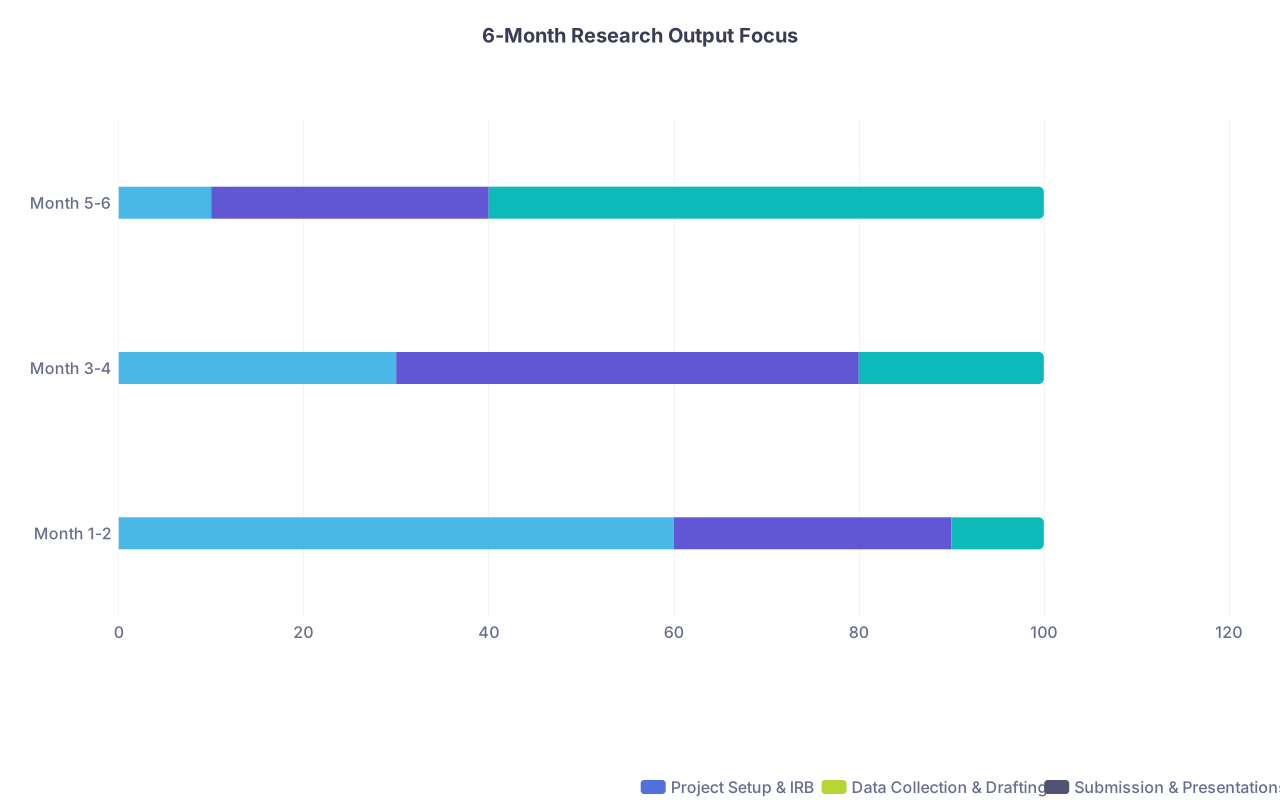
| Category | Project Setup & IRB | Data Collection & Drafting | Submission & Presentations |
|---|---|---|---|
| Month 1-2 | 60 | 30 | 10 |
| Month 3-4 | 30 | 50 | 20 |
| Month 5-6 | 10 | 30 | 60 |
Think of your 6 months in three phases:
Months 1–2: Positioning & project acquisition
- Find mentors
- Get on 2–3 realistic projects
- Start at least one fast‑timeline project where you can be first author
Months 3–4: Heavy lifting & drafts
- Data extraction / analysis
- Drafting manuscripts, abstracts, posters
Months 5–6: Submissions & polish
- Submit manuscripts and abstracts
- Present if possible
- Lock in “submitted,” “accepted,” or at minimum “in preparation” with clear roles
We will break this into actionable weekly tasks. But first, you need to choose the right weapons.
Step 1: Stop Chasing Unicorns – Choose Fast‑Timeline Project Types
If you have no publications and 6 months, some ideas are flat‑out bad:
- Prospective RCTs
- Complex multi‑site trials
- Basic science wet lab projects starting from zero
These are multi‑year efforts. You do not have multi years.
Instead, you target project types with shorter pathways from idea → submission:
- Case reports / image reports / brief communications
- Retrospective chart reviews with a narrow scope
- Quality improvement (QI) projects
- Secondary analysis of existing datasets
- Narrative or systematic reviews (done correctly, tightly scoped)
Here is how they compare on speed and impact:
| Project Type | Time to Submission | First-Author Potential | IRB Needed? |
|---|---|---|---|
| Case Report/Image | 2–8 weeks | High | Usually No* |
| Short Retrospective | 2–4 months | High | Yes |
| QI Project | 2–4 months | High | Often QI-only |
| Secondary Data Analysis | 2–4 months | Medium–High | Often Yes |
| Narrative Review | 1–3 months | High | No |
*Case reports often need HIPAA/privacy review or institutional determination they are not human subjects research. Do not skip that.
Your target mix for 6 months with no publications:
- One first‑author fast win (case report, short review, or narrowly focused QI)
- One medium‑sized project (retrospective chart review / secondary analysis)
- One “supporting role” project (mid‑author on someone else’s ongoing paper)
Three projects. Not ten. You want things that can move.
Step 2: Month 1–2 – Secure Mentors and Projects (Aggressively, Not Desperately)
You are not begging for “any research.” That is how you end up 14th author on something that publishes in 2028.
You are offering a clear value proposition: organized, reliable manual labor in exchange for authorship and mentorship.
2.1 Find the right mentors
Target people who:
- Are actively publishing in the last 1–3 years
- Have a track record of involving students
- Are in (or adjacent to) your target specialty
Where to look:
- Your department’s website “Publications” or “Research” page
- Recent PubMed searches for “[Your Institution] + [Specialty]”
- Residents/fellows who have first‑author papers in the last 1–2 years
Once you identify 5–10 realistic targets, you move to actual outreach.
2.2 Email template that does not get ignored
Subject line examples:
- “Med student interested in [field] – can help with data collection / drafting”
- “Resident‑led projects in [field]? MS3 available 6 months, 10 hrs/week”
Body (shorter than you think):
Dr. [Name],
I am a [MS3/MS4] at [Institution] applying to [Specialty] this upcoming ERAS cycle.
I have a 6‑month window where I can reliably commit ~8–10 hours per week to research. I am especially interested in [specific area they work in, e.g., sepsis outcomes, spine surgery QI].
I can help with:
– Data extraction and chart review
– Literature reviews and reference management (EndNote/Zotero)
– Drafting sections of manuscripts (Intro/Methods/Results drafts)I would appreciate the chance to contribute to any ongoing projects where there is a clear path to authorship for substantive work.
CV attached for reference. I am happy to meet briefly or start with a small task to show you how I work.
Best,
[Name]
[Year, School]
[Phone]
Key points:
- You specify time commitment.
- You specify tasks.
- You explicitly mention authorship expectations without sounding entitled.
Send 10–15 of these, not 2. Follow up once after 7–10 days.
2.3 Say this in the first meeting
Your goal in the first 15 minutes:
- Clarify expectations
- Identify at least one project with a 6‑month horizon
- Negotiate authorship trajectory
Script it:
- “My priority is to have concrete outputs by [ERAS month]. Are there any projects where substantial contribution over the next few months could realistically lead to authorship?”
- “If I handle X (data collection, initial draft), what authorship position would make sense?”
- “Is there any ongoing project that is stuck due to lack of bandwidth where I can help move it to submission?”
If they are vague, noncommittal, or “maybe you can help collect a few charts and we will see”… you do not rely on that as a core project. Keep them as optional.
You want at least:
- 1 project where you are explicitly first or second author
- 1–2 where you are mid‑author but the paper is already in motion
Step 3: Fast‑Timeline Projects You Can Actually Execute
Now the brass tacks: what to do, step‑by‑step, for each typical “fast” project.
3.1 Case reports / case series
These are the fastest if you have an interesting patient or imaging.
Timeline: 2–8 weeks to submission if you stay on it.
Steps:
Identify cases
- Ask residents/attendings: “Any unusual or educational cases recently that might be good for a case report?”
- Check morbidity & mortality or grand rounds cases.
Pick the right journal first
- Not NEJM. Think: specialty case report journals, Cureus, BMJ Case Reports, Radiology Case Reports, etc.
- Read 2–3 recent case reports to copy structure and length.
Confirm IRB / privacy
- Some institutions require a brief IRB “not human subjects” determination or privacy review.
- Obtain consent if your institution expects it.
Draft fast using a template
Standard sections:- Abstract
- Introduction (2–4 short paragraphs)
- Case presentation
- Discussion (with 5–15 key references)
- Conclusion / Learning points
You can write a rough draft in 2–3 focused evenings.
Circulate to co‑authors with clear deadlines
- “Here is the full draft; if I do not hear back in 7 days, I will proceed with submission and can still incorporate minor edits afterward.”
You must drive the timeline. Many otherwise “interested” attendings will sit on drafts forever if you let them.
- “Here is the full draft; if I do not hear back in 7 days, I will proceed with submission and can still incorporate minor edits afterward.”
Submit, then pivot to abstracts
- Even if the journal review takes months, you can still list “Submitted” on ERAS.
- You can also repurpose the case for a local poster or regional meeting.
3.2 Small retrospective chart review
This is your classic “real” clinical research that programs like to see.
Timeline: 2–4 months from start to submission if you are disciplined and the scope is tight.
Example: “Outcomes of patients with [condition] treated with [intervention] at our center from 2018–2023.”
Steps:
Narrow the question
Smaller is faster. Choose:- 1–2 key outcomes
- 1 primary predictor or comparison group
- 1 department/setting
Create a simple protocol (2–3 pages)
- Background and rationale
- Objectives / hypotheses
- Inclusion/exclusion criteria
- Data elements to collect
- Basic statistical plan (with help from a stat person if possible)
IRB submission
- Use prior protocols as templates. Ask residents for a redacted version.
- Aim for “exempt” or “minimal risk” retrospective status.
Build your data collection sheet (before IRB approval arrives)
- Spreadsheet (Excel/Google Sheets) or REDCap.
- Each row = 1 patient. Columns = variables.
- Define each variable clearly (data dictionary).
Once IRB approved: grind through data collection
- Block 2–3 hour chunks, 3–4 times per week.
- Aim for 10–20 charts per session, depending on complexity.
Quick stats
- Simple descriptive stats + t‑tests/chi‑square/logistic regression if justified.
- Do NOT freestyle advanced modeling without help; reviewers will shred that.
Draft the manuscript
- Results first (tables, figures).
- Methods (you already wrote this for IRB).
- Introduction and Discussion last.
Submit to a realistic journal
- Specialty‑specific lower to mid‑tier journal is fine.
- The key is: accepted for review and proof you did actual work.
Step 4: Structure Your 6 Months Week‑by‑Week
You are juggling school/rotations and research. You cannot rely on “when I have time.” That means “never.”
Here’s a practical weekly minimum:
- 6–10 hours per week consistently
- Protected into your calendar like a rotation or exam
Breakdown:
- 2–3 evenings on weekdays (1.5–2 hours each)
- 1 longer weekend block (3–4 hours)
Here is a sample 6‑month progression.
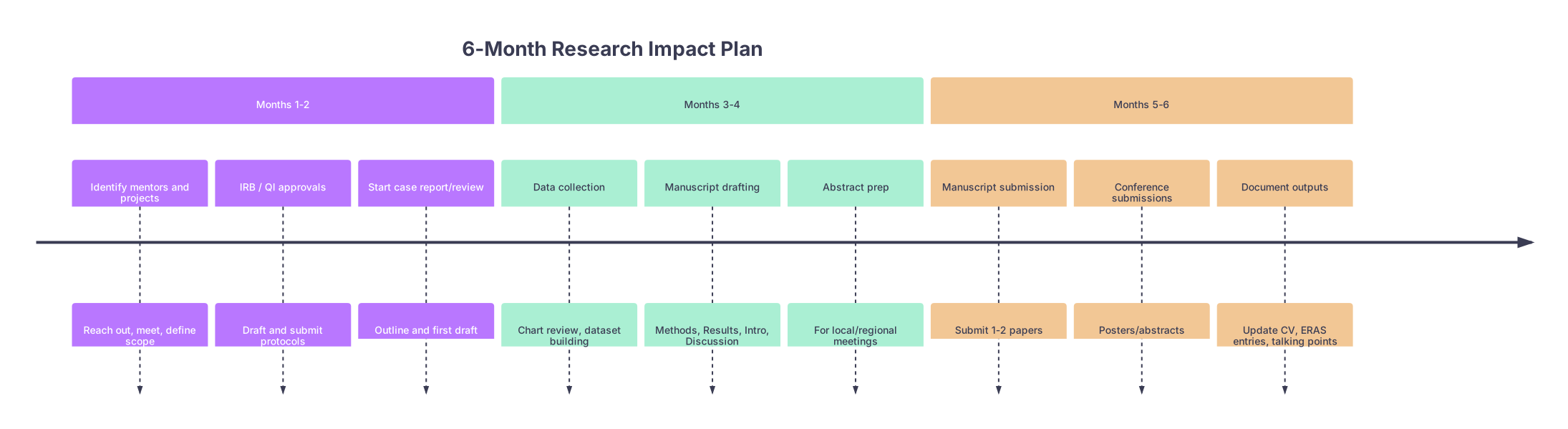
| Period | Event |
|---|---|
| Months 1-2 - Identify mentors and projects | Reach out, meet, define scope |
| Months 1-2 - IRB / QI approvals | Draft and submit protocols |
| Months 1-2 - Start case report/review | Outline and first draft |
| Months 3-4 - Data collection | Chart review, dataset building |
| Months 3-4 - Manuscript drafting | Methods, Results, Intro, Discussion |
| Months 3-4 - Abstract prep | For local/regional meetings |
| Months 5-6 - Manuscript submission | Submit 1-2 papers |
| Months 5-6 - Conference submissions | Posters/abstracts |
| Months 5-6 - Document outputs | Update CV, ERAS entries, talking points |
If you actually put that on your calendar with specific sessions, your odds of success jump dramatically.
Step 5: How ERAS Sees “No Publications Yet”
Programs do not only care about accepted publications. They care about:
- Concrete scholarly activity
- Trajectory – are you doing work now that is likely to lead to publications?
- Understanding of the research process – enough to discuss methods, limitations, what you did personally
ERAS allows you to categorize:
- Peer‑reviewed papers (published, accepted, or submitted)
- Oral/poster presentations
- Other scholarly projects (QI, curriculum development, etc.)
You can honestly list:
- “Submitted” with full citation and PMID as “pending” or blank
- “In preparation” if there is a near‑final draft and all authors listed
- Accepted abstracts and posters, even if the conference is upcoming
Your six‑month goal is not “X accepted publications.” Your real goal is:
- 1–2 manuscripts submitted (first or second author preferred)
- 1–3 abstracts/posters accepted or submitted
- At least one project where you can say:
“I designed the data collection, extracted the charts, and wrote the first draft of the Methods and Results.”
That level of involvement reads very differently in interviews than:
“I helped collect some data on a big project but I’m not sure what happened with it.”
Step 6: Make Your Contribution Undeniable (and Defensible)
Weak applicants say “I was involved in a couple of projects.” Strong applicants say:
“On Project A, I reviewed 142 charts and built the initial REDCap database. On Project B, I drafted the first version of the introduction and created the main outcome table. On the QI project, I designed the data collection form and presented results at our departmental conference.”
To get there, do three things:
6.1 Document everything you do
Keep a running research log (simple document or spreadsheet):
Columns:
- Project name
- Mentor
- Your role
- Dates and hours contributed
- Specific tasks completed
- Current status (IRB submitted, data collection 50%, draft complete, submitted to Journal X, etc.)
This log will:
- Feed your ERAS descriptions
- Save you when you are updating your CV at 1 a.m.
- Help you answer “Tell me about your research” with specifics instead of vague hand‑waving
6.2 Clarify authorship early and revisit it once
At project start:
“Assuming I handle A, B, and C, would first or second author be appropriate?”
Mid‑project (after you have delivered real work):
“Given that I have completed X, Y, and Z, does first author still seem appropriate? What else would you like me to take on to make that secure?”
If a mentor is evasive or keeps moving the goalposts, do not waste all 6 months on that single project. Maintain involvement, but invest more energy where authorship is realistic.
6.3 Turn every project into multiple outputs
You are not gaming the system. You are doing what academics do.
From one retrospective study, you can often get:
- 1 manuscript
- 1 abstract for a local/regional/national conference
- 1 departmental presentation (counts as a presentation on ERAS if formal)
From a QI project:
- 1 internal presentation
- 1 poster at a quality/safety conference
- Maybe a short publication in a QI journal
From a case report:
- 1 manuscript
- 1 poster using the same case
Same work. Multiple legitimate outputs.
Step 7: Contingency Plans – What If Things Get Stuck?
Science moves slower than your ERAS deadline. Some things will bog down: IRB delays, mentors disappear, journals sit on reviews.
You need redundancy.
7.1 If IRB approval is delayed
While IRB is pending:
- Work on a narrative review on a tightly defined topic related to your planned project.
- Draft the introduction and methods sections of your retrospective paper (they do not depend on your data yet).
- Start a case report or QI project that might not need full IRB.
7.2 If mentors are slow to give feedback
- Set polite but clear deadlines: “If I do not hear back by [date], I will move forward with submission and can still incorporate minor edits afterward.”
- Ask a resident or fellow to provide first‑pass feedback to move things forward.
- Focus on sections you control: tables, figures, formatting for journal submission.
7.3 If nothing is submitted by month 4
You are behind schedule. Do this:
Audit all projects:
- What is closest to submission?
- What is bottlenecked by someone else?
Ruthlessly prioritize:
- Put 70–80 percent of your effort into the project that could realistically be submitted in the next 6–8 weeks.
- Trim extras that are clearly not making it before ERAS.
Add one ultra‑fast project:
- Case report
- Short “clinical image”
- Brief narrative review (1,500–2,000 words) for a lower‑impact but legitimate journal
You are going for at least one clean, finished product by month 6, with others in the pipeline.
Step 8: How to Talk About Your Research on ERAS and in Interviews
If you follow this plan, by ERAS you should have:
- Some combination of “submitted,” “in preparation,” and “accepted” items
- Clearly defined roles in 2–3 projects
You must present this without sounding like you are overselling.
On ERAS “Experiences”:
- Be explicit about your contributions: “Designed data collection form, reviewed ~120 patient charts, drafted Methods and Results sections, and coordinated abstract submission to [Conference].”
- Do not label something “submitted” if nobody has actually clicked “submit” in the journal system.
In interviews, use this structure for each major project:
- 1–2 sentence overview
- Your role (concrete tasks)
- Key challenge and how you handled it
- Status and next steps
Example:
“We looked at 5‑year outcomes of patients undergoing [procedure] at our center. I helped design the data extraction sheet and reviewed 137 charts, focusing on perioperative complications and readmissions. The IRB process was slower than expected, so while we waited I drafted the introduction and background. The paper is now submitted to [Journal], and in the meantime we presented an abstract at our regional meeting.”
That sounds like a grown‑up who actually did work. Which is what programs want.
Quick Reality Check: What Is Achievable In 6 Months?
If you start from zero today and put in 6–10 focused hours per week, a realistic outcome by ERAS:
- 1–2 first‑ or second‑author submissions (case report, review, or small retrospective/QI)
- 1–3 abstracts/posters (some accepted, some under review)
- 1–2 mid‑author ongoing projects that may publish later but show involvement now
That is enough to go from “no research” to “this applicant is clearly engaged and productive.” It will not magically turn you into a research superstar, but it changes the conversation in your favor—especially in research‑leaning specialties.
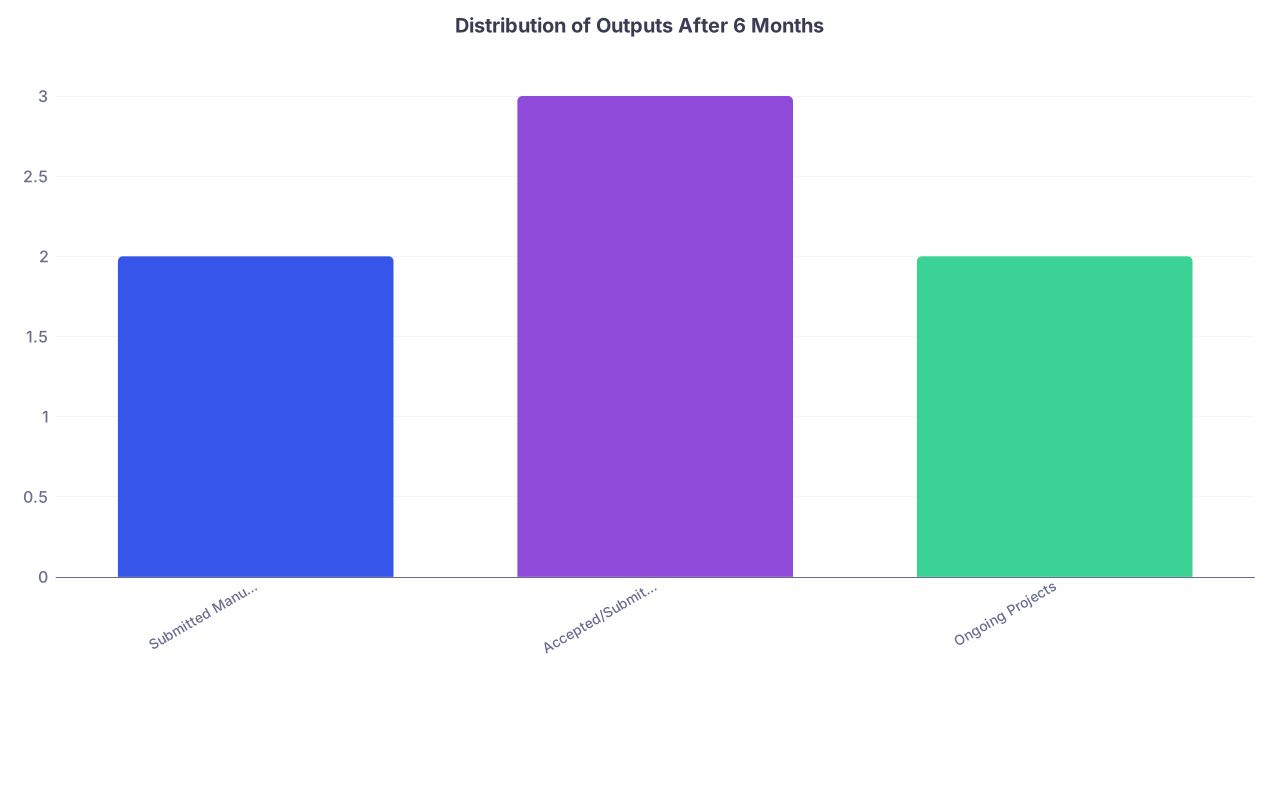
| Category | Value |
|---|---|
| Submitted Manuscripts | 2 |
| Accepted/Submitted Abstracts | 3 |
| Ongoing Projects | 2 |
FAQs
1. Can I list “in preparation” manuscripts on ERAS, or is that pointless?
You can list them in the “Experiences” section as research activities, but they should not be in the peer‑reviewed publications area unless at least submitted. If you write “in preparation,” be ready to describe the project in detail and have an actual near‑complete draft. Two or three “in preparation” items with strong, verifiable work behind them are fine. Ten vague “in prep” items look like fantasy football.
2. Is it better to be 1st author on a small paper or 5th author on a big one?
For most applicants with no prior publications, one solid first‑author small paper is more impactful than being buried on a multi‑author mega‑study. Programs like to see that you can own a project start to finish. The ideal scenario is both: a first‑author small project plus one or two mid‑author roles on larger work. If you must pick, prioritize at least one thing where your ownership is obvious.
3. Does a low‑impact or “easy” journal hurt me?
A legitimate peer‑reviewed journal rarely hurts you. No one in an interview is going to grill you about impact factor unless you are applying to extremely research‑heavy programs, and even then your role matters more. Obviously, avoid predatory journals and anything that looks shady. But a short case report in a modest specialty journal is still a real, citable publication and shows that you can finish work and see it through.
4. How many hours per week do I actually need if I am on a tough rotation?
The bare minimum to see real progress is about 6 hours per week, every week. On lighter months, push that to 10–12 hours to build a buffer for brutal rotations. The bigger mistake is binge‑working 20 hours one week and then going dark for a month. Slow and consistent wins: 3 evenings at 2 hours plus a 2‑hour weekend block is far more productive than random all‑nighters.
Key points to walk away with:
- Stop chasing massive, slow projects. Pick fast‑turnaround designs where you can be first or second author and actually submit something within 6 months.
- Treat research like a rotation: fixed weekly hours, structured tasks, and clear deliverables. Drive the timeline yourself, or it will not move.
- ERAS cares more about concrete, describable work and trajectory than about perfect impact factors. Build 2–3 real projects you can own and talk about in your sleep.