The obsession with research in residency applications is badly misunderstood—and it is costing strong clinical applicants interviews they could absolutely earn.
If your profile is clinically heavy but research light, you are not doomed. You are poorly packaged. That is fixable.
Here is how to fix it, step by step.
Step 1: Get Brutally Clear On Where You Actually Stand
Stop guessing whether your research is “enough.” You need to know how your numbers and experiences compare to typical applicants in your specialties.
A. Inventory your research honestly
Write down, in one place:
- Peer-reviewed publications (PMID or accepted in press)
- Abstracts / posters / oral presentations
- QI (quality improvement) projects
- Case reports / case series
- Chart reviews, retrospective studies
- Basic science or bench work
- Education research, curriculum projects
- IRB submissions (even if still pending)
- Anything where you:
- Formulated a question
- Used data or systematic observation
- Produced a shareable “product” (poster, talk, protocol, curriculum, guideline)
Now label each item with:
- Role: first author, middle author, collaborator, data collection only
- Status: published, accepted, submitted, in preparation, ongoing
- Specialty area: aligned with your target specialty or not
Most students underestimate how much “counts.” QI, small projects, and education work all matter if you package them correctly.
B. Compare yourself to your specialty norms
Different specialties have very different expectations.
| Specialty Type | Typical Expectation for Research-Heavy Applicants |
|---|---|
| Dermatology | 5–15 outputs, often multiple pubs |
| Plastic Surgery | 5–20 outputs, multi-year projects |
| Radiation Oncology | 4–10 outputs in-field |
| Neurosurgery | 5–15 outputs, some high-impact |
| Ophthalmology | 3–8 outputs, often ophtho-related |
| ENT | 3–8 outputs |
| Competitive IM Fellowships (Cards, GI, Heme/Onc) | Strong research portfolio preferred |
If you are going into:
Family Medicine, Pediatrics, Psychiatry, General IM, Neurology, EM
→ “Light” research is much easier to compensate with clinical strength, leadership, and teaching.Dermatology, Plastics, Neurosurgery, ENT, Rad Onc, Ophthalmology
→ Being research-light is a real liability at top programs. Still addressable, but you need a different level of strategy.
Step 2: Decide Your Core Narrative Before You Touch ERAS
You cannot out-random your way into a coherent application. You need a central story.
For a clinically heavy but research-light profile, your core narrative should sound like one of these:
“Clinically excellent, systems-focused future educator or leader who uses data to improve care.”
(Good for IM, Peds, FM, Psych, EM, OB/GYN, Neurology.)“Hands-on, patient-centered future proceduralist who has translated bedside problems into small but meaningful scholarly work.”
(Good for Surgery, Anesthesia, EM, OB/GYN.)“Later-blooming researcher who found their question through clinical work and is now on a steep upward trajectory.”
(For research-heavy fields where you are playing catch-up.)
Pick one archetype. Everything you say about research has to reinforce that story:
- Your PS
- Your experiences section
- Your LORs (if you brief your writers properly)
- Your interviews
If your story is, “I am an outstanding clinician who improves systems,” then your “light” research becomes “targeted scholarly QI work” that directly supports that identity.
Step 3: Reframe What You Already Have as “Scholarly Work”
You probably have more usable material than you think. The trick is language and structure.
A. Convert vague bullets into clear scholarly entries
Bad ERAS entry:
“Helped with QI project improving handoff communication between residents.”
Better:
“Resident Co-lead, Handoff Communication QI Project
- Performed baseline chart review of 120 admissions to quantify handoff-related delays
- Co-developed structured handoff template; educated 45 residents via 4 small-group sessions
- Post-implementation, observed 25% reduction in documented handoff omissions and 15% faster order completion times”
See the difference. Same project. Now it reads like real, measurable scholarly activity.
B. Identify “almost research” and make it count
Look for these hiding spots:
- Morbidity & mortality (M&M) presentations
- Local grand rounds or noon conference lectures
- Protocols you wrote or revised
- Order sets or clinical pathways you helped design
- Patient education materials you created
Turn them into ERAS entries under:
- “Publications/Presentations”
- “Other Scholarly Activity”
- “Teaching and Curriculum Development”
Do not pretend they are peer-reviewed if they are not. But do present them as:
- Structured
- Data- or literature-informed
- Disseminated to others
That is the definition of scholarship many community and mid-tier academic programs actually care about.
Step 4: Fix Your ERAS Research Section Line by Line
Here is how to present a research-light portfolio with maximum impact.
A. Prioritize clarity over volume
Programs skim first. They look for:
- Area of work (Is it in their field?)
- Your role (Did you lead or just pipette?)
- Productivity (Did anything come out of it?)
For each item, answer these three in 1–3 lines.
Example: Case Report (Unpublished, Presented Locally)
“First author case report on late-presenting spinal epidural abscess in an IV drug user; conducted chart review and literature synthesis, presented at medicine grand rounds; manuscript in preparation with supervising attending.”
That sounds intentional and active, not “I just did some busywork.”
B. Use status labels strategically and honestly
Use these statuses clearly:
- Published (with citation / PMID)
- Accepted
- Submitted
- Manuscript in preparation
- Ongoing data collection
Do not stuff everything with “in preparation” just to look busy. One or two serious “in prep” projects with specific details are fine. Ten vague “in prep” entries make you look unserious.
C. Tie each project back to your clinical interests
Instead of generic descriptions, add one line that links back to your future as a resident.
Example:
“This project deepened my interest in managing complex heart failure in resource-limited settings.”
Or:
“Led me to appreciate the impact of standardized order sets on throughput in a busy ED.”
You are reminding the reader: this is not random; it is aligned with who you are as a clinician.
Step 5: Rewrite Your Personal Statement Around Clinical Strength + Targeted Scholarship
You cannot ignore the research gap in a research-heavy field. You also cannot spend a whole page apologizing for it.
Here is the structure that works.
A. Open with clinical, not research
Start with a clinical vignette or turning-point moment that:
- Shows you as thoughtful, engaged at the bedside
- Illustrates the type of doctor you are becoming
- Anchors your interest in the specialty
Then pivot:
“As I followed patients like Mr. K across multiple admissions, I began to see patterns in how our system failed them. That curiosity—why the same problems kept resurfacing—pushed me toward the small but meaningful projects that now shape my early scholarly work.”
You have just placed your research as a natural extension of caring about patients. Not as a checklist item you forgot to do.
B. Frame your research as “deliberate, focused, and growing”
You are not the “I have 20 publications” applicant. You are the “what I did was targeted and thoughtful” applicant.
You can say something like:
“Unlike some of my peers, I did not begin medical school with a decade of bench research behind me. My earliest priorities were clinical: understanding the patients in front of me and learning to care for them safely. As I gained confidence, I began to ask broader questions about why our system performs the way it does. That shift led to a series of focused projects…”
Then briefly summarize 1–2 key projects, with emphasis on:
- Your role
- What you learned about the specialty
- How it changed your day-to-day clinical practice
That framing turns “light research” into “intentional research that started once I had real clinical questions.”
C. Address the elephant in the room without groveling
For research-heavy fields (derm, plastics, rad onc, neurosurg, ophtho, ENT), you may need one explicit line about your trajectory:
“I recognize that my formal research portfolio is more modest than that of some applicants. Over the past two years, however, I have built a trajectory I intend to continue—one that begins at the bedside, identifies a problem, and then uses data to test solutions.”
You acknowledged it. You repositioned it as trajectory, not deficiency. Then move on.
Step 6: Extract “Scholarly” Talking Points From Your Clinical Work
A lot of your clinical experiences can be framed in ways that appeal to academic programs without pretending you did a randomized trial.
Ask yourself, for each major clinical role:
- Did I change how something was done?
- Did I measure anything?
- Did I teach anyone?
- Did I standardize a process, even informally?
Examples that can be reframed:
- You redesigned a patient list template so sign-out errors decreased.
- You tracked your own antibiotic de-escalation rates and showed your team.
- You created a mini-handout on COPD management for interns.
- You started a journal club on your rotation and actually tracked attendance or feedback.
You can turn those into ERAS bullets like:
“Implemented structured patient list format for night-float team, reducing missed tasks on sign-out from 4–5 nightly pages to 0–1.”
Or:
“Developed a concise, evidence-based COPD management guide for interns; incorporated GOLD guideline tables and distributed to 15 housestaff.”
Not fake research. But clearly analytical and improvement-oriented. Program directors like that.
Step 7: Plug Your Gaps Proactively Before Application Season (If You Still Have Time)
If you are reading this 6–18 months before applying, you have room to add meaningful substance. Do not chase perfect. Chase credibility.
A. Fast, realistic projects that carry real weight
Aim for projects that can realistically reach a poster or abstract within 6–9 months:
- Retrospective chart review with a very narrow question
- Well-done case series in your target specialty
- Single interesting case with genuine teaching value
- QI project with pre- and post-intervention data
- Curriculum development with evaluation component
You want:
- One mentor who will answer emails
- A clear endpoint (poster at local/regional meeting, abstract, internal presentation)
- Your role as first author or clear lead
B. Do not waste time on endless background work
I see this constantly:
“I spent 400 hours collecting data for a project that was never written up.”
That does almost nothing for you. If you are clinically heavy and behind on research, you cannot afford to be pure labor.
Non-negotiables when starting a project:
- There is a draft figure or table already sketched.
- There is a target conference or journal named up front.
- Your role includes analysis or writing, not just data collection.
If these are not true, walk away and find a different project.
Step 8: Be Smart About Where You Apply (Programs Are Not All the Same)
Some programs truly do not care if you have 0 publications. Others will quietly screen you out for not hitting an arbitrary research count.
You cannot change them. You can choose your mix.
A. Understand program types
Rough view:
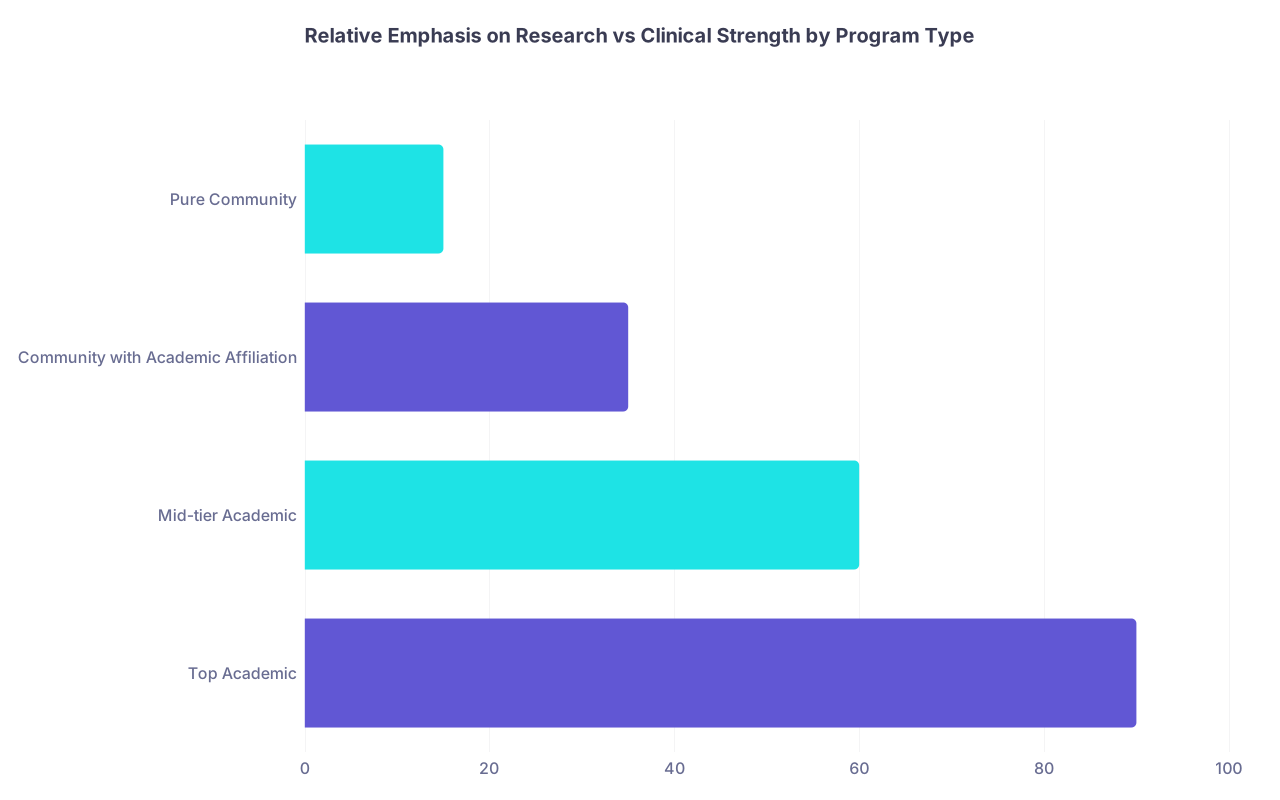
| Category | Value |
|---|---|
| Top Academic | 90 |
| Mid-tier Academic | 60 |
| Community with Academic Affiliation | 35 |
| Pure Community | 15 |
Top Academic: Research almost mandatory for competitive specialties. Clinically strong but research-light applicants must bring something exceptional (insane Step scores, unique background, or clear upward research trajectory with strong letters).
Mid-tier Academic: More flexible. Solid, focused small-scale projects plus strong letters and genuine interest in their program can overcome lighter research.
Community with Academic Affiliation: Often prefer workhorses. Will love your clinical strength. Small QI or teaching projects are more than enough.
Pure Community: Many do not value research highly at all unless you are planning an academic career. Your job: show reliability, clinical maturity, and a team-first attitude.
B. Align your list with your reality
If you are clinically heavy and research light and chasing derm, neurosurg, or plastics at top-10 programs with no pubs, you are playing the lottery.
You need:
- A balanced list (include community and hybrid programs)
- Programs whose websites and residents show:
- Minimal pressure to publish
- Strong clinical volume
- Only a handful of faculty with heavy research portfolios
Step 9: Handle Interviews Without Sounding Defensive or Apologetic
Eventually someone will ask: “Tell me about your research experience,” or “How do you see scholarship playing a role in your career?”
You need a clean, confident answer. Not a confession.
A. Use this 3-part structure
What you have done (brief, concrete)
“I have focused on small, clinically grounded projects: a QI initiative on handoff communication, a case report in heart failure, and a retrospective chart review on recurrent COPD admissions.”What you learned that matters for residency
“Those projects taught me how to define a question clearly, collect usable data without disrupting patient care, and present results to a team in a way that actually changes practice.”Where you are going next
“At your program, I would like to build on that foundation—particularly through your X QI track and the resident research day—to continue turning front-line problems into practical projects.”
Short. Direct. No apology.
B. If directly challenged about being research-light
If someone says, “I notice you have fewer publications than some applicants,” respond like this:
“That is fair. I came into medical school without prior bench experience and initially focused on becoming a strong clinician. As I grew more comfortable on the wards, I began to take on small, very focused projects tied directly to patient care. My portfolio is smaller, but it is tightly connected to the kind of work I hope to do as a resident. I also see residency as the time to expand that work in a more systematic way, particularly through your [specific program resource].”
Own it. Explain it. Pivot to the future.
Step 10: Align Your Letters of Recommendation With Your Narrative
Your letters can do a lot of heavy lifting to reassure programs that your “light” research does not equal “light” work ethic or curiosity.
When you ask for letters, explicitly brief your writers. Something like:
“I am applying to [specialty]. My strengths are clinical performance, work ethic, and team leadership. My research portfolio is more modest, but I have worked on several QI / small projects. It would help me greatly if your letter could speak to:
- My ability to analyze clinical problems
- My reliability and independence on the wards
- Any examples where I took initiative to improve a process or patient care”
You are not telling them what to write. You are giving them a lens.
That way, when PDs see that your publication count is low but your letters talk about you like you are already a junior resident, the “risk” looks much smaller.
Quick Example: Before and After
Let me show you how the same applicant can look completely different.
Baseline facts:
- 1 poster at school research day (case report, not published)
- Helped with a QI project on timely discharge summaries
- No prior undergrad research
- Strong clinical evals, solid Step scores, good leadership
Weak presentation
ERAS Research section:
- “Participated in research project on discharge summaries.”
- “Worked on case report.”
PS barely mentions research.
Applies heavily to top academic IM programs despite minimal output.
Result: Looks like a student who did the minimum and does not “get” scholarship.
Strategic presentation
ERAS:
- “Co-led QI project on discharge summary timeliness; performed baseline audit of 150 discharges, co-designed new EMR template, and presented results at resident conference; reduced late summaries from 45% to 18% over 3 months.”
- “First-author case report on atypical presentation of infective endocarditis in an IV drug user; performed literature review and delivered poster at institutional research day.”
PS:
- Starts with clinical story of complex discharge gone wrong.
- Explains how frustration led to QI project.
- Frames case report as another example of turning real cases into shareable lessons.
Interview answers:
- Clean narrative around “clinically focused, systems-minded, small-scale scholar.”
Result: Same raw material. Much stronger perceived trajectory.
FAQ (Exactly 3 Questions)
1. Does QI actually “count” as research on residency applications, or do programs just want traditional bench/clinical trials work?
Well-run QI absolutely counts as scholarly activity at most programs, especially in IM, FM, Peds, Psych, EM, and OB/GYN. The key is that it is:
- Systematic (pre/post data, defined metrics)
- Documented (poster, presentation, formal report)
- Transferable (others could implement your intervention)
Top-tier research departments may still prioritize traditional research, but even they respect good QI—particularly if it improves their own metrics like LOS, readmissions, or patient safety.
2. I am applying this cycle with essentially no research. Is there anything I can still do now that will matter?
Yes, but you must be realistic. At this point:
- You will not create a high-impact publication before interviews.
- You can still:
- Formalize a small QI project you are already informally doing
- Prepare a strong grand rounds or case conference and list it
- Join a very focused, late-stage project as a writing assistant to help push a paper or abstract over the finish line
These will not magically transform you into a research-heavy applicant, but they will show initiative and give you concrete talking points for interviews.
3. Should I ever skip listing a weak or unfinished project because it makes me look scattered or unproductive?
Yes. If a project:
- Has no clear product (no poster, talk, abstract, or defined endpoint)
- Is something you barely remember or cannot explain well
- Was essentially abandoned and will never move forward
Then leaving it off is usually better. List projects that you can discuss confidently and that produce even modest outputs. A few well-presented, thoughtful activities look far better than a laundry list of half-finished ideas.
Key points:
- You are not doomed by light research, but you are absolutely punished for poor framing and random, unproductive projects.
- Package your clinical strength and small-scale scholarship into a coherent, forward-looking narrative and target programs that actually value that profile.