
You are an MS3 in February or March. Your classmates are quietly flexing: “I’m on my third abstract,” “My mentor thinks we’ll submit by June,” “I just got added to a multi‑center trial.”
You?
You have…maybe one weak poster from M1 summer. Or a case report half-finished in a Google Doc. Or nothing at all.
You’re starting to realize two things:
- Research matters more than your school initially admitted.
- You are running out of time before ERAS.
Let me be blunt: you cannot go back and manufacture a 3-year research arc. But you absolutely can salvage this. I have seen students go from “nothing in February” to “respectable research section in September” — enough to match well in IM, anesthesia, psych, EM, OB/Gyn, even some surgical prelim spots.
You just need a focused, no-BS strategy and you need to start now.
Step 1: Diagnose Your Actual Situation (1 Week Max)
Before you start frantically emailing people, you need a clear picture of your baseline and your constraints.
1.1. Take inventory of what you already have
Write this down in one place (Word doc, Notion, whatever):
- Publications (any type)
- PubMed-indexed? Non-indexed? Institutional journal?
- Abstracts / posters / oral presentations
- Local, regional, national?
- Ongoing projects
- Where are they stuck? Data? IRB? Writing? Ghosting mentor?
Be brutally honest. A “draft idea” in your head is not a project. A half-coded dataset with no clear plan for submission is barely a project.
1.2. Clarify your specialty target and competitiveness
If you are still floating between two specialties, pick the more competitive one as your research bar.
Very rough tiers:
| Specialty Tier | Examples | Typical Research Expectation* |
|---|---|---|
| Ultra-competitive procedural | Derm, Plastics, Ortho, ENT, Uro | 5–15+ items, strong pubs |
| Competitive/Mid-to-high | Radiology, Anesthesia, EM, Neuro | 3–8 items |
| Core but increasingly research-aware | IM, OB/Gyn, Gen Surg, Psych | 2–6 items |
| Less research-sensitive (for now) | FM, Peds, PM&R | 0–3 items |
*“Items” = anything in ERAS Research section: papers, abstracts, posters, case reports, QI.
If you’re aiming for derm or plastics and you’re in this situation late in MS3 with no serious research, you need a different-plan plus salvage-plan (dual-apply, research year, etc.). I’ll cover that later.
For IM, anesth, EM, psych, OB, gen surg, neuro, radiology: salvage is very possible.
1.3. Map your time window
Key dates:
- When does your MS3 year end?
- When do you take Step 2?
- When do you start sub‑Is/Aways?
- ERAS open for editing: usually June
- ERAS submission: usually September
Count how many weeks you have from today to mid‑August, then estimate realistic research hours/week.
Be honest:
- Light rotations (FM, psych, neuro): 10–15 hrs/week possible.
- Heavy rotations (surgery, ICU, OB nights): maybe 3–5 hrs/week.
- Dedicated Step 2 period: assume near-zero research unless you are desperate and extremely disciplined. Step 2 > new abstract.
You are not going to create 12 projects. You need 2–4 high-yield, realistically finishable things.
Step 2: Shift Your Strategy From “Ambitious” to “Finishable”
Your earlier research approach probably looked like this:
“I want to join a cool prospective study or RCT” → Months of IRB, data delays, and ultimately nothing scoreable before ERAS.
You do not have that luxury now. You need short time-to-product projects.
2.1. Target project types with short timelines
Rank these by speed to something on ERAS:
Retrospective chart reviews with existing data
- Ideal if data is already pulled or easily extractable from an existing database.
- You help with analysis and writing → abstract within 2–8 weeks.
Case reports and small case series
- If you have the right mentor/service (onc, ICU, NICU, transplant), you can pull 1–3 cases and submit to a lower-tier journal or specialty conference relatively quickly.
Secondary analyses / spin-off projects
- Existing big dataset in a lab: you take one angle (subgroup, secondary outcome) and write it up under senior author’s supervision.
Chart-based QI projects with clear endpoints
- Pre/post intervention audits, protocol compliance, time-to-antibiotics, etc.
- Some journals and many conferences love QI.
Reviews / narrative reviews / brief reports
- Not as impressive as original research.
- But can be turned around in 4–6 weeks if structured and well-managed.
What to avoid at this stage:
- Brand new RCTs
- Complex prospective cohorts
- Animal/basic science projects from scratch
- Projects without a clear target journal or conference
Those are great if you are M1 or early M2. Right now, they are how you burn 6 months and get nothing actionable.
2.2. Decide what “success” looks like for you
For most non-ultra-competitive specialties, a reasonable salvage target:
By ERAS submission, you want:
- Total 3–6 “line items” in your research section, of which:
- 1–2 can be “submitted” or “in preparation”
- 1–3 should be at least accepted as a poster/abstract or online ahead-of-print
Quick example targets by June–August:
- 1 retrospective abstract submitted to a national or regional meeting
- 1 case report submitted to a journal
- 1 small QI or educational project submitted as a poster
- Re-analyze or help finish one stalled project to the point of submission
Your CV transforms from:
- “Nothing” to:
- “2 posters, 1 case report submitted, contributing author on 1 original study in submission.”
Not stellar. But very salvageable if the rest of your application is solid.
Step 3: Aggressive but Strategic Mentor Hunting (2–3 Weeks Max)
This is where most students flail. They send vague emails, wait for people to respond, and lose 2 months.
You do not have that time.
3.1. Who to target first
You are looking for mentors with three traits:
- They are research-active in your specialty of interest.
- They have projects already in progress or data in hand.
- They have a track record of involving students and getting them on papers/posters.
Prioritize:
- Faculty who publish often (scanning PubMed with your institution name + specialty)
- Program directors / APDs in your target field
- Fellows (yes, fellows) in busy academic divisions (ICU, cards, heme-onc, EM, etc.)
- Clinical researchers leading QI initiatives
Check:
- Department website (look for “publications” or “research interests”)
- Conference programs (faculty from your institution presenting)
- Residents with recent posters in your field
3.2. How to email in a way that gets a “yes”
Subject line must scream helpful + specific + time‑limited.
Example subject lines:
- “MS3 with 4–6 hrs/week – seeking help finishing existing project in [Field]”
- “Available to help rapidly move existing [Specialty] project to submission”
- “MS3 interested in [X specialty] – can assist with data/writing on ongoing work”
Body (condensed, concrete, no fluff):
- Who you are (school, year)
- Your specialty interest (1–2)
- Your time availability (specific hours/week until which month)
- Very brief prior research experience (even if small)
- Explicit ask: to join existing projects near completion, or help finish stalled ones
Example:
Dr. Smith,
My name is [Name], an MS3 at [Institution], very interested in anesthesiology. I am on lighter rotations from now through June and can reliably dedicate 6–8 hours per week to research.
I have limited prior research (one small quality improvement poster in M1), but I am comfortable with data entry in Excel/REDCap and basic stats in SPSS, and I write quickly.
I am specifically looking to join existing anesthesia projects that are already underway, where an extra pair of hands could help move things to abstract or manuscript submission in the next several months. I am very willing to do the “grunt work” (chart review, data cleaning, reference formatting, first-draft writing) in exchange for authorship where appropriate.
Would you be open to a brief meeting to discuss any projects where I could be helpful?
Thank you for your time,
[Name]
[Cell]
Send 10–20 of these, personalized but not overcomplicated. Wait 5–7 days, send one polite follow-up.
Do not stop at one “yes.” You want 2–3 mentors in parallel because 1–2 will inevitably stall.
Step 4: Pick 2–4 Projects and Build a Ruthless Execution Plan
Once someone bites, your job is to move from “interested” to “indispensable” in days, not months.
4.1. In your first meeting, ask the only questions that matter
Questions to ask each mentor:
- “What existing projects are close to submission but stuck?”
- “Is there any dataset that is already collected but needs analysis or writing?”
- “What would a realistic contribution from me look like between now and August?”
- “If I take the lead on drafting, is authorship realistic? At what position?”
You are looking for:
- Clear scope
- Clear timeline
- Explicit expectations about authorship
If a mentor says, “We are starting a long-term prospective study and might have data in a year,” that is a no for your salvage window.
If they say, “We have data on 300 patients, just need someone to clean it and write an abstract for [Conference], deadline in 6 weeks,” that is golden.
4.2. Choose projects based on speed and control
Your ideal mix:
- 1 project where you are first author (case report, small QI, or single-center retrospective).
- 1–3 projects where you are middle author but the work is already in motion.
Control matters. A single first-author case report you own from start to finish is often worth more, practically, than being the 12th author on a giant multi-center trial you barely touched.
Once chosen, write a one-page “micro-plan” per project:
- Title / Working title
- Aim
- Your role
- Concrete outputs (poster, abstract, manuscript)
- Specific target venue/journal
- Deadlines (self-imposed + external, like conference deadlines)
- Weekly time blocks (with rotation-friendly schedule)
Post this where you can see it daily.
Step 5: Implement a High-Output Weekly Workflow
This part decides whether any of this appears on ERAS or evaporates into “in progress.”
5.1. Block your time like it is a rotation
Pick specific recurring slots. For example:
- Tue/Thu evenings 7–10 pm
- Sat 9 am–1 pm
Tell yourself: research is a real rotation. You do not blow it off randomly. Clinical duties and Step 2 always come first, but Netflix does not.
5.2. Break projects into brutal micro-tasks
Do not sit down and say, “Work on case report.” That is vague and paralyzing.
Instead:
For a case report:
- Night 1: Pull the chart, outline sections, write the clinical course in bullet points
- Night 2: Draft intro (5–6 paragraphs) and discussion bullet points
- Night 3: Format references in a reference manager, create 2 figures/tables
- Night 4: Clean draft, send to mentor with 3 specific questions
For a retrospective abstract:
- Session 1: Learn the variable dictionary, define inclusion/exclusion criteria
- Session 2–3: Pull 20 sample charts, test data collection form, fix issues
- Session 4–5: Collect full dataset or your assigned chunk
- Session 6: Run basic descriptive stats with whoever handles stats
- Session 7–8: Draft abstract based on template from prior group abstracts
The rule: Every session ends with visible progress you could show someone.
5.3. Communicate like someone who finishes things
Mentors love two things: initiative and reliability.
Pattern to follow:
- After each 4–7 days of work → send a concise update.
- When you send a draft → ask 1–3 key questions and propose a turnaround time.
Example:
Dr. Smith,
Attached is the first draft of the abstract (249 words). I focused on [primary outcome] as discussed.
Three specific questions:
- Are you okay with the way I framed the primary outcome in the results?
- Would you prefer we include the secondary analysis of [X], or save that for full manuscript?
- Is [Conference] in June still our target, or do you have another in mind?
If this looks reasonable, I can incorporate your edits by next Tuesday.
You will get more attention and more projects if you make your mentor’s life easy.
Step 6: Use Conferences and Lower-Tier Venues Strategically
You do not need everything in NEJM. You need accepted, citable work.
6.1. Prioritize where you can get accepted quickest
Good options:
- Regional specialty conferences (state ACP, regional anesthesia, state EM, etc.)
- Institutional research days
- Specialty subgroup meetings (trauma, critical care, hospital medicine)
- Online-only, open-access journals with reasonable standards
Your mentors will know:
- Which conferences have high acceptance rates
- Which journals are realistic for a small case series or QI study
Your script to mentors:
“For this project, what conference and what journal do you think has the best chance of accepting it on the first try, given our timeline before ERAS?”
Speed > prestige in your situation. You need things “Accepted” or at least “Submitted” with a clear path.
6.2. Time your submissions
Conference deadlines are predictable. Map them out:
- Spring deadlines (Feb–Apr) → summer/fall meetings
- Summer deadlines (May–July) → fall/winter meetings
If it is already too late for big national meetings, hit:
- Regional meetings
- Institutional symposia
- Online specialty-specific meetings that sprung up post‑COVID
Poster at a regional meeting: still counts. Still goes in ERAS. Still something to talk about on interview day.
Step 7: Be Smart About “In Preparation” and CV Framing
You will not convert every project to “Accepted” by ERAS, and that is fine. But you must avoid looking like you padded your CV with vaporware.
7.1. How to label works honestly in ERAS
Use:
- “In preparation” only if:
- There is a complete draft OR
- You are actively revising with a clear target journal/conference.
- “Submitted” only if:
- It has actually been submitted. To a real place.
Do not list vague ideas or half-sketched projects.
A reasonable ERAS research section for a salvaged MS3 might look like:
- 1 case report – “Accepted for publication, Journal of X”
- 1 retrospective abstract – “Accepted, State Y Specialty Conference”
- 1 QI project – “Submitted, Hospital Medicine Regional Meeting”
- 1 original paper – “In preparation for submission to [Journal]; completed draft under revision with senior author”
That passes the sniff test.
7.2. How to talk about low research volume on interviews
You will get this question in some form:
“I notice you have some research but not a lot – can you tell me about that?”
Your script:
- Own it
- Show that you course-corrected
- Emphasize quality over quantity and what you learned
Example:
“I was slower to get involved in research than I should have been. During M1/M2, I focused heavily on coursework and did not proactively seek out projects. In MS3 I realized that was a gap, especially given my interest in anesthesiology, so I found mentors with ongoing projects that I could help move across the finish line. That led to [case report] and [QI abstract], where I learned a lot about [specific skill]. Going forward, I plan to continue building that foundation in residency, but I am glad I could still contribute meaningfully this year.”
Own the delay. Show the salvage. Then pivot to what you actually learned.
Step 8: Decide If You Need a Research Year or Backup Plan
Some of you are not just “low research” — you are “no research, aiming for derm/ENT/plastics/ortho at top programs with mediocre scores.” That is a different problem.
8.1. When a research year is a rational move
Consider a dedicated research year if:
- You want ultra-competitive procedural specialties (derm, plastics, ENT, ortho, urology).
- You are at or below the mean on Step scores for those specialties.
- Your school is not strongly known in that field.
- You currently have 0–1 research items.
In that scenario, salvaging 2–3 posters in 6 months will not hide the gap. A structured research year with:
- 2–3 first-author manuscripts
- 3–6 abstracts/posters
- Strong letters from research faculty
…can be the difference between matching and not.
8.2. When a smart dual-apply or pivot makes more sense
If a research year is not feasible, you may need to:
- Dual-apply (e.g., ENT + prelim surgery, or radiation oncology + IM)
- Pivot to a neighboring or different specialty that fits your profile better
Do your homework:
- Look up NRMP Charting Outcomes for your specialty.
- Talk to your dean or someone who actually understands match data, not just vibes.
Do not cling to a fantasy path while doing nothing to make it realistic. Decide early, then commit fully to the plan.
Step 9: Protect Step 2 and Your Clinical Performance
One last harsh truth: research will not save you if your Step 2 and clinical grades crater because you were up all night doing chart review.
Programs still value:
- Step 2 CK
- Clerkship grades
- Sub‑I performance
- Letters of recommendation
Your priority stack:
- Step 2 CK – do not compromise your dedicated study time for one more abstract.
- Core clerkships – honors on key rotations often matters more than one extra poster.
- Sub‑I / Away rotations – where your letters and real-world impression are formed.
- Research (salvage plan).
What this means practically:
- During Step 2 dedicated: pause research or scale to maintenance mode.
- During brutal rotations: lower your weekly research target. Better to move slowly than fail the clerkship.
If a project starts to threaten your ability to pass exams or honor rotations, you cut scope, ask for help, or step back. Do not martyr yourself for a poster.
A Concrete 4–5 Month Salvage Example
Let me give you a realistic mini‑timeline for an MS3 in March with zero research, aiming for anesthesiology or IM.
Assumptions:
- It is March 1.
- Step 2 is scheduled for late June.
- ERAS submission in early September.
Month 1 (March)
- Inventory your situation (2 days).
- Identify 15–20 potential mentors in your specialty at your institution.
- Send targeted emails as above.
- Have 3–5 meetings.
- Choose 2–3 projects:
- Case report in ICU
- Retrospective chart review in perioperative medicine
- Small QI project on pre-op checklist compliance
Month 2 (April)
Case report:
- Draft complete manuscript.
- Send to mentor by mid‑month.
- Revise and submit to lower-tier specialty journal by end of April.
Retrospective project:
- Finalize variable list and inclusion/exclusion with mentor/statistician.
- Start chart review, aim to complete at least 50–100 charts.
QI Project:
- Define outcome, measure current baseline performance using extant data.
- Draft abstract structure.
Month 3 (May)
Retrospective:
- Finish data collection.
- Work with stat person to run basic analyses.
- Draft an abstract for a regional or national meeting with early-summer deadline.
QI:
- Complete pre-intervention data and basic analysis.
- Draft abstract targeting institutional or regional meeting.
Case report:
- Hopefully under review; respond quickly to minor revisions if requested.
Month 4 (June – mostly Step 2 focused)
- Step 2 priority.
- Minimal research:
- Short check-ins.
- Minor edits to drafts.
- Submissions if timelines demand it.
Month 5 (July)
- Get final acceptance/decisions on abstracts.
- Clean up ERAS entries:
- Case report: maybe accepted or under review.
- 1–2 abstracts: at least accepted to conferences.
- QI: submitted to conference, possibly accepted.
By ERAS:
- 1 case report (submitted/accepted).
- 1 retrospective abstract accepted to a meeting.
- 1 QI abstract accepted/submitted.
- Possibly one additional project as middle author if you got pulled into another group’s work.
That is how you go from “zero” to “respectable” in about 4–5 months.
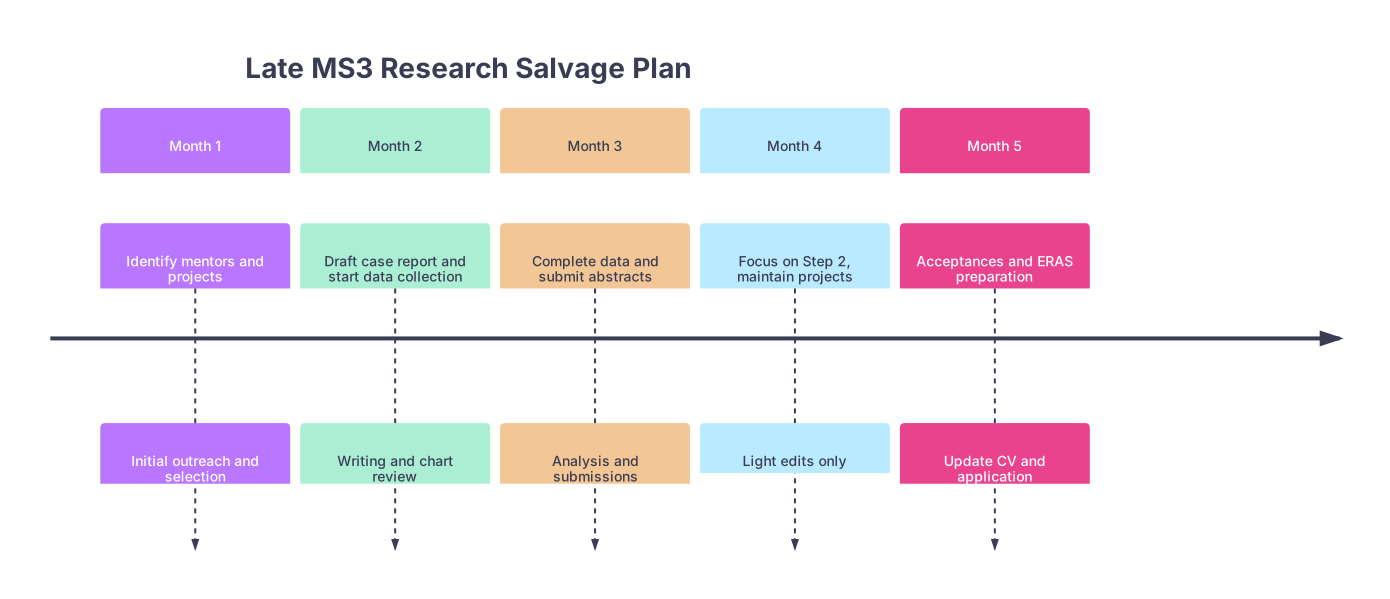
| Period | Event |
|---|---|
| Month 1 - Identify mentors and projects | Initial outreach and selection |
| Month 2 - Draft case report and start data collection | Writing and chart review |
| Month 3 - Complete data and submit abstracts | Analysis and submissions |
| Month 4 - Focus on Step 2, maintain projects | Light edits only |
| Month 5 - Acceptances and ERAS preparation | Update CV and application |
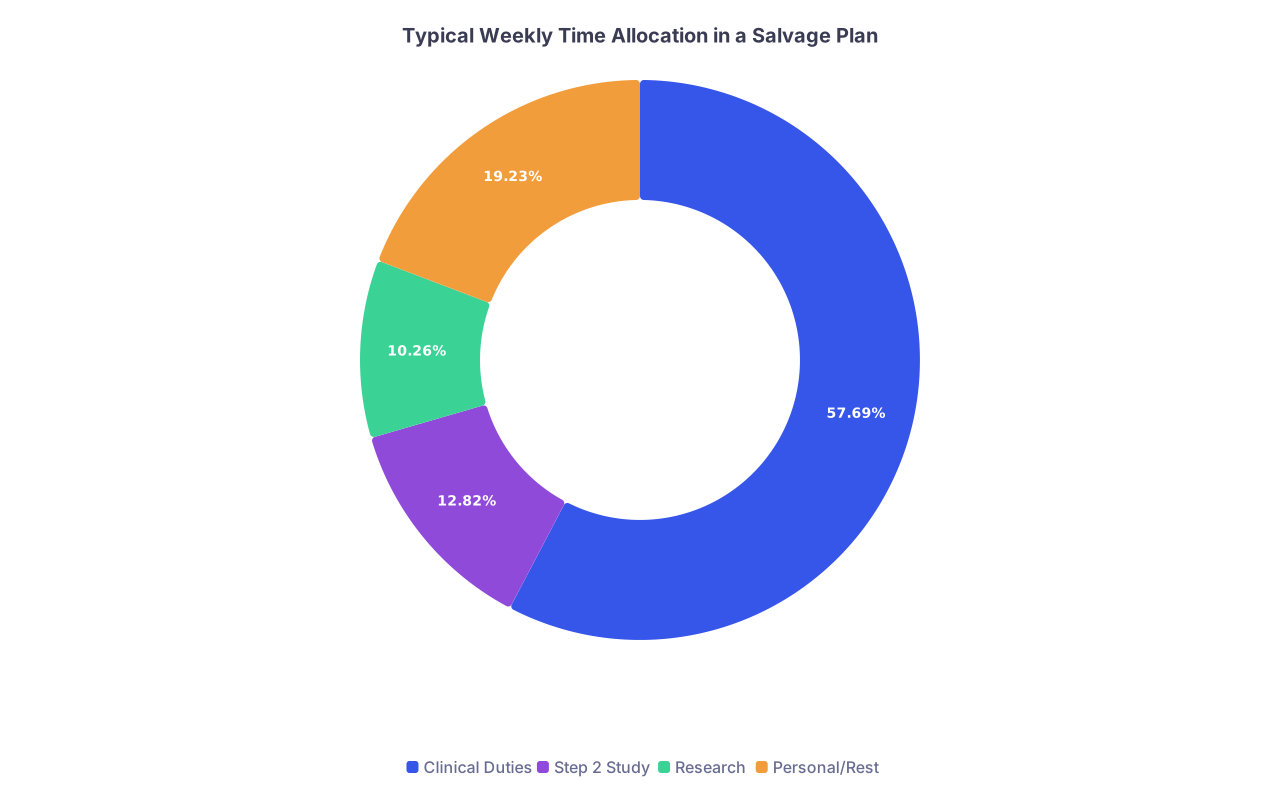
| Category | Value |
|---|---|
| Clinical Duties | 45 |
| Step 2 Study | 10 |
| Research | 8 |
| Personal/Rest | 15 |
Key Takeaways
- You cannot rebuild three missing years of research in a few months, but you can absolutely create 2–4 meaningful, citable projects that change how your application looks.
- Stop chasing big, slow, glamorous studies. Focus aggressively on finishable projects with existing data and mentors who already know how to get things across the line.
- Protect Step 2 and your clinical performance. Research is a multiplier, not a substitute, for a solid core application.