Why Your Research Profile Matters So Much in Radiation Oncology
Radiation oncology is one of the most research-driven and competitive specialties. As an MD graduate aiming for a radiation oncology residency, your research portfolio is not just a bonus—it is often a key deciding factor in whether you receive interviews and how you are ranked.
Programs know that radiation oncologists must navigate rapidly evolving technologies (IMRT, SBRT, proton therapy), biologic therapies, AI-based planning, and complex clinical trials. For that reason, they heavily value applicants who:
- Understand research methods
- Can critically interpret oncology literature
- Have demonstrated persistence and productivity
- Show evidence of collaboration and academic curiosity
Your research profile helps residency programs answer several questions:
- Will you be able to contribute to ongoing departmental research?
- Are you likely to publish during residency and beyond?
- Can you handle the intellectual rigor of a radiation oncology residency?
If you are graduating from an allopathic medical school and targeting the allopathic medical school match, you are competing with applicants who often have multiple oncology projects, presentations, and publications. The good news: a well-planned approach can help you build (or significantly strengthen) your research profile, even if you feel behind right now.
In this guide, we will walk through practical strategies to develop a strong, realistic, and compelling radiation oncology research portfolio as an MD graduate residency applicant.
Understanding What “Counts” as Research in Radiation Oncology
Before you start accumulating lines on your CV, you should understand what types of research and scholarly work radiation oncology residency programs tend to value.
1. Clinical Radiation Oncology Research
This is the most common and most accessible category for MD students and MD graduates:
- Retrospective chart reviews (e.g., outcomes after SBRT for lung lesions)
- Clinical outcomes or toxicity analyses
- Patterns-of-care studies (e.g., variation in dose fractionation)
- Quality-of-life or patient-reported outcome studies
- Implementation science (e.g., improving contouring adherence)
Why it’s valuable:
- Directly applicable to daily clinical radiation oncology practice
- Leads to conference abstracts and manuscripts
- Often feasible within 6–18 months
2. Translational and Basic Science Research
These projects bridge lab science and patient care:
- Radiobiology (DNA damage, tumor microenvironment, radiosensitizers)
- Immuno-oncology and radiation synergy
- Biomarkers of radioresistance or radiosensitivity
- Radiation physics/biology modeling
Pros:
- Highly impressive if you are considering an academic career
- Shows technical depth and long-term scientific engagement
Challenges:
- Often require longer timelines and more intensive training
- Harder to complete and publish quickly, especially late in medical school
3. Physics, Dosimetry, and Technology Research
Radiation oncology is closely tied to medical physics. Projects might include:
- Dosimetric comparisons (e.g., IMRT vs. VMAT vs. proton plans)
- Development or validation of planning algorithms
- AI/ML in segmentation or treatment planning
- Quality assurance or safety interventions
These are particularly attractive to programs with strong physics collaborations and can highlight your comfort with technology and quantitative thinking.
4. Education, Quality Improvement, and Outcomes
Research for residency does not have to be purely clinical or lab-based. In radiation oncology, programs also value:
- QI projects (e.g., improving time-to-treatment for palliative RT)
- Educational interventions (e.g., contouring curricula for residents)
- Health services research, cost-effectiveness studies
- Disparities and access-to-care projects in radiation oncology
These can sometimes be completed more quickly and still lead to strong presentations and publications.
5. Scholarly Output Beyond Research
Residency programs also value evidence of academic activity, even if not formal research:
- Book chapters on radiation oncology topics
- Narrative or scoping reviews
- Case reports and case series
- Clinical guidelines or consensus statements (if involved)
These show that you can write, synthesize literature, and contribute to the field’s knowledge base.

How Many Publications Are “Enough” for Radiation Oncology?
One of the most common questions is: how many publications are needed for a competitive rad onc match?
There is no single magic number, but there are realistic benchmarks.
Interpreting “Enough” in Context
Programs evaluate your research in context:
- Did you have access to a home radiation oncology department?
- Are you an MD graduate from a research-heavy allopathic medical school?
- Did you take a dedicated research year?
- Are you applying straight through or after another training/degree?
A candidate from a well-resourced academic center who did a research year is expected to have more output than a student from a smaller program without a home rad onc department.
Typical Ranges for Competitive Applicants
Based on NRMP Charting Outcomes trends, specialty competitiveness, and program director surveys (up to 2024), many successful radiation oncology applicants have:
- 3–10 total scholarly items (abstracts, posters, oral presentations, and publications combined)
- 1–3 peer-reviewed publications, with at least one oncology-related strongly preferred
- Several conference abstracts or posters at ASTRO, ASCO, RSNA, or regional meetings
For MD graduates from research-intensive allopathic medical schools, particularly those targeting top academic programs, it is common (but not mandatory) to see:
- 5–15 total scholarly works
- 3–6+ publications (including middle-author work)
However, programs often prefer meaningful engagement and clear continuity over sheer quantity.
Quality and Relevance > Raw Numbers
A focused and coherent research story can be more powerful than an inflated publication count in unrelated areas. For example:
- One first-author radiation oncology outcomes paper
- One or two oncology-related abstracts at national meetings
- A survey study or QI project in a radiation oncology department
…can be more impressive than 10 low-impact, non-oncology co-authorships with minimal involvement.
What If You Have Zero Publications Right Now?
If you are an MD graduate with no publications and planning to apply within 1 year:
- Aim for:
- 1–2 projects likely to yield abstracts within 6–9 months
- Potential for at least 1 manuscript submitted or in revision by ERAS opening
- Emphasize:
- Your role (data collection, analysis, drafting sections)
- Skills gained (statistics, methodology)
- Strong letters from research mentors attesting to your contribution
If your timeline is extremely short (6–8 months), prioritize fast-turnaround projects such as retrospective chart reviews, case series, or educational/QI projects that can realistically generate presentations or at least submitted manuscripts by application time.
Step-by-Step Strategy to Build a Strong Radiation Oncology Research Profile
Step 1: Clarify Your Timeline and Goals
Ask yourself:
- When are you applying for radiation oncology residency?
- Do you have (or can you create) a dedicated research block or gap year?
- Are you aiming for primarily academic programs, community-based programs, or both?
Your answers will shape the scope and intensity of your research plan:
Short timeline (≤ 12 months to ERAS)
Focus on:- Retrospective chart reviews
- Survey studies
- Case reports/series
- QI/educational projects
Longer timeline (12–24+ months)
You can incorporate:- Prospective observational studies
- Translational or lab work
- More complex multi-institutional projects
Step 2: Find the Right Mentors and Environment
For MD graduate residency applicants, your research environment is crucial.
Start with Your Home Institution
If your allopathic medical school has a radiation oncology department:
Visit the department website:
- Look at faculty profiles and publication lists
- Identify those whose work interests you (e.g., CNS, GU, lung, pediatrics, physics)
Reach out with a concise email:
- Briefly introduce yourself and your interest in radiation oncology
- Highlight any prior research skills (stats, coding, previous projects)
- Express specific interest in their area based on a recent publication
- Ask if they have ongoing or upcoming projects where a motivated MD graduate could contribute meaningfully
Be clear about:
- Your timeline (e.g., 12 months until residency application)
- Your anticipated available hours per week
- Your goals (abstracts, manuscripts, exposure to clinical rad onc)
If You Do Not Have a Home Rad Onc Department
You still have options:
- Look for:
- Affiliated cancer centers or nearby academic hospitals
- Medical oncology or surgical oncology groups with radiation collaborators
- Cold email:
- Radiation oncologists at nearby institutions, especially those with joint appointments or teaching roles
- Consider:
- Virtual research collaborations
- Remote data work (chart review, database analysis)
- Participating in multi-institutional projects through national groups or mentor networks
Be patient—cold emails may have a low response rate. Personal introductions from your dean’s office, research office, or another attending can help.
Step 3: Select Projects Strategically
For an MD graduate aiming at a rad onc match, the ideal project portfolio balances:
- Feasibility within your timeline
- Clear rad onc or oncology relevance
- Opportunity for tangible outputs (abstracts, posters, publications)
- Room for you to make a real contribution (not just data grunt work)
A high-yield mix might include:
One primary project
- You are first or co-first author
- Retrospective clinical or outcomes study in a key site (e.g., breast, prostate, lung)
- Clear plan for manuscript submission before ERAS
One to three secondary projects
- Co-author roles on others’ ongoing projects
- Tasks: data extraction, chart review, simple statistical analysis, writing sections
- Goal: abstracts and co-authored publications
One fast-turnaround scholarly piece
- Case report or case series
- Narrative or mini-review
- Education or QI project
- goal: short manuscript plus regional or national presentation
When meeting with potential mentors, ask explicitly:
- “What is the realistic timeline for abstract and manuscript submission?”
- “What would my role be, and how is authorship typically decided?”
- “Has this kind of project successfully led to publications for students in the past?”
Step 4: Build Concrete Skills that Make You Indispensable
To generate meaningful research for residency, you should become useful quickly. Invest in learning:
- Basic statistics:
- Descriptive stats, t-tests, chi-square, Kaplan–Meier, Cox regression
- Use of SPSS, R, Stata, or Python depending on your group’s preference
- RedCap or similar data capture tools
- Literature searching and reference management (PubMed, EndNote, Zotero)
- Basic contouring concepts and RT principles (to understand what you are studying)
You do not need to be an expert statistician, but if you can:
- Clean and organize datasets
- Run simple analyses under supervision
- Create publication-quality tables and figures
…you will rapidly become a high-value collaborator. This often translates into better authorship positions and stronger letters.
Crafting a Coherent and Compelling Research Narrative
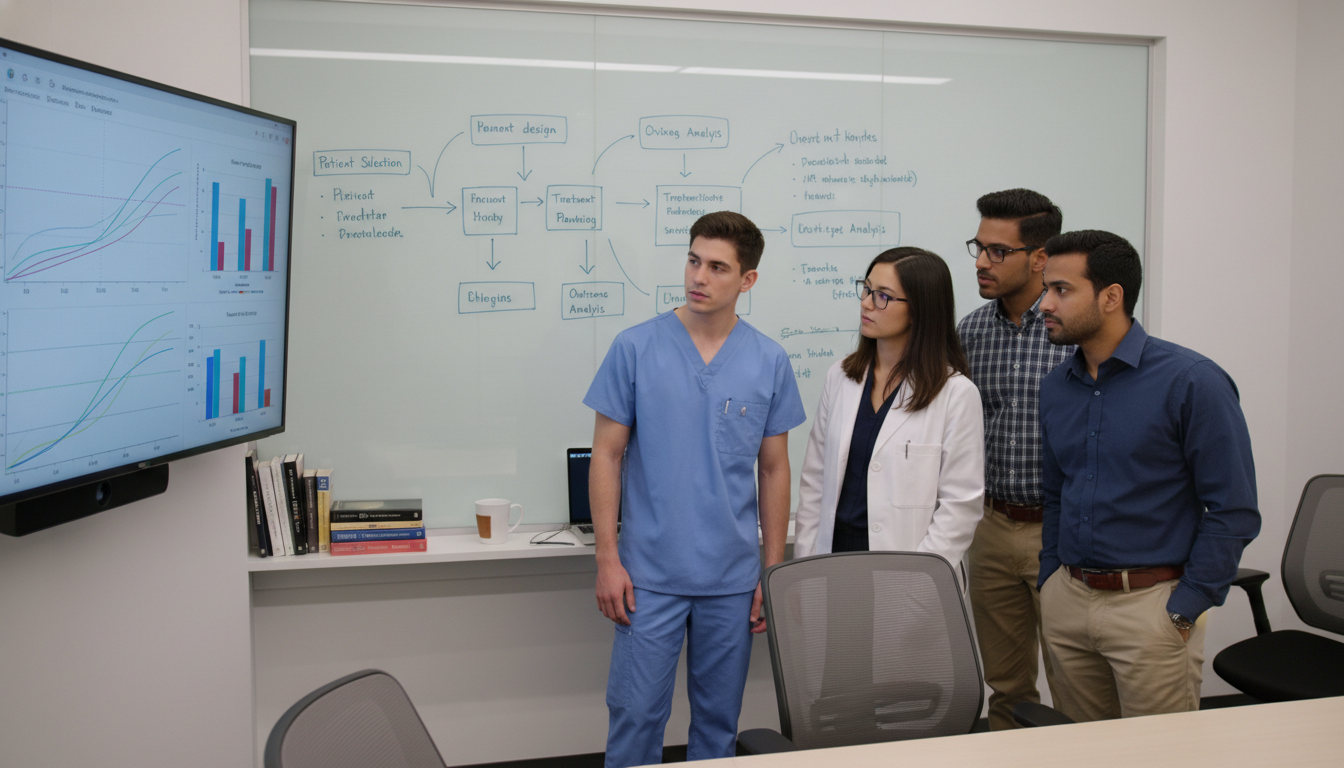
Programs are not only counting your publications; they are also looking for a story that makes sense.
Develop a Thematic Focus (But Don’t Be Too Narrow)
You do not need all your work in one disease site, but a thematic throughline helps:
Examples:
Focus on CNS tumors:
- Retrospective study of stereotactic radiosurgery outcomes
- Abstract on radionecrosis predictors
- Case report on re-irradiation in metastases
Focus on health disparities and access:
- Patterns-of-care study in palliative radiation
- Survey on delays to radiation initiation
- QI project optimizing referral pathways
A theme helps interviewers remember you:
“The applicant who’s done a lot of work on lung SBRT” is more memorable than “the one with random scattered papers.”
Be Ready to Explain Your Role and Impact
On your CV, and especially during interviews, you must be able to clearly explain:
- Why the research question mattered clinically or scientifically
- Your specific role:
- Designing the study or data collection tools
- Extracting and cleaning data
- Performing or assisting with analyses
- Drafting specific sections of the manuscript
- What you learned:
- Methodology
- Interpretation of oncologic outcomes
- Ethical and logistical aspects of clinical research
If your contributions were modest, be honest—but highlight diligence and reliability. Program directors and faculty notice when applicants inflate their role.
Presenting Your Work: Conferences and Beyond
Publications for match are important, but presentations at major meetings also carry significant weight.
Aim for:
- National or major specialist meetings:
- ASTRO (primary for radiation oncology)
- ASCO, ASCO GU/GI/Breast, SABR Consortium, RSNA, AAPM
- Regional or institutional symposia
- State or regional oncology or radiation oncology meetings
- Medical school or hospital research days
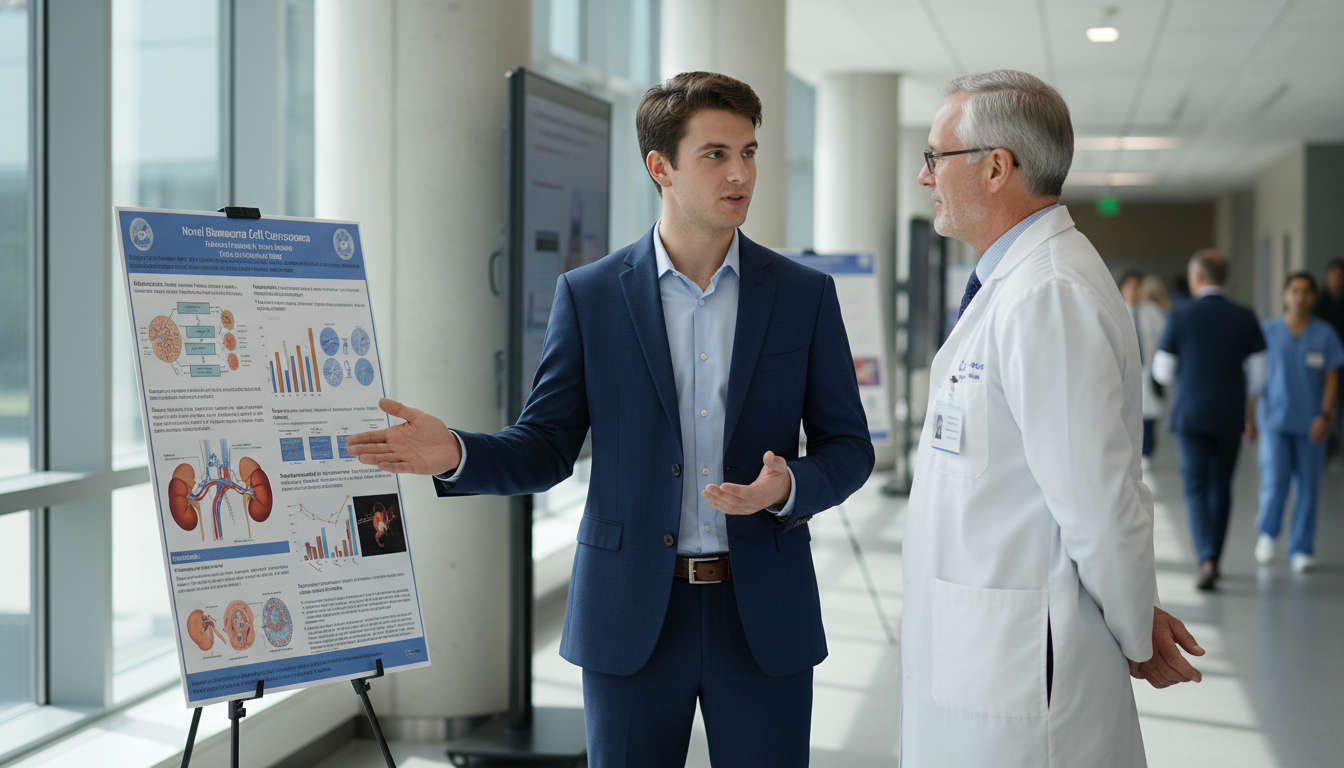
Presenting a poster or oral abstract:
- Demonstrates communication skills
- Provides strong talking points for interviews
- Often leads to networking with future colleagues and mentors
If a meeting is prior to interview season, attending in person can be a major advantage for visibility and letters.
Common Pitfalls and How to Avoid Them
Pitfall 1: Chasing Too Many Projects at Once
It is easy to say yes to every opportunity, especially if you are worried about the rad onc match. But scattered, unfinished projects are far less valuable than a smaller number of completed works.
To avoid this:
- Limit yourself initially to 2–3 projects where you have a clear timeline and role
- Ask mentors explicitly about realistic completion deadlines
- Schedule periodic check-ins to maintain momentum
Pitfall 2: Ignoring Authorship Dynamics
Clarify expectations early:
- Who will be first author?
- Who will handle data collection, analysis, and writing?
- What is the approximate target journal?
This is particularly important if you are an MD graduate with limited time before applying. Being a perpetual middle author on multiple incomplete projects is not ideal. Search for at least one project that realistically positions you as first or lead co-author.
Pitfall 3: Poor Documentation and Organization
Disorganized students delay projects and frustrate mentors. Avoid this by:
- Maintaining a well-structured shared folder (e.g., OneDrive, Google Drive)
- Keeping a detailed log of:
- Data variables and definitions
- Inclusion/exclusion criteria
- Dates of major steps (IRB submission, data lock, abstract submission)
- Using reference managers and consistent citation styles
This helps ensure that, even if your timeline is tight, you can bring projects to completion and be prepared to discuss them confidently.
Pitfall 4: Overemphasizing Research at the Expense of Clinical Excellence
Radiation oncology remains a clinical specialty. Program directors want balanced applicants:
- Strong clinical evaluations and clerkship grades
- Good board scores (where still applicable)
- Solid letters of recommendation from both radiation oncologists and core clerkships
Research should enhance, not replace, your clinical development. If you are an MD graduate taking a research year, seek some clinical exposure (shadowing in clinic, tumor boards, chart rounds) so you stay connected to patient care.
Putting It All Together: An Action Plan for the MD Graduate
Here is a concrete roadmap you can adapt:
If You Are 18–24 Months from Application
- Months 1–3:
- Identify mentors and join a rad onc research group
- Begin 1 primary project and 1–2 secondary projects
- Take an online short course in biostatistics or clinical research
- Months 4–9:
- Complete data collection for your primary project
- Present preliminary findings at an institutional or regional meeting
- Submit at least 1–2 abstracts to national meetings (ASTRO, etc.)
- Months 10–18:
- Draft and submit your primary manuscript
- Finalize at least one secondary project for publication or submission
- Work on 1 fast-turnaround piece (case report, review, or QI project)
If You Are 9–12 Months from Application
- Months 1–2:
- Secure at least one reliable rad onc mentor
- Join a retrospective project already approved or nearly approved by IRB
- Months 3–6:
- Lead data collection and basic analysis
- Submit an abstract to a regional or national meeting
- Months 7–10:
- Co-write the manuscript; aim for submission before ERAS
- If possible, add a small case report or QI project in parallel
- Months 11–12:
- Polish your CV and personal statement to emphasize your research story
- Ask mentors for letters highlighting your research work ethic and potential
If You Are < 9 Months from Application
Your options are more constrained, but you can still:
- Join at least one project that is near-completion
- Take on clear and intensive responsibilities (e.g., data analysis, final draft preparation)
- Aim for:
- Abstract acceptance at a meeting (even if scheduled post-ERAS)
- Manuscript submission (even if not yet accepted) to list as “submitted” or “in revision”
- Focus on generating strong letters that attest to:
- Your initiative and reliability
- Your ability to learn and apply research methods quickly
FAQs: Research Profile Building for Radiation Oncology Applicants
1. I’m an MD graduate from an allopathic medical school with no radiation oncology department. Can I still build a competitive research profile?
Yes, but it requires extra initiative. Steps you can take:
- Look for nearby institutions or cancer centers with rad onc departments.
- Ask your dean’s office or research office for help with introductions.
- Consider remote collaborations—many retrospective studies can be done via secure remote access and regular virtual meetings.
- If rad onc–specific projects are difficult to obtain, do high-quality oncology research (e.g., medical oncology, surgical oncology, radiology) and highlight the oncology connection in your application.
Programs understand institutional limitations and will weigh your achievements relative to your available resources.
2. How many publications do I realistically need for a competitive rad onc match?
There is no fixed minimum, but for many successful MD graduate residency applicants:
- 1–3 peer-reviewed publications (ideally at least one oncology-related)
- Several abstracts or presentations at institutional, regional, or national meetings
- A total of 3–10 scholarly items (abstracts, posters, papers) is common
Emphasize quality, relevance to radiation oncology, and a coherent research narrative. A single strong first-author rad onc paper plus a few co-authored works can be very competitive.
3. Does research outside of oncology help my application?
Yes, especially if:
- It demonstrates methodological rigor (e.g., well-designed clinical or translational studies)
- You had a substantial role (design, analysis, writing)
- You can articulate what you learned and how those skills translate to oncology research
However, rad onc–specific or oncology-related work is more directly impactful. If most of your current research is outside oncology, try to add at least one or two oncology-focused projects before applying.
4. How should I list “submitted” or “in-progress” papers on ERAS?
Be accurate and conservative:
- “Submitted” only if the manuscript is actually submitted to a journal.
- “Provisional acceptance” or “in revision” only if you have received formal communication from the journal.
- “In preparation” should be used sparingly; many programs discount these heavily.
Never exaggerate your role or the status of a manuscript. Integrity is critical, and faculty can and do verify details.
Building a strong research profile for a radiation oncology residency as an MD graduate is absolutely achievable, regardless of your starting point. Focus on:
- Securing dedicated, supportive mentors
- Choosing feasible, oncology-relevant projects
- Developing concrete analysis and writing skills
- Producing a small but meaningful body of work
If you do this thoughtfully and deliberately, your research portfolio will not only strengthen your rad onc match odds—it will also lay the foundation for a successful, academically engaged career in this rapidly evolving specialty.